Fitness
Is It Possible to Burn 1,000 Calories a Day?


Burning 1,000 calories a day might sound like a lofty goal, but it’s not as far-fetched as it seems. Whether you’re an athlete looking to boost performance or someone looking to shed extra pounds, understanding how calorie burning works is essential for reaching your health and fitness goals. That’s why we spoke with certified personal trainers and fitness experts who explain how you can burn 1,000 calories a day through regular exercise and increased daily activity, making it an achievable goal regardless of your fitness level.
Increasing your daily calorie expenditure can accelerate weight loss, improve cardiovascular health, and boost overall fitness. Additionally, torching more calories can ramp up your metabolism, helping you maintain a healthy weight. However, it’s crucial to approach your calorie-burning goals with a balanced perspective and a well-structured plan. Pushing yourself too hard, not recovering between workouts, and poor nutrition habits can thwart your calorie-burning efforts, potentially leading to injuries and burnout. That’s why health and fitness experts stress the importance of incorporating rest days into your routine and eating a balanced diet rich in essential nutrients.
Now, let’s explore how you can burn 1,000 calories a day, along with practical tips and expert advice on maintaining this goal in the long term.
What are calories, and how is calorie burn measured?

“Calories are units of energy used to measure the energy content of foods,” explains TJ Mentus, CPT, a certified personal trainer at Garage Gym Reviews. “The calories in food give your body the energy it needs to function and perform all the activities needed to stay alive, such as breathing, moving, and circulating blood. The excess is stored as fat when the body consumes more calories than it needs for energy. When caloric consumption is less than the body needs, it burns fat to make up the deficit that does not come from nutrition. A heart rate tracker is the best way to measure caloric burn since calorie burn is correlated with heart rate. This is because the heart rate increases, so does the need for oxygen, which requires more energy.”
Calorie burn is influenced by several factors, such as your Basal Metabolic Rate (BMR), which is the number of calories your body needs to maintain basic physiological functions at rest. According to the National Academy of Sports Medicine, your Total Daily Energy Expenditure (TDEE) includes BMR multiplied by a certain physical activity multiplier based on how much exercise you get a week. Factors like age, weight, gender, and activity level also significantly impact how many calories you burn daily.
Is burning 1,000 calories a day possible?
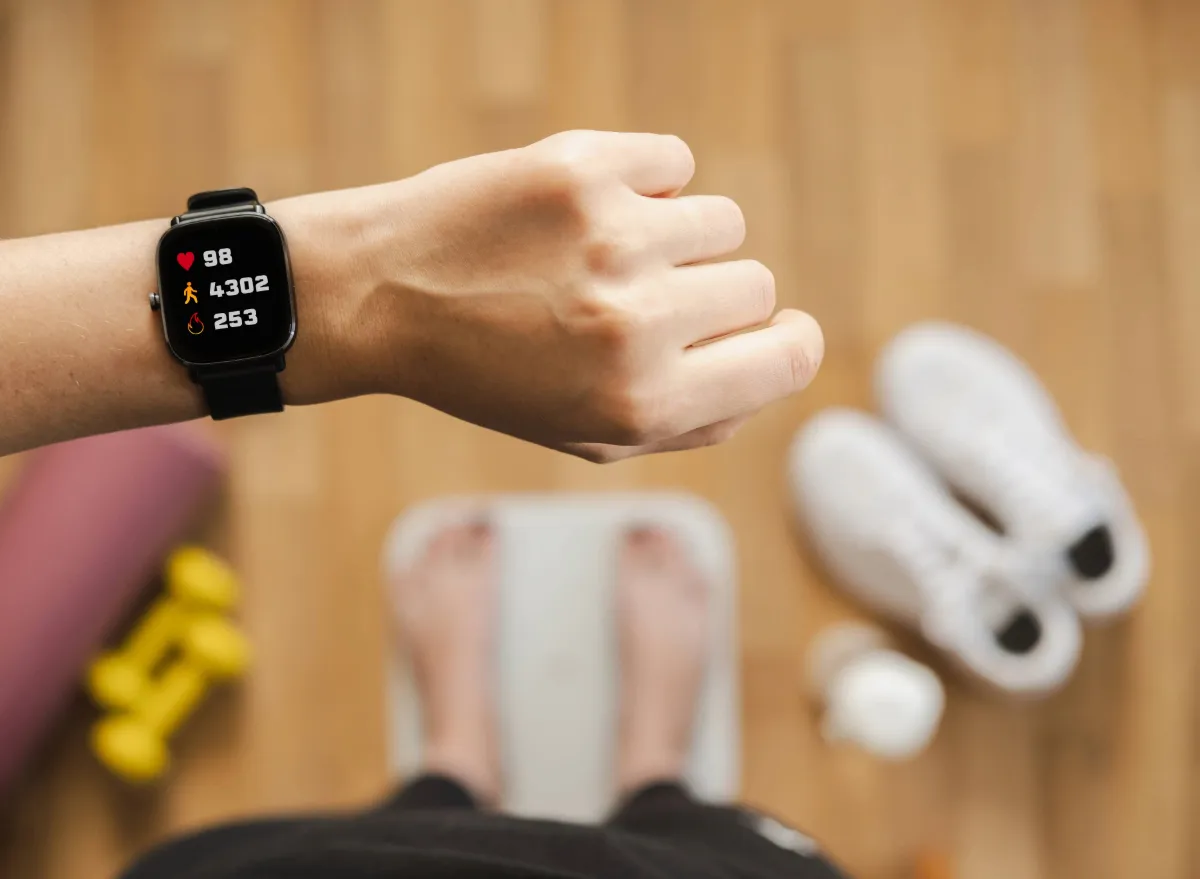
Burning 1,000 calories daily is possible, but the odds of success vary widely depending on your fitness level and body type. Physically active people and those with larger bodies or more muscle mass may find burning 1,000 calories easier than those who are sedentary, smaller in size, or lacking muscle.
“A typical strength workout will burn 300 to 400 calories in one hour on average,” says Mentus. “One hour of running will burn between 600 to 700 calories. Looking at those two typical forms of exercise, you will need to exercise at least two hours a day, which may not be realistic for most people. Unless you’re already in good shape, I would not suggest going right into two hours of working out as you will place yourself at a higher risk of burnout and possible injury.”
How long do you have you have to exercise to burn 1,000 calories?
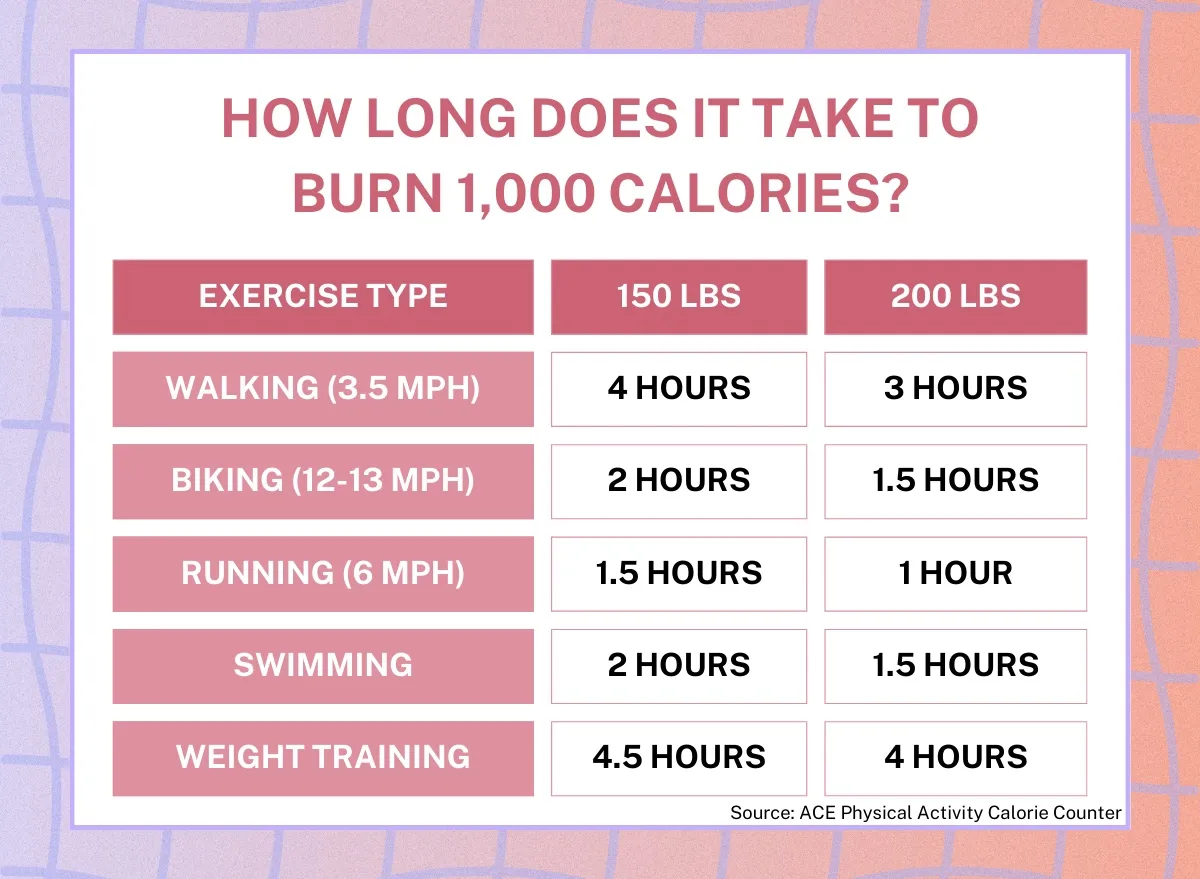
Again, the time required to burn 1,000 calories varies widely based on body type, age, fitness level, and the form of exercise.
“Higher intensity activities generally burn more calories,” says Kyrie Furr, CPT, a certified personal trainer and performance coach with Barbend. “For example, high-intensity interval training (HIIT) workouts can vary widely in intensity, but they typically involve alternating between bursts of high-intensity exercise and periods of rest or lower intensity.”
Furr points out that for many individuals, torching 1,000 calories may require a combination of exercises and physical activity scattered throughout the day rather than one long, intense workout.
Safety and risks of burning 1,000 calories a day:

Burning 1,000 calories a day is an ambitious goal with potential risks. Pushing yourself too hard can lead to overtraining and inadequate recovery time, potentially resulting in injuries, fatigue, and burnout. That’s why balancing intense workouts with proper nutrition, hydration, and rest is essential to continue exercising consistently and burning calories sustainably.
Before starting any new workout routine, speak with a fitness professional or your health care provider to help avoid injury and burnout while staying on track toward your health and fitness goals.

Sign up for our newsletter!



Fitness
Lawlor: It’s a fitness exercise, but there were lots of positives – Fleetwood Town Football Club

Skip to content

The latest NHS exercise guidance reinforces what we’ve been preaching for years: hitting that 150-minute weekly movement target isn’t necessarily a get-out-of-jail-free card. It states that prolonged sedentary time is independently harmful, even for those of us who diligently carve out time for the gym. Verbatim, it says ‘prolonged sitting is harmful, even in people who achieve the recommended levels of moderate to vigorous physical activity’.
Chief Medical Officer Professor Sir Chris Whitty has been especially vocal about how detrimental it could be, highlighting hybrid working as a potential health hazard. ‘Without wanting to exaggerate, I think it’s important people think through, for example, hybrid working means quite a lot of people could very easily do very little other than leave their homes, where previously people would be routinely going to work, and that often meant at least some physical [activity],’ he said at a briefing.
I understand his logic, but it’s pretty reductive. Working from home isn’t the villain here – working from one chair is.
When we label remote work as “bad for your health”, we risk throwing the baby out with the bath water. In reality, for many – certainly the whole of the Women’s Health office, but also my less-fitness-conscious sister and stepdad, plus my entire friendship group – working from home often means being more active. It means more time to fit in a lunchtime run, to get some steps in before work, or to run some errands on a quick break.
On the other hand, plenty of office workers are more sedentary than they are at home. They sit at a desk for nine hours straight before driving home, whether to be seen to work tirelessly in front of their manager, or simply because they’re pulled from pillar to post in an office setting. For those who do have an office commute, eliminating that often stressful period of the day allows for better sleep, and more time for the movement breaks we need to break up the dreaded sedentary time. Not to mention that many commutes are almost entirely sedentary on a train/tube/bus.
The potential problem, the advice suggests, is the lack of incidental movement – the walk to the train, the stroll to a meeting room, or heading out for lunch – that’s naturally baked into your day when you’re in the “official” office. Without a commute or a day in the office, the onus is on you to manufacture movement in.

Regular stretching counts as a movement break
Without sounding evangelical, I’ve made this a non-negotiable part of my day. On WFH days, I work out or walk every single morning before I log on, and walk again every evening, even if just a lap around the block. During the day, I have a personal rule: if I’m downstairs, I use the upstairs toilet (and vice versa). Sounds excessive, but it forces me to activate my muscles and add to my step count every few hours.
Beyond that, the options are endless if you’re intentional. Use a standing desk or put your laptop on a kitchen worktop during calls. Take every phone meeting on foot, pacing your hallway if necessary. Set a timer to stand up every 30 mins to stretch, grab a glass of water, or do a quick load of laundry.
We don’t need to return to the office to be healthy; we need to bring movement back into our homes. The goal: to stop being professional sitters.
As Women’s Health UK’s fitness director and a qualified Pilates and yoga instructor, Bridie Wilkins has been passionately reporting on exercise, health and nutrition since the start of her decade-long career in journalism.
After earning a first-class degree in journalism and NCTJ accreditation, she secured her first role at Look Magazine, where she launched the magazine’s health and fitness column, Look Fit, before going on to become Health and Fitness writer at HELLO!
Since, she has written for Stylist, Glamour, Cosmopolitan, Marie Claire, Elle, The Metro, Runner’s World and Red. Today, she oversees all fitness content across Women’s Health online and in print, spearheading leading cross-platform franchises, such as ‘Fit At Any Age’, which showcases the women proving that age is no barrier to exercise.
She has also represented the brand on BBC Radio London, plus various podcasts and Substacks – all with the aim to encourage more women to exercise and show them how. Outside of work, find her trying the latest Pilates studio, testing her VO2 max for fun (TY, Oura), or posting workouts on Instagram.

If you ask anyone on the gym floor how to grow a bigger set of shoulders, you’ll probably find that no two answers are the same. In between front raises, upright rows, machine presses and cable raises, shoulder day can quickly become a long list of exercises.
However, fitness creator and coach Eric Evans, also known on social media as Average to Jacked, thinks most lifters are overcomplicating things. He says that if he had to start from scratch after over a decade of training, he’d strip his shoulder workouts back to just two simple moves.
‘If I had to start over today, I’d build my shoulders with just two movements: a lateral raise and also a rear delt fly,’ he explains.
According to Evans, the reason for this isn’t because those exact exercises are magic, but because they work the correct movement pattern for the muscle.
‘Your body doesn’t know the name of the exercise you’re doing,’ he argues. ‘It really only knows the fundamental movement pattern you’re asking it to perform and also the amount of tension you’re placing on the muscle.’
So, you don’t have to perform cable lateral raises if your gym only has dumbbells, or use a reverse pec deck if you’d rather do bent-over rear delt flyes. As long as you’re training the same movement pattern and progressing the move with intensity or volume, you’ll achieve a similar result.
According to the coach, lateral raises deserve a place in your programme because they primarily target the side delts, helping create broader-looking shoulders and a more pronounced ‘V-taper’. Rear delt flyes train the back of the shoulders to create a rounder, more 3D physique.
‘I’m not including anything for the front delts, and that’s intentional,’ he says. ‘Your front delts are already heavily involved every time you do pressing exercises for your chest.’
For most lifters already bench pressing, incline pressing or overhead pressing regularly, he argues the side and rear delts are more likely to be the limiting factor.
‘I don’t think the front delts are what’s holding their shoulders back. I think it’s the side and rear delts,’ he adds.
He recommends focusing on controlling every rep, and avoiding using momentum to swing the weight. He also suggests working in the 8-15 rep range, adding reps until you reach the top of the range before increasing the load and repeating the process – also known as progressive overload.
‘You definitely don’t need to hit your shoulders from 10 different angles,’ he says. ‘You just need to consistently train these two movement patterns, push them hard and then gradually get stronger over time.’
The Bottom Line
Research suggests muscle growth is driven more by sufficient training volume, progressive overload and proximity to failure than by constantly changing exercises and programme hopping. In fact, that could hinder it. So if your shoulder workouts have become jam-packed with unnecessary variations, simplifying your approach may be exactly what helps you make more consistent progress in the long term.
If there’s one thing Kori Sampson knows, it’s how to optimise your body composition for performance. To tap into his knowledge as an elite athlete and coach, we asked him to create a 4-week plan to help you move faster, recover quicker and keep pushing when the fatigue sets in – all while improving your muscle-to-fat ratio.
Ready to build muscle, burn fat and come out the other side looking, feeling and performing better? Click here to get 14 days of free access to the plan via the Men’s Health app.

-

 Rhode Island4 minutes ago
RISP Warwick Arrests July 10: Threatening Officials, DUI – WarwickPost.com
-

 South-Carolina11 minutes ago
Editorial: There’s an easy solution to SC budget impasse, but legislators won’t like it
-

 South Dakota14 minutes ago
10 North Dakota Small Towns With Unmatched Friendliness
-

 Tennessee19 minutes ago
Former Tennessee Football Position Coach Beats Out Vols For Commitment of Elite Recruit | Rocky Top Insider
-

 Texas26 minutes ago
This Week in Texas: $1500 for every Texas Household, ICE accountability, politics in sports
-

 Utah29 minutes ago
Utah woman’s viral video helps raise more than $174K for Navy veteran she spotted at airport
-

 Vermont34 minutes ago
802 Homes to release free home design catalog aimed at lowering construction costs
-

 Virginia41 minutes ago
Southwest, Central Virginia Weather | 6 p.m. – July 11, 2026

