Connect with us

Fitness

3 Morning Exercises Build Core Strength Faster Than Planks After 50

Published

on

3 Morning Exercises Build Core Strength Faster Than Planks After 50

Starting your day with a healthy dose of exercise can help build core strength and stability.

Many famous fitness icons believe in the power of morning exercise. Actor and fitness enthusiast Mark Wahlberg is one major fan and stays dedicated to his intense 4 a.m. workout sessions. In fact, the celeb says early morning workouts make him feel like he can “conquer the world“—they help him begin each day with a feeling of accomplishment, and science agrees.

According to Piedmont Healthcare, rising early and working out offers mental clarity, less distractions, and a boosted metabolism for the rest of the day. Having a morning routine in place is also a way to ensure it gets done. And one essential age-related item on that a.m. bucket list? Building your core. A strong core is essential for independent, active living. Your core includes your back, pelvic, and abdominal muscles, and helps you walk, lift, bend, and more. It’s also key when it comes to keeping you from slouching and remaining balanced.

We spoke with Doug Bertram, M.S., L.Ac., MTCM—Founder & CEO of Structural Elements®, a three-time Ironman triathlete, and ultramarathoner—who shares three morning exercises to build core strength faster than planks after 50. With more than 30 years of experience, Bertram has progressed the field of orthopedic wellness by focusing on the body’s structure rather than pain symptoms on their own. He developed the Structural Elements® Balancing Method, an integrative approach emphasizing postural alignment, fascia mapping, and tensegrity-based assessment.

Advertisement

“Core strength often declines after the age of 50 due to several factors, primarily related to the natural aging process,” Bertram tells us. “One significant factor is sarcopenia, which is the age-related loss of muscle mass. As muscle fibers decrease, the core muscles, crucial for stability and support, become weaker. This decline in core strength negatively impacts balance, increasing the risk of falls, which can be particularly dangerous for older adults. Additionally, weakened core muscles contribute to poor posture, leading to discomfort and potential back pain.”

Daily movement can become more laborsome, decreasing overall mobility, confidence, and independence. In addition to sarcopenia, stiffening of the fascia and reduced elasticity of tissues can make you less capable of distributing load.

Which Core Muscles Should Be Prioritized To Build Functional Strength?

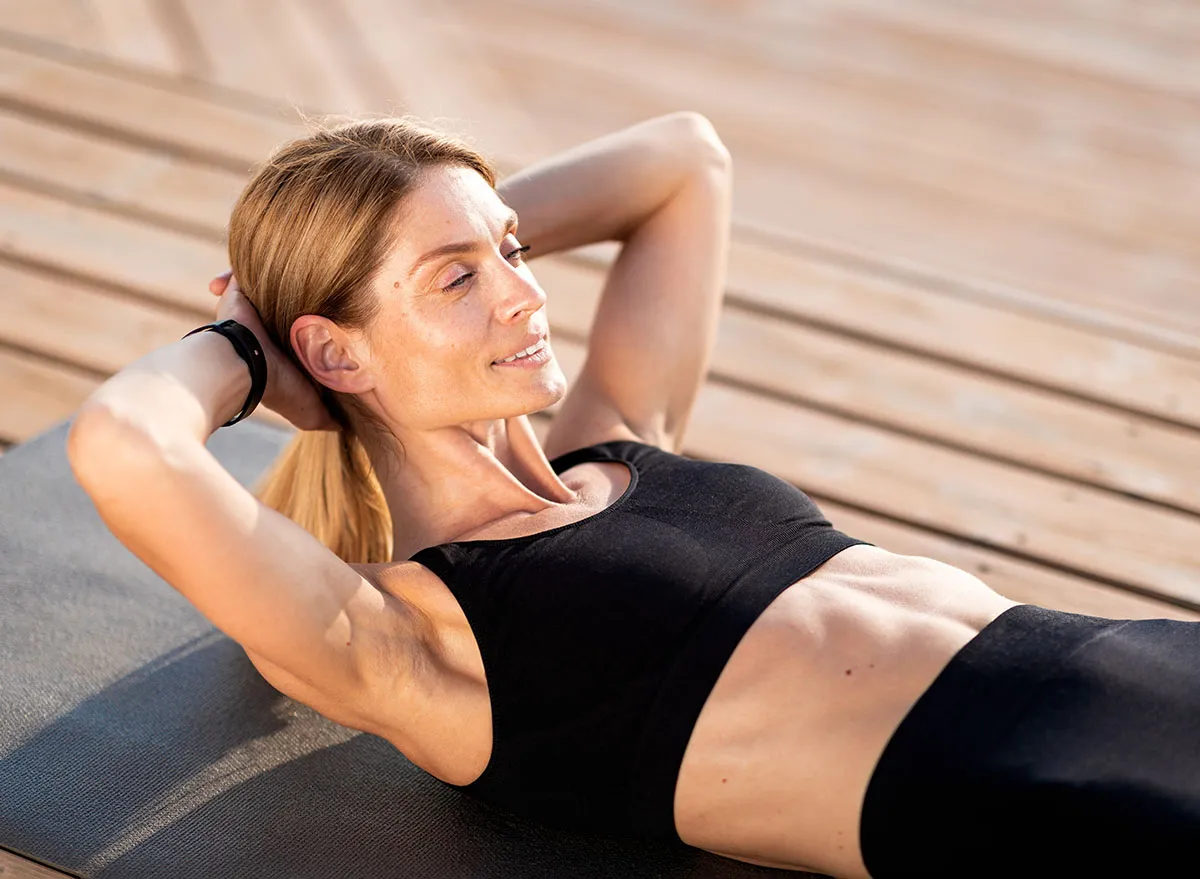
Outside Workout. Smiling Middle Aged Woman Making Abs Crunches Exercise Outdoors, Closeup Shot Of Beautiful Sporty Female Training On Yoga Mat On Wooden Pier, Working Out Abdominal Muscles
Shutterstock

In order to build functional core strength after 50, it’s essential to prioritize specific muscle groups that contribute to overall support and stability.

“The transverse abdominis is essential for stabilizing the pelvis and spine, while the multifidus plays a crucial role in spinal alignment and stability,” Bertram tells us. “The rectus abdominis, commonly known for creating the ‘six-pack,’ is involved in overall core function. Additionally, the obliques are vital for rotational movement and lateral stability. Lastly, strengthening the pelvic floor muscles is important for core stability and can improve overall health and function, particularly in maintaining continence.”

Below, Bertram offers three morning moves that can help boost core strength more efficiently than planks. These exercises offer a safe yet effective way to strengthen the essential muscles in your core.

Bird-Dog

“The bird-dog involves starting on all fours and extending one arm and the opposite leg while engaging the core, which enhances stability and activates multiple core muscles,” Bertram says.

  1. Start on all fours.
  2. Extend your left arm and right leg, keeping your core braced.
  3. Hold for a moment before returning to the start position.
  4. Switch sides, continuing to alternate.

Dead Bug

“The dead bug is performed lying on the back with arms extended and knees bent, lowering one arm and the opposite leg without arching the back, promoting core control and stability without straining the back,” Bertram points out.

  1. Lie face-up on the mattress with your arms extended toward the sky and knees lifted and bent to 90 degrees.
  2. Press your lower back into the mattress as you gradually lower your left arm and extend your right leg.
  3. Return to the center.
  4. Then, lower your right arm and left leg.
  5. Continue to alternate.

Seated Leg Lifts

Advertisement

“Seated leg lifts entail sitting on a sturdy chair and lifting one leg off the ground while engaging the core, making it easier on the joints while effectively strengthening the abdominal muscles,” Bertram says.

  1. Begin seated at the edge of your chair with your legs straight out. Hold onto the sides of the chair.
  2. Activate your abs as you lift both legs and bring your knees toward your chest.
  3. Hold for 2 seconds at the top, making sure not to round your back.
  4. Slowly lower.

Alexa Mellardo

Alexa is a freelance writer, editor, and content strategist based in Greenwich, CT. She has 11+ years of experience covering wellness, fitness, food, travel, lifestyle, and home. Read more about Alexa

Fitness

Fitness Trackers: Benefits and What To Look For

Published

on

Fitness Trackers: Benefits and What To Look For

Fitness trackers seem to be everywhere — from smartwatches and rings to devices you clip to your clothes. But if you’re not a “gym person,” you might wonder whether they’re worth it.

Advertisement

Cleveland Clinic is a non-profit academic medical center. Advertising on our site helps support our mission. We do not endorse non-Cleveland Clinic products or services. Policy

The short answer? They can be helpful tools for many people, but they’re not magic.

“Fitness trackers give you information about your body and your activity,” says certified personal trainer Curt Fischer, CPT. “What really matters is how you use that information to stay consistent and keep moving.”

Advertisement

Fischer shares advice about what to know when choosing and using a fitness tracker.

What are fitness trackers?

Fitness trackers are devices that monitor your physical activity and certain body metrics throughout the day, and even overnight. Depending on your model, they may have features like:

  • Step logging
  • Distance tracking
  • Calorie burn estimates
  • Heart rate and heart rhythm information
  • Blood oxygen levels
  • Minutes of exercise
  • Period tracking
  • Medication logging
  • Noise monitoring
  • Fall detection
  • Sleep quality

But not every metric is equally reliable.

Some measurements — like heart rate — tend to be fairly accurate as long as you’re wearing the device properly. Others, like body composition estimates, may be less precise.

“A lot of those advanced measurements are more of an estimate,” Fischer notes. “They can be off, so it’s important not to rely on them as exact numbers.”

Benefits of fitness trackers

Fitness trackers aren’t just for athletes or gym regulars. They can offer practical benefits for just about anyone. Let’s take a look at what you can learn about your health by using one regularly.

Advertisement

Awareness

Perhaps one of the biggest advantages fitness trackers can offer is that they can help you understand your body better.

“You can learn a lot about yourself and your habits,” Fischer says. “Over time, you start to recognize your heart rate, your patterns and how your body responds to activity.”

That awareness can help you make more informed choices about your health and daily habits.

Motivation

Most trackers are designed to encourage movement, whether that’s through step counts, activity rings or reminders to stand up. Even small nudges from your tracker can help you maintain healthy habits.

Likewise, features like notifications when you reach a certain goal or opportunities to share your activity with friends can help you celebrate a job well done.

Advertisement

Feedback

Instead of guessing how hard you’re working, a tracker can help you gain insight in real time.

Heart rate monitoring, for example, can help you gauge your exercise intensity. The American Heart Association, among other groups, encourages adults to get at least 150 minutes of moderate intensity exercise per week, or 75 minutes of vigorous exercise.

With a fitness tracker, your heart rate is at your fingertips (or on your wrist, as the case may be). So, you can know if you’re working at the proper intensity.

“If you can see your heart rate during activity, you know whether you’re in that moderate intensity range, where you’re really getting benefits,” Fischer explains.

Safety and peace of mind

Some devices include features like fall detection, emergency alerts or GPS tracking. While not always perfect, these tools can offer reassurance. And they can be especially helpful for older adults or people with certain health concerns.

Advertisement

“There are features that can alert others if something happens,” Fischer shares. “That peace of mind can be valuable for a lot of people.”

Tracking progress

Seeing your data over time — whether it’s daily activity or heart rate trends — can help you spot improvements.

“If your heart rate comes down over time with the same activity, that’s a sign you’re getting fitter,” Fischer illustrates.

That kind of feedback can reinforce healthy habits and give you a sense of accomplishment.

Choosing the best fitness tracker for your needs

The market for fitness trackers is huge. Costs vary wildly, as do features. So, choosing the best fitness tracker for your needs can take some research and forethought.

Advertisement

Here are a few things to consider:

  • Your main goal: Are you focused on tracking general activity, heart rate, sleep or something more advanced, like GPS for outdoor workouts?
  • Ease of use: Some devices are simple and straightforward. Others come with steeper learning curves. If you prefer something basic, a simpler model may be a better fit. If it’s too complicated to use regularly, you’re less likely to benefit from it.
  • Form factor: If you already have a favorite watch or bracelet, wearing a clip-on or ring-style tracker may be better for you. On the other hand, rings can pose a safety risk for some jobs. So, what works for you may be different from what works for other people.
  • Compatibility: Most devices will send data to an app on your smartphone. And that technology may be brand-specific. Make sure your tracker will play nicely with your tech.
  • Battery life: Fitness trackers need to be charged — some more than others. Consider how you’ll use your tracker to determine how long you need the batter to last.
  • Accuracy: Heart rate tracking with a fitness device is generally reliable. Other features may vary. If absolute accuracy is important, focus on devices known for strong performance in the areas you care about.
  • Cost: Prices can vary widely. Basic models may cost less than $50, while high-end devices can cost hundreds of dollars. And the upfront price may not be the whole story. “A lot of these devices come with subscriptions or added features that cost extra,” Fischer says.
  • Lifestyle fit: Think about how you’ll actually use it day to day. If you won’t wear a watch to bed, for example, a sleep-tracking feature isn’t going to do you much good.

Fitness trackers can be useful tools — but they’re just that: tools.

“They don’t improve your health on their own,” Fischer states. “What matters is that you wear them, review your stats and stay active.”

In other words, the best fitness tracker is the one you’ll use (and keep charged). Using it regularly can help you move more, learn more about your body and stick with habits that support your health.

Continue Reading

Fitness

Women who hit this weekly exercise target halve their risk of early death – here’s how to reach it

Published

on

Women who hit this weekly exercise target halve their risk of early death – here’s how to reach it

Staying active is key to lifelong health – but it becomes even more important in midlife. Hormonal changes, particularly during menopause, can lead to reduced muscle mass, lower bone density and slower recovery.

A new study published in PLOS Medicine reinforces this, finding that women who meet recommended physical activity guidelines have around half the risk of dying from any cause compared to those who are inactive.

Researchers from the University of Sydney analysed data from 11,169 women born between 1946 and 1951 (aged 47-52 at the start of the study) over more than 15 years. Participants, part of the Australian Longitudinal Study on Women’s Health, completed nine surveys between 1996 and 2019.

They reported how often they met the World Health Organization guideline of 150 minutes of moderate-to-vigorous physical activity per week between 2001 and 2016.

The study’s results

Just 5.3 per cent of women who met the activity guidelines died during the study, compared with 10.4 per cent of those who didn’t. In other words, staying active throughout midlife was linked to roughly half the risk of death.

Advertisement

Similar trends were seen for deaths from cardiovascular disease and cancer, although smaller sample sizes made these findings less conclusive. Researchers were also unsure whether starting exercise later – in your mid-50s or 60s – offers the same benefits as staying active consistently through midlife.

‘Staying active throughout midlife can make a real difference for women’s long-term health,’ said study author Dr Binh Nguyen, from the Prevention Research Collaboration at the University of Sydney’s Charles Perkins Centre and School of Public Health. ‘Maintaining recommended levels of physical activity over multiple years helps protect against early death,’ she added.

Physical activity guidelines

Like the WHO, the NHS recommends 150 minutes of moderate or 75 minutes of vigorous activity a week for adults aged 19-64.

Moderate activity includes brisk walking, cycling or dancing. Vigorous exercise includes running, swimming, climbing stairs, and sports such as football or rugby.

How to exercise during midlife

Staying active during midlife can be challenging, particularly if you’re dealing with lower energy levels or physical symptoms linked to hormonal changes.

Advertisement

Former Olympian and Women’s Health trainer Michelle Griffith-Robinson shares her advice for staying consistent and comfortable:

  • Wear breathable clothing to help manage overheating and hot flushes.
  • Try new activities like Pilates, yoga or martial arts to improve balance and keep things interesting.
  • Include strength training at least twice a week to support bone health, reduce body fat and boost metabolism.
  • Aerobic exercise releases endorphins, helping to lift mood and maintain a healthy weight.
  • If you’re feeling tired, listen to your body and scale back – even a walk counts.

After years living with endometriosis and undergoing seven rounds of IVF, Radio 4 presenter Emma Barnett turned to training with PT Frankie Holah to rebuild strength and a more positive relationship with her body. Download the Women’s Health UK app to access Frankie’s full training plan.

Get the app


Headshot of Kate Cheng

Continue Reading

Fitness

Forget sit-ups — the ‘body saw’ is the spine-conserving, six-pack building exercise you’ve probably never heard of

Published

on

Forget sit-ups — the ‘body saw’ is the spine-conserving, six-pack building exercise you’ve probably never heard of

It’s common knowledge in fitness circles, but a lot of people don’t know that the classic sit-up exercise — that staple of gym classes and boot-camp style training — is actually terrible for your back, and most personal trainers and fitness apps are quietly leaving it in the past.

Military organizations, including the US Army Rangers and British Army, are also dropping it from their fitness tests. The age of the sit-up is over — so everyone who was tortured with it at school can breathe a sigh of relief.

Continue Reading

Trending