In this article, we will look at the 8 Cheap Penny Stocks to Buy Right Now. Let’s look at where Lument Finance Trust, Inc. (LFT) stands against other cheap penny stocks.
The economy of the United States has stabilized, with inflation continuously cooling down and the risk of recession overruled. The Federal Reserve cut interest rates on September 18, slashing them by half a point as a start to its first easing cycle in four years. The Federal Reserve statement said:
“The Committee has gained greater confidence that inflation is moving sustainably toward 2 percent, and judges that the risks to achieving its employment and inflation goals are roughly in balance.”
However, Fed Chair Jerome Powell announced on September 30 that the recent aggressive half-percentage point interest rate cuts should not be interpreted as a sign that future rate cuts would also be as aggressive. Instead, they are likely to be smaller. Talking to the National Association for Business Economics, he said:
“Looking forward, if the economy evolves broadly as expected, policy will move over time toward a more neutral stance. But we are not on any preset course. The risks are two-sided, and we will continue to make our decisions meeting by meeting.”
Powell expressed confidence in the country’s economic strength, claiming that inflation is expected to continue cooling. He also indicated that if the economic data shows consistency in the coming days, two more rate cuts would likely materialize in 2024. These, however, are expected to come in smaller quarter percentage point increments. This trend goes against market expectations for more aggressive cuts and easing.
During a Q&A session after his speech in Nashville, Tennessee, he said that:
Advertisement
“This is not a committee that feels like it’s in a hurry to cut rates quickly. If the economy performs as expected, that would mean two more rate cuts this year, a total of 50 [basis points] more.”
Sustainable Growth Expected in Small Caps Amidst Market Shifts
On July 26, Nathan Moser, Managing Director and Senior Portfolio Manager at Impax Asset Management, discussed some long-term possibilities for small-cap stocks on Schwab Network. Talking about the recent changes in small stocks, he discussed the positive shift and noted that the recent rise in small caps appears more sustainable after years of struggle. This trend is primarily driven by strong inflows into ETFs and passive investment vehicles.
Despite short-term volatility, Mooser believes the market’s current move could last for years. He thus encouraged buying on market dips, while highlighting the need to focus on profitable, high-quality companies due to the potential risks typically associated with lower-quality stocks in small caps.
Our Methodology
We first consulted stock screeners from Finviz and Yahoo Finance to create an initial list of 15 publicly traded penny stocks with forward P/E ratios of less than 15 as of October 1, 2024. From this list, we selected the 8 stocks with the highest number of hedge funds holders as of Q2 2024, and used that as our ranking metric. The stocks we identified are profitable, have positive EPS growth, and are expected to remain profitable in the future as well.
Advertisement
Why are we interested in the stocks that hedge funds pile into? The reason is simple: our research has shown that we can outperform the market by imitating the top stock picks of the best hedge funds. Our quarterly newsletter’s strategy selects 14 small-cap and large-cap stocks every quarter and has returned 275% since May 2014, beating its benchmark by 150 percentage points (see more details here).
8 Cheap Penny Stocks to Buy Right Now
8 Cheap Penny Stocks to Buy Right Now
Lument Finance Trust, Inc. (NYSE:LFT)
Share Price: $2.52
Forward P/E: 6.33
EPS Growth This Year: 53.80%
Advertisement
Number of Hedge Fund Holders: 5
Lument Finance Trust (NYSE:LFT) is a real estate investment trust that invests in, originates, finances, and manages a commercial real estate debt investment portfolio. Its primary focus is transitional floating-rate CRE mortgage loans while emphasizing middle-market multifamily assets. It also invests in other CRE-related investments, including preferred equity, mezzanine loans, commercial mortgage-backed securities, construction loans, fixed-rate loans, and other CRE debt instruments.
The company’s mortgage loan investment portfolio comprises around 88 senior secured floating rate loans with around $1.4 billion in aggregate unpaid principal balance. Lument Investment Management, LLC externally manages the company. Lument Finance Trust (NYSE:LFT) holds a competitive advantage due to its expertise in the origination, underwriting, and active asset management of multifamily mortgage investments. It also boasts strong sponsorships from the broader Lument and ORIX platforms, positioning it as a value proposition in today’s public markets. Despite the current challenging environment, the company raised its common dividend by $0.01 in June. This represents a 14% sequential increase over Q1.
It also fully deployed its capital into strong, predominantly multifamily credits by the end of 2023. Since then, it has focused on actively managing its loan investment portfolio.
The company has differentiated itself from its market peers by focusing on middle-market multifamily credit, allowing it to deliver a stable and sustainable dividend to its shareholders and preserve shareholder capital. According to the company, multifamily, particularly middle-market multifamily, is expected to remain a strong-performing asset class in the long term despite a modest softening of multifamily fundamentals.
Advertisement
Lument Finance (NYSE:LFT) continually maintains a strong liquidity position, with around $65 million in unrestricted cash on its balance sheet. Persistent elevated short-term rates have allowed the company to produce attractive returns on its cash balance. Intentionally adopting a defensive cash position, Lument Finance (NYSE:LFT) has gained the flexibility to manage the more challenging credits in its portfolio.
Overall, LFT ranks sixth among the 8 cheap penny stocks to buy right now. While we acknowledge the potential of LFT as an investment, our conviction lies in the belief that AI stocks hold greater promise for delivering higher returns, and doing so within a shorter timeframe. If you are looking for an AI stock that is more promising than LFT but that trades at less than 5 times its earnings, check out our report about the cheapest AI stock.
READ NEXT: $30 Trillion Opportunity: 15 Best Humanoid Robot Stocks to Buy According to Morgan Stanley and Jim Cramer Says NVIDIA ‘Has Become A Wasteland’.
Advertisement
Disclosure: None. This article is originally published at Insider Monkey.
New York City, NY, July 11, 2026 (GLOBE NEWSWIRE) — Recently, the US financial market has been undergoing a new round of structural changes. With the continued surge in investment in artificial intelligence (AI), a large amount of international capital is flowing into US technology companies, while the US Treasury market faces pressure from factors such as widening fiscal deficits, increased bond supply, and persistently high long-term yields.
The market generally believes that global capital allocation patterns are changing, and the US financial market is thus entering a new stage of development. For decades, the US current account deficit has primarily relied on overseas official institutions purchasing US Treasury bonds for financing, a mechanism that has long supported the international status of the US dollar.
However, as global central banks gradually diversify their asset allocation, coupled with the continued expansion of the US fiscal deficit, some overseas investors are beginning to reduce their allocation to US Treasury bonds, preferring to invest in growth industries such as artificial intelligence and semiconductors.
AI Drives Financial Market Innovation
Driven by the wave of artificial intelligence, the US technology sector continues to attract international capital inflows. A recent study by Deutsche Bank indicates that in recent years, inflows of foreign capital into the US stock market have continued to grow, while inflows into US Treasury bonds have slowed relatively, creating a significant gap that indicates capital is gradually shifting towards technological innovation.
Advertisement
Meanwhile, US long-term Treasury yields remain high, and the market continues to focus on fiscal financing pressures, interest rate policy, and the future trajectory of the US dollar. Analysts believe that under the new capital flow pattern, the correlation between the technology industry, the stock market, and the US dollar is constantly strengthening, and artificial intelligence is becoming a key factor driving the development of the US financial market.
Against this backdrop, EX DeFi announced the launch of its AI-driven automated trading technology, combining artificial intelligence, big data analytics, and automated execution to provide users with a more intelligent and efficient trading experience.
According to EX DeFi, the system can analyze market prices, transaction data, technical indicators, and other multi-dimensional information in real time, and automatically execute trades based on user-preset strategies, improving market analysis efficiency while helping to optimize strategy execution processes.
Advertisement
EX DeFi stated that it will continue to advance its artificial intelligence technology research and development, continuously improving data analysis capabilities, automation levels, and platform performance to provide users with more intelligent and convenient trading assistance tools.
The Application of AI in Fintech Continues to Expand
In recent years, artificial intelligence (AI) has become a key development area for global financial institutions and technology companies. From massive data analysis and market trend identification to risk management and strategy optimization, AI is continuously improving the intelligence level of financial services.
Currently, EX DeFi’s technological research and development is mainly focused on the following areas:
AI Market Data Analysis
Advertisement
Automated Trading Technology
Intelligent Risk Management
System Monitoring and Performance Optimization
Platform Infrastructure Upgrades
The company stated that it will continue to invest in research and development to continuously improve its AI analysis capabilities and enhance the overall operational efficiency and technical performance of the platform.
Advertisement
Continuously Improving the Platform Security System
Regarding platform security, EX DeFi has established a multi-layered security system covering data encryption, multi-factor authentication (2FA), real-time monitoring, automatic anomaly detection, and intelligent risk control, continuously improving platform stability and user account security.
The company stated that it will continue to optimize its security architecture and technology system in the future, using AI-assisted risk monitoring to continuously improve the platform’s reliability and overall service quality.
Accessing the Platform
Users can create an account through EX DeFi’s official website to explore available AI-driven trading solutions.
Advertisement
The company stated that registered users can view different types of AI-powered trading contract services and determine whether the technology aligns with their individual profit goals and risk tolerance.
Users should carefully read all relevant information before using any AI-powered fintech service.
About EX DeFi
EX DeFi is a fintech platform focused on AI applications, automated trading technology, and market data analysis. It is committed to providing users with smarter and more efficient trading and investment solutions through AI, big data analytics, and automation technologies.
Looking ahead, as AI continues to develop in the fintech field, EX DeFi stated it will continue to increase investment in technology research and development, continuously improving its AI analysis capabilities, platform infrastructure, and automated service system to provide users with a more intelligent, secure, and efficient fintech service experience.
Advertisement
For more information on EX DeFi’s trading technology, please visit:
There are plenty of AI stocks whose valuations have surged amid the current AI boom. There are now three companies worth at least $4 trillion, six companies worth at least $2 trillion, and 15 companies worth at least $1 trillion. And of the 15 companies worth at least a trillion, 13 are tech companies.
One of the newest members of the trillion-dollar club is Micron(MU 1.05%), which had a market cap of $1.07 trillion as of the market close on July 8. The stock is up more than 660% in the past 12 months and 200% this year, making investors a lot of money along the way — including President Donald Trump.
Trump’s 2025 financial disclosure showed that he owned between $1.67 million and $6.65 million in Micron stock. Should Trump’s stake in Micron be a sign that investors should follow his lead?
Image source: The Motley Fool.
At the right place at the right time
Trump’s stake in Micron is noteworthy given the company’s $250 million commitment to the president’s “Trump Account.” But when you set that aside, the investment in Micron is a matter of striking while the iron is hot.
Advertisement
Micron is a memory chip maker and has found itself at the right place at the right time during the current AI boom. As AI hyperscalers such as Amazon, Microsoft, and Alphabet have spent billions building out data centers and other AI infrastructure, there has been a shortage of memory hardware that these data centers rely on to operate.
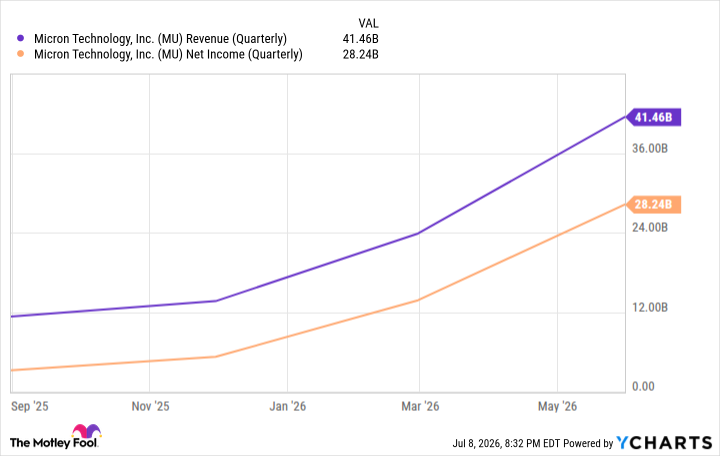
Given the high demand and short supply, Micron has been able to considerably raise prices and improve its profits and margins (though it has been accused of collusion and price-fixing). In the past year, Micron’s revenue has increased by 266%, while its net income has surged by 782%.
MU Revenue (Quarterly) data by YCharts
Unsurprisingly, the unique position Micron has found itself in — both financially and in terms of market position — has attracted many investors hoping to capitalize on it. And based on the president’s latest disclosure, he’s been one of those investors.
Today’s Change
(-1.05%) $-10.39
Advertisement
Current Price
$981.25
Key Data Points
Market Cap
$1.1TMarket cap calculated using publicly traded shares outstanding only. Does not include unlisted, private, or dual-class non-traded shares. Implied market cap may vary.Market cap calculated using publicly traded shares outstanding only. Does not include unlisted, private, or dual-class non-traded shares. Implied market cap may vary.
Day’s Range
$954.13 – $998.00
Advertisement
52wk Range
$103.38 – $1255.00
Volume
859.4K
Avg Vol
Advertisement
51.2M
Gross Margin
72.60%
Dividend Yield
0.05%
Advertisement
Should you follow Trump’s lead?
You shouldn’t invest in Micron simply because the president did. It’s true his stake in the company means he has a vested interest in making sure the stock does well, but you don’t want to blindly follow his moves simply for that reason.
You should, however, consider investing in Micron because its unique market position is bound to last for the foreseeable future. But even when supply meets demand, and Micron can’t command the premium it’s currently charging, the company will still have long-term agreements in place.
It’s operating in a cyclical industry that’s riding the high end, but it’s still a solid company with good long-term potential. It’s likely to be highly volatile along the way, but I trust its trajectory.
GRAND FORKS — Student loan repayment options and federal PLUS loans are seeing the biggest changes with the implementation of the federal One Big Beautiful Bill Act, said the director of student finance at the University of North Dakota.
Matt Lukach said students will see minor changes, but most of the work to make the alterations will fall upon UND’s system.
“It’s going to create work on our end, though, because all these changes will be manual, so we will have a lot more work on the back end. But hopefully, our students won’t see too much of a change from past years,” he said.
On Wednesday, July 1, changes to federal student aid programs from the OBBBA went into effect. Of the changes, Luckach sees the removal of the SAVE (Saving on a Valuable Education) loan repayment plan, the removal of the Graduate PLUS Loan Program and the alteration to the Parent PLUS Loan Program and scheduled reductions for federal loans at the undergraduate level as the most significant.
For undergraduate loans, students previously could get their full federal loan even if they were not a full-time student taking 12 credits. Following the changes, loans will be pro-rated down, depending on how many credits a student is taking. Most of UND’s undergraduate students are full-time students, Lukach said. For part-time students, UND will work to make adjustments to loan offers early so they won’t be as affected if they need to find alternative funding. UND already makes schedule reductions for Pell Grant funding.
Advertisement
A big change that may affect graduate students is the removal of the federal Graduate PLUS Loan Program. Some graduate students have used it to fund living expenses and pay for shortfalls while they finish their program. Graduate borrowers who have had a PLUS loan disbursed before July 1, 2026, while enrolled in a program, can continue to borrow for three academic years or the remainder of their program, whichever is less. Newer graduate students won’t be able to get the loans, and Lukach has seen movement in the private loan sector to balance this.
“We have had a lot of traffic, a lot of movement in the private loan sector in the last year to come up with options to help fill that gap of graduate PLUS loans,” he said. “The private educational loan industry is doing a pretty good job of coming up with some really comparable options to that loan.”
The Parent PLUS Loan Program won’t be going away, but it will be capped. Eligible parents can borrow a maximum of $20,000 per aid year per dependent student. In the past there was no cap, but Lukach said there wasn’t a high percentage of parents borrowing more than $20,000.
In Lukach’s opinion, the financial aid changes will be minor to current and incoming students. The bigger changes, he said, are in student loan repayment.
The SAVE plan, PAYE (Pay As You Earn) plan and the ICR (Income-Contingent Repayment) plan all are being phased out. Loan servicers are reaching out to current borrowers notifying them they have to choose different plans, though they can pay through the ICR plan until July 1, 2028. Their other options include a new tiered standard repayment plan and the new Repayment Assistance Plan.
Advertisement
RAP allows borrowers to pay monthly payments of 1-10% of the borrower’s income based on their adjusted gross income, with a minimum monthly payment of $10.
“I honestly don’t know what the effects of these new plans will be yet, because we’ve not heard from anybody, and they just went into effect,” Lukach said. “I’m sure we’ll see some chatter in the next few months on that (RAP) to see if it looks good, bad, the same. It’s hard to tell if it will be a benefit or a detriment to those people who are on the SAVE plan. We’re real early in this.”
New borrowers who borrow loans on or after July 1, 2026, have the options of the new tiered repayment plan or RAP.
Same as any other year, Lukach offers students this advice: Make a financial plan and know what is needed.
UND also has a monthly payment plan to cover gaps between a student’s charges and their financial aid, something Lukach has noticed students use more over the years. Overall, he’s seeing students be more fiscally responsible.
Advertisement
“It’s a good sign,” he said. “It means we have really high-quality students at the University of North Dakota, which I really, really love.”