Entertainment
Who's afraid of Roy Cohn? Not Jeremy Strong


Brutal. Vicious. Crooked. Cruel.
So filmmaker Ali Abbasi’s new biopic “The Apprentice” describes its dominant figure, a New York and Washington, D.C., power broker who lies, cheats, charms and browbeats his way into the uppermost ranks of American business and government.
No, it’s not Donald Trump. It’s Roy Cohn.
As the film depicts with garish flair, the pugilistic, Bronx-born attorney — who first came to prominence prosecuting Julius and Ethel Rosenberg for espionage, then served as chief counsel to Sen. Joseph McCarthy during his anticommunist witch hunt — took Trump under his wing in the 1970s, handing the ambitious real-estate developer’s son a fiendish playbook for success. Attack, attack, attack. Deny everything. Never admit defeat. By the time of his disbarment and death from AIDS complications in 1986, however, the roles were reversed, and Cohn lost sway with his erstwhile mentee as Trump stepped out of his shadow.
Throughout “The Apprentice,” Cohn comes across not only with his renowned ferocity, but also with uncommon empathy, courtesy of actor Jeremy Strong.
“If Roy Cohn walked into this room right now, I don’t think I would want to shake his hand,” says Strong, 45, seated in a bar off the sun-dappled courtyard of the San Vicente Bungalows on an early fall afternoon. “But from the distance of a piece of work and trying to understand him — humanistically and creatively — I had to find, for lack of a better word, love. Which is a bit of a grenade to say out loud.”
Fresh off a silent meditation retreat in upstate New York, the “Succession” star folds the same circumspection into nearly all of his stacked, erudite sentences, which are peppered with literary allusions (Kafka’s “The Zürau Aphorisms”) and film-industry names (Danish director Tobias Lindholm). At times Strong pauses so long that I launch into my next question, only to be interrupted by the continuation of an apparently unfinished thought. He denies being “gun shy” about press since the publication of a viral 2021 New Yorker profile in which a number of his collaborators — some named, others anonymous — looked askance at the lengths to which he’ll go to embed himself in a character.
“I think I’m a fairly earnest person, and that’s gotten me in trouble,” Strong insists, “but I’m not interested in camouflaging or disguising myself. Life is too short.”
Strong, left, as Roy Cohn, with Sebastian Stan as Donald Trump in “The Apprentice.”
(Festival de Cannes)
The topic at hand isn’t just the life and times of Roy Cohn, of course. When “The Apprentice” premiered earlier this year at the Cannes Film Festival, the Trump campaign swiftly threatened a lawsuit, calling the film “pure malicious defamation” and suggesting it “should not see the light of day.” Then, as if the former president’s wish had come true, the project languished for months without a distributor. Despite repeated reassurances from Abbasi, Strong, writer Gabriel Sherman and actor Sebastian Stan, who plays Trump, that “The Apprentice” was not a political polemic but a character study, it seemed plausible, as recently as August, that the film would remain on the shelf until after next month’s election, if not indefinitely. (It was ultimately picked up by Briarcliff Entertainment.)
“We sort of narrowly escaped the jaws of being effectively censored in this country,” Strong says. “That’s something that happens in Russia, North Korea. Not democratic countries. I think people in Hollywood were really wary of touching this, and that was disheartening.”
In theaters Friday, “The Apprentice” arrives in the home stretch of a bruising, chaotic presidential election campaign, sure to be scrutinized as closely as any film of the fall. Supporters of the Republican nominee will likely follow the Trump camp’s lead in calling the movie — in which Trump rapes first wife Ivana (Maria Bakalova) and undergoes multiple cosmetic surgeries — a hit piece, while his most ardent opponents may see any attempt to humanize Trump or Cohn as beyond the pale.
Given the fraught political environment, Strong strains to frame his approach to the character as a historian might, decoupling understanding from endorsement. Although he uses words like empathy, kinship and love to explain how he got under Cohn’s skin, he also describes the attorney as a “cancerous conundrum” and a “demonic Peter Pan.”
“God, it’s really dangerous,” Strong says. “I feel like I could get in trouble for saying anything positive about him. When I say these things, I only really mean them in a creative arena, because creatively a character like Roy is like Iago. You don’t want to say anything nice about Iago. But as an actor, Iago is one of the great roles. This feels like one of the great roles.”
Strong is not alone in his estimation. As a key character in Tony Kushner’s Pulitzer-winning 1991 play “Angels in America,” Mike Nichols’ 2003 HBO miniseries adaptation thereof, the 1992 TV movie “Citizen Cohn,” last year’s miniseries “Fellow Travelers” and numerous documentaries, Cohn has inspired more major films and TV series than even Harvey Milk. His many portrayals have resulted in two Tonys, an Emmy and a Peabody. I ask Strong if he thinks there’s any merit to the criticism about straight actors playing gay characters, and receiving acclaim for doing so, when such opportunities and plaudits remain a rarity for out gay actors.
“Yes, it’s absolutely valid,” Strong says. “I’m sort of old fashioned, maybe, in the belief that, fundamentally, it’s [about] a person’s artistry, and that great artists, historically, have been able to, as it were, change the stamp of their nature. That’s your job as an actor. The task, in a way, is to render something that is not necessarily your native habitat. … While I don’t think that it’s necessary [for gay roles to be played by gay performers], I think that it would be good if that were given more weight.”
Then, as I begin to follow up, he interjects, “What do you think?”
I think it’s complicated, if I’m being honest. I think it might be passé of me even to ask about it. At least for cis, white gay men, who have consistently dominated LGBTQ+ representation in film and television, the flagrantly stereotypical performances — the ones that treat the character’s sexuality as if it were another layer of hair, makeup or wardrobe — are now few and far between. It’s hard to muster one’s revolutionary fervor for Cohn, the man the “Bad Gays” podcast once labeled “the polestar of human evil.”
And yet that is exactly what makes this real-life character — a closeted, self-hating homosexual who helped launch the Lavender Scare and remained silent about the AIDS crisis even as it killed him — an ideal test case. The fact remains that no out gay man has ever won an Oscar for playing a queer character in the 96-year history of the Academy Awards. Meanwhile, this season alone could conceivably add two more names — Strong and Daniel Craig for “Queer” — to the list of nine straight men who’ve previously done so. (The numbers for women, and nominations, are scarcely any better.) In light of the disproportion, one can’t help but draw the conclusion that pundits and voters still understand playing gay as one mark in the column for “outstanding performance.” Which raises the question: Might a gay actor get more credit if he opted to play our community’s most notorious supervillain, instead of another tragic hero we’re determined to uplift? Would that appear, to the film academy’s approximately 10,000 members, a little more like “acting,” and less like life?
Compared with Pacino’s outraged and outrageous Cohn, spraying a vulgarian’s spittle across Nichols’ magisterial “Angels,” Strong’s performance is a model of white-knuckle control, swaggering when Cohn exerts his power, wilting when he can’t. When Cohn learns that Trump has gifted him fake-diamond cuff links for what will turn out to be his final birthday, Strong invests the petty indignity with pathos, as a man who would step over anyone to get ahead realizes he’s subject to the same ruthless forces. Along with Will Brill’s turn in “Fellow Travelers,” painting Cohn as practically lovesick for his partner in anticommunism, G. David Schine, “The Apprentice” is the closest any screen actor has come to reflecting the description of the attorney on the AIDS Memorial Quilt: “Bully. Coward. Victim.”
“What I do feel, whoever plays any part ever, is that you have to take these things as seriously as you take your own life, and it is not a game, and that these people and their struggles and the experiences you’re trying to render are not a plaything,” Strong says. “If I didn’t believe that I could understand on some deep level his anguish and turmoil and his need, and the sort of Gordian knot that every character has but Roy has particularly — if I didn’t believe that I could understand it or connect to it in a way that is faithful or voracious, I wouldn’t have done it. I certainly don’t do these things just for my own self-aggrandizement.”
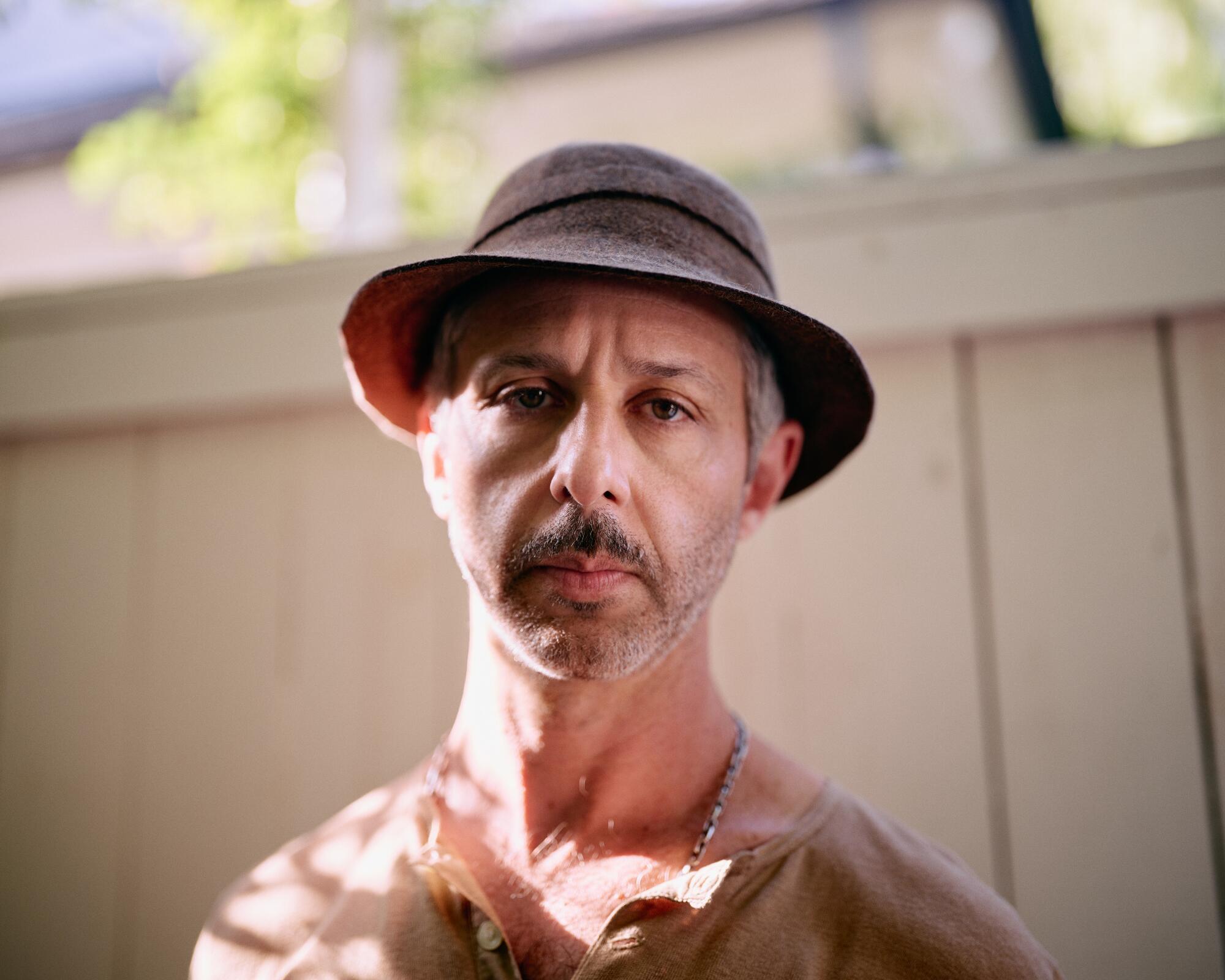
“You have to take these things as seriously as you take your own life,” says Strong of diving into the role of Roy Cohn. “And it is not a game.”
(Marcus Ubungen / Los Angeles Times)
Strong has become an almost scholarly fount of biographical information about Cohn, littering our conversation with enough details about the man’s home decor (porcelain frog figurines), taste in poetry (Joaquin Miller’s “Byron”) and dinner order at Le Cirque (Bumble Bee tuna, off-menu) to give Cohn‘s biographers a run for their money.
When Abbasi offered the role to Strong, the actor was already familiar with Cohn, not only from “Angels in America,” but also from the research he did after being approached to play Cohn in another film project about five years ago. Signing on to “The Apprentice” sent Strong’s prep work into overdrive, including studying video of Cohn to learn his “sui generis” voice — a hectoring New York sneer that’s authoritative but rarely loud — and interviewing Cohn profiler Ken Auletta. Strong says Cohn also represents his most dramatic physical transformation.
“I haven’t had to alter my body in that way,” says Strong, who underwent a doctor-supervised “starvation diet” and a regimen of tanning booth visits and biweekly spray tans to match Cohn’s notoriously leathery look. “He was obsessed with his physical appearance. He had a tremendous amount of vanity.”
With an Emmy for “Succession” and a Tony for this spring’s revival of Henrik Ibsen’s “Enemy of the People” under his belt, and Oscar buzz for his performance in “The Apprentice” already building, Strong’s own motivations are evolving. While career disappointment once spurred him, he is now just “looking for a limb to go out on.” I liken it, during the course of our conversation, to gymnast Simone Biles developing never-before-attempted vaults to challenge herself.
“I no longer feel thwarted in that way and I can pay my rent,” Strong says. “And I don’t take any of that for granted because it happened late for me. I have the luxury of choice and the luxury, more importantly, of getting to choose things that matter most to me, things that feel meaningful. I want to keep pushing myself — that Simone Biles thing of finding new ways to find the frontier and work that kind of requires a radical courage to do. Which for me is most things, because I find it all pretty fearful.”
After we’ve parted ways, Strong texts me a quote by Bruce Springsteen — “The pressures of the business are powerless in the face of what is real” — from music journalist Fred Goodman’s history “The Mansion on the Hill,” which Strong is reading to prepare to play Springsteen manager Jon Landau in the upcoming biopic starring Jeremy Allen White. I, too, am a collector of quotations, and after joking that newspaper stories should have epigraphs, I suggest one, from Wallace Stegner, that seems apropos to our conversation about Cohn: Present your subject in his own terms, judge him in yours.
“That’s a good one,” Strong texts. “For actors too.”



Just when you think Pixar’s petting-zoo cute new movie “Hoppers” is flagrantly ripping off James Cameron, the characters come clean.
movie review
HOPPERS
Running time: 105 minutes. Rated PG (action/peril, some scary images and mild language). In theaters March 6.
“You guys, this is like ‘Avatar’!,” squeals 19-year-old Mabel (Piper Curda), the studio’s rare college-age heroine.
Shoots back her nutty professor, Dr. Fairfax (Kathy Kajimy): “This is nothing like ‘Avatar!’”
Sorry, Doc, it definitely is. And that’s fine. Placing the smart sci-fi story atop an animated family film feels right for Pixar, which has long fused the technological, the fantastical and the natural into a warm signature blend. Also, come on, “Avatar” is “Dances With Wolves” via “E.T.”
What separates “Hoppers” from the pack of recent Pix flix, which have been wholesome as a church bake sale, is its comic irreverence.
Director Daniel Chong’s original movie is terribly funny, and often in an unfamiliar, warped way for the cerebral and mushy studio. For example, I’ve never witnessed so many speaking characters be killed off in a Pixar movie — and laughed heartily at their offings to boot.
What’s the parallel to Pandora? Mabel, a budding environmental activist, has stumbled on a secret laboratory where her kooky teachers can beam their minds into realistic robot animals in order to study them. They call the devices “hoppers.”
Bold and fiery Mabel — PETA, but palatable — sees an opportunity.
The mayor of Beaverton, Jerry (Jon Hamm), plans to destroy her beloved local pond that’s teeming with wildlife to build an expressway. And the only thing stopping the egomaniacal pol — a more upbeat version of President Business from “The Lego Movie” — is the water’s critters, who have all mysteriously disappeared.
So, Mabel avatars into beaver-bot, and sets off in search of the lost creatures to discover why they’ve left.
From there, the movie written by Jesse Andrews (“Luca”) toys with “Toy Story.” Here’s what mischief fuzzy mammals, birds, reptiles and insects get up to when humans aren’t snooping around. Dance aerobics, it turns out.
Per the usual, “Hoppers” goes deep inside their intricate society. The beasts have a formal political system of antagonistic “Game of Thrones”-like royal houses. The most menacing are the Insect Queen (Meryl Streep — I’d call her a chameleon, but she’s playing a bug), a staunch monarch butterfly and her conniving caterpillar kid (Dave Franco). They’re scheming for power.
Perfectly content with his station is Mabel’s new best furry friend King George (Bobby Moynihan), a gullible beaver who ascended to the throne unexpectedly. He happily enforces “pond rules,” such as, “When you gotta eat, eat.”
That means predators have free rein to nosh on prey, and everybody’s cool with it. Because of bone-dry deliveries, like exhausted office drones, the four-legged cast members are hilarious as they go about their Animal Planet activities.
No surprise — talking lizards, sharks, bears, geese and frogs are the real stars here. They far outshine Mabel, even when she dons beaver attire. Much like a 19-year-old in a job interview, she doesn’t leave much of an impression.
Yes, the teen has a heartfelt motivation: The embattled pond was her late grandma’s favorite place. Mabel promised her that she’d protect it.
But in personality she doesn’t rank as one of Pixar’s most engaging leads, perhaps because she’s past voting age. Mabel is nestled in a nebulous phase between teenage rebellion and adulthood that’s pretty blasé, even if a touch of tension comes from her hiding her Homo sapien identity from her new diminutive pals. When animated, kids make better adventurers, plain and simple.
“Hoppers” continues Pixar’s run of humble, charming originals (“Luca,” “Elio”) in between billion-dollar-grossing, idea-starved sequels (“Inside Out 2,” probably “Toy Story 5”). The Disney-owned studio’s days of irrepressible innovation and unmatched imagination are well behind it. No one’s awed by anything anymore. “Coco,” almost 10 years ago, was their last new property to wow on the scale of peak Pixar.
Look, the new movie is likable and has a brain, heart and ample laughs. That’s more than I can say for most family fare. “A Minecraft Movie” made me wanna hop right out of the theater.
Entertainment
Ulysses Jenkins, Los Angeles artist and pioneer of Black experimental video, dies at 79
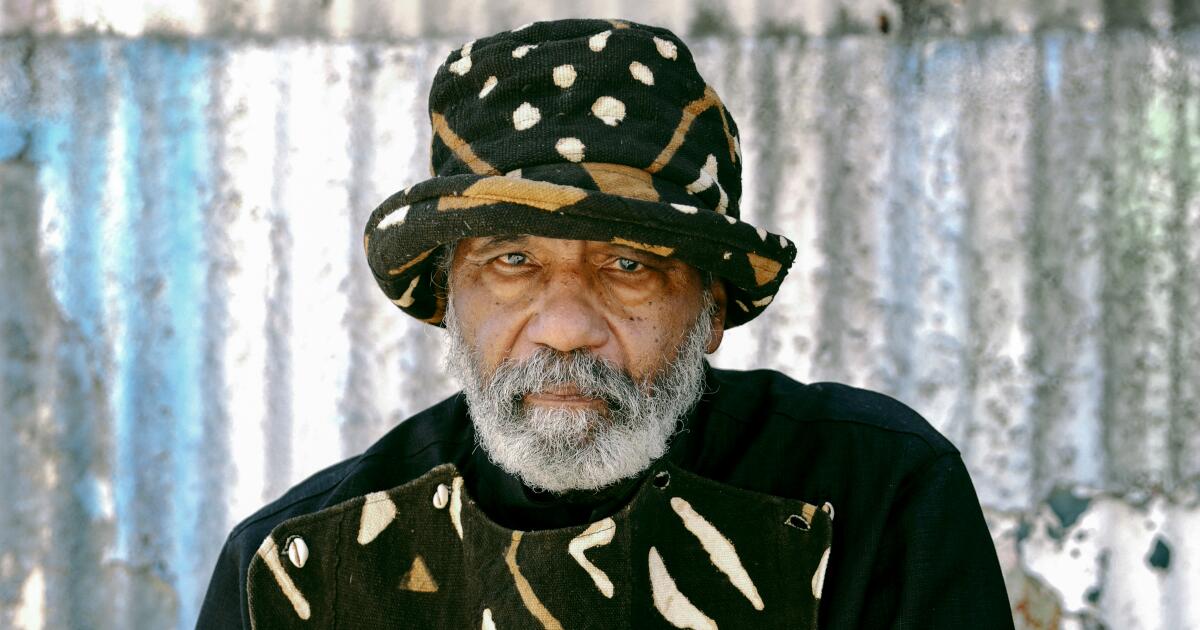
Ulysses Jenkins, the pioneering Los Angeles-born video artist whose avant-garde compositions embodied Black experimentalism, has died. He was 79.
Jenkins’ death was confirmed by his alma mater Otis College, where he studied under renowned painter and printmaker Charles White in the late 1970s and returned as an instructor years later. The Los Angeles art and design school shared a statement from the Charles White Archive, which said, “Jenkins had a profound impact on contemporary art and media practices.”
“A trailblazing figure in Black experimental video, he was widely recognized for works that used image, sound, and cultural iconography to examine representation, race, gender, ritual, history, and power,” the statement said.
A self-proclaimed “griot,” Jenkins throughout his decades-spanning career maintained an art practice grounded in the tradition of those West African oral historians who came before him. Through archival documentaries like “The Nomadics” and surrealist murals like “1848: Bandaide,” he leveraged alternative media to challenge Eurocentric representations of Black Americans in popular culture.
He was both an artist and a storyteller who sought to “reassert the history and the culture,” he told The Times in 2022. That year, the Hammer Museum presented Jenkins’ first major retrospective, “Ulysses Jenkins: Without Your Interpretation.”
“Early video art was about the problems with the media that we are still having today: the notions of truth,” Jenkins said. “To that extent, early video art was a construct that was anti-media … a critical analysis of the media that we were viewing every night.”
Born in 1946 to Los Angeles transplants from the South, Jenkins was ambivalent about the city, which offered his parents some refuge from the blatant systemic racism they encountered in their hometowns, but housed an entertainment industry that had long perpetuated anti-Black sentiment.
“What Hollywood represents, especially in my work, is the classic plantation mentality,” Jenkins told The Times in 1986. “Although people aren’t necessarily enslaved by it, people enslave themselves to it because they’re told how fantastic it is to help manifest these illusions for a corporate sponsor.”
Jenkins, who participated in a group of artists committed to spontaneous action called Studio Z, was naturally drawn to video art over Hollywood filmmaking. “I can address any issue and I don’t have to wait for [the studios’] big OK. I thought this was a land of freedom, and video allows me that freedom and opportunity that I can create for myself and at least feel that part of being an American,” he said.
Jenkins went on to deconstruct Hollywood’s vision of the Black diaspora in experimental video compositions including “Mass of Images,” which incorporates clips from D.W. Griffith’s notoriously racist “The Birth of a Nation,” and “Two-Tone Transfer,” which depicts, in Jenkins’ words, a “dreamscape in which the dreamer awakens to a visitation of three minstrels who tell the story of the development of African American stereotypes in the American entertainment industry.”
Jenkins’ legacy is not only artistic but institutional, with the luminary having held teaching appointments at UCSD and UCI, where he co-founded the digital filmmaking minor with fellow Southern California-based artists Bruce Yonemoto and Bryan Jackson.
As artist and educator Suzanne Lacy penned in her social media tribute to Jenkins, which showed him speaking to students at REDCAT in L.A., “he has been an important part of our histories here in Southern California as video and performance artists evolved their practices.”

4/5 stars
Bounding into cinemas just in time for spring, the latest Pixar animation is a pleasingly charming tale of man vs nature, with a bit of crazy robot tech thrown in.
The star of Hoppers is Mabel Tanaka (voiced by Piper Curda), a young animal-lover leading a one-girl protest over a freeway being built through the tranquil countryside near her hometown of Beaverton.
Because the freeway is the pet project of the town’s popular mayor, Jerry (Jon Hamm), who is vying for re-election, Mabel’s protests fall on deaf ears.
Everything changes when she stumbles upon top-secret research by her biology professor, Dr Sam Fairfax (Kathy Najimy), that allows for the human consciousness to be linked to robotic animals. This lets users get up close and personal with other species.

Kansas City man sentenced for cocaine trafficking, possession of illegal firearm

Kentucky vs. Texas A&M Injury Report: The usual suspects are out
Louisiana Lottery Powerball, Pick 3 results for March 2, 2026

How the Good Neighbor Day of Giving telethon is impacting Maine’s communities

50 years on the run: Maryland family killing suspect still never caught

Florida High School Football Rankings: Top 25 teams – Oct. 21

Cleary's 21 help Le Moyne down Central Connecticut State 69-64 in OT

How old is Bo Nix? What to know about Oregon quarterback ahead of 2024 NFL Draft

99th annual Pony Swim held in Virginia

Indiana Members Credit Union announced as new anchor tenant at Bottleworks District

Trump sends official notification to Congress on strikes against Iran

Unexpected birth brings hope to near-extinct Amazon tribe

Supreme Court blocks redrawing of New York congressional map, dealing a win for GOP

Map: Earthquake Shakes Central California

Gas prices could jump as Middle East tensions threaten global oil supply
-

 World5 days ago
Exclusive: DeepSeek withholds latest AI model from US chipmakers including Nvidia, sources say
-

 Massachusetts6 days ago
Mother and daughter injured in Taunton house explosion
-

 Denver, CO5 days ago
10 acres charred, 5 injured in Thornton grass fire, evacuation orders lifted
-

 Louisiana1 week ago
Wildfire near Gum Swamp Road in Livingston Parish now under control; more than 200 acres burned
-

 Technology1 week ago
YouTube TV billing scam emails are hitting inboxes
-

 Politics1 week ago
OpenAI didn’t contact police despite employees flagging mass shooter’s concerning chatbot interactions: REPORT
-

 Technology1 week ago
Stellantis is in a crisis of its own making
-

 Oregon4 days ago
2026 OSAA Oregon Wrestling State Championship Results And Brackets – FloWrestling