Sports
Introducing the most dangerous pass in football


A sharp, anxious intake of breath, followed by a round of applause that carries a mixture of quiet admiration and, more than anything, relief. On other occasions, it ends with supporters shaking their heads and asking why.
We are talking about the crowd reaction to — and I’m borrowing this description from a colleague who is a regular at Stamford Bridge — “the most dangerous pass in football”.
It’s the short, vertical ball from the goalkeeper to — typically, but not always — the midfield pivot, who is receiving under pressure, back to goal and close to their own penalty area.
Exhibit A: Chelsea’s Robert Sanchez trying, and failing, to pass to Moises Caicedo against Brighton earlier this season, when Carlos Baleba scored.
What a season Carlos is having! 🔥 pic.twitter.com/D7qC37kvwb
— Brighton & Hove Albion (@OfficialBHAFC) September 29, 2024
It was a case of role reversal for Baleba against Fulham when Alex Iwobi profited from a stray pass from the Brighton goalkeeper Bart Verbruggen.
Forcing the error. 👊 pic.twitter.com/g0Jmd2O2LN
— Fulham Football Club (@FulhamFC) December 6, 2024
As for Chelsea, they got their own back at Southampton, where Noni Madueke read Joe Lumley’s pass (35 seconds onwards in the clip below) to Kyle Walker-Peters and set up Christopher Nkunku for their second goal.
Tune into all of Wednesday night’s action. 📺#CFC | #SOUCHE pic.twitter.com/zY3em5RMBA
— Chelsea FC (@ChelseaFC) December 5, 2024
Fulham? It’s a minor miracle they didn’t concede against Newcastle when Bernd Leno signposted a pass to Emile Smith Rowe and Newcastle’s players were left shaking their heads in disbelief after Fabian Schar somehow failed to score.
Brentford had a reprieve against Ipswich, who were perilously close to serving a goal up on a plate to West Ham in October. A VAR offside call rescued Tottenham Hotspur’s Fraser Forster at Bournemouth, whose goalkeeper, Kepa Arrizabalaga, was lucky that Gabriel Martinelli didn’t punish him for a loose straight ball against Arsenal, which is where Mads Hermansen passed Leicester and Harry Winks into trouble (see below) in September.

As for Manchester United, the awful goal they conceded against Viktoria Plzen in the Europa League last week was yet another example.
The list goes on and on and, in many ways, provides fuel for those who wonder why so many teams continue to take such chances playing out from the back and in particular by using this type of pass.
There are probably a few ways to answer that question. The first thing to say is that, on a broader level, the coaches that play this way believe it makes far more sense to attack in a controlled way, in possession, through a mix of established principles and rehearsed movement patterns, even if that leads to the odd mistake, rather than tossing a coin and hoping it lands heads up — which is how they view knocking longer balls forward.
The second point — and this shines through when you discuss some of the incidents highlighted above with coaches who are proponents of this style of play – is that the execution of that bounce pass close to goal, taking in the decision-making around it, the positioning, and the movement and the timing, is the problem when it goes wrong, not the pass itself.
Third, it’s inevitable that the moments when it breaks down will get far more attention than the good passages of play.
Before we look at some more examples, it’s worth pointing out that some Premier League clubs — or maybe that should be ‘some Premier League managers and goalkeepers’ — have little or no inclination to play this game of risk and reward. The goalkeepers at Bournemouth (Arrizabalaga went off-piste against Arsenal), Crystal Palace, Everton, Newcastle United and Nottingham Forest in particular tend to play short sideways passes in build-up or go long.
In fact, even when the No 6 drops deep to receive a vertical ball in space with no sign of any pressure, the pass is often turned down by their goalkeepers. Below is Nottingham Forest’s Danilo, arms outstretched, asking for a ball he was never going to receive from the goalkeeper, Matz Sels.
Newcastle’s Nick Pope does the same (Bruno Guimaraes is pointing out that Sandro Tonali is free below)…
… as does Everton’s Jordan Pickford.
That said, Pickford bizarrely deviated from the script at Arsenal on Saturday. What followed was a car-crash moment between him and James Tarkowski, as the Everton goalkeeper bobbled a pass that the centre-back struggled to control, encouraging Martinelli to press. The expressions on the faces of the two Everton players afterwards said it all.
Time to look at some passages of play that show the reward and not just the risk, beginning with Arsenal’s 1-1 draw at Chelsea in November.
Declan Rice is the player to watch here. He takes up a starting position behind Nicolas Jackson, on the opposite side to the free man (William Saliba) he wants to find after Arsenal have provoked Chelsea’s press with a short goal kick.
Cole Palmer makes the standard run (curved) for any player leading the press in this situation, attempting to force the ball one way. Jackson, meanwhile, is ready to jump to Gabriel if David Raya returns the pass.
Timing and understanding are absolutely key to what happens next. Rice waits until Palmer gets closer to Raya and then runs on the blind side of Jackson to receive a soft pass in front of him that…
… he can play first time to Saliba, and Arsenal are out.
It is a pattern you will see again and again at Arsenal and elsewhere.
Below is an example of Ryan Gravenberch doing the same thing for Liverpool on the opening day at Ipswich.
Gravenberch is an interesting player to watch when receiving straight passes because of his exceptional ability to take the ball under pressure on the half-turn. In the image below, Chelsea’s Romeo Lavia is pressing him.
But Caoimhin Kelleher’s pass is ‘safe side’ (away from where Lavia is approaching), and Gravenberch is a master of getting his body between the opponent and the ball to protect and turn in one motion.
Not only are Arsenal and Liverpool retaining possession in these images, but they’re also taking opposition players out of the game while building an attack.
Take a look at this example of Manchester City playing out against Liverpool at Anfield at the start of December. The image that starts this phase of play is remarkable and, in many ways, captures the modern game: Ruben Dias is playing one-versus-one against Luis Diaz, 10 yards out, with nobody in goal (Stefan Ortega is on the corner of the six-yard box, out of picture).
As soon as Dias passes to Ortega, Manuel Akanji knows he has to connect with the City goalkeeper. Cody Gakpo, circled on the left, is already anticipating the pattern and preparing to press Dias.
The natural thing for Akanji to do — and what happens 99 times out of 100 — would be to pass to Dias.
Indeed, Mario Lemina did exactly that against Liverpool in September. Salah read him like a book but, uncharacteristically for him, shot wide of an open goal.
Akanji, however, scanned prior to receiving from Ortega and, aided by Dias also pointing where to play next, recognised both the need and the opportunity for a different (and much more progressive) pass to Kyle Walker.
As the City right-back travels forward, a line of four Liverpool players are out of the game.
But that’s Arsenal, Liverpool and Manchester City, I hear you say. What about clubs outside the traditional ‘Big Six’?
Brentford are a fascinating case study, in part because of their evolution under Thomas Frank. The percentage of long passes from their goalkeepers has dropped by a third in less than two years. Furthermore, the bounce pass to play out has been used frequently this season and with the exception of a mix-up against Ipswich that went unpunished and a slightly nervy moment in the first half against Chelsea on Sunday, it has worked extremely well.
The example below is from Brentford’s game against Villa and starts with Ethan Pinnock passing a goal kick to Mark Flekken. Vitaly Janelt’s clean technique and game intelligence really stand out in these scenarios.
In the image below, Janelt has his right hand outstretched, preaching calm and telling Flekken to wait as Ollie Watkins starts to make that familiar curved run. Clearly, this passage of play asks a lot of Flekken — or any goalkeeper. It’s not just about being good with their feet; they need to be calm, trust their team-mates, and make smart decisions in response to the opposition press.
When Watkins gets closer, Janelt makes his move, arriving at pace and running off the back of John McGinn, who has his eyes on Flekken and Pinnock.
Youri Tielemans leaves Yehor Yarmoliuk and jumps, along with McGinn, to press Janelt. But the Brentford midfielder and Flekken have worked it perfectly and Nathan Collins is ‘out’.
Three Villa players have been bypassed as Collins drives forward and…
… a few seconds later, Yoane Wissa has the ball inside the Villa half and Brentford have a four-versus-four attack.
The instinct is to say that the passages of play highlighted above look relatively straightforward. In reality, they require hours and hours of practice on the training ground as well as players who have both the technical ability and the mental fortitude to handle the ball in these situations and deal with the crowd anxiety. Indeed, that leads into a question that football fans will often ask about their team: are our players good enough to play this way?
Let’s analyse some clips of where it goes wrong.
The clip below is from Manchester United’s game against Tottenham in September. Diogo Dalot, playing the role of auxiliary No 6, receives a straight pass from Onana with his back to goal. Both United centre-backs — Matthijs de Ligt and Lisandro Martinez — are higher than you would expect in this scenario.
Normally, the pass made from the player occupying Dalot’s position here would be first time and with the left foot given where Dejan Kulusevski is pressing. But Dalot takes a touch to control with his right foot…
… turns his whole body around and passes with his right foot, too, allowing Kulusevski to get close to blocking. That extra touch also means Brennan Johnson is able to press Martinez easier (admittedly, Martinez’s lack of depth doesn’t help).
Panicked, Martinez blindly helps the ball on…
… and Pedro Porro is now on the attack for Spurs.
Some coaches are a lot more detailed with their messages than others. They will talk, for example, about the importance of goalkeepers receiving the ball in a neutral position, so that the opponent leading the press doesn’t know which side to jump and also discourage goalkeepers from making sweeping actions with their passes (picture that awkward Pickford ball to Tarkowski at Arsenal) to prevent the ball arriving with a bounce or with spin on it.
In other words, completing a pass to a team-mate isn’t enough when playing out against a press; it’s about giving the player receiving the ball the best possible opportunity of making their next action perfect — after all, multiple passes will often be required. It’s interesting to hear Liverpool players talking about how their manager, Arne Slot, has stopped training sessions because passes have not been played to the back foot of the receiver.
The problem with one sloppy pass is that it often leads to another. In the next photo, the Ipswich goalkeeper, Arijanet Muric, plays a ball around Tottenham’s Dominic Solanke using the outside of his right foot. It’s high risk and comes off, but the pass isn’t easy for Sam Morsy to play first time and that contributes to the next pass being untidy…
… which ends up with Dara O’Shea jumping to try to get the ball under control and encouraging Spurs to press even more.
Ipswich are committed to playing out from the back under Kieran McKenna and their build-up involves a lot of straight passes that they generally execute well — the montage below is from Saturday’s game at Wolves.
McKenna — and this feels important for any coach who wants to play this way — took time to explain his philosophy to the Ipswich fans to try to manage the apprehension that often builds in stadiums during these phases of play.
Away from home can be more challenging, though, and rival supporters will revel in the sort of moment that Ipswich endured at West Ham earlier in the season.
The first thing that jumps out when you watch the passage below is the setup. As well as being very close to the penalty area, both of Ipswich’s defensive midfielders, Morsy and Kalvin Phillips, are marked from behind before the goal kick and that feels like a red flag.
Morsy is unable to arrive at speed or on the blind side of an opponent. As for Phillips, he makes the penalty area more crowded by dropping inside and bringing Lucas Paqueta with him.
In fact, Phillips almost gets in the way of Morsy’s pass…
… which ends up at the feet of Paqueta.
Amid a scene of chaos in the Ipswich penalty area, O’Shea clears off the line.
On the subject of overcrowding, there were 14 players (8 v 6) in a tight space when Southampton tried to play out against Villa this month (see the image below). Southampton survived this one, but they conceded against Liverpool in a not-dissimilar fashion and there was the Chelsea goal, too.
Watching Southampton this season, it was hard to avoid the conclusion that neither Lumley nor Alex McCarthy, both of whom deputised for the injured Aaron Ramsdale, were equipped to play Russell Martin’s brand of football at this level — and maybe they weren’t alone.
Clearly, there are times when the straight pass isn’t on and the goalkeeper needs to adopt a more pragmatic approach. Fulham’s Sander Berge is pictured below signalling to Leno that he should miss him out and go over the top of Brighton’s aggressive press.
Getting caught in two minds is probably the worst position for a goalkeeper to be in and that’s what happened to Tottenham’s Guglielmo Vicario against Brentford (below). It’s almost as if Vicario is so programmed to play that straight pass (it’s central to the way Spurs build up under their manager Ange Postecoglou) that he doesn’t recognise an alternative. Fabio Carvalho capitalised on Vicario’s indecision but, to the Spurs goalkeeper’s credit, he recovered and denied Bryan Mbeumo moments later.
Both Vicario and Forster, his deputy, have had their share of close shaves this season, most recently at Bournemouth a couple of weeks ago, where Kulusevski felt like a sitting duck for Tyler Adams when the straight pass arrived.
On Sunday, against Southampton, Spurs were at it again right from the kick-off.
Four passes later, James Maddison was running through on goal and putting his team 1-0 up.
The risk, Postecoglou and others will argue, is worth the reward.
(Top photos: Getty Images; design: Meech Robinson)



Sports
London descends into disorder as Morocco fans flood streets after World Cup elimination by France

NEWYou can now listen to Fox News articles!
Public unrest began in parts of London late Thursday night, and it appears Morocco’s exit from the 2026 FIFA World Cup at the hands of France is the reason.
France took down Morocco 2-0, eliminating the African country for the second consecutive tournament, this time in a quarterfinal match.
As a result, many feared Paris would erupt into riots, especially after the chaos that followed Paris Saint-Germain’s UEFA Champions League victory over Arsenal in May.
Instead, images and videos from Edgware Road in northwest London showed police clashing with large crowds as smoke billowed through the streets and debris littered the roadway.
A police vehicle is parked in a road as people from pro-Palestinian activist groups gather near the Edgware United Synagogue during a demonstration against the “Great Israeli Real Estate Event” organized by real-estate agency My Home in Israel, which markets property in Israeli settlements in the occupied West Bank, in London, Britain, June 14, 2026. (Toby Shepheard)
Riot police, equipped with shields and body armor, tried to contain the crowds as they clashed with people launching fireworks and throwing debris. One video also appeared to show an officer down.
KYLIAN MBAPPÉ, OUSMANE DEMBÉLÉ FIRE FRANCE INTO WORLD CUP SEMIFINALS WITH WIN OVER MOROCCO
It’s unknown what happened to the officer who was down on the asphalt or how he was injured.
Fans waved Moroccan flags in the middle of the streets, which held up traffic. Some even jumped on top of vehicles trying to get through the area.
Moroccan fans in the stands before a FIFA World Cup 2026 quarterfinal match between France and Morocco at Boston Stadium July 9, 2026, in Foxborough, Mass. (Richard Sellers/SportsphotoAllstar)
Similar scenes unfolded after Egypt’s World Cup exit, when Argentina rallied for a controversial 3-2 victory that featured several disputed officiating decisions.
Paris, on the other hand, looked more like a city celebrating than one on the brink of a riot. Supporters of both France and Morocco flooded the streets, slowing traffic in several parts of the city.
One video showed horns blasting from cars with French and Moroccan flags out the windows on the L’avenue des Champs-Élysées in Paris. Supporters on the side of the road, waving their own flags, joined in on the celebration.
France’s Kylian Mbappé scored his eighth goal of this World Cup, which ties him for the most with Argentina’s Lionel Messi. Ousmane Dembélé also scored in the second half for France in the 2-0 win over Morocco.
It’s the third straight semifinal appearance for France, while Morocco still made World Cup history despite the loss. After becoming the first African country to reach the quarterfinals and semifinals in World Cup history in 2022, Morocco added to that by becoming the first-ever African nation to reach more than one quarterfinal.
Moroccan fans react while attending a watch party for the World Cup round of 8 match between France and Morocco in Boston, Massachusetts, on July 9, 2026. (Joseph Prezioso/AFP)
CLICK HERE TO DOWNLOAD THE FOX NEWS APP
Morocco’s exit means there are no more African nations alive in the World Cup. France will be taking on the winner of Spain and Belgium, while England and Norway and Argentina and Switzerland face off in the quarterfinals.
Follow Fox News Digital’s sports coverage on X and subscribe to the Fox News Sports Huddle newsletter.
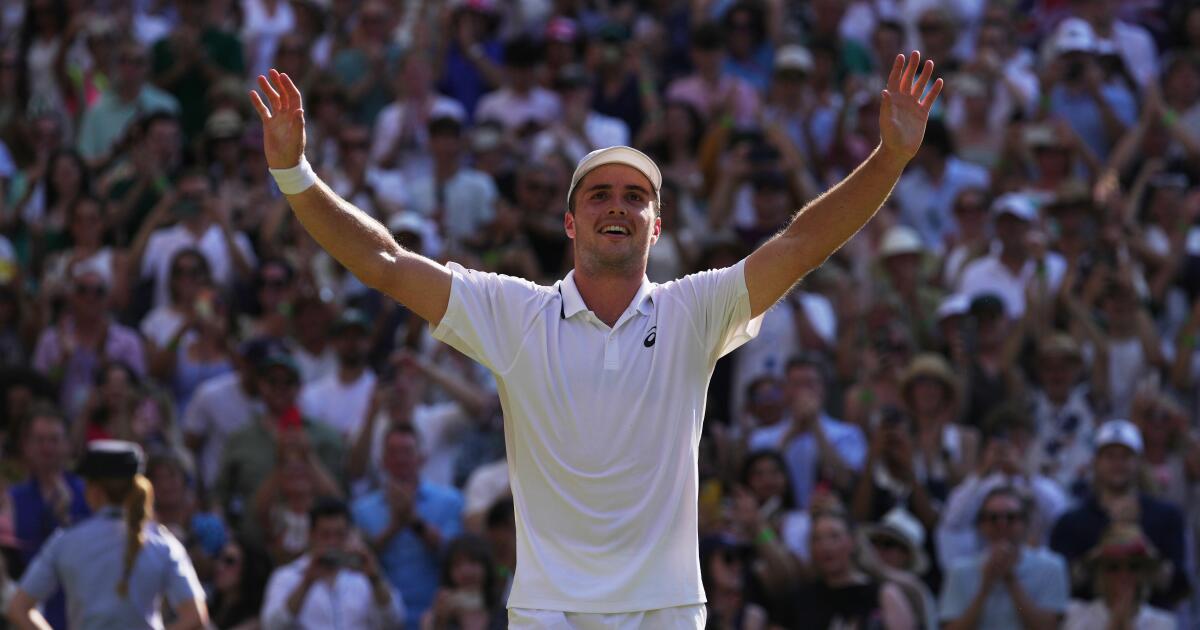
LONDON — A local boy sleeps in his own bed, plays in front of a king and queen and makes a Cinderella run to the Wimbledon semifinals. Sounds like a Hollywood script that might never see the silver screen.
But it’s no fairy tale — it’s Arthur Fery’s out-of-nowhere performance over the last 10 days.
Fery, a virtually unknown British wild card with a triple-digit ranking, has become the emotional heartbeat of Wimbledon while legitimately diverting some national attention from England’s World Cup quest.
The royal treatment at his matches across the All England Club has come in more ways than one.
Fery, who grew up five minutes from Wimbledon and is staying at home during the tournament, first played before grass-court king Roger Federer, Wimbledon’s eight-time singles champion, during Monday’s fourth-round victory. Two days later, he beat No. 9 seed and French Open runner-up Flavio Cobolli of Italy in the quarterfinals 6-4, 7-6 (4), 6-0 in front of Queen Camilla.
Ranked 114th, Fery had never reached the semifinals of an ATP Tour event, let alone a major, before his brief chat with the queen following the match.
“She just said, ‘Congratulations, keep going,’” 23-year-old Fery told reporters later. “I told her it was my birthday on Sunday, so it would be great to play the Wimbledon final on my birthday.”
That’s still a match away. To get there, Fery will have to get past one of the hottest players on tour: No. 2 seed Alexander Zverev, who is fresh off his first Grand Slam title at the French Open. Looming on the other side of the draw is a highly anticipated showdown between defending champion Jannik Sinner against 24-time major winner Novak Djokovic.
If Fery can continue his magical run to the end, he would become the first British wild card to win a Wimbledon title.
Arthur Fery reacts after defeating Flavio Cobolli in the Wimbledon quarterfinals on Wednesday.
(Maja Smiejkowska / Associated Press)
Born in France, Fery’s family moved to Wimbledon when he was an infant. His mother played professional tennis. He was a top British junior but chose to sharpen his game for three years in the U.S. collegiate system at Stanford, as many of his compatriots have done.
“I came out with a lot of hunger coming out of that, and I was ready to attack the pro circuit,” Fery said.
After struggling with bone bruising in his arm that limited him to playing mostly on the lower-tier Challenger circuit in recent years, Fery is finally healthy and playing consistently.
His path to the last four in London has been a masterclass in clutch come-from-behind performances. The Brit has stared down near-certain elimination in multiple matches, repeatedly breaking his opponents’ momentum with Houdini-like on-court acts.
At 5-foot-9, Fery possesses a skill set perfectly suited for low-bounding grass.
His compact strokes, low center of gravity, and elite movement allow him to hug the baseline, take time away from opponents, and confidently execute delicate volleys at the net, according to ESPN analyst Chris Eubanks.
“He defends well,” said Eubanks, a 2023 Wimbledon quarterfinalist. “He can scrap. He can claw. He can dig his way back into points. And when he ventures forward, he’s very, very comfortable at the net. This is a picture-perfect example of someone whose game is built for the surface.”
Still, it’s hard to fathom the multitude of milestones for Fery, who briefly reached the No. 1 ranking in college and earned 2023 Pac-12 Singles Player of the Year honors before leaving early to pursue a pro career.
He arrived at Wimbledon with just one main-draw victory at a major, a losing record as a professional, and only one previous ATP quarterfinal, at Queen’s Club last month. He’s now 11-8, won his first two five-set matches, and is the first British wild card to reach the Wimbledon men’s semifinals in the Open Era. The only other men’s wild-card semifinalist was Goran Ivanisevic, who won the title as a wild card in 2001.
Fery, who started the season ranked No. 185 and will climb to at least No. 36 after the tournament, said there were a “lot of first times” as he reflected on his unprecedented run. “First five-setter, longest match that I’ve ever played, first time breaking into the top 100, first second week in a slam, all at home, five minutes from where I grew up. It’s a great story for me,” he said.
The gap with his fellow semifinalists is understandably massive.
Entering Wimbledon, Djokovic, Sinner and Zverev’s combined records include 29 Grand Slam titles, 2,088 match wins and 155 tour-level titles. Fery was 6-8 in tour-level matches with zero titles.
But he has singlehandedly lifted the tournament for locals. With top hopes Jack Draper and Emma Raducanu withdrawing before the tournament and the rest of Britain’s singles prospects falling one by one — 18 men and women were eliminated by the third round — Fery became the nation’s last knight standing.
If his first name inevitably evokes Arthurian legend, Fery’s march through the draw gave Britain reason to believe again. No sword, no Round Table, just world-class shot-making, a lion’s heart and a Centre Court crowd thrilled to rally behind him.
“This is really quite something to see on home soil,” said Russell Fuller, the BBC’s tennis correspondent, who compared it with Raducanu’s stunning U.S. Open win in 2021 as a qualifier.
Fery earned every bit of it.
In the first round against Damir Dzumhur, Fery dropped the opening set and trailed by a break in the second before surging back. Against Zizou Bergs in the third round, he faced a 4-1 deficit with a double break in the fourth set, and again fell behind 4-1 in the fifth, before somehow surviving.
Then, stepping onto Centre Court for the first time against former top-10 stalwart Grigor Dimitrov of Bulgaria in the fourth round, Fery clawed out of a 2-sets-to-1 hole and a break down in the fourth set to clinch the victory in a fifth-set tiebreak.
“He carries himself with humility, but he’s a fierce competitor, and he’s got a ton of belief in himself,” said Stanford men’s coach and former top-60 player Paul Goldstein, who flew to England Tuesday to see his former charge compete against Cobolli.
While Fery attempts to outmaneuver Zverev on Friday, the other semifinal features a 2025 Wimbledon semifinal rematch between seven-time Wimbledon winner Djokovic and top-ranked Sinner, who defeated the Serb in straight sets on his way to the title. It’s also their second Grand Slam semifinal meeting in 2026. At January’s Australian Open on hard courts, Djokovic bested 24-year-old Sinner in five sets before falling to now-injured Carlos Alcaraz in the Melbourne final.

Arthur Fery hits a return during his Wimbledon quarterfinal win over Flavio Cobolli on Wednesday.
(Clive Brunskill / Getty Images)
Djokovic, 39, enters the match after surviving a grueling five-set, 5-hour-plus quarterfinal slugfest against No. 3 Félix Auger-Aliassime that concluded just minutes before Wimbledon’s 11 p.m. curfew. But the seventh-seeded Serb has a way of defying Father Time and he has had two days to recover on a surface where points are shorter and generally less taxing on the body.
Italy’s Sinner, who defeated Alcaraz in last year’s Wimbledon final, has been efficient if not at the level that saw him capture five consecutive titles before crashing out in the second round at the French Open. After a first-round scare here, the four-time Grand Slam champion has dominated opponents behind his improving serve, winning 80% of his first-serve points. He hasn’t dropped a set since the opening round. Sinner leads the head-to-head with Djokovic 6-5.
According to Eubanks, Djokovic must disrupt Sinner’s movement to break his rhythm, and take his chances.
“He’s got to play similar to how he played in Australia, where it was just all-out aggression,” Eubanks said.
For Sinner, he added: “His serve can be a neutralizing force for what Novak is going to try to do.”
On the other side of the ledger, Fery’s poise under pressure and deft use of the home crowd will be paramount to continue his surprise run against Germany’s Zverev, whom he called a “step up again” from his last five matches. Zverev, 29, is seeking his fifth major final and first at Wimbledon.
“I’m ready for it,” Fery said. “I have nothing to lose. I’m just going to go out there and … put my game on the court, do what I’ve done, believe in myself. We’ll see where that takes me.”
Home has never been closer to Centre Court. Nor has Arthur Fery ever been closer to tennis history.
Sports
Pirates star pitcher makes unfortunate history after being taken out in middle of perfect game bid

NEWYou can now listen to Fox News articles!
Jared Jones was flirting with Major League Baseball history on Wednesday night — he got it, but it was not what he originally envisioned.
The Pittsburgh Pirates pitcher retired the first 18 batters he faced, but he was taken out in the middle of his perfect game bid after six innings.
Now, the Pirates certainly have their reasons — the 24-year-old Jones hasn’t thrown more than 81 pitches in eight starts since returning May 20 after missing all of last season while undergoing ulnar collateral ligament internal brace surgery on May 21, 2025. He was yanked with 77 pitches and likely would have needed more than 100 pitches to record the 25th perfect game in MLB history.
Jared Jones of the Pittsburgh Pirates pitches during the first inning against the Atlanta Braves at PNC Park on July 8, 2026, in Pittsburgh, Pennsylvania. (Photo by Joe Sargent/Getty Images)
However, Jones left the game after getting zero run support, so when the Atlanta Braves tacked on three runs late for a 3-0 victory, Jones instead found himself in the wrong chapter of the history books.
According to Opta Stats, Jones became the first pitcher in the modern era (since 1920) to pitch at least six perfect innings and not record a win.
“It does suck. Something’s cool coming on, but I’m on what? My eighth start off of surgery? I completely understand it, and it is what it is,” Jones told reporters after the game.
Pittsburgh Pirates starting pitcher Jared Jones (17) makes his way to the field to warm up before pitching against the Atlanta Braves at PNC Park. (Charles LeClaire/Imagn Images)
JUSTIN VERLANDER ANNOUNCES HE WILL RETIRE AFTER THIS SEASON: ‘I’VE REALIZED THAT TIME HAS COME’
Jones said he didn’t entertain attempting to complete the perfect game.
“Not with the pitch count,” he said. “Not really ever expecting to go nine right now, so that was never in my head.”
Joey Bart, traded to the Braves from the Pirates on June 18, followed a double by Mike Yastrzemski with a 422-foot, two-run homer to left-center field off a slider from Dennis Santana. Drake Baldwin added an RBI single to center in the ninth for good measure.
It was the second time in less than a week that a pitcher was taken out of the game with a perfect bid through six innings — the Miami Marlins took Eury Perez out after seven innings in which he had 92 pitches. Perez, too, is in the midst of returning from injury and has surprisingly found himself right in the postseason mix.
He was pulled for Lake Bachar to start the eighth, and the Marlins allowed eight runs to the Athletics in the final two innings, but held on to win 9-8.
Jared Jones (17) of the Pittsburgh Pirates delivers a pitch during a MLB game against the Cincinnati Reds on June 27, 2026, at PNC Park in Pittsburgh, Pennsylvania. (Joe Robbins/Icon Sportswire via Getty Images)
CLICK HERE TO DOWNLOAD THE FOX NEWS APP
The Pirates are 4.0 games out of the final wild card spot, which is held by the Marlins.
The Associated Press contributed to this report.
Follow Fox News Digital’s sports coverage on X, and subscribe to the Fox News Sports Huddle newsletter.
-

 Connecticut3 minutes ago
Marian Katz Obituary
-

 Delaware6 minutes ago
DE health officials ‘on pins and needles’ after measles cases in PA
-

 Florida11 minutes ago
Florida man accused of driving drunk, causing head-on crash and seriously injuring 2
-

 Georgia18 minutes ago
Georgia cops’ alleged misuse of Flock license plate tracking data fuels privacy concerns
-

 Hawaii21 minutes ago
3 candidates to be considered for District 18 seat
-
 Idaho26 minutes ago
“We won’t insure you”: Robie Creek homeowners struggle to get home insurance due to wildfire risks
-

 Illinois33 minutes ago
After recent Illinois lightning strikes, officials share safety tips
-

 Indiana36 minutes ago
Kelsey Mitchell winner completes Fever comeback against Mercury, without Caitlin Clark

