Business
How Wally Amos Made His Cookies — and Himself — ‘Famous’


Before the answers to life’s questions fit in our pocket, you used to have to turn a dial. If you were lucky, Phil Donahue would be on, ready to guide you toward enlightenment. In a stroke of deluxe good fortune, Dr. Ruth Westheimer might have stopped by to be the enlightenment. He was the search engine. She was a trusted result.
Donahue hailed from Cleveland. The windshield glasses, increasingly snowy thatch of hair, marble eyes, occasional pair of suspenders and obvious geniality said “card catalog,” “manager of the ’79 Reds,” “Stage Manager in a Chevy Motors production of ‘Our Town.’” Dr. Ruth was Donahue’s antonym, a step stool to his straight ladder. She kept her hair in a butterscotch helmet, fancied a uniform of jacket-blouse-skirt and came to our aid, via Germany, with a voice of crinkled tissue paper. Not even eight years separated them, yet so boyish was he and so seasoned was she that he read as her grandson. (She maybe reached his armpit.) Together and apart, they were public servants, American utilities.
Donahue was a journalist. His forum was the talk show, but some new strain in which the main attraction bypassed celebrities. People — every kind of them — lined up to witness other people being human, to experience Donahue’s radical conduit of edification, identification, curiosity, shock, wonder, outrage, surprise and dispute, all visible in the show’s televisual jackpot: cutaways to us, reacting, taking it all in, nodding, gasping. When a celebrity made it to the “Donahue” stage — Bill Clinton, say, La Toya Jackson, the Judds — they were expected to be human, too, to be accountable for their own humanity. From 1967 to 1996, for more than 6,000 episodes, he permitted us to be accountable to ourselves.
What Donahue knew was that we — women especially — were eager, desperate, to be understood, to learn and learn and learn. We call his job “host” when, really, the way he did it, running that microphone throughout the audience, racing up, down, around, sticking it here then here then over here, was closer to “switchboard operator.” It was “hot dog vendor at Madison Square Garden.” The man got his steps in. He let us do more of the questioning than he did — he would just edit, interpret, clarify. Egalitarianism ruled. Articulation, too. And anybody who needed the mic usually got it.
The show was about both what was on our mind and what had never once crossed it. Atheism. Naziism. Colorism. Childbirth. Prison. Rapists. AIDS. Chippendales, Chernobyl, Cher. Name a fetish, Phil Donahue tried to get to its bottom, sometimes by trying it himself. (Let us never forget the episode when he made his entrance in a long skirt, blouse and pussy bow for one of the show’s many cross-dressing studies.) Now’s the time to add that “Donahue” was a morning talk show. In Philadelphia, he arrived every weekday at 9 a.m., which meant that, in the summers, I could learn about compulsive shopping or shifting gender roles from the same kitchen TV set as my grandmother.
Sex and sexuality were the show’s prime subjects. There was so much that needed confessing, correction, corroboration, an ear lent. For that, Donahue needed an expert. Many times, the expert was Dr. Ruth, a godsend who didn’t land in this country until she was in her late 20s and didn’t land on television until she was in her 50s. Ruth Westheimer arrived to us from Germany, where she started as Karola Ruth Siegel and strapped in as her life corkscrewed, as it mocked fiction. Her family most likely perished in the Auschwitz death camps after she was whisked to the safety of a Swiss children’s home, where she was expected to clean. The twists include sniper training for one of the military outfits that would become the Israel Defense Forces, maiming by cannonball on her 20th birthday, doing research at a Planned Parenthood in Harlem, single motherhood and three husbands. She earned her doctorate from Columbia University, in education, and spent her postdoc researching human sexuality. And because her timing was perfect, she emerged at the dawn of the 1980s, an affable vector of an era’s craze for gnomic sages (Zelda Rubinstein, Linda Hunt, Yoda), masterpiece branding and the nasty.
Hers was the age of Mapplethorpe and Madonna, of Prince, Skinemax and 2 Live Crew. On her radio and television shows, in a raft of books and a Playgirl column and through her promiscuous approach to talk-show appearances, she aimed to purge sex of shame, to promote sexual literacy. Her feline accent and jolly innuendo pitched, among other stuff, the Honda Prelude, Pepsi, Sling TV and Herbal Essences. (“Hey!” she offers to a young elevator passenger. “This is where we get off.”) The instructions for Dr. Ruth’s Game of Good Sex says it can be played by up to four couples; the board is vulval and includes stops at “Yeast Infection,” “Chauvinism” and “Goose Him.”
On “Donahue,” she is direct, explicit, dispelling, humorous, clear, common-sensical, serious, vivid. A professional therapist. It was Donahue who handled the comedy. On one visit in 1987, a caller needs advice about a husband who cheats because he wants to have sex more often than she does. Dr. Ruth tells Donahue that if the caller wants to keep the marriage, and her husband wants to do it all the time, “then what she should do is to masturbate him. And it’s all right for him to masturbate himself also a few times.” The audience is hear-a-pin-drop rapt or maybe just squirmy. So Donahue reaches into his parochial-school-student war chest and pulls out the joke about the teacher who tells third-grade boys, “Don’t play with yourself, or you’ll go blind.” And Donahue raises his hand like a kid at the back of the classroom and asks, “Can I do it till I need glasses?” Westheimer giggles, maybe noticing the large pair on Donahue’s face. This was that day’s cold open.
They were children of salesmen, these two; his father was in the furniture business, hers sold what people in the garment industry call notions. They inherited a salesman’s facility for people and packaging. When a “Donahue” audience member asks Westheimer whether her own husband believes she practices what she preaches, she says this is why she never brings him anywhere. “He would tell you and Phil: ‘Do not listen to her. It’s all talk,’” which cracks the audience up.
But consider what she talked about — and consider how she said it. My favorite Dr. Ruth word was “pleasure.” From a German mouth, the word conveys what it lacks with an American tongue: sensual unfurling. She vowed to speak about sex to mass audiences using the proper terminology. Damn the euphemisms. People waited as long as a year and a half for tickets to “Donahue” so they could damn them, too. But of everything Westheimer pitched, of all the terms she precisely used, pleasure was her most cogent product, a gift she believed we could give to others, a gift she swore we owed ourselves.
I miss the talk show that Donahue reinvented. I miss the way Dr. Ruth talked about sex. It’s fitting somehow that this antidogmatic-yet-priestly Irish Catholic man would, on occasion, join forces with a carnal, lucky-to-be-alive Jew to urge the exploration of our bodies while demonstrating respect, civility, reciprocation. They believed in us, that we were all interesting, that we could be trustworthy panelists in the discourse of being alive. Trauma, triviality, tubal ligation: Let’s talk about it! Fear doesn’t seem to have occurred to them. Or if it did, it was never a deterrent. Boldly they went. — And with her encouragement, boldly we came.
Wesley Morris is a critic at large for The New York Times and a staff writer for the magazine.




The luxury shopping center in Pacific Palisades will reopen next month after more than $100 million in renovations forced by the January 2025 wildfire that devastated the Los Angeles neighborhood.
Palisades Village will reopen Aug. 15, owner Rick Caruso announced Wednesday. The outdoor center survived the blaze that destroyed homes and other businesses but needed refurbishment to eliminate contaminants that the fire could have spread.
Crews are putting finishing touches on mall buildings after tearing them down to the studs, treating the wood and rebuilding the walls, Caruso said.
“Everybody’s working, and stores are moving their products in,” he said. “It’s a really cool feeling that people have really locked arms and are working together.”
An electrician installs lighting for a restaurant at Rick Caruso’s Palisades Village on Thursday. The shopping center is scheduled to reopen mid-August.
(Myung J. Chun / Los Angeles Times)
Pacific Palisades resident Allison Polhill, who is rebuilding the home of 30 years that her family lost in the blaze, said she is “thrilled” at the prospect of returning to the mall she used to frequent. Its comeback is a boost for the community, she said.
“Every single step that we make to reopen our commercial corridors is going to bring more people back into the Palisades,” said Polhill, who expects to move back into her home at the end of August.
A total of 6,822 structures were destroyed in the Palisades fire, including more than 5,500 residences and 100 commercial businesses, according to the California Department of Forestry and Fire Protection.
Caruso previously attributed the mall’s survival to the hard work of private firefighters and the fire-resistant materials used in the mall’s construction.
The $200-million shopping and dining center opened in 2018 with a movie theater and a roster of upmarket tenants, including Erewhon, which may be the only grocer in the heart of the fire-ravaged neighborhood when it opens.
Caruso’s company was able to fill the mall with tenants despite the long shutdown.
Palisades Village is 99% leased, with the majority of tenants returning, said Jackie Levy, chief financial and revenue officer. Nearly one-third of the shops and restaurants are new to the property.
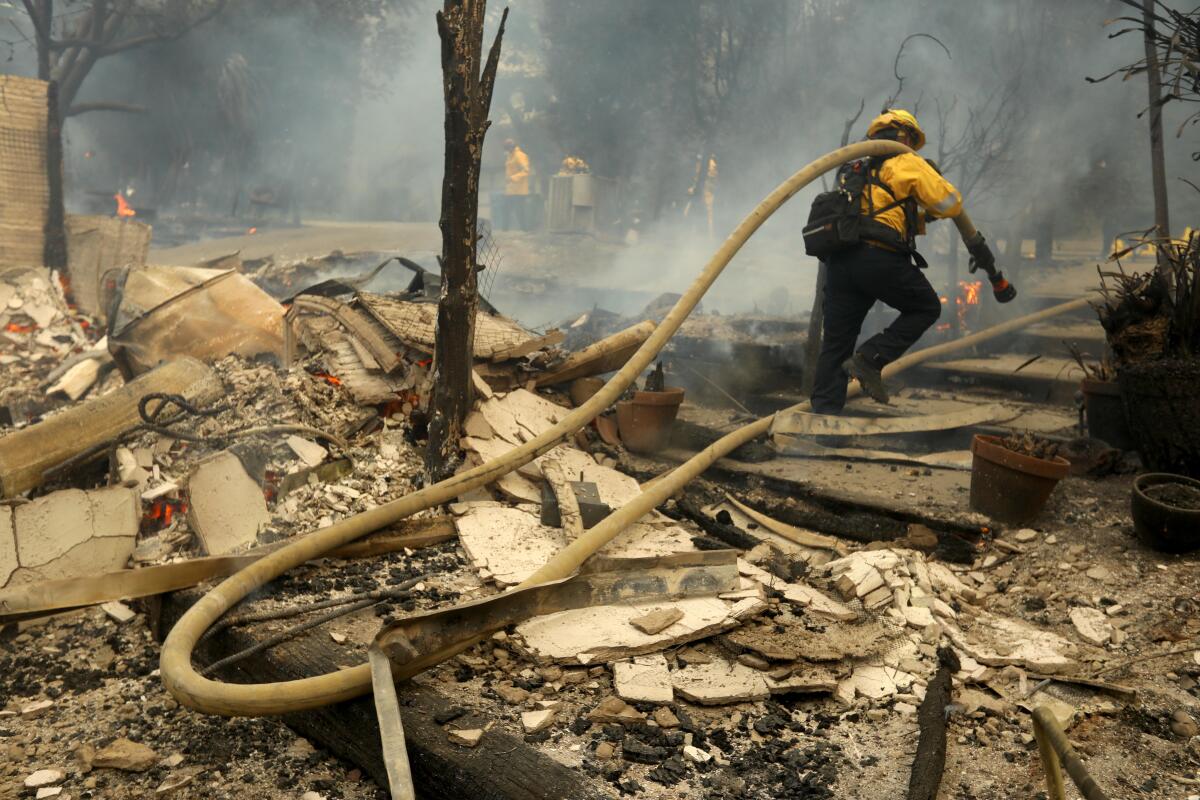
A firefighter carries a hose back to his rig while walking through a destroyed home from the Palisades fire in Pacific Palisades on Jan. 7, 2025.
(Genaro Molina / Los Angeles Times)
Last year, Pacific Palisades-based fashion designer Elyse Walker said she would reopen her eponymous store in Palisades Village after losing her 25-year flagship location on Antioch Street to the inferno.
Other neighborhood shops destroyed in the fire that are reopening at the mall include K Bakery and Loomey’s Toys, which caters to children up to age 12 and used to be across the street from Palisades Elementary Charter School.
“It’s been a journey and I’m excited because I wasn’t sure that there was going to be a place to come back to,” said toy store owner Amanda Rastegar. “Hopefully we can bring some of that magic back.”
Rastegar’s home in the Palisades survived but was damaged by the fire. The family returned about eight weeks ago. Her last memory of the fire was a burning supermarket.
“I just couldn’t wrap my brain around what was happening,” she said. “By the time I left, Gelson’s was on fire.”
Among the returning tenants is Angelini Ristorante & Bar. Well-known Los Angeles chef Gino Angelini said he will be in the kitchen next month for a return of the Italian restaurant.
“We won’t do a big celebrity open,” he said. “We want to have a very soft opening and see our customers come back.”

Construction takes place at Rick Caruso’s Palisades Village on Thursday. The shopping center is scheduled to reopen mid-August.
(Myung J. Chun / Los Angeles Times)
An elaborate celebration would not feel “correct for me,” Angelini said, because the devastation has been “very sad” for so many.
Other new tenants include local chef Nancy Silverton, who has agreed to move in with a new Italian steakhouse called Spacca Tutto. Women’s activewear retailer LESET will open its first West Coast location.
Caruso said he is optimistic that customers will return to the center, even though many Pacific Palisades residents are still dispersed. One tracking system estimated that about 30% of the Village’s customer base was impacted by the fire, he said.
“That means 70% did not get impacted, so there’s a lot of customers still left out there,” Caruso said. Historically, the center drew customers from as far away as Beverly Hills and Calabasas, as well as Malibu, Brentwood and Santa Monica.
He also hopes many will be inspired to visit the revived mall.
“I believe in the goodness of people and I believe that people are going to want to support the Palisades,” he said. “They’re going to want to be there and support the businesses that have had the courage and the heart to reopen.”

Walmart is rapidly expanding its network of electric vehicle chargers designed for customers to use while they shop.
The network could help fill gaps in EV infrastructure in states with greater need for chargers. Walmart, which has more than 5,000 locations in the U.S. and hundreds in California, says more than 90% of Americans live within 10 miles of one of its stores.
The chargers also offer an incentive for customers to choose Walmart — Walmart Plus members will receive a 10% discount off an average price of $0.46 per kilowatt-hour of energy at the company’s chargers.
Walmart chargers are already available at more than 75 locations in 17 states, with Texas boasting the most charging stations, followed by Florida and Arizona.
Matthew Nelson, Walmart’s director of energy policy, said last week on LinkedIn that the network will soon reach 29 states, including California.
“We are delivering on the promise of affordable, reliable and convenient charging,” Nelson said in his post.
According to Walmart’s website, six charging stations are coming to California soon, though the company did not offer a specific timeline.
The chargers will be installed at stores in Antelope, Brea, Fresno, Stockton, Suisun City and Vallejo.
Most charging sites in California will include eight to 16 fast-charging stalls, said Walmart spokesperson Kelsey Bohl.
The company first announced plans in April 2023 to install its own EV chargers at Walmart and Sam’s Club stores, with a goal of installing thousands of chargers by 2030. Partnering with ABB E-Mobility and Alpitronic, it added 25 new charging sites this past May and six more in June.
“Walmart is building a leading retail-integrated EV fast-charging network, focused on delivering an affordable, reliable and convenient charging experience where customers already shop,” Bohl said in an emailed statement. “Customers can charge while they shop, access stations through the Walmart app they already use, and benefit from affordable pricing.”
The charging stations already available include 612 individual charging stalls using 400-kilowatt chargers. Each stall has a dual charging cord with both Combined Charging System and North American Charging Standard connectors. The standard connectors, designed by Tesla, are smaller and lighter than the combined systems.
The primary way to pay for the chargers is through the Walmart app, but the company is also experimenting with built-in credit card readers to allow those without the app to use the stations.
Customers can check charger availability on the Walmart app. The company said the chargers will be available 24 hours a day.

Robotaxis could be turning into robocops.
A self-driving Waymo reported two teens to San Mateo, Calif., police on Monday after they were found drinking alcohol and shooting toy guns in the back of the vehicle.
According to a social media post from the San Mateo Police Department, officers detained two 15-year-olds after the Waymo they were riding in contacted the department and stopped in a parking lot until law enforcement arrived.
“Parents do you know where your teens are?” the San Mateo Police Department wrote on Facebook following the incident. “Waymo does!”
Officers removed both teens from the vehicle and determined they were using toy guns to shoot Orbeez out the windows. Orbeez are small, water-absorbing beads sold at toy stores.
“Toy guns, water guns, and BB guns all pose real dangers, especially to an untrained eye,” the Police Department said. “The simple handling of them can cause fear in [passersby].” “
A video posted on Facebook shows at least five officers and a police dog responding to the scene and approaching the Waymo with their weapons raised.
Waymo did not immediately respond to a request for comment.
Waymo vehicles have internal cameras and microphones that may be used in an emergency or to “promote safety and security,” according to Waymo’s online support page.
The cameras are also used to ensure the vehicles are clean and to help find lost items, according to the support page.
The company said it does not use facial recognition or other biometric identification technologies to identify individuals.
“In more urgent circumstances, support may access live video during a trip,” the Waymo page said.
The San Mateo Police Department’s Facebook post has garnered nearly 60 comments, with one user accusing Waymo of “snitching.”
“At least they got a designated driver?!” one user commented.
-
 Lifestyle29 minutes ago
We unpack the 2026 Emmy nominations : Pop Culture Happy Hour
-

 Technology37 minutes ago
Get a $30 credit when you reserve Samsung’s upcoming Galaxy phones
-

 World44 minutes ago
Critics say Turkey’s verbal attacks on Israel have crossed into antisemitism
-

 Politics46 minutes ago
WATCH: Dana White drops 2028 hints while raving about his favorite Trump cabinet secretary
-

 Health52 minutes ago
Katie Couric couldn’t remember the year or the president during frightening brain episode
-

 Sports59 minutes ago
Justin Verlander announces he will retire after this season: ‘I’ve realized that time has come’
-

 Technology1 hour ago
Apple AI security update proves hackers move fast
-
Business1 hour ago
Fire-damaged Pacific Palisades shopping center sets reopening date

