West
SJSU responds to volleyball player mass exodus after trans athlete scandal rocked program

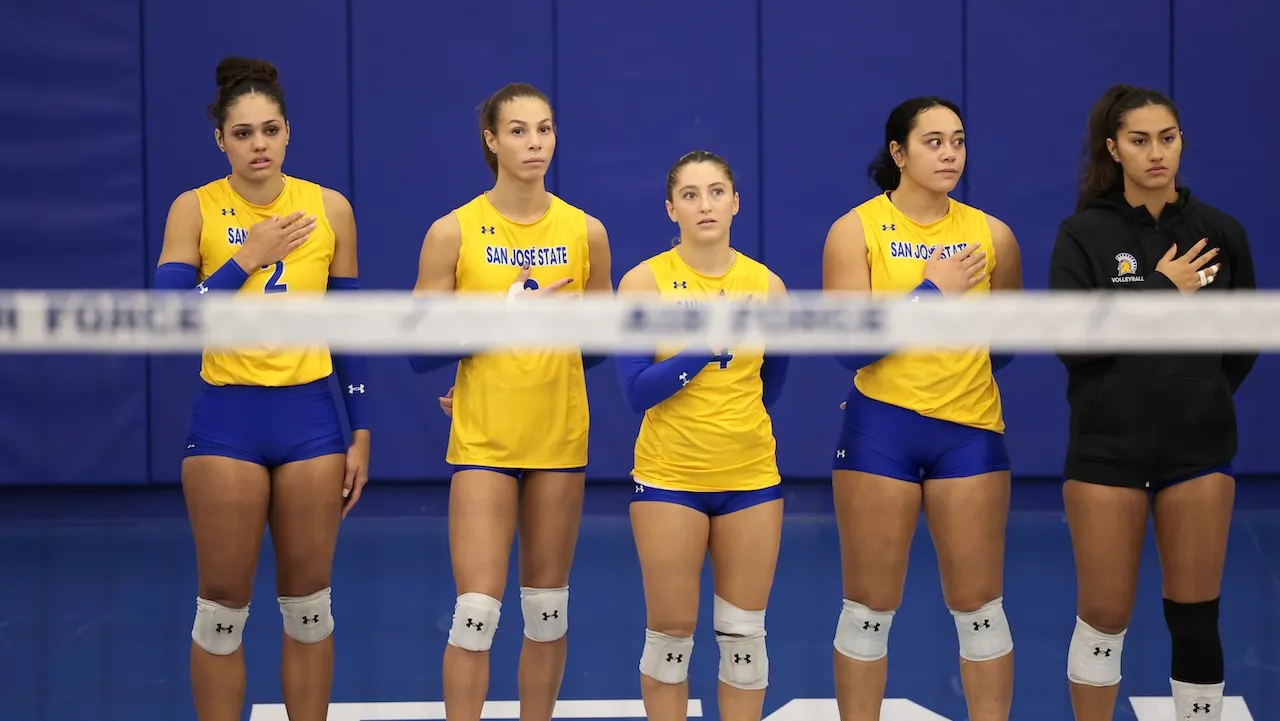
San Jose State University has acknowledged a recent mass exodus of volleyball players who entered the transfer portal after a controversy-riddled season involving a trans athlete on the team.
The university provided a statement to Fox News Digital in which it expressed “respect” for the recent wave of players who have opted to transfer. “Student athletes have the ability to make decisions about their college athletic careers, and we have the utmost respect for that,” the statement read.
The San Francisco Chronicle reported that seven of the team’s players have entered the transfer portal.
In an article detailing the San Jose State University Spartans’ transgender athlete scandal, the New York Times referred to the biological female athletes on the team as “non-transgender women.” (AP Photo/David Zalubowski)
The seven players who are transferring will be leaving the team after a season that included eight forfeited matches, regular police protection, national scrutiny and internal turmoil between players and coaches. One player even received threats of physical harm amid the controversy.
Head coach Todd Kress even spoke about how the 2024 season was one of the “most difficult” of his life after the team’s loss in the conference final to Colorado State, in a statement provided to Fox News Digital.
“This has been one of the most difficult seasons I’ve ever experienced, and I know this is true as well for many of our players and the staff who have been supporting us all along. Maintaining our focus on the court and ensuring the overall safety and well-being of my players amid the external noise have been my priorities,” Kress said.
The transgender player, Blaire Fleming, is out of eligibility after completing a fourth collegiate season in 2024. The team’s season ended in the Mountain West Conference championship game after it advanced to the title game by virtue of a forfeit from Boise State in the semifinal round. Boise State previously forfeited two regular season games to San Jose State amid the controversy involving Fleming, accounting for three of its seven conference wins via forfeit this year.
A loss to Colorado State in the conference final ended the season and prevented the controversy from slipping into the NCAA tournament. The loss effectively ended Fleming’s collegiate career.
In September, co-captain Brooke Slusser joined a lawsuit against the NCAA alleging the program withheld knowledge about Fleming’s birth gender from her and other players on the team. Slusser alleged she was made to share changing and sleeping spaces with Fleming without knowing that Fleming was a biological male.
Slusser, along with several other players in the Mountain West, filed a separate lawsuit against the conference and San Jose State in November over Fleming’s presence. That lawsuit included testimony from former San Jose State volleyball players Alyssa Sugai and Elle Patterson alleging they were passed over for scholarships in favor of Fleming.
That lawsuit also alleges that San Jose State players spoke up about an alleged scheme by Fleming to have Slusser spiked in the face with a volleyball in a game against Colorado State on Oct. 3. Slusser was not spiked in the face in that game, and an investigation by the Mountain West concluded without finding sufficient evidence of the alleged plot.
SJSU TRANSGENDER VOLLEYBALL SCANDAL: TIMELINE OF ALLEGATIONS, POLITICAL IMPACT AND A RAGING CULTURE MOVEMENT
Assistant coach Melissa Batie-Smoose was suspended by the program in early November after she filed a Title IX complaint against the university for showing favoritism toward Fleming over the other players, especially Slusser. Batie-Smoose’s complaint also included allegations of Fleming’s plot to have Slusser spiked in the face.
Slusser previously told Fox News Digital that Batie-Smoose’s dismissal severely impacted the morale of the team.
“After we found out that she was released, a lot of the team just kind of broke down and was kind of freaking out, and even one of my teammates was like, ‘I don’t feel safe anymore,’ because there’s no one now that we feel like we can go and talk to about our concerns or our actual feelings and can actually speak freely in front of,” Slusser said.
Slusser added that she and other players lost trust in the coaches, including head coach Kress.
“You can’t truly voice how you’re feeling without them just trying to cover it up or act like it’s all OK. With Melissa, you could voice how you felt, and she could comfort you and validate your feelings and at least make you feel heard compared to the other coaches,” Slusser said.
Kress also blamed the team that forfeited for igniting backlash against his team, as each forfeit brought about more controversy and media attention.
San Jose State Spartans players look on prior to the game against the Air Force Falcons at Falcon Court at East Gym on Oct. 19, 2024 in Colorado Springs, Colorado. (Andrew Wevers/Getty Images)
“Sadly, others who for years have played this same team without incident chose not to play us this season. To be clear, we did not celebrate a single win by forfeiture. Instead, we braced for the fallout. Each forfeiture announcement unleashed appalling, hateful messages individuals chose to send directly to our student-athletes, our coaching staff and many associated with our program.”
However, these issues did not stop the players from at least having some fun on what was their final road trip as San Jose State Spartans for most of them.
Slusser previously told Fox News Digital that the team went out to a magic show together when they traveled to Las Vegas for the Mountain West tournament, and even had a team Thanksgiving meal together at the team hotel with takeout from a local diner with many of their families.
However, that was not enough to keep the seven players who have entered the transfer portal attached to the program, as the team will be facing a major roster turnover as it looks to rebound on the court and in its reputation in 2025.
Follow Fox News Digital’s sports coverage on X, and subscribe to the Fox News Sports Huddle newsletter.
Read the full article from Here



The David Woods abuse case and Iowa’s child welfare crisis
David Woods is serving 100-year prison sentence in connection with a case in which he adopted, then abused, boys from the Iowa foster care system.
New Mexico State Treasurer Laura Montoya reintroduced baby bonds to legislative teams at a recent conference.
During this conference, Montoya and her team explained what baby bonds would do, what they would mean for New Mexicans and asked for their thoughts and what she could change to help get it passed in the New Mexico Legislature.
Baby bonds are a way for parents to set children up for success later down the line, Montoya said. New Mexico would allocate around $7,000 to each newborn child as part of the bond proposal. The bond would grow over time, and the child would have access to it at age 18. Bonds could be used for a down payment for a car or to pay for parts of school that are not covered by the lottery or opportunity scholarships, buying or renovating a home, or starting a business all withing the state of New Mexico.
Montoya said the funds would not be used for random expenses.
“Now you might be saying, ‘when I was 18 and I would never give myself that money.’ You’re not getting the money directly. So, what happens is it all gets put into a pool of cash that is invested by the State Investment Council. They manage the money and then when you need it, let’s say you’re a student and NMSU gives us an invoice, you say ‘yes, I went to school and NMSU needs to be paid out,’” Montoya said. “Then it goes to the appropriate (agency), whether it’s EFA (Education Freedom Account) or whoever the Legislature designates, will then sign off the check and send it directly to NMSU. So, it’s their money but it isn’t their money.”
Montoya hypothesized on how a bond would benefit a young New Mexican.
“So, you consider an 18-year-old from a working-class family living in Rio Arriba (County), who dreams of attending a four-year college and eventually becoming a nurse. However, achieving this dream would have been difficult given her family’s working-class income. Having a Baby Bond has already made a difference. Research indicates that even small dollar savings accounts with money designated for school results in low-and middle-income children being more likely to enroll in college,” Montoya said.
Montoya said that statistics from the Treasurer’s Office, other state government agencies and pulled from public records to show what a baby bond could do for someone in a low income bracket.
“So, in Rio Arriba only 6% of adults have a degree beyond a bachelor’s degree. Only 7.5% of renters in Rio Arriba are able to afford median home price and baby bonds can contribute to significant decreases in student loan debt especially for women and people of color. You’ll see that same $7,000 she used $13,000 of it for nursing school when she was 18. Then, she still made another $23,000 and she used 30,000 for a home down payment. By the end of it she still had $150,000,” Montoya said.
The children who receive baby bonds would gain access to them only by taking a financial literacy course — or as Montoya calls it financial fitness course. This could be offered through state banks, but she said maybe later down the line it will be offered in kindergarten through grade 12.
“Financial fitness for me is something that I’m very passionate about because I grew up super humble and we didn’t have anyone to teach us what that looked like in having a savings account and investing and so many New Mexicans don’t. So, the one place we can learn this is in our schools, and we need to partner because a lot of our schools don’t have some of that expertise,” she said. “We need to partner with our banks; we need to partner with others that are doing the work already. We don’t need to reinvent the wheel. We just need to bring more people in to partner.”
Department Head and Professor at NMSU Harikuman Sankaran questioned whether the bonds could be used by students already relying on the New Mexico Legislative Lottery Scholarship and New Mexico Opportunity Scholarship. Deputy State Treasurer Ricky Serna said students had the option to access the funds regardless of scholarship awards.
“If I’m a student that says, ‘I live in Albuquerque and I’m going to UNM, I already don’t have to pay tuition and I have a scholarship and now I don’t have to pay for books and fees. Do I have to now wait until I buy a home to access my baby bond?’ Maybe it’s ‘No, I can tell UNM I have enough to put me to work in the school of arts and sciences or put me to work somewhere because I want to use some of my money now, right?’ I think that’s the idea,” Serna said.
Montoya said that this concern would be addressed later to not overcomplicate the bond proposal.
“But that’s something the Legislature can do in the future, too. I mean we have 18 years, so I don’t want to complicate it at this moment. I just want to keep it as simple as possible, but I understand (the concern) of what you’re saying on the long-term investment to have them buy in,” Montoya said.
Montoya said Baby Bonds have the potential to address some of the state’s largest issues – poverty, educational attainment and housing. As the bond recipient gets older it too can ease the burden of housing, retirement and reliance on public assistance.
Children born in New Mexico could access the investment between the ages 18 and 35 to build wealth.
Montoya asked the public to comment on the use of Baby Bonds, an issue the state Legislature will consider in the 2027 Legislative session.
Leighanne Muñoz is the business and development reporter for the Las Cruces Sun-News and is a fellow with the New Mexico Local News Fellowships and Internships Program, which places emerging journalists in newsrooms across New Mexico. Learn more at www.newmexicolocalnewsfellowships.org. Email her at lmunoz@gannett.com.
The Oregon Lottery offers several draw games for those aiming to win big.
Here’s a look at July 2, 2026, results for each game:
Winning Pick 4 numbers from July 2 drawing
1PM: 3-2-1-6
4PM: 7-1-7-6
7PM: 6-2-0-4
10PM: 5-3-8-0
Check Pick 4 payouts and previous drawings here.
Feeling lucky? Explore the latest lottery news & results
When are the Oregon Lottery drawings held?
- Powerball: 7:59 p.m. on Monday, Wednesday and Saturday.
- Mega Millions: 7:59 p.m. on Tuesday and Friday.
- Pick 4: 1 p.m., 4 p.m., 7 p.m. and 10 p.m. daily.
- Win for Life: 7:30 p.m. on Monday, Wednesday, and Saturday.
- Megabucks: 7:29 p.m. on Monday, Wednesday, and Saturday.
This results page was generated automatically using information from TinBu and a template written and reviewed by an Oregon editor. You can send feedback using this form.

-

 New Jersey4 minutes ago
Legendary NJ Fourth of July lobster catch created record that will never be broken
-

 New Mexico7 minutes ago
$7K baby bond for each New Mexico child? What the state treasurer is proposing
-

 North Carolina12 minutes ago
Warsaw man extradited back to Duplin County in last year’s lottery ticket probe
-

 North Dakota19 minutes ago
North Dakota’s Vantis BVLOS system now open to UAS operators at no cost – Unmanned airspace
-

 Ohio22 minutes ago
Licking County real estate transfers for June 15-19, 2026, hit $697K
-

 Oklahoma27 minutes ago
Can Missouri football get revenge on Oklahoma? How Sooners shape up
-
Oregon34 minutes ago
Oregon Lottery Pick 4 results for July 2
-

 Pennsylvania37 minutes ago
‘Large and growing’ parasitic infection reported in 17 states, including Pa. and NJ

