Lifestyle
A fire closed a bookstore named Friends to Lovers. Romance readers kept it afloat


Owner Jamie Fortin opened Friends to Lovers book store on Nov. 14. Three days later, a fire closed her to close the shop.
Suhyoon Wood with AEDP
hide caption
toggle caption
Suhyoon Wood with AEDP
When Jamie Fortin moved to Washington, D.C., five years ago, she fell in love with the Virginia neighborhood of Alexandria and vowed to open a small business there. Last month, Fortin’s promise to herself became a reality. She opened Friends to Lovers, a romance-themed bookstore inspired by Meet Cute, a romance bookstore in her hometown of San Diego.
Friends to Lovers celebrated its grand opening on Nov. 14. “It was honestly just so joyful,” Fortin said. “We had a line around the block, which is not something I expected.”

Before the fire, Fortin estimated that Friends to Lovers offered around 800 romance titles.
Suhyoon Wood with the AEDP
hide caption
toggle caption
Suhyoon Wood with the AEDP
Just three days later, though, Fortin’s excitement went up in smoke after the building caught fire. The store sustained smoke damage, leaving the entire stock of books and merchandise unsafe to sell. Fortin was forced to close the store and go into what she described as “solutions mode.”
Fortin created the Friends and Lovers bookstore to be a space where women and queer people, who make up the overwhelming majority of romance readers, could feel safe.

In the U.S., the demand for romance books is booming. According to Publisher’s Weekly, seven of the top 10 books of the year fell under this category. In August, 550 bookstores across the U.S., U.K. and Canada participated in Bookstore Romance Day — the biggest celebration yet. Many readers have also taken to the internet to share their passion. Romance books dominate the #BookTok, a TikTok community with over 100 billion views. Creators like @listenwithbritt and @kendra.reads share their recommendations and reviews with hundreds of thousands of followers. Their videos have garnered millions of likes and views. Despite the genre’s popularity, Fortin says most of the bookstores she frequented didn’t dedicate much space to the genre. “Even though it may be their most popular selling genre, most bookstores have one or two shelves of romance,” she said.

At the grand opening of Friends to Lovers, many readers expressed the same sentiment. Some traveled more than an hour to browse the shelves. Readers came from Charlottesville, Va., Baltimore, Md. and more.
“Romance-centered bookstores are sorely lacking,” said Kayla Lloyd, who traveled from Annapolis to check out the bookstore. “We can go to Barnes & Noble and we can see the romance section, but you’re not going to get the selection that’s here.” Fortin says she stocks local and independent authors as well as bestsellers. She estimates that the bookstore offered about 800 titles before the fire.
“Outside of gay bars in the area, I think that there is definitely a lack of third spaces for people of color and queer people to hang out,” said Eleanor Bodington, a customer at Friends to Lovers.
Fortin partnered with two women who owned small businesses in the area to help launch their brands at the grand opening event. Women and queer-owned businesses also make all of the store’s non-book merchandise, including bags, hats and more. Even her store’s location was intentional, Fortin says. She wanted Friends to Lovers surrounded by other small businesses so that readers would be encouraged to support other entrepreneurs like her after they came to her store. “When I woke up [after the fire], I felt like I needed to live up to this space that I created that people are now relying on as a space they feel at home and safe,” Fortin said.
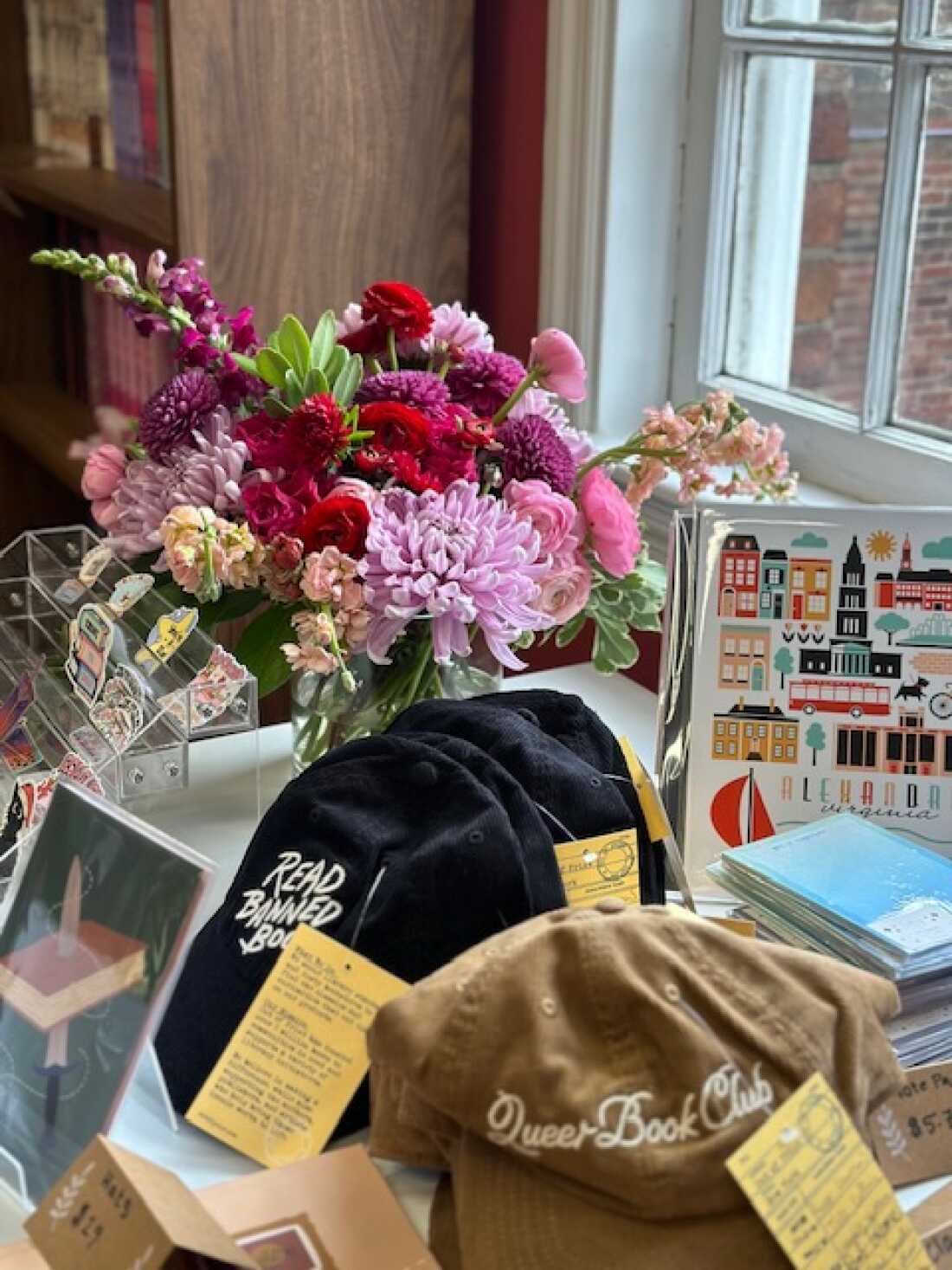
Fortin partnered with women and queer-owned businesses to create merchandise for her bookstore, including hats and stickers.
Courtesy of Maryam Bami
hide caption
toggle caption
Courtesy of Maryam Bami
Despite being open for just a few days, the community Fortin hoped to reach rallied around her business. Donations flooded in, surpassing Fortin’s $20,000 GoFundMe goal in 24 hours. After assessing the full extent of the damage, Fortin increased her donation goal to $45,000, eventually surpassing that one as well.
Fortin says she believes that her dedication to her goal of supporting women and queer businesses, combined with the tight-knit nature of the romance reading community, helped her rebuild quickly. “The community support has really buoyed me and pushed me to create something better out of the ashes, as it were,” she said. “There were more people than I ever expected that cared about my little bookstore.”
“When you set your mission, and you really stand by it, people say, ‘We love that mission. We’ll live that out as well,”‘ Fortin said.
Fortin opened a long-term pop-up location for Friends to Lovers on Dec. 7 at a nearby business. She continues to search for a new permanent location for the shop.
“It has been so overwhelming. I feel like the community is not letting me sit and wallow in my grief. Instead, they’ve said, ‘We’re going to fix this. We’re going to make sure it’s successful.”‘
Fortin says that because the romance community is used to their traditionally feminine interests not being respected, it doesn’t take the brick-and-mortar location for granted.
“I think we haven’t always had a lot of overwhelming support for things that women love,” Fortin said. “We love to say that things are ridiculous when women love them. There’s a lot of things that men love that we don’t consider ridiculous.” Fortin points out that teenage girls were the ones who loved the Beatles first before they became a household name. “Romance is one of the genres with the most staying power, that’s always been the least respected.”
“We’re creating a safe space to talk about things that are not celebrated in regular spaces,” she said. “Once women and queer people saw that, everyone said ‘let’s all stand behind this together.”‘
“The outpouring of support has been amazing as a bystander to watch,” said Maryam Bami, owner of Old Town Flower Gal. Bami launched her floral business at the Friends to Lovers grand opening. “I thought I was a fan of romance until I met some of the supporters of the bookstore.” Bami is one of several woman-owned businesses Fortin intentionally collaborated with. “She really just took a chance on all of us and really elevated us in the process,” she said.

Maryam Bami was one of several female entrepreneurs who launched their brand at the Friends to Lovers grand opening. Bami owns Old Town Flower Gal, a floral shop that specializes in “flower bombs.”
Courtesy Maryam Bami
hide caption
toggle caption
Courtesy Maryam Bami
As Fortin writes a new chapter for Friends to Lovers, she still views her community of business owners as vital to the bookstore’s success. She hopes readers supporting her rebuilding efforts will also patronize the nearby businesses that were also affected by the fire. She’s also encouraged supporters to donate to fundraisers for other businesses affected by the fire. “Women have constantly had to lift each other up and be each other’s solid ground,” she said. “If [my business] has all this hype and support and encouragement, I need to use that to build up other women and other brands.”


Students walk on the Stanford University campus on March 14, 2019, in Stanford, Calif.
Ben Margot/AP
hide caption
toggle caption
Ben Margot/AP
When Theo Baker arrived at Stanford University a few years ago, he joined the student newspaper, following the path of his journalist parents, Peter Baker, a White House correspondent for The New York Times, and Susan Glasser, a writer for The New Yorker.
Through his reporting as a student journalist, he eventually broke a story about manipulated data in Stanford President Marc Tessier-Lavigne’s neuroscience research that helped lead to the university president’s resignation.
Theo Baker’s book, How to Rule the World: An Education in Power at Stanford University was released May 19. In it, Baker describes Stanford as a place where proximity to Silicon Valley gives rise to a parallel system of influence, recruitment and money, with investors looking to identify promising students almost as soon as they arrive on campus.
He told Morning Edition host Steve Inskeep there was “a sort of Stanford inside Stanford,” where elite students are drawn into an “alternate reality” of excess and access to cut corners.
In the interview, he discusses how Stanford is not just a university but also a pipeline where status and power can matter as much as ideas.
We reached out to Stanford University for comment and have not heard back.
Listen to the interview by clicking play on the blue box above.


The scoreboard shows the results of the women’s singles final match between Iga Swiatek of Poland and Amanda Anisimova of the U.S. at the Wimbledon Tennis Championships in London, Saturday, July 12, 2025.
Kirsty Wigglesworth/AP
hide caption
toggle caption
Kirsty Wigglesworth/AP
Fifteen points in tennis? Nice. Thirty, 40 — even better. Advantage — that sounds good. “Love” — that also must be great, right? Well, not quite.
As the French Open rolls on and Serena Williams has announced her return to the sport, maybe you’ve been paying a little more attention to tennis. The sport’s scoring system is notably distinct, and can sometimes be hard to grasp for newcomers. But even tennis aficionados might not know why, or how, “love” became the unmistakable callout for zero points. For this installment of NPR’s Word of the Week, we’re exploring how a word that signifies trailing behind got such a sweet name.
“Love” comes from the heart — or an egg?
It’s hard to pinpoint when the first tennis ball went over the net. Tennis is a derivative of lots of other sports, such as “jeu de paume,” a handball game played in France, said JT Buzanga, the collections manager at the International Tennis Hall of Fame museum.

But tennis became a patented, official sport in 1874, said Steve Flink, a journalist whose tennis coverage got him inducted into the International Tennis Hall of Fame. It has retained its unique, mysterious scoring system ever since.
“By and large, the original system has held up almost entirely,” Flink said.
The use of “love” goes back to the late 18th century, said Jesse Sheidlower, a lexicographer. But it was used earlier than that in card games such as whist and bridge. Before the term made its way to tennis, the sport favored plain old “nothing,” or “nil,” he said.
Why love in the first place, though? Historians don’t really know for sure, but there are a few theories.
The French could have something to do with it. Some historians believe “love” derives from “l’oeuf,” which means “the egg” in French. Because eggs are shaped like zeros, terms such as “goose egg” and “duck’s egg” have been used in other contexts to mean zero, Sheidlower said.
It’s also possible English speakers mispronounced l’oeuf as “love.” But Sheidlower isn’t convinced that’s the answer.
“It’s the French equivalent of an English expression. But since that expression doesn’t appear in French, the French word wouldn’t have been used,” he said.
To be sure, France has had a lot of influence on tennis culture, Buzanga said. For example, “deuce” or a game tied at 40 points, comes from the French word for “two”: “deux.” But he prefers another prominent theory: that “love” comes from the idiom “for the love of the game.” Even if a player hasn’t scored, it doesn’t matter, because their heart is in it. It’s the theory Sheidlower said is the most plausible, because the idiom was used by the English before tennis was popularized.

Another variation of the “love of the game” theory is that the word could have come from the Dutch “lof,” or “honor” — or the Latin “amare,” meaning “to love,” Flink said.
But if tennis’ “love” doesn’t come from a French word, the theory at least has a French sensibility.
“I think the ‘for the love of the game’ is kind of romantic,” Buzanga said.
“Love” probably isn’t going anywhere
Tennis used to be a sport of leisure. The style of play has changed a lot over the years; players are more athletic and competitive, for instance, Flink said. But the rules of the sport are more steadfast, he said.
“There’s this incredible, enduring respect for tradition in tennis,” he said. “Changes are not made easily.”
There has been one major change in modern history: the tie-break. Matches can go on and on because players have to score two consecutive points to break a deuce, or by two games to break a tied set. But the onset of television meant matches would have to get shorter if the sport wanted to capture a larger audience, Flink said.

Change even came for “love.” An alternative sprouted up in the 1970s, and is still used today: “bagel,” named for its zero shape, Sheidlower said. Novices may say “zero,” and insiders will understand what they mean, but they “will needle them about it,” Flink said.
But “love” still prevails.
“People kind of like it,” Flink said. “It’s different. Why say zero when you can say love?”
-

 Augusta, GA5 minutes ago
Gaines endorses Kendrick in Augusta mayoral runoff
-

 Washington, D.C12 minutes ago
Juvenile injured after gunfire reported in DC’s Michigan Park neighborhood
-

 Cleveland, OH15 minutes ago
Cleveland readies for pre-World Cup soccer match
-

 Austin, TX20 minutes ago
Texas lawmakers discuss rural hospitals
-

 Alabama27 minutes ago
Alabama has one of college football’s toughest schedule stretches in 2026
-

 Alaska30 minutes ago
Former Alaska corrections officer sentenced to 150 years in prison for killing wife and teen daughter
-

 Arizona35 minutes ago
Dozens charged under Preston’s Law in Arizona
-

 Arkansas42 minutes ago
Stockton rappers plead guilty to possessing machine gun, marijuana in Arkansas traffic stop

