Entertainment
The Black Keys on the L.A. hangout that led to their funky new album

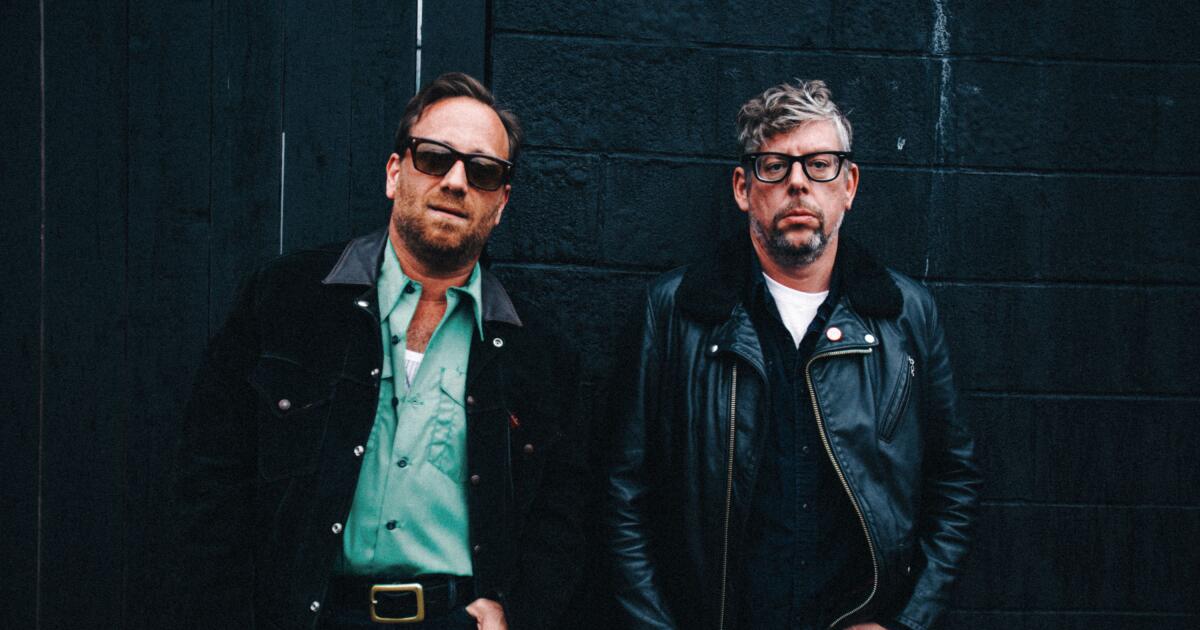
Twenty-four hours or so before the release of their new album, Dan Auerbach and Patrick Carney of the Black Keys are sipping old fashioneds at the Chateau Marmont as they reminisce about the days when the two of them ran a lawn-mowing business with one lawnmower between them.
“And one weed whacker,” Carney says.
“One lawnmower and one weed whacker,” Auerbach confirms. “And one gas canister. All in the same minivan we used for gigs. So all of our s— smelled like gasoline and grass clippings all the time.”
This was in the early 2000s, when they formed this once-scuzzy blues-rock duo in their shared hometown of Akron, Ohio — Auerbach on guitar and vocals, Carney on drums — and immediately began playing every deserted bar they could.
Two decades later, the Black Keys’ lives are very different, with four Grammy Awards, a pair of double-platinum albums and, thanks to Carney’s colorful marriage to singer-songwriter Michelle Branch, a level of tabloid scrutiny the members never even thought to dread back in Akron. (More on that marriage in a minute.)
On this recent evening, Carney, 43, and Auerbach, 44, have returned to the Chateau after a day of hand shaking and meeting taking while in town from Nashville, where they both live, to promote their latest LP, which somehow has only now used the title “Ohio Players.” Earlier they had lunch at the Beverly Hills Hotel with their manager of 2½ years, Irving Azoff, whose other famous clients include the Eagles, U2 and Jon Bon Jovi.
“We’d never been there in all our years of coming to L.A.,” Carney says. “That exterior is amazing, and everything else was terrible. But I think that sums up Beverly Hills.” He looks around the dimly lighted lounge. “This is more our steez. The thing about the Chateau is that it’s so classy but the rooms kind of look exactly like an apartment I had in Akron.”
Indeed, for all their success — at one point, Carney mentions that pandemic shutdowns wiped out $20 million of Black Keys concert income in 2020 — there’s something about the band’s current situation that evokes the Black Keys’ busy first chapter, when they dropped four studio albums in just over four years. Having seriously burned out on the road, the duo went dormant in August 2015 and didn’t play a show again until September 2019; since reuniting, they’ve been on a creative tear, releasing another four LPs, including “Ohio Players,” their 12th overall.
Says Dan the Automator, the veteran hip-hop producer who was among the band’s many collaborators on the new album: “They’re cranking together right now.”
The novelty this time is that they seem to be enjoying it. The Black Keys’ liveliest effort since 2011’s hook-jammed “El Camino” (which drew a Grammy nomination for album of the year), “Ohio Players” is a loose and funky party record with catchy choruses and chewy grooves and guest appearances by the likes of Beck, Juicy J and Oasis’ Noel Gallagher. The album’s freewheeling vibe — think Beck’s “Odelay” meets the soundtrack of “Rushmore” — was inspired in part by the band’s so-called record hangs in which Carney and Auerbach haul their collection of vintage 45s to a bar and DJ late into the night; to make the album, they ventured from Nashville, where they typically record at Auerbach’s Easy Eye Sound Studio, to work in rooms in London and Los Angeles.
“Honestly, we weren’t doing anything financially smart if we were trying to make money,” Carney says, recalling long stays at the Chateau and what he called its London equivalent, the Chiltern Firehouse. “But it wasn’t about that. It was about trying to maximize the experience.”
They so maximized it that “Ohio Players” almost ended up a double album, according to Carney, at least until he and Auerbach thought better of that idea. “There’s been a couple bands that have released very long albums recently that are complete garbage,” he says. “I’m not gonna name names, but there was one that had like 40 f— songs. Dan and I realized we didn’t want anything to do with making a pile of s—.”
Though the Black Keys broke out as a scrappy two-piece, they went into “Ohio Players” eager to “flex our Rolodex,” as Carney puts it. “There’s a lot of features in rap, but in rock these days there’s very little of it,” the drummer says — a shift from the late ’60s, he adds, when “Clapton would jump on a Beatles record or whatever.” For Auerbach, the collaborations — other musicians on the record include rapper Lil Noid, Leon Michels on saxophone and multi-instrumentalist Greg Kurstin — were a way to add fresh wrinkles to the band’s established sound just as a new documentary heralds the approach of legacy-act status.
“I think it was important to us to release a new album at the same time as the movie,” Auerbach says of director Jeff Dupre’s “This Is a Film About the Black Keys,” which premiered at last month’s South by Southwest festival in Austin. “But also, we wouldn’t have been able to do this kind of collaborating when we started, or even 10 years ago,” the singer adds. “It’s really only now that Pat and I are confident enough to sit in a room and let something unfold without getting in the way.”
At the top of their wish list of accomplices, both men say, was Beck, who ended up performing on half of “Ohio Players’” 14 tracks, including the swaggering “Beautiful People (Stay High)” and “Paper Crown,” a fuzzy rap-rock-soul mash-up that also features a verse by Juicy J of Memphis’ pioneering Three 6 Mafia. Carney remembers wearing out a copy of “Odelay” as a teenager while on a family road trip from Akron to Washington, D.C.; Auerbach singles out “One Foot in the Grave,” Beck’s 1994 album of lo-fi folk songs, as a formative influence. “The way he bridged the gap as this guy who was on MTV but who was playing these Mississippi John Hurt-style songs — I was just like, Oh s—, I understand this,” Auerbach says of Beck, whom the Black Keys have known since he invited the band on the road as an opening act in 2003.
Almost as crucial as hooking up with Beck was doing it in L.A., which Carney describes as “a place that’s very conducive to creativity for us.” He lived with Branch in Toluca Lake for about a year when they got together around 2015, and he quickly “fell in love with the Valley”; these days he’s partial to the scene in West Hollywood, which offers “a culture we don’t have in Nashville,” he says. “When we’re home, I’m just watching football with my friends. But when we’re here, we’re, like, rubbing shoulders with Jason Momoa.”
The cover of the Black Keys’ “Ohio Players.”
(Easy Eye Sound / Nonesuch Records)
The Black Keys initially set up at North Hollywood’s historic Valentine Recording Studios, where Bing Crosby and the Beach Boys once worked. “That was great because it feels like you’re in your grandparents’ basement,” Carney says. “But they were adamant that there was to be no weed smoking in the control room, which was a deal breaker.” They eventually relocated to Hollywood’s Sunset Sound, a familiar setting after the six weeks they spent there making 2014’s “Turn Blue” with producer Danger Mouse.
To get Gallagher in the mix, the Black Keys agreed to go to the Oasis guitarist in London — “which was a big deal,” Carney says, “because I hadn’t gotten Dan to leave the country since 2015.” Auerbach was playing in Paris with his side project the Arcs the night of that year’s horrific terrorist attack that killed 90 people at an Eagles of Death Metal concert at the Bataclan theater. “Definitely made me a little leery of wanting to travel for a while,” Auerbach says now. “Subconsciously, I knew we had to get back, so I thought this was a great way to do it without the pressure of a tour.”
With Gallagher, the band wrote three songs in three days, including “On the Game,” a stately ballad with Beatlesque guitars that feels lush yet proudly hand-played. Carney says it’s that slightly sloppy quality that attracts listeners to the Black Keys’ music — and not just to theirs. “I think that’s why Mac DeMarco is so popular,” he says of the scruffy indie-rock crooner. “You can smell the realness. Or this new Waxahatchee record. I don’t hear big hits but I hear something you can really get a hold of.” He laughs. “A lot of that kind of stuff misses the mark because it just takes one person in the room who wants to straighten something out to ruin it.”
One of “Ohio Players’” appealing kinks comes in “Candy and Her Friends,” where a crisp psych-rock tune suddenly slows to a half-time lurch with the entrance of Lil Noid, an underground Memphis rapper whose mid-’90s “Paranoid Funk” cassette has been a favorite of Auerbach’s since he discovered it on YouTube. “We were listening to it in the car one night in L.A. on the way back to the Chateau,” Auerbach says. “And then we were just like, ‘I wonder what Lil Noid is up to?’ We looked him up and he was in Memphis, just down the road from us in Nashville. So we invited him to the studio.”
“Dan is a genuine lover of hip-hop,” says Dan the Automator, who’s known for his work with Kool Keith, Prince Paul and Del the Funky Homosapien, among other acts. “I mean, he’s into some regional stuff that I’m not even really up on.”
Auerbach equates the rawness of “Paranoid Funk” to that of records by Hasil Adkins, the rockabilly oddball who garnered a cult following in the ’80s and ’90s. “Pure folk art,” he calls the kind of music he’s drawn to. But of course, it’s been years since the Black Keys themselves could be considered anything close to outsiders. The night after our drinks, the band celebrates the release of “Ohio Players” (whose cover photo was shot in a bowling alley) with an invite-only gig at Highland Park Bowl filled with contest winners and music-industry types; also there dancing near the makeshift stage is Branch, with whom Carney reconciled after a messy 2022 incident in which she accused the drummer of cheating on her — in a tweet, no less — then was arrested on a domestic assault charge for slapping Carney.
Is the price of having a hit—
“We haven’t had one,” Carney interrupts back at the Chateau, which is certainly untrue given that five of the band’s songs have topped Billboard’s alternative airplay chart. So is the price of having a hit that you have to accept becoming a celebrity of some sort, with all the attention on your private life that that role entails?
“People are interested in stuff where they don’t know what’s going on,” Carney says. “And I get where the intrigue comes from. The thing is, being in a marriage is hard. I was actually just talking to my therapist about this. I was like, ‘Here’s the truth about marriage: I don’t know one that I can use as a reference that’s not unconventional or a little bit f— up.’ So whatever this is supposed to be, it’s gonna have to be its own model.”
As Carney speaks, Auerbach nods with what looks like recognition. His ex-wife is interviewed in the Black Keys doc and speaks frankly about his shortcomings as a partner. “Squirmworthy” is the word he uses to describe the experience of watching the film. “I’m glad I don’t have to watch it again,” he says. Then again, the movie recounts one of Auerbach’s most cherished experiences, when he traveled as an 18-year-old to rural Mississippi and jammed with another pure folk artist: the bluesman T-Model Ford. There’s a picture from that day that shows Auerbach, a high school sports star from a solidly middle-class upbringing, sitting in the scrubby yard outside Ford’s double-wide trailer home.
Asked how the encounter shaped his youthful conception of the musician’s existence, he says, “I didn’t see any of it like that. I didn’t think about quality of life. I just thought, I’m sitting across from the coolest person I’ve ever met, and he loves my playing. Nothing else mattered.”
And now? What would the Black Keys say if someone could guarantee they could make whatever music they wanted for the rest of their lives but only if they traded the rock star trappings for Ford’s more meager circumstances?
“Depends,” Auerbach says. “Where’s that double-wide at?”


By and large, the zombie subgenre has bitten off more than it can chew in modern times. Between George Romero survival films and camp comedies, the well has become pretty infected. But once in a while, along comes a movie like This Is Not A Test.
Let’s sink our teeth into this new release and see how it stacks up against the classics.
The tone and tenor of this film represent the classic survival movies like Night Of The Living Dead. But the thing that grabs the audience about This Is Not A Test is the trauma of the characters. Holt shines as a withdrawn survivor of an abusive home, trying to cut through the wreckage to reunite with her sister. Each of the main characters have standout traits, and they bathe in strongly acted moments as the stress of the situation changes who they are.
The gore in This Is Not A Test is pretty strong. The attacks spring quickly and when they do, the special effects team does a good job showcasing the battle scars. The camera work is also frenetic in a good way, because the chaos of the chase scenes puts the viewers in a first-person perspective. This film lets you feel like a part of the survivors, so their journeys are interactive.

Longtime fans may say that there’s nothing new in This Is Not A Test, and maybe they’re right. There’s no fresh take on the monsters here, no crazy origin, nothing that we haven’t seen in the past fifty-eight years. But the pacing nails a great balance between getting to know the characters and getting the zombie splatter fest. The mental meltdowns of the characters feel well earned, and the arc of Sloane and her sister brings a lot of heart and investment to the story. Even the most jaded zombie horror fans will find something to appreciate here, even as a background movie.
Adam MacDonald has made another intense hit here, and This Is Not A Test is currently available to stream on Shudder.
Entertainment
‘You’re scaring my people.’ Shia LaBeouf’s alleged stalker arrested after posting viral video
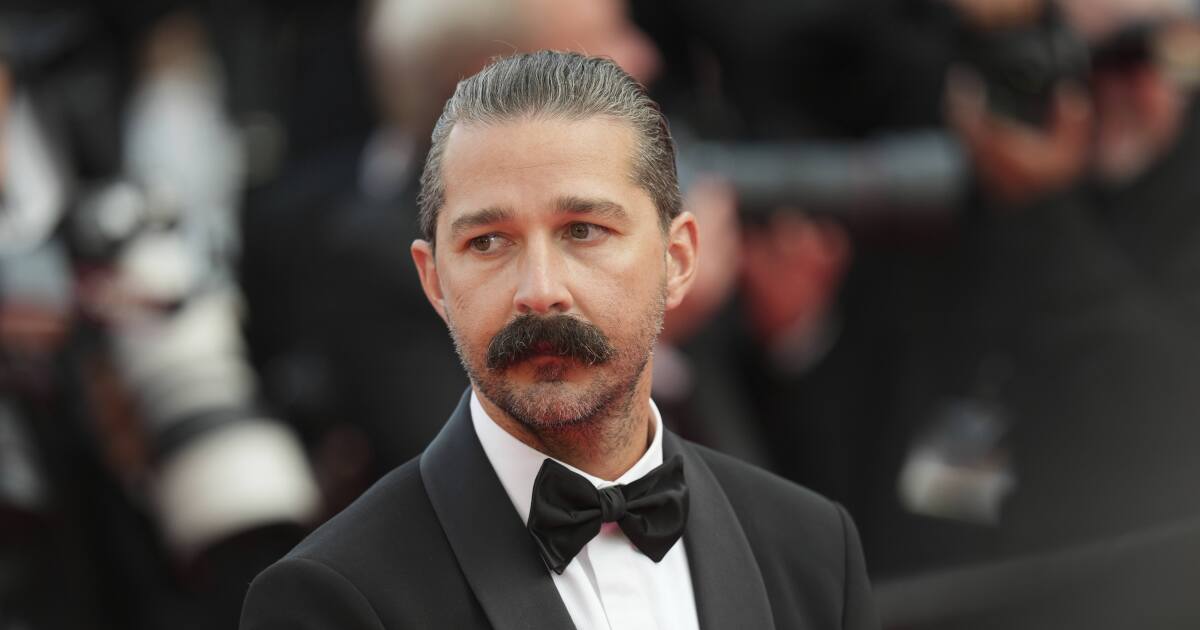
Shia LaBeouf’s alleged stalker has been arrested after posting a video of the actor asking to be left alone.
According to Orleans Parish Sheriff’s Office booking records, Alyssa Lee Couture, 40, was arrested Monday night and booked on a misdemeanor charge of stalking. Hours earlier, Couture had posted a video of a confrontation with LaBeouf in what appeared to be a grocery store parking lot. The “Honey Boy” actor is shown speaking to Couture through the window of a car.
“Leave me alone. God bless you. Leave me alone,” LaBeouf says calmly in the video. “You’re scaring my dad. You’re scaring my people. Leave me alone.”
Couture has posted more than 5,000 videos on her Instagram, most of which feature the woman addressing the embattled actor, whom she appears to believe is her husband. In a GoFundMe launched in May, Couture wrote that she was hoping to raise $70,000 to find permanent housing and that she had been living in her car and staying with family members. She also wrote that she had schizophrenia, among other disabilities.
Although the New Orleans Police Department does not identify Couture’s stalking victim as LaBeouf due to privacy policies, the timeline of her booking appears to line up with the confrontation with LaBeouf.
According to People, LaBeouf left Los Angeles after his split from actor Mia Goth last year and relocated to Louisiana to be closer to family.
In June, he pleaded guilty to three counts of simple battery, months after he went viral for his involvement in a Mardi Gras altercation in New Orleans. The actor, 39, was arrested in New Orleans on Feb. 17. At the time, New Orleans police confirmed LaBeouf was charged with two counts of simple battery for allegedly assaulting two men near a bar in the French Quarter. TMZ published bystander video of the incident and footage of LaBeouf walking through the French Quarter hours before the brawl.
The actor was released from jail shortly after his arrest and posted $100,000 in bond. More than a week after LaBeouf’s initial arrest, the New Orleans Police Department issued a second warrant for the actor’s arrest in connection with the same incident, and he racked up an additional simple battery charge. Prior to the second arrest, a New Orleans judge ordered LaBeouf to begin substance abuse treatment and undergo weekly drug testing.
Times staff reporter Alexandra Del Rosario contributed to this report.

- THE ODYSSEY
- Starring: Matt Damon, Tom Holland and Anne Hathaway
- Directed by: Christopher Nolan
- Rated: R
- Running time: 2 hrs 45 mins
- Universal
Our score: 4.5 out of 5
EPIC. If I was asked to describe Christopher Nolan’s latest film, that is the word I would use. He has mounted a film that rivals the greatest achievements of filmmakers like Cecil B. DeMille or David Lean. And, like the films of those mentioned, it’s runs a tad too long.
I was shocked, but pleased, to see that my 12-year-old granddaughter recently did a school paper on King Agamemnon. Thank goodness they’re still teaching History in our schools. Based on Homer’s “The Odyssey,” the film tells the story of King Odysseus (Damon) and his adventures which, if you’ve read “The Odyssey,” include the Trojan Horse, the Cyclops and assorted angry Greek gods. The film covers each of these adventures in great detail, sparing nothing in the production design department. While Odysseus is away – and he’s gone for a l-o-n-g time, his wife Penelope (Hathaway) has to endure a never ending string of “suitors,” men lining up in the hopes of replacing the King should he not return. The men are nothing more then scavengers, taking advantage of the law of Zeus, which decrees no one should be turned away. This angers the Queen’s son, Telemachus (Holland), who must control his temper when the men try to bait him into a fight, the idea being if Telemachus is killed, the new husband would become the King. It’s all very interesting and complicated. And long.
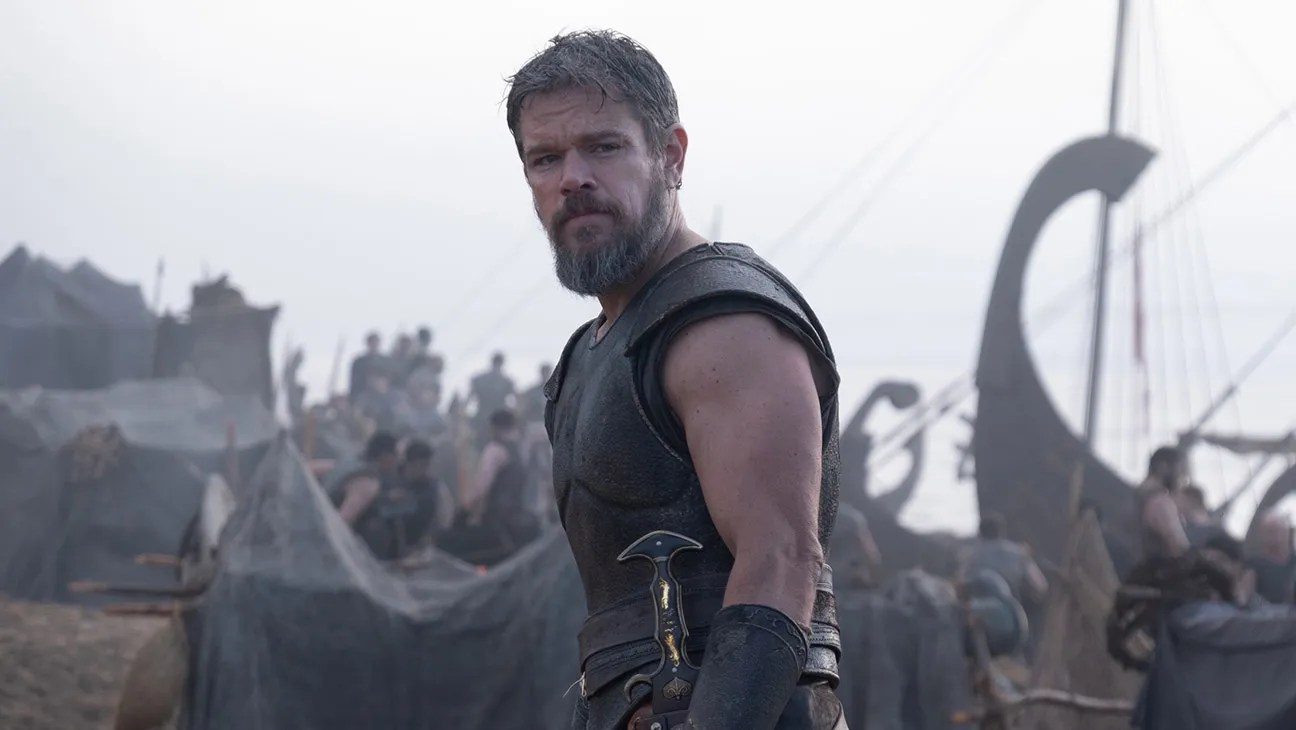
Director Nolan is one of the rare filmmakers who, in my opinion, has never made a bad film. From “Memento” to the “Dark Knight” trilogy to the Oscar-winning “Oppenheimer,” he has proven himself a true master of cinema. “The Odyssey” only adds to that distinguished resume’
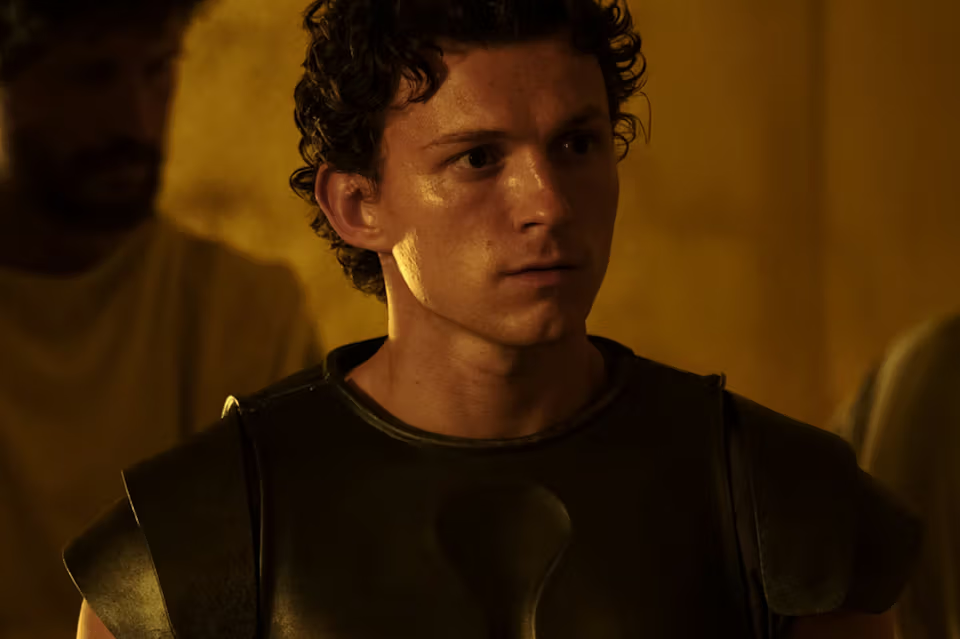
The cast is a tribute to Nolan himself who, like Woody Allen, can pretty much get anyone he wants for his films because, as an actor, why wouldn’t you want a credit in one of his films. Besides the three stars named above, the cast includes Robert Pattinson, John Leguizamo, Zendaya, James Remar, Jon Bernthal, Oscar nominees Samantha Morton and Elliot Page as well as Oscar winners Charlize Theron and Lupita Nyongo. As MGM used to advertise, “more stars than there are in heaven.”
The script and story are pretty faithful to the source material, though for some reason it bothered me whenever Telemacus referred to Odysseus as “dad.” Never father. The weird things you notice. Visual.y the film is stunning and the Trojan Horse and battle of Troy are worth the price of admission alone. I will add that I did see the film in 70 mm and, if that format is playing in your town, I urge you to see it in that format.
On a scale of zero to five, “The Odyssey” receives ★★★★ ½
-

 Detroit, MI9 minutes ago
Detroit’s air quality early Thursday ranked as hazardous, worst in the world
-

 San Francisco, CA21 minutes ago
‘It was a scene from the Titanic’: Fishermen recall rescuing passengers from sinking boat in SF Bay
-

 Dallas, TX28 minutes ago
Big picture takeaways from the Dallas Mavericks first week at Summer League
-

 Miami, FL34 minutes ago
“We’re going to be champions”. Argentina fans in Miami Beach celebrate team’s win against England
-

 Boston, MA40 minutes ago
4 Red Sox Trade Targets to Solidify Boston’s Push for a Playoff Spot
-

 Denver, CO45 minutes ago
RTD considers ending Denver’s 16th Street FreeRide shuttle due to budget issues
-

 Seattle, WA51 minutes ago
Trump immediately fires the new court-appointed top prosecutor in Seattle | CNN Politics
-

 San Diego, CA57 minutes ago
Karepango San Diego Comic-Con 2026 Debuts, Merchandise

