Entertainment
Review: In 'The Breaking Ice,' a trio comes together for a stretch of wild abandon

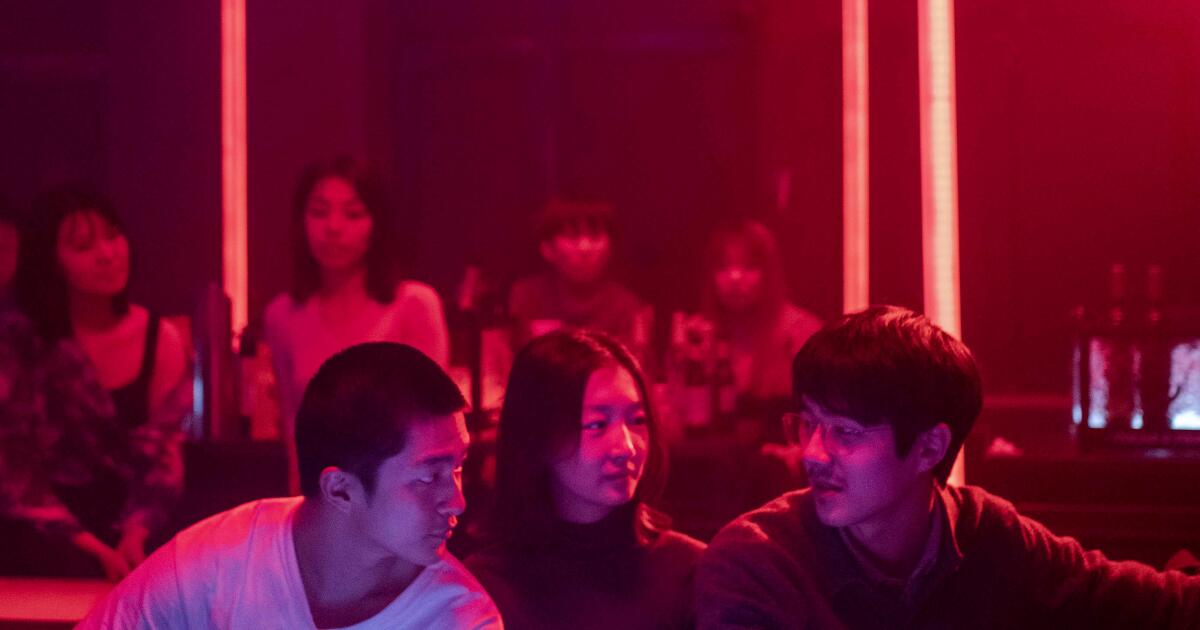
To leave something behind doesn’t necessarily imply a sense of direction. That active limbo permeates writer-director Anthony Chen’s appealingly liquid “The Breaking Ice,” about a trio of disaffected Chinese twentysomethings defying their chilly northern environs by forming a quick, meaningful connection over an alcohol-fueled weekend.
From the delicate impermanence of snow to the appealing solidity of a frozen river, water becomes a well-mined metaphor in Chen’s modestly restive drama, which is set in a border region of China alongside North Korea that itself hews to no set identity. (And yes, as you might have speculated, boundaries are another active metaphor in the film.)
In the wintry foothills of Yanji, tour guide Nana (Zhou Dongyu) leads busloads of cheery Chinese travelers on day trips to the area’s traditional Korean villages, where costumed inhabitants perform ritualized dances. In between perky spiels and herding tourists, Nana has a brooding countenance: She likes her silent smoke breaks when she isn’t sardonically dismissing the cautious advances of kind, handsome pal Xiao (Qu Chuxiao), an employee at the restaurant where her groups eat lunch.
A brief glimpse of Nana’s performative charm and private hardness draws the attention of lonely Haofeng (Liu Haoran), a bank associate from Shanghai in town for a wedding, which may be an excuse for a more drastic decision. (He routinely ignores phone calls from a persistent mental-health counselor.) Seeing a chance to get out of his head, he joins Nana’s tour. Subsequently, she becomes intrigued by this sweatered, bespectacled figure lingering like a needy stray, and invites him to party with her and Xiao on their days off. Nana’s cramped, messy apartment becomes the place where everyone crashes, and two characters manage a nervy, fumbling hook-up.
A scene from the movie “The Breaking Ice.”
(Strand Releasing)
This temporary “Jules and Jim”-style bond, which includes motorcycle excursions out of town, impromptu dares (cue the Godard reference), and plenty of clubbing, certainly looks invigorating in the way freshly minted abandon can be. And when you expect a frisson of jealousy to disrupt this unit — conditioned as we are by a lifetime of these tales — Chen avoids it, suggesting his characters are more interested in cohesion’s heady rush than collision’s emotional pitfalls.
And yet Chen, a Singaporean who’s made something of a theme out of unexpected connections between those outside their comfort zone (“Wet Season,” last year’s “Drift”), keeps his lost characters’ vulnerabilities as an undercurrent. Their stabs at freedom are invariably colored (beyond Yu Jing-pin’s nimble cinematography) by a gently swirling, intangible sadness, like a frost each of them can see but know will dissipate as long as they keep moving on to the next thing. Kin Leonn’s percolating score, reminiscent of the earliest days of ambient indie soundtracks, is similarly double-sided as an aural companion: swooning and melancholy in equal measure.
The payoff is a movie that, more than not, lyrically roams between states of being while skirting the need to explain itself. The experiment mostly works. You’d be surprised how nice it is to glean only a little bit about someone’s past — through an artful visual effect, or a couple of enigmatic sentences — without it feeling like something that we’ll need to see resolved for the sake of a tidy narrative.
It’s bracing to watch a movie whose very flow communicates how to experience it, which can also be said of Zhou’s captivating turn as a young woman committed to being elusive as a ward against what being still and reflective might bring up. Her co-stars do fine work too, but something about Zhou’s pulsating portrayal seems to get nearest to what Chen’s after in “The Breaking Ice” about a young generation’s anxieties, toggling between the exhilarating restlessness of running water and those times when one feels cold and hard.
‘The Breaking Ice’
Not rated
In Mandarin and Korean, with English subtitles
Running time: 1 hour, 37 minutes
Playing: Now at Laemmle Royal, West Los Angeles



Wasteman, 2025.
Directed by Cal McMau.
Starring David Jonsson, Tom Blyth, Alex Hassell, Neil Linpow, Paul Hilton, Corin Silva, Layton Blake, Jack Barker, Fred Muthui, Lunga Skosana, Robert Rhodes, Keaton Ancona-Francis, and Cole Martin.
SYNOPSIS:
Follows parolee Taylor whose fresh start hopes are jeopardized by cellmate Dee’s arrival. As Dee takes Taylor under his wing, a vicious attack tests their bond, forcing Taylor to choose between protecting Dee and his own parole chances.

Backing up its intentions and messaging with real spliced-in cell phone footage of rowdy, uncontrollable prison behavior in an understaffed British penitentiary, director Cal McMau’s narrative debut feature Wasteman (from a screenplay by Eoin Doran and Hunter Andrews) is often purposely, effectively disorienting. That’s not merely limited to be incorporated leaked footage (this is a prison that, in some respects, is more of a recreational facility than one for rehabilitation, since the guards are in such low quantity, all while the incarcerated are rather easily smuggling drugs through drone technology while typically unbothered in their jail cells playing video games in between hard partying or fighting one another), but the brutality as well, with claustrophobic, tilted camera angles and a shakiness that lends a visceral grime to that physicality.
The exception to this disorder seems to be rising star David Jonsson’s Taylor, still using drugs but also consistently avoiding any such drama. He is quiet and timid to the point where he not only comes across empathetic, but one wonders how he became locked up alongside an otherwise degenerate bunch. It turns out that due to a new law going into effect, some prisoners will be released on good behavior, which, in Taylor’s case, means that he is far from a problem here despite abusing drugs. Nevertheless, he is nervously excited about the possibility of reconnecting with his teenage son, even if a phone call with his separated ex-partner makes it clear that she is firmly against such a reunion.

There also wouldn’t be a film here without a wrench being thrown into that impending release back into society, which is where the introduction of new cellmate Dee (a manipulative and psychotic Tom Blyth) enters as an inmate more concerned with taking over the in-house drug dealing hierarchy rather than fronting anything remotely close to good behavior. By extension, this jeopardizes Taylor’s chances of being released. That’s also not to say Dee doesn’t have his friendly moments, such as letting Taylor use his phone to reconnect with his son on social media.
Where Wasteman makes up for in familiar plotting is its sense of authenticity, which comes through not only in the previously mentioned cuts to rowdy cell phone footage but also in the decision to work with a charity and round out the rest of the ensemble with formerly incarcerated individuals who are now reformed. One gets a full sense of the microcosmic incarceration society, the pecking order, and just how low on the rung Taylor is, since he isn’t like most of the others. There is also a full-blown riot at one point that parallels and mirrors the clips of authentic footage. It’s scripted, somehow almost feeling as dangerous.

When Wasteman inevitably comes down to a bond tested between Taylor and Dee, that too is less about thrills and more to do with capturing rawness; part of a brawl here contains one character vomiting on another, driving home just how dirty, literally and figuratively, the film gets in its unflinching depictions of life on the inside for this particular penitentiary. It’s fiction with a dash of documentary, each with bracing importance. It’s enough to ensure the film doesn’t go to waste for its minor shortcomings.
Flickering Myth Rating – Film: ★ ★ ★ / Movie: ★ ★ ★
Robert Kojder
https://www.youtube.com/watch?v=embed/playlist

When I was a child, I watched “The Jetsons” and “Lost in Space” and imagined my adult self living in a world of high-tech ease: flying cars, self-cleaning rooms, high-speed trains, personal jetpacks and wise-cracking robotic companions capable of solving any problem in a trice.
Instead I got Google (now with an irritating and frequently wrong AI feature), increased gridlock, Roombas, far too many passcodes/two-factor authenticator systems and a bunch of motorized ice chests cluttering up the sidewalks.
The last of which were recently banned, mercifully if temporarily, in Glendale. Reading about the city’s upcoming moratorium on delivery robots, I literally cheered. I hate them so much.
I know, I know, they’re adorable, with their wide “eyes” and squat toddler-like determination as they trundle along, pausing in careful recalculation whenever they encounter a curb, street sign, a sidewalk cafe table. Hating them makes me feel a bit like those folks who ban children from weddings or make snarky comments about dogs showing up just about everywhere (two things I would never do).
A Serve Robotics delivery robot heads to work Feb. 13. They navigate autonomously using LiDAR and only require human intervention if they get stuck, damaged or are heavily vandalized.
(Myung J. Chun / Los Angeles Times)
But though I am happy to accommodate dog walkers, stroller-pushers and other slow-moving/space-requiring pedestrians, I am less happy to do so for a tricked-out little metal box as it picks its way over potholes and sidewalk cracks on a “heroic” mission to deliver takeout to someone who, presumably, lives less than a mile away from its source.
And it isn’t just cranky-pants impatience. I recently became part of a face-off between two opposite-running Coco bots on the small strip of sidewalk in front of Cafe Figaro. The minutes-long standstill forced several people into the street; many more, including my husband and his cane, engaged in a potentially perilous stutter-step around the two knee-high, randomly moving yet noncommunicative vehicles.
One of which was, for reasons of its own, sporting an American flag — maybe it wants to be a Mars rover when it grows up.
Delivery bots, including those made by Coco, a company begun in 2020 by two UCLA graduates, have been around for a while. Early rollouts, however, were small and often plagued by trouble. Stranded or struggling robots became the new Bird scooters — nifty ideas that proved more problematic in practice.
In the last two years, however, improved models have become an increasing presence; Coco, which has expanded across the country, recently announced a bigger, bolder next-gen model.

The Coco 1, left, alongside the new Coco 2 (Next-Gen) at the Coco Robotics headquarters in February in Venice. Coco Robotics launched its next-generation, fully autonomous delivery robot, Coco 2.
(Kayla Bartkowski / Los Angeles Times)
Many people love Coco and other delivery robots, which partially replace traffic-clogging, exhaust-spewing delivery drivers with a more environmentally friendly alternative.
Others do not, viewing the bots as sidewalk lice that create hazards and take jobs from humans. Several cities, including Chicago, Toronto and San Francisco, have already instituted bans; Glendale is, as Long Beach recently did, taking a less draconian approach, putting the robots on pause while city officials figure out a regulatory framework.
Good luck with that. The e-bike craze, which is putting many people, including kids, in the hospital at an alarming rate, has thus far defied similar regulatory frameworks. As with delivery robots, the possible benefits of e-bikes — environmentally friendly, traffic-decreasing, super fun to ride — created a demand that ignores the dangers created by popularity.
Unlike e-bikes, or the electric scooters that preceded them, delivery robots aren’t yet causing widespread physical harm. Even my own feelings for those motorized metal coolers are fueled by existential disappointment as much as personal irritation.
In many ways, the high-tech future I envisioned as a child has come to pass — we have computers in our pockets, driverless cars, thumbprint and face ID, and voice-activated remote controls for everything. We may not be able to teleport, either physically or via hologram, but we can Zoom or video chat with pretty much anyone anywhere. ChatGPT is not exactly J.A.R.V.I.S., but it’s something. High-speed trains, and pretty much any mass transportation improvement, continue to elude the United States, but one can experience them elsewhere.

Matt Wood, Serve Robotics supervisor, drives a robot to a holding area earlier this year in the company’s parking lot where it and 26 others were to be transported by delivery truck to a farther service location.
(Myung J. Chun / Los Angeles Times)
The problem is, of course, that reality is much more complicated than futuristic visions sold by “The Jetsons,” “Minority Report” or the cultural marketers of Silicon Valley. Like e-bikes, every advancement creates a host of new problems — hackers, identity theft, system failures, increased energy demands. Labor-saving devices are rarely that — instead labor is shifted, from one department to another, from the body to the brain, or standards are raised — when laundry is done by a machine, its operator must ensure that all clothing is bright, soft, sweet smelling and stain-free just as those who have been given a company smartphone must be available 24/7. After all, how hard is it to answer a text?
Delivery robots are both disappointing in their reality and alarming in their symbolic implication. With all manner of industries constricting and AI threatening entry-level positions, many people have become delivery drivers, full-time or as an economically necessary side gig. Are robots coming for them as well? And are we all going to step around them and post photos on Instagram as they do?
It’s a lot to put on a relatively new and small industry that remains, thus far, a cute and novel way to receive a salad or a few groceries. Those who fear imminent robotic world domination can actually take heart — like the AI actor Tilly Norwood, these little geezers have limited abilities. They don’t go very far, or move very fast; they are easily damaged and disabled (especially in Philadelphia). If they are the vanguard of a sentient nonhuman enemy, we don’t have much to fear yet.
Still, as these robots grow in number and size, those big innocent “eyes” and the cutesy design take on an unnerving air. As Albert Brooks said in “Broadcast News”: “What do you think the devil is going to look like if he’s around … he will be attractive, he’ll be nice and helpful.”
And deliver your lunch.

Ryan Gosling in Sony Pictures’ ‘Project Hail Mary’
Now in Theaters
“Project Hail Mary”
(Amazon – MGM Pictures)
Rated PG-13
“I put the ‘Not’ in ‘astronaut!’
When was the last time you walked out of movie theater feeling not only better about humanity but also our future?
Based on the revered 2021 Andy Weir novel of the same name, and adapted for the screen by Drew Goddard (“Buffy the Vampire Slayer,” “Daredevil” and “The Martian”), “Project Hail Mary” is an ingeniously crafted and perfectly paced sci-fi drama about a biologist and school teacher who wakes up from a coma aboard a spacecraft that’s on a mission to save all life on Earth. As both the star and co-producer, it took Ryan Gosling seven years to bring this vastly entertaining instant classic to the big screen, and it was so worth the wait.
Admittedly, I wasn’t thrilled with the trailers or even the tone that seemed to give ABC afterschool-special vibes. But after seeing it in its entirety, everything about it blew me away.
Who Are We?
Bursting with fascinating and enthralling moral quandaries, it makes viewers question themselves and our species. And refreshingly, “Project Hail Mary” is a magnificent “grand idea” kind of story that seamlessly weaves themes of self-preservation, obligation, the intrinsic meaning of humanity and most powerfully (and surprisingly) friendship. You will come away with fresh personal revelations and deep, self-examinations that you probably never intended to ponder, which is the beauty of epic sci-fi tales like this. They force us to muse about the kinds of societies we want to live in.
And with the wondrous inclusion of Gosling’s all too real co-star Rocky, I became so emotionally gripped, that I was close to tears a few times. I just love it when a film not only challenges but surpasses whatever preconceived notions you may have held about it beforehand.
Intensely moving, meticulously thoughtful, endlessly nuanced and massively entertaining, it’s easy to see why “Project Hail Mary” is already considered one of the best films of the year.
-@TheAndreKelley
.

ONLY IN THEATERS
“You, Me & Tuscany”
(Will Packer Productions)
Rated PG-13
“You pretended to be the White Italian man’s fiancé?
But ended up catching feelings for the Black Italian cousin-brother?”
As expected, “You, Me & Tuscany” is really, really cute. Halle Bailey (“The Little Mermaid,” “Grown-ish”) and Rege-Jean Page (“Black Bag,” “Bridgerton”) are initially combative, though there’s little doubt as to where the two are headed in this charming and delightfully executed story. Writer-producer Will Packer (“Think Like A Man,” “Girls Trip”) outdid himself in this colorful, feel-good, family-friendly, classic comedy of errors.
Glorious Tuscan Countryside
And while making excellent use of the lush and intoxicating Tuscan countryside, what I found curiously effective was that the dynamic of the ensemble became as big a part of the film as the romance itself. Surprisingly, I was completely caught off-guard as those familial aspects developed. And though Rege-Jean Page is not my cup of tea (too skinny, too pretty) as a lead, I now see why women react to him the way they do. He’s a very good dramatic actor, he holds attention quite easily on the big screen and of course, that face-card would never be declined.
Also, with Black women now becoming the most educated, economically-empowered and increasingly, well-traveled demographic of society, Packer smartly captures that zeitgeist with this well-produced and topically focused vacation vehicle.
Notably, his critically-acclaimed and commercially successful “Girls Trip” was domestically based whereas Tuscany makes faithful and fantastic use of the kinds of village locales and gorgeous countrysides we’d all like to visit. So what better way to explore and find parts of ourselves while also falling in love than abroad?
A Welcome Genre Update
And finally, be it his television shows or movies, I sincerely love Will Packer’s upscale treatment and desperately needed update of the romantic-comedy genre. Typically, the majority are White and situation-based, whereas this one was Black-centered and in an international setting. So, those aspects alone I genuinely enjoyed.
I’m a sucker for thoughtful production with Black folks looking great, being well-lit and shot properly. We don’t often get passport-driven international fare with a wonderful balance of warmth, humor and heart like this, so don’t wait to stream it. “You, Me & Tuscany” is well worth the trip.
@YOUMETUSCANY
#YOUMETUSCANY
.

NOW IN THEATERS
“Hoppers”
(Pixar) Rated PG
“Let’s squish the humans!”
Impressively, within mere minutes of its opening we get a solidly hilarious understanding of Mabel Tanaka’s deeply feisty affinity for animals, and her incessant, almost uncontrollable desire to help them.
Voiced delightfully by Piper Curda (Disney Channel’s “A.N.T. Farm”) as the willful and resourceful protagonist, she makes quick use of new technology that allows her to infiltrate and talk to the animal kingdom.
John Hamm (“Bridesmaids,” “Mad Men”) is fantastic as her arch nemesis, the town’s preening and vainglorious, Gavin Newsom-esque Mayor Jerry, who’s behind the ominous threat to the very habitat that Mabel and her friends are fighting to defend.
State-of-the-art Animation
And true to the magnificent legacy of Pixar’s usual flawless execution (“Hoppers” is their 30th film) the state-of-the-art animation is absolutely gorgeous and intriguing to look at. Much of it, especially with regard to the larger animals, is unlike anything I’ve ever seen. You almost want to reach out and touch them. The hair and body textures are next-level fascinating and so lifelike, it’s as if you’re watching plush animals come to life in this brilliantly spooled sci-fi comedy.
And don’t get it twisted nor let the animation aspects of talking animals fool you. There are some very clear (as well as oblique) nods to our current reality that make this more than what it appears on the surface. Ingeniously, it imparts universal themes of cooperation, community and inclusion, as well as a plethora of life-lessons we want all young people exposed to.
Stay for the Credits
Unfortunately, there’s no usual Pixar short at the beginning of the movie and like any Marvel film, I strongly urge you to stay for the end credits. Witty, warm and a bit whimsical, “Hoppers” is brimming with hilarious and heartfelt laughs and lessons.
And with everything that’s currently happening in our world, there’s never been a better time to enjoy what’s going on in someone else’s.

Kentucky Wildcats set to host Utah transfer Terrence Brown on visit

Hour-by-hour: When to expect showers & thunderstorms Tuesday in Vermont, New York

Virginia’s Spanberger Approves Workplace Heat Safety Standards

Aviation safety bill based on DC midair collision faces House vote Tuesday

A tornado touched down in Taylor County on April 13, NWS confirms

Florida High School Football Rankings: Top 25 teams – Oct. 21

How old is Bo Nix? What to know about Oregon quarterback ahead of 2024 NFL Draft

Cleary's 21 help Le Moyne down Central Connecticut State 69-64 in OT

99th annual Pony Swim held in Virginia

Indiana Members Credit Union announced as new anchor tenant at Bottleworks District

Video: How Stephen Miller Is Adjusting Trump’s Immigration Agenda

Biden DOJ weaponized FACE Act against pro-life Americans, 882-report alleges

Mass drone warfare is Europe’s rising security threat
Man accused in Molotov cocktail attack of OpenAI CEO’s home charged with attempted murder

Embattled Rep Tony Gonzales announces plans to resign amid sexual misconduct allegations
-

 Atlanta, GA1 week ago
1 teenage girl killed, another injured in shooting at Piedmont Park, police say
-

 Georgia7 days ago
Georgia House Special Runoff Election 2026 Live Results
-

 Arkansas4 days ago
Arkansas TV meteorologist Melinda Mayo retires after nearly four decades on air
-

 Pennsylvania1 week ago
Parents charged after toddler injured by wolf at Pennsylvania zoo
-
 Milwaukee, WI1 week ago
Potawatomi Casino Hotel evacuated after fire breaks out in rooftop HVAC system
-

 Austin, TX6 days ago
ABC Kite Fest Returns to Austin for Annual Celebration – Austin Today
-

 World1 week ago
Zelenskyy warns US-Iran war could divert critical aid from Ukraine
-

 World1 week ago
Indonesia receives bodies of peacekeepers killed in southern Lebanon