Education
As Trump Targets Universities, Schools Plan Their Counteroffensive


With a now-rescinded White House directive that threw millions of federal dollars for education and research into uncertainty, President Trump and his allies tried to prove they were not bluffing with their campaign threats to target universities.
But before President Trump even returned to office, many of the nation’s well-known universities were already preparing to fight back.
While few college presidents are especially eager to spar with Mr. Trump and Vice President JD Vance in public, schools have been marshaling behind-the-scenes counteroffensives against promises of an onslaught of taxes, funding cuts and regulations.
Some universities have hired powerhouse Republican lobbying firms. Others are strengthening, or rebuilding, their presences in Washington.
Many are quietly tweaking their messaging and policies, hoping to deter policymakers who know it can be good politics to attack higher education — even when they themselves are products of the schools they castigate on cable television. Rutgers University, for example, announced last week that it would cancel a conference on diversity, equity and inclusion, a focus of the new administration.
A spokeswoman for the university said the decision, which prompted criticism, was made after many speakers from a federally funded program withdrew from the conference, citing an executive order that targets the topic.
“There’s a concern among a lot of campuses,” said Kenneth K. Wong, a professor of education policy at Brown.
Some efforts to rehabilitate higher education’s reputation were already in the works, a response to attacks leaders in Congress made after campus protests over the war in Gaza. But now university officials are confronting an administration whose leaders have made clear their contempt for some wings of higher education. Mr. Trump has said schools are dominated by “Marxists, maniacs and lunatics,” and Mr. Vance has called them “insane.”
The ominous saber rattling from Mr. Trump and his allies includes threats to endowments, federal research funding, student financial aid, diversity initiatives and the potential deportation of roughly 400,000 undocumented students enrolled in U.S. schools.
Several major universities have responded by hiring lobbyists whom Republican leaders might view favorably. Harvard University has turned to a Capitol Hill heavyweight, Ballard Partners, the former firm of both Mr. Trump’s attorney general-designate, Pam Bondi, and his chief of staff, Susie Wiles. Columbia University signed up with BGR Government Affairs, which counts Haley Barbour, a former Mississippi governor and Republican National Committee chairman, among its co-founders.
Duke University, which has an in-house government relations effort, brought in DLA Piper as an adviser. One of the firm’s executives is Richard Burr, a Republican who represented North Carolina (where Duke is located) in the Senate for 18 years.
The University of Notre Dame recently registered its own lobbyists for the first time since Mr. Trump’s previous term. And Yale University is beginning its own theater of operations in Washington.
“The university decided to open an office in Washington, D.C. after conducting benchmarking among peer institutions,” Karen Peart, a Yale spokeswoman, wrote in an email, citing upcoming higher education “issues” on Capitol Hill.
The latest activity in Washington came after some other schools ramped up lobbying efforts.
As recently as 2022, Washington University in St. Louis paid $50,000 for its lobbying in the capital. The next year, it raised that spending to $250,000. That exploded to $720,000 in 2024, federal records show. A university spokeswoman did not comment.
Across the country, university officials and their allies said that they were somewhat more prepared for what to expect under Mr. Trump than they were when he first ascended to power in 2017. Eight years later, they said, they had a better sense of Mr. Trump’s approach to the presidency and have also looked for insights into his administration’s ambitions in the “Project 2025” plan, which is closely linked to many of his appointees.
The administration wasted no time in launching those plans with a flurry of executive orders in its first week. One seeks to ban diversity, equity and inclusion initiatives, including those run by contractors that receive federal student aid funding — a category that includes virtually every campus.
Mr. Trump also ordered federal agencies to compile lists of “nine potential civil compliance investigations” of organizations, including higher-education institutions with endowments over $1 billion.
In a public conference call on Monday sponsored by DLA Piper, Mr. Burr said that while the rest of the Trump administration’s higher education policy was not yet entirely clear, “we believe that endowments are a target of revenue, potentially, in a tax bill.”
Few topics are as alarming to the leaders of the country’s wealthiest universities.
Endowments were largely exempt from taxation for years. But in 2017, during Mr. Trump’s first term, Republicans led a charge to impose a 1.4 percent excise tax on the investment income of large private university endowments. Now there are discussions of raising it to 14 percent, or even 21 percent.
As a senator, Mr. Vance was a leading proponent of increasing the endowment tax, proposing an increase to 35 percent for endowments of $10 billion or more. Despite his Yale law degree, funded partly by the university, Mr. Vance has previously called for an “attack” on universities.
“Why is it that we allow these massive hedge funds pretending to be universities to enjoy lower tax rates than most of our citizens, people who are struggling to put food on the table?” he said when he was a senator, adding: “It’s insane. It’s unfair.”
At least 56 schools were forced to pay the 1.4 percent tax in 2023, totaling more than $380 million, according to an analysis by the National Association of College and University Business Officers. Records show that representatives of major universities were busy presenting their anti-endowment positions on Capitol Hill last year. In the fourth quarter, about 10 top schools, including Stanford and Cornell, lobbied on the tax.
They have often built their case around what they contend would be lost if universities had to pay more of the government’s bills: money that they use for research and tuition support, particularly for low-income students.
At Wesleyan University, for example, that amounted to $85 million last year that served 1,500 students, according to Michael S. Roth, Wesleyan’s president.
“So it’s real money,” Dr. Roth said, adding that a tax increase would make it harder for the university to support students. He added, “It means we will be serving fewer worthy applicants.” Dr. Roth said that Wesleyan would not be hiring outside lobbyists but, instead, would use that money to assist students.
Mr. Burr also said universities would be affected if the Trump administration targeted funds for research. He noted that the National Institutes of Health and the Centers for Disease Control and Prevention had both recently issued directives to suspend public communications, research-grant reviews, travel and training for scientists.
On Monday evening, the administration also issued a sweeping pause on trillions in federal grant funding, which a federal judge blocked about 24 hours later — but only after a day of chaos and tumult for campus leaders.
Ted Mitchell, the president of the American Council on Education, which represents more than 1,600 campuses nationwide, called it the “most irresponsible public policy” he had ever witnessed. The organization called for the order’s reversal; the White House backed away from the order on Wednesday.
The pause had been designed to give the administration time to determine whether grants align with Mr. Trump’s priorities. In the 2023 fiscal year, universities received close to $60 billion in federal funding for research.
Barbara Snyder, the president of the Association of American Universities, which includes dozens of the most prominent schools in the country, noted that the explosion of anger in Washington toward universities was not necessarily new.
“It’s more challenging than it was 20 years ago,” she said, but added: “I don’t think this has all been an overnight change.”
Even as universities muster defenses, no consensus has emerged among them about how best to approach the second iteration of Mr. Trump’s Washington.
“Our institutions,” Ms. Snyder said, “have their own ways of doing these things.”



In our national memory, George Washington is a mythic figure, cast in metal, carved in stone. His leadership, first as general, then as president, is so intertwined with the roots of this country that it is sometimes hard to separate the man from the idea of America. How does one imagine the living presence of such an icon, much less embody him?
There is a small fraternity of men bold enough to try. At historical parks and commemorations from Virginia to Seattle, these interpreters (their preferred term) transform themselves into Washington. Each has his own approach, but what all their representations seek to capture is a legacy that has endured from his time to ours. If America, at least in part, is an idea, then our national project becomes, like theirs, an act of interpretation, an imperfect attempt to translate some idealized vision into the messy reality of our own time.
— Ezekiel Kweku
“By some strange quirk
of genetics, I have
Washington’s exact
dimensions. Where my
sleeves fall on my wrist,
the size of my chest, the
size of my thighs, where
the breeches fall to my
knees, are all identical.”
John Koopman, 67, often performs
while riding his horse, Bear. He
has portrayed Washington for 20 years.
James Fryer, 70, wears a replica of a general’s uniform that Washington designed himself. He recently completed training to portray Washington for the nonprofit Historic Philadelphia.
“Some people portray George as a marble statue. I don’t do a marble George. I am interested in talking to everyone, even those who yell at me because George was a slave owner. I want to respect them, try to educate them, or maybe even inspire them.”
Vern Frykholm, 77, was moved to bring his interpretation of Washington to Washington State, where he lives, after seeing a 2011 performance in Pennsylvania.
Dean Malissa, 73, signs his personal
correspondence, including emails,
as Washington did: “Your Most Humble
and Obedient Servant.” He became
the Official George Washington
at Mount Vernon in 2004, and held
that role for nearly 20 years.
“I describe him sometimes as just a dude. I look at him and think, I could see myself in the same world, making similar bad decisions or similar good decisions.”
Daniel Cross, 39, portrayed a young Washington at Virginia’s Colonial Williamsburg until last year. He now works with organizations around the country.
Curt Radabaugh, 62, has 13,000 history books in his personal library, including several hundred about Washington. He is a veteran of the U.S. Marines and a retired police officer.
“He’s a mentor, a father
figure, and not only in the
sense that he’s a patriarch
of the country. Because
I grew up without a
father, he kind of became
my surrogate father.”
Brian Hilton, 58, says he researches
Washington’s era every morning before
his children get up and at night after
they go to bed. He is a high school history
teacher near Richmond, Va.
Daniel Shippey, 57, partners on interpretations with his wife, Kelly, who portrays Martha Washington. Kelly researched 18th-century hair techniques to create her husband’s costume hairstyle. They live in Virginia.
“You’re playing the myth of George Washington as well as the historical figure. I make his voice a little firmer and deeper than it probably was in real life. I play him a little funnier than he probably was. In reality, if you came to see him, he probably wouldn’t talk to you as much as I do.”
Doug Thomas, 53, is Washington’s second cousin nine times removed.
John Godzieba, 67, has reenacted
the crossing of the Delaware as
Washington every Christmas for the
past 16 years at Pennsylvania’s
Washington Crossing Historic Park.
“In many ways I don’t look like him. My eye color is wrong. My nose is wrong. My hair color is wrong. I wouldn’t have cast myself in this role.”
Ron Carnegie, 64, has portrayed Washington at Colonial Williamsburg for 20 years.
Ryan Williams, 37, is a veteran who specializes in playing a young Washington during the French and Indian War. He lives in Virginia.
“Some people portray
Washington almost
like a superhero.
I like to bring out that
he has faults. He’s a
person like you or me.”
Michael Grillo, 64, is a historical
tailor who hand-sews his own clothes
for reenactments. He also makes
period props, including two American
battle flags and pewter mugs
engraved with Washington’s crest.
Martin Schoeller is a photographer and director known for his close-up portraits of everyone from world leaders and celebrities to female bodybuilders. For this project, he used a large format camera to photograph 13 historical interpreters of George Washington — many of whom arrived in full uniform — over three days in Virginia and New York City.
Additional reporting by Tenzin D. Tsagong. Interviews have been edited and condensed for length and clarity. Top quotes from Brian Hilton, Daniel Shippey and Daniel Cross.
Produced by Sara Barrett, Danny DeBelius and Sam Whitney. Additional production by Olivia James.
One task the robots can take from us? Cleaning. Especially hard-to-access windows. So when writers Caroline Mullen and Evan Dent found this little guy — whose government name is “EcoVacs Winbot Mini” — they were intrigued. Could he clean the uncleanable? Caroline and Evan put their robot friend to the test at both the Wirecutter office and a high-rise apartment. Is a robo-window cleaner more effective than scrubbing yourself?

new video loaded: School Year Cut Short and Aid Delivery Slowed Amid Fuel Crisis in Cuba

By McKinnon de Kuyper
June 22, 2026
-
 Lifestyle58 seconds ago
They just completed all of L.A. Times’ 101 Best California Experiences — and we’ve got questions!
-
 Politics7 minutes ago
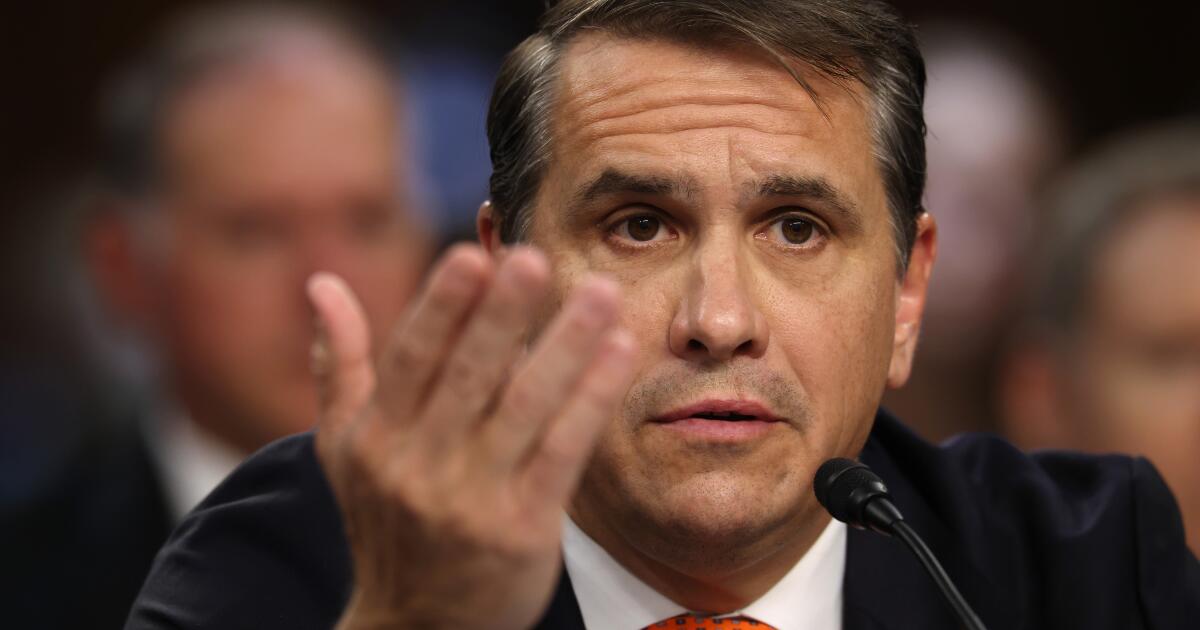
Blanche to face questions about his independence at attorney general confirmation hearing
-
 Sports19 minutes ago
How World Cup senior citizens like Lionel Messi have bio-hacked longer careers
-

 World31 minutes ago
Baltic presidents warn of Russian infrastructure attack plans
-
News1 hour ago
ICE should do traffic stops despite recent shootings, Trump says, seeming to oppose new suspension
-

 Los Angeles, Ca3 hours ago
Southern California hits hottest day of its extreme heat warning
-

 Detroit, MI3 hours ago
Steve Yzerman out as Detroit Red Wings GM, moves to senior advisor role
-
 San Francisco, CA3 hours ago
Supervisors urge California to expand S.F. speed-camera program


