Crypto
German Law Enforcement Seizes Russian No KYC Exchanges – Chainalysis


On September 19, 2024, the German Federal Criminal Police (BKA) seized the infrastructure of 47 Russian-language no-KYC (Know Your Customer) cryptocurrency exchanges. Dubbed “Operation Final Exchange,” the takedown stands out not only for its breadth, but also for the light it has shined on the central role instant-swap style no-KYC exchanges play in facilitating on-chain cybercrime.
As their name suggests, no-KYC exchanges have no known process for collecting customer information before allowing any level of deposit or withdrawal. They do not require a name, phone number, or email address, and make no attempt to verify this information prior to permitting transactions. As such, these services allow a range of cybercriminals to abuse their services without KYC controls to identify or disrupt illicit activity. The BKA’s Operation Final Exchange landing page calls out ransomware affiliates, botnet operators, and darknet vendors as users of the 47 targeted exchanges. Beyond that, these services offered fiat on- and off-ramping for sanctioned Russian banks, creating an avenue for sanctions evasion.
Below, we’ll dive into these exchanges’ on-chain activity, explore their nexus to sanctioned Russian banks, and discuss the disruption’s implications.
Who are these 47 No KYC Exchanges?
Our data reveals interesting patterns about the services targeted by the BKA, with robust direct and indirect exposure to various illicit services. At least seventeen of the exchanges saw a month of more than 50% of direct inflows from illicit sources. At least twelve saw a month where more than 30% of direct inflows were from darknet marketplaces (DNMs). At least six saw at least one month where stolen funds comprised more than 30% of total direct inflows. At least five had at least one month where more than 30% of indirect inflows were from sanctioned entities.
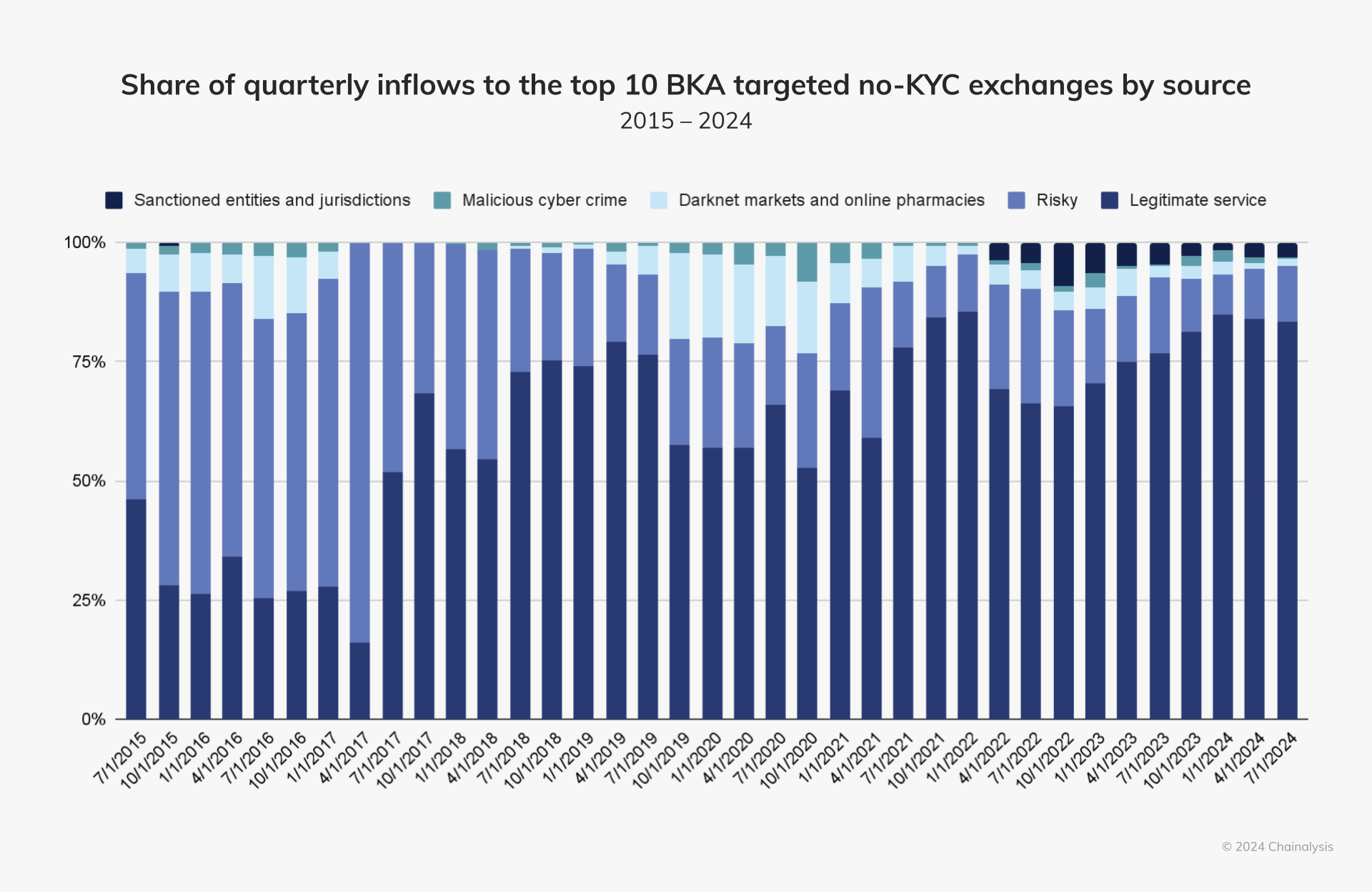
This exposure demonstrates that for many of these services, laundering illicit funds was a substantial part of their businesses. Indeed, as depicted in the below Chainalysis Crypto Investigations graph, the top ten services targeted by the BKA transacted with a broad array of illicit services, including, but not limited to, sanctioned entities, ransomware actors, DNMs, and darkweb escrow and breached data brokers.
The chart below shows the quarterly inflows to the top ten exchanges taken down by the BKA. These services received value from a variety of sources, including periods of significant inflows from drug-related DNMs, online pharmacies, malicious cybercriminals such as ransomware gangs, and funds stolen in heists and scams.
There is also a notable increase over time in the proportion of inflows from legitimate sources, notably centralized exchanges. While this change to the composition of inflows might in other circumstances suggest that the services were in the process of cleaning up their platforms, the reality is likely more complicated. In this case, the increased inflows from otherwise legitimate sources most likely represent the growing use of these services for sanctions evasion on the part of Russian nationals, who are likely trying to leverage these no KYC exchanges to evade sanctions on Russian banks.
How do these services work?
These services operate as instant-swap style services, in which users, without providing any personal information or going through any verification process, can swap from one currency to another. The offerings include crypto-to-crypto and fiat-to-crypto swaps, allowing users to instantly exchange popular cryptocurrencies and stablecoins, or to connect their bank account to on-/off-ramp fiat to crypto instantly.
As with other categories of the illicit crypto ecosystem, we have observed that no KYC exchanges, particularly those targeted by the BKA, often have overlapping or similar on-chain infrastructure, and in some instances even share off-chain networks, such as website shells, employees and administrators, physical locations, and ownership structures, to name a few. More often than not, these websites have no affiliated company incorporation, registration, phone numbers, physical addresses, or any indicator of jurisdictional operation. Unlike other high-risk and illicit services, most of these services do not have a social media presence, instead offering users the ability to interface with a bot on their homepages. Despite using servers based in Germany, these services cater primarily to a Russian clientele, as suggested by their default language settings in Russian and information on banking services for fiat transactions provided by sanctioned Russian banks, such as Sberbank.
Connectivity to sanctioned Russian banks
Many of the 47 no KYC exchanges were Russian-language platforms offering fiat-to-crypto and crypto-to-crypto instant exchange services. As we covered in our recent analysis of Russia’s new cryptocurrency legislation, Russian-language instant exchangers can be exploited to quickly move fiat currency from sanctioned Russian banks to specified crypto wallets, enabling entities to evade sanctions. Given the dramatically increased sanctions pressure on Russian banks following the full-scale invasion of Ukraine in February 2022, instant exchangers have emerged as a convenient way to on- or off-ramp funds for sanctioned banks. Of the 47 no KYC exchanges targeted in Operation Final Exchange, all that we have identified on-chain accepted on- and off-ramping with sanctioned Russian banks.
Breadth of disruption likely to generate actionable inroads
Most of the exchanges targeted by BKA have been active since 2021 or before, and the top three in terms of transactions processed – Xchange.cash, 60cek.org, and Bankcomat.com – have been active since 2016 or before, according to the Operation Final Exchange landing page. The longevity of these services suggests a substantial portion of customers affected will need to establish alternative financial facilitation and laundering pathways.
The disruption’s impact is likely to extend far beyond the no KYC exchanges targeted. As the BKA stated, it is now in possession of these exchanges’ development, production, and backup servers, as well as transactional details, registration data, and IP addresses. This data will likely be instrumental in generating follow-on leads for the BKA and key international law enforcement partners in the months to come. We continue to track this phenomenon closely and will flag new no KYC exchanges that emerge as key players in this space.
This website contains links to third-party sites that are not under the control of Chainalysis, Inc. or its affiliates (collectively “Chainalysis”). Access to such information does not imply association with, endorsement of, approval of, or recommendation by Chainalysis of the site or its operators, and Chainalysis is not responsible for the products, services, or other content hosted therein.
This material is for informational purposes only, and is not intended to provide legal, tax, financial, or investment advice. Recipients should consult their own advisors before making these types of decisions. Chainalysis has no responsibility or liability for any decision made or any other acts or omissions in connection with Recipient’s use of this material.
Chainalysis does not guarantee or warrant the accuracy, completeness, timeliness, suitability or validity of the information in this report and will not be responsible for any claim attributable to errors, omissions, or other inaccuracies of any part of such material.



Crypto
Morgan Stanley Targets Ethereum and Solana ETF Market Share Amid Intensifying Fee Competition

Key Takeaways
- Morgan Stanley’s ethereum and solana filings extend the bank’s proprietary crypto ETF strategy beyond its existing Bitcoin fund.
- The proposed pricing suggests crypto ETFs are shifting from product novelty toward competition for investor assets.
- Both trusts would include staking and institutional custody but remain preliminary offerings without confirmed launch dates.
Why the Crypto ETF Market May Be Entering a Commodity Phase
Morgan Stanley’s proposed ethereum and solana exchange-traded funds (ETFs) would enter a market where issuers increasingly offer similar exposure to the same assets. The firm recently amended both filings with the U.S. Securities and Exchange Commission (SEC) to include a 0.14% management fee, below Grayscale’s 0.15% and Franklin Templeton’s 0.19%. The narrow spread signals intensifying price competition.
Brian Rudick, chief strategy officer at Solana treasury company Upexi and formerly head of research at crypto trading firm and liquidity provider GSR, argued that the fee matters less than what it suggests about the market’s development. On July 9, he shared on X:
“Issuers don’t compete on price until the product is close to a commodity and the fight is for share, the same compression the spot BTC ETFs went through.”
“ SOL ETF AUM already crossed $1B, led by Bitwise’s BSOL, so there is real share to fight over,” he added.
The argument places the 0.14% fee within a shift from product creation to asset gathering. Once several issuers offer similar exposure, management costs become one of the clearest points of distinction. His comparison with spot bitcoin ETFs suggests ethereum and solana products may be entering the same phase of fee compression.
Bitwise launched its solana ETF, BSOL, on NYSE Arca in October 2025, marking the first U.S.-listed vehicle to provide direct exposure to spot SOL. The fund goes beyond simple price tracking by actively staking its holdings, allowing staking rewards to contribute to fund returns after applicable expenses.
How Morgan Stanley Designed the Ethereum and Solana Trusts
The Morgan Stanley Ethereum Trust would trade on NYSE Arca under the ticker MSSE and track the Coindesk Ether Benchmark 4PM NY Settlement Rate. Alongside its proposed 0.14% fee, Morgan Stanley Investment Management intends to stake 50% to 80% of the trust’s ether under normal conditions.
BNY and Coinbase Custody would hold the ethereum trust’s assets. Staking providers and custodians would receive an aggregate 5% of staking rewards, leaving the remainder with the trust. Net rewards would be distributed monthly, but at least quarterly, though the filing does not guarantee the amount.
The Morgan Stanley Solana Trust would trade on NYSE Arca under the ticker MSOL and track the Coindesk Solana Benchmark 4PM NY Settlement Rate. It would also carry a proposed 0.14% fee. The trust may stake up to 100% of its SOL while keeping some holdings unstaked for redemptions, expenses and distributions.
BNY and Coinbase Custody would also serve as custodians for MSOL. Staking providers and custodians would receive 5% of staking rewards, leaving 95% with the trust. Net rewards would be distributed monthly, but at least quarterly, while validator block rewards and transaction fees would not accrue to shareholders.
What Morgan Stanley’s Bitcoin ETF Shows About the Strategy
Morgan Stanley has already used the same fee level in its spot bitcoin product. The Morgan Stanley Bitcoin Trust began trading under the ticker MSBT on April 8, 2026, with a 0.14% annual management fee. That undercut Blackrock’s IBIT at 0.25% and Bitwise’s spot bitcoin ETF at 0.20%.
MSBT became the first proprietary spot cryptocurrency ETF launched under the name of a major U.S. commercial bank. As of July 10, 2026, it traded at $18.47 per share and held about $364.23 million in total net assets. Its debut ranked in the top 1% of ETF launches by volume and early adoption.
The proposed ETH and SOL funds remain preliminary, and shares cannot be sold until the registration statements become effective. No firm launch dates have been announced. SEC effectiveness and subsequent asset flows would show whether Morgan Stanley’s combination of low fees, staking income and bank-backed distribution can win market share.

The cryptocurrency market dynamics have been consistent over the years, with prices fluctuating in cycles and trends. Such a pattern triggers discussions among crypto community members, particularly key opinion leaders and experts who explore researched data and historical trends to predict the future.
Notably, the evolving nature of the Bitcoin ecosystem triggers sentiments that differ from the digital asset’s early days. Experts analyzing this new phase, alongside developments in alternative cryptocurrency ecosystems, are projecting the crypto market, leaving pointers of what users should expect.
Bitcoin is a Scarce Commodity
One such expert and key opinion leader is Samson Mow, CEO of Jan3, a blockchain project that aims to accelerate hyperbitcoinization. In a recent interview, Mow highlighted the scarcity of Bitcoin that many users have yet to recognize. According to Mow, most people still don’t get what true scarcity means.
🚨 BIG Bitcoin Scarcity Warning from @Excellion (SAMSON MOW, CEO of @JAN3com) 🚨 — COACHTY (@TheRealTRTalks) July 8, 2026
Most people still don’t get what true scarcity means.
“There’s so much demand right now — from $Strategy, ETFs, nation-states, and regular HODLers — that most of the year’s mined $BTC supply is… pic.twitter.com/i2v1BvUadC
The renowned Bitcoin expert explained that there is so much demand for Bitcoin from Michael Saylor’s Strategy, ETFs, nation-states, and regular HODLers. He noted that demand is so high that most of the year’s mined $BTC supply has already been taken up multiple times over.
Mow cited a pattern among many Bitcoiners who typically postpone buying $BTC during pullbacks, expecting that the price would drop further. He emphasized that “there is no later” with Bitcoin, predicting the price will return above $100,000 soon. According to Mow, every institution on earth wants a share of the 21 million Bitcoin supply, which would make the cryptocurrency more expensive in the future.
For context, BlackRock has reportedly resumed accumulating $BTC. After recording steady outflows for approximately two weeks, the asset manager reversed course by purchasing $250 million worth of Bitcoin over the past two days. Besides direct purchases, on-chain data show several $BTC transfers from Coinbase Prime to the IBIT BlackRock wallet, valued at around $17 million to $19 million.
BlackRock’s crypto asset holdings have crossed $50.3 billion, comprising 730,440 $BTC, equivalent to $45.52 billion, and 2.752 million $ETH worth $4.79 billion. According to experts, BlackRock’s crypto accumulation pattern indicates that institutional demand for $BTC and $ETH remains unabated.
Ethereum Remains in Demand
Popular crypto influencer, identified as Tanaka on X, aligns with the growing $ETH demand philosophy. Tanaka described the propagation of settlement layers, such as the Robinhood Chain and the Arbitrum Orbit, as clear examples of how TradFi can move on-chain via L2s. He noted that these solutions create scenarios that funnel into increased demand for $ETH.
Tanaka highlighted the recent surge in meme activity on these chains, noting that the solutions go beyond that, covering real-world assets (RWAs), stock tokens, lending, and DeFi. According to Tanaka, L2 activities settle back to Ethereum, $ETH gas creates demand for using the cryptocurrency, while stock tokens, such as NVDA, AAPL, and GOOG, are going on-chain, all boosting demand for $ETH.
Meanwhile, Tanaka cited a scenario that could create more demand for Ethereum—Robinhood onboarding retail TradFi into tokenized stocks and DeFi. According to him, that would be a very positive signal for $ETH. In the meantime, Ethereum is used as the settlement layer for RWA, DeFi, and traditional financial products.
It is worth noting that developments around the Robinhood Chain are not the only factors behind $ETH’s potential demand. Tanaka noted that, despite considering it a positive catalyst, $ETH still depends on $BTC, macro, ETF flows, and Ethereum upgrades to sustain its momentum and remain relevant in the cryptocurrency ecosystem.
The Latest Meme Coin Narrative
Besides Bitcoin and Ethereum, crypto experts consider the meme coins ecosystem another relevant sector of the crypto market, despite the changing dynamics. Zippy, a key opinion leader in the meme coin sector, stated that the lifecycle of meme narratives is getting shorter with every cycle. According to him, what used to last for days or even weeks now often fades within 24 hours.
Zippy noted that most meme tokens experience sharp corrections as soon as liquidity rotates elsewhere. He explained that the new pattern does not mean the meme market is over. Instead, it signifies that capital is rotating at a much faster pace, and rather than staying with one token, the market is constantly chasing the next story.
The meme coin opinion leader noted that the new ecosystem narrative has emerged with meme waves led by ecosystems attracting fresh liquidity rather than old narratives trying to recover. He identified Robinhood as one of the leading ecosystems currently drawing attention in the meme coin sector.
However, Zippy noted that timing matters as much as conviction in the current meme ecosystem dispensation. According to him, sometimes, knowing when to exit is more valuable than knowing when to buy.
Related:Bitcoin Scarcity Gets Real as 403K $BTC Leaves Exchanges
Crypto
Bitdeer Invests $36 Million in First US Sealminer Factory as Bitcoin Mining Margins Stay Tight

Key Takeaways
- Bitdeer is building a $36M Nevada plant to produce 10,000 Sealminer units monthly by 2026.
- Sealminer efficiency targets weak mining margins as hashprice stays near historic lows.
- Bitdeer is expanding U.S. manufacturing and AI infrastructure to strengthen long-term growth.
Bitdeer Targets 10,000 Monthly Sealminer Units With New $36 Million Nevada Factory
Bitdeer is moving ahead with a major U.S. manufacturing push, breaking ground on a $36 million advanced electronics facility in Sparks, Nevada, even as bitcoin mining economics remain near historic lows.
The 187,000-square-foot plant will be the company’s first domestic manufacturing and assembly site in the U.S. It is expected to be completed by the end of 2026 and is designed to produce 10,000 Sealminer units per month.
Bitdeer said the project will create about 70 local jobs across engineering, skilled technician and support roles. The facility will expand the company’s U.S. footprint beyond mining and data centers, adding a domestic production base for its proprietary mining machines.
“Producing our advanced Sealminer units right here in Nevada reflects our long-term commitment to building capacity and nurturing the talent necessary to support our growing digital infrastructure operations in America,” remarked Paul Hanson, Chairman of Bitdeer Industrial.
Vertical Integration During a Mining Slump
The timing is notable. Bitcoin miners are still dealing with weak hashprice, a key measure of mining revenue per unit of computing power.
Spot hashprice was recently around $29.81 per PH/s/day, after touching a daily low of $27.89 on Feb. 24. March also marked a record-low monthly average of $31.27, according to industry data.
The pressure reflects several factors: the April 2024 halving, rising network hashrate, and low transaction-fee revenue. Together, they have reduced revenue for miners using the same amount of computing power.
At these levels, profitability is increasingly concentrated among operators with cheap power and newer, more efficient machines.
Bitdeer is trying to address that pressure through vertical integration. The company has been developing its own Sealminer hardware and deploying the machines across its self-mining fleet.
Catherine Guo, CEO of Bitdeer Industrial, commented that the Sparks plant reflects the company’s contribution to Nevada’s diversifying economy.
“Our commitment underscores the state’s strategic advantages, including a highly accessible and skilled workforce, robust logistics networks, and a consistently business-friendly environment,” Guo said.
U.S. Expansion Meets AI Demand
The Nevada facility will complement Bitdeer’s existing U.S. data centers and its innovation hub in San Jose, California.
The project also comes as Bitdeer expands across mining and AI infrastructure. In its May operating update, the company reported 70.2 EH/s of self-mining hashrate, 921 bitcoin mined during the month, and about $69 million of annualized recurring revenue from its AI Cloud business.
Bitdeer also said it was in advanced talks with a potential colocation tenant at its Tydal, Norway site. That follows a broader industry trend in which miners are exploring AI and high-performance computing uses for power-rich data center assets.
The facility is expected to begin contributing to Bitdeer’s manufacturing capacity as the mining hardware market becomes more selective. Weak hashprice can slow equipment demand, but it can also push well-capitalized miners to replace older machines with more efficient models.
-

 Cleveland, OH4 minutes ago
Cleveland’s First Round woes must end with the 2026 class
-

 Austin, TX7 minutes ago
Texas reports dozens of cyclosporiasis cases tied to contaminated fresh produce
-

 Alabama19 minutes ago
Small Plane Makes Emergency Landing In Peanut Field Near Florida-Alabama Line : NorthEscambia.com
-
Alaska22 minutes ago
An Alaska vacation can remind Israelis the world doesn’t revolve around them | The Jerusalem Post
-
 Arizona27 minutes ago
Arizona AG continues to investigate Glendale apartment complex after Friday deadline to fix A/C
-

 Arkansas34 minutes ago
Office of Keep Arkansas Beautiful Now Part of the ARDOT
-

 California37 minutes ago
Amber Alert issued for 3-year-old out of California City in Kern County
-

 Colorado42 minutes ago
Colorado Highway getting bicycle bypass bridge


