Business
Snoopy is everywhere right now — from jewelry to pimple patches. Why?


As a child, Clara Spars, who grew up in Charles M. Schulz’s adoptive hometown of Santa Rosa, assumed that every city had life-size “Peanuts” statues dotting its streets.
After all, Spars saw the sculptures everywhere she went — in the Santa Rosa Plaza, at Montgomery Village, outside downtown’s Empire Cleaners. When she and her family inevitably left town and didn’t stumble upon Charlie Brown and his motley crew, she was perplexed.
Whatever void she felt then is long gone, since the beagle has become a pop culture darling, adorning all manner of merchandise — from pimple patches to luxury handbags. Spars herself is the proud owner of a Baggu x Peanuts earbuds case and is regularly gifted Snoopy apparel and accessories.
“It’s so funny to see him everywhere because I’m like, ‘Oh, finally!’” Spars said.
The spike in Snoopy products has been especially pronounced this year with the 75th anniversary of “Peanuts,” a.k.a. Snoopy’s 75th birthday. But the grip Snoopy currently has on pop culture and the retail industry runs deeper than anniversary buzz. According to Sony, which last week acquired majority ownership of the “Peanuts” franchise, the IP is worth half a billion dollars.
To be clear, Snoopy has always been popular. Despite his owner being the “Peanuts” strip’s main character and the namesake for most of the franchise’s adaptations, Snoopy was inarguably its breakout star. He was the winner of a 2001 New York Times poll about readers’ favorite “Peanuts” characters, with 35% of the vote.
This year, the Charles M. Schulz Museum celebrated the 75th anniversary of the “Peanuts” comic strip’s debut.
(Brennan Spark / Charles M. Schulz Museum)
But the veritable Snoopymania possessing today’s consumers really exploded with the social media boom of the early 2010s, said Melissa Menta, senior vice president of global brand and communications for Peanuts Worldwide.
That’s also when the company saw the first signs of uncharacteristically high brand engagement, Menta said. She largely attributed the success of “Peanuts” on social media to the comic strip’s suitability to visual platforms like Instagram.
“No one reads the comic strips in newspapers anymore,” Menta said, “but if you think about it, a four-panel comic strip, it’s actually an Instagram carousel.”
Then, in 2023, Peanuts Worldwide launched the campaign that made Snoopy truly viral.
That year, the brand partnered with the American Red Cross to create a graphic tee as a gift for blood donors. The shirt, which featured Snoopy’s alter ego Joe Cool and the message “Be Cool. Give Blood,” unexpectedly became internet-famous. In the first week of the collaboration, the Red Cross saw a 40% increase in donation appointments, with 75% of donors under the age of 34.
“People went crazy over it,” Menta said, and journalists started asking her, “Why?”
Her answer? “Snoopy is cute and cool. He’s everything you want to be.”

“Charles Schulz said the only goal he had in all that he created was to make people laugh, and I think he’s still doing that 75 years later,” Schulz Museum director Gina Huntsinger said.
(Brennan Spark / Charles M. Schulz Museum)
The Red Cross collaboration was so popular that Peanuts Worldwide brought it back this year, releasing four new shirt designs. Again, the Snoopy fandom — plus some Woodstock enthusiasts — responded, with 250,000 blood donation appointments made nationwide in the month after the collection’s launch.
In addition to the Red Cross partnership, Peanuts Worldwide this year has rolled out collaborations with all kinds of retailers, from luxury brands like Coach and Kith to mass-market powerhouses like Krispy Kreme and Starbucks. Menta said licensed product volume is greater than ever, estimating that the brand currently has more than 1,200 licensees in “almost every territory around the world,” which is approximately four times the number it had 40 years ago.
Then again, at that time, Schulz enjoyed and regularly executed veto power when it came to product proposals, and licensing rules were laid out in what former Times staff writer Carla Lazzareschi called the “Bible.”
“The five-pound, 12-inch-by-18-inch binder given every new licensee establishes accepted poses for each character and painstakingly details their personalities,” Lazzareschi wrote in a 1987 Times story. “Snoopy, for example, is said to be an ‘extrovert beagle with a Walter Mitty complex.’ The guidelines cover even such matters as Snoopy’s grip on a tennis racquet.”
Although licensing has expanded greatly since then, Menta said she and her retail development associates “try hard not to just slap a character onto a T-shirt.” Their goal is to honor Schulz’s storytelling, she added, and with 18,000 “Peanuts” strips in the archive, licensees have plenty of material to pull from.
Rick Vargas, the senior vice president of merchandising and marketing at specialty retailer BoxLunch, said his team regularly returns to the Schulz archives to mine material that could resonate with customers.
“As long as you have a fresh look at what that IP has to offer, there’s always something to find. There’s always a new product to build,” Vargas said.
Indeed, this has been one of BoxLunch’s strongest years in terms of sales of “Peanuts” products, and Snoopy merchandise specifically, the executive said.

BaubleBar co-founder Daniella Yacobovsky said the brand’s “Peanuts” collaboration was one of its most beloved yet.
(BaubleBar)
Daniella Yacobovsky, co-founder of the celebrity-favorite accessory retailer BaubleBar, reported similar high sales for the brand’s recent “Peanuts” collection.
“Especially for people who are consistent BaubleBar fans, every time we introduce new character IP, there is this huge excitement from that fandom that we are bringing their favorite characters to life,” Yacobovsky said.
The bestselling item in the collection, the Peanuts Friends Forever Charm Bracelet, sold out in one day. Plus, customers have reached out with new ideas for products linked to specific “Peanuts” storylines.
More recently, Peanuts Worldwide has focused on marketing to younger costumers in response to unprecedented brand engagement from Gen Z. In November, it launched a collaboration with Starface, whose cult-favorite pimple patches are a staple for teens and young adults. The Snoopy stickers have already sold out on Ulta.com, Starface founder Julie Schott said in an emailed statement, adding that the brand is fielding requests for restocks.
“We know it’s a certified hit when resale on Depop and EBay starts to spike,” Schott said.
The same thing happened in 2023, when a CVS plush of Snoopy in a puffer jacket (possibly the dog’s most internet-famous iteration to date) sold out in-store and started cropping up on EBay — for more than triple the original price.
The culprits were Gen-Zers fawning over how cute cozy Snoopy was, often on social media.

“People who love Snoopy adore Snoopy, whether you grew up with ‘Peanuts’ or connect with Snoopy as a meme and cultural icon today,” said Starface founder Julie Schott.
(Starface World Inc.)
Hannah Guy Casey, senior director of brand and marketing at Peanuts Worldwide, said in 2024, the official Snoopy TikTok account gained 1.1 million followers, and attracted 85.4 million video views and 17.6 million engagements. This year, the account has gained another 1.2 million followers, and racked up 106.5 million video views and 23.2 million engagements.
Guy Casey noted that TikTok is where the brand experiences much of its engagement among Gen Z fans.
Indeed, the platform is a hot spot for fan-created Snoopy content, from memes featuring the puffer jacket to compilations of his most relatable moments. Several Snoopy fan accounts, including one dedicated to a music-loving Snoopy plushie, boast well over half a million followers.
Caryn Iwakiri, a speech and language pathologist at Sunnyvale’s Lakewood Tech EQ Elementary School whose classroom is Snoopy-themed, recently took an impromptu trip to the Charles M. Schulz Museum in Santa Rosa after seeing its welcome center decked out with Snoopy decor on TikTok. Once she arrived, she realized the museum was celebrating the “Peanuts” 75th anniversary.

Last year, the Schulz Museum saw its highest-ever attendance, driven in large part by its increased visibility on social media.
(Brennan Spark / Charles M. Schulz Museum)
It’s a familiar story for Schulz Museum director Gina Huntsinger.
“Last December, we were packed, and I was at the front talking to people, and I just randomly asked this group, ‘Why are you here?’”
It turned out that the friends had traveled from Washington, D.C., and Las Vegas to meet in Santa Rosa and visit the museum after seeing it on TikTok.
According to Stephanie King, marketing director at the Schulz Museum, the establishment is experiencing its highest-ever admissions since opening in 2002. In the 2024–2025 season, the museum increased its attendance by nearly 45% from the previous year.
Huntsinger said she’s enjoyed watching young visitors experience the museum in new ways.
In the museum’s education room, where visitors typically trace characters from the original Schulz comics or fill out “Peanuts” coloring pages, Gen Z museumgoers are sketching pop culture renditions of Snoopy — Snoopy as rock band Pierce the Veil, Snoopy as pop star Charli XCX.
“When our social media team puts them up [online], there’s these comments among this generation that gets this, and they’re having conversations about it,” Huntsinger said. “It’s dynamic, it’s fun, it’s creative. It makes me feel like there’s hope in the world.”
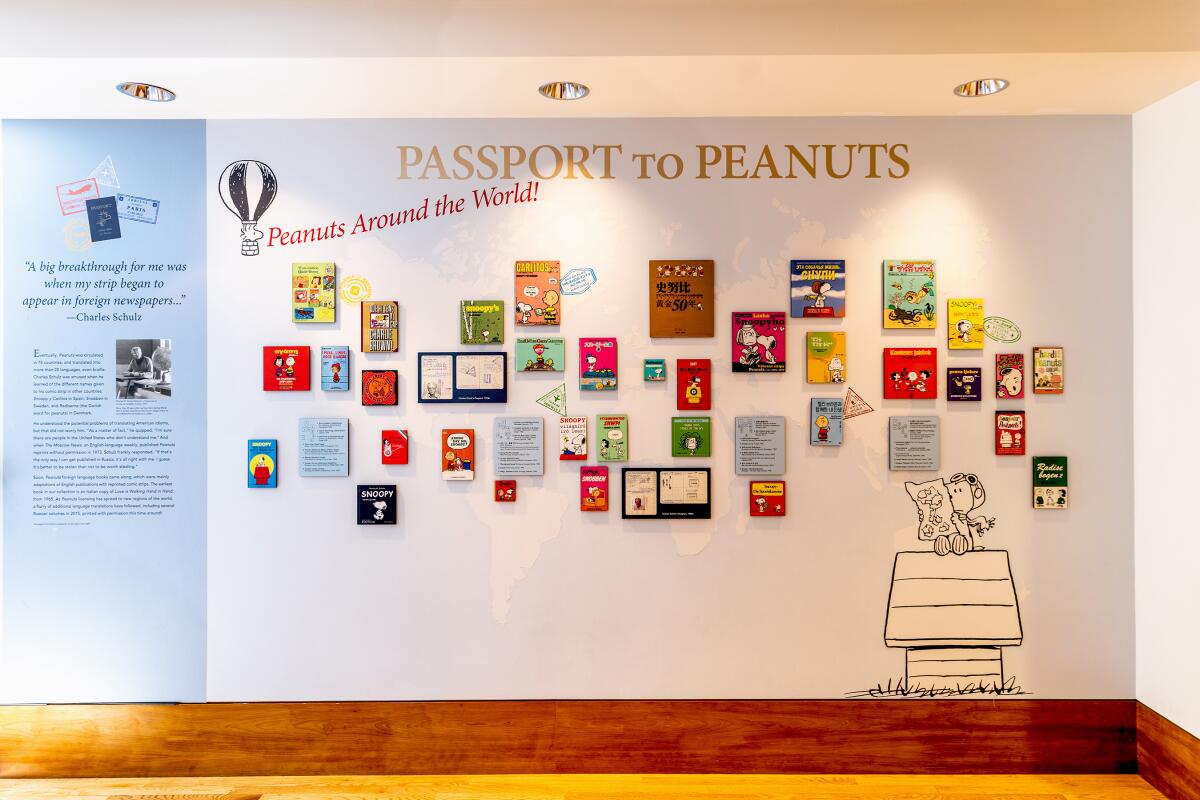
The Schulz Museum’s “Passport to Peanuts” exhibition emphasizes the comic’s global reach.
(Brennan Spark / Charles M. Schulz Museum)
Laurel Roxas felt similarly when they first discovered “Peanuts” as a kid while playing the “Snoopy vs. the Red Baron” video game on their PlayStation Portable. For Roxas, who is Filipino, it was Snoopy and not the “Peanuts” children who resonated most.
“Nobody was Asian. I was like, ‘Oh, I’m not even in the story,’” they said.
Because Snoopy was so simply drawn, Roxas added, he was easy to project onto. They felt similarly about Hello Kitty; with little identifying features or dialogue of their own, the characters were blank canvases for their own personification.
Roxas visited Snoopy Museum Tokyo with their brother last year. They purchased so much Snoopy merchandise — “everything I could get my hands on” — that they had to buy additional luggage to bring it home.
For some Snoopy enthusiasts, the high volume of Snoopy products borders on oversaturation, threatening to cheapen the spirit of the character.
Growing up, Bella Shingledecker loved the holiday season because it meant that the “Peanuts” animated specials would be back on the air. It was that sense of impermanence, she believes, that made the films special.
Now, when she sees stacks of Snoopy cookie jars or other trend-driven products at big-box stores like T.J. Maxx, it strikes her as a bit sad.
“It just feels very unwanted,” she said. For those who buy such objects, she said she can’t help but wonder, “Will this pass your aesthetic test next year?”
Lina Jeong, for one, isn’t worried that Snoopy’s star will fade.

“[Snoopy is] always able to show what he feels, but it’s never through words, and I think there’s something really poetic in that,” said Lina Jeong.
(Brennan Spark / Charles M. Schulz Museum)
Jeong’s affinity for the whimsical beagle was passed down to her from her parents, who furnished their home with commemorative “Peanuts” coffee table books. But she fell in love with Snoopy the first time she saw “Be My Valentine, Charlie Brown,” which she rewatches every Valentine’s Day.
This past year, she was fresh out of a relationship when the holiday rolled around and she found herself tearing up during scenes of Snoopy making Valentine’s crafts for his friends.
“Maybe I was hyper-emotional from everything that had happened, but I remember being so struck,” that the special celebrated platonic love over romantic love, Jeong said.
It was a great comfort to her at the time, she said, and she knows many others have felt that same solace from “Peanuts” media — especially from its dear dog.
“Snoopy is such a cultural pillar that I feel like fads can’t just wash it off,” she said.
Soon, she added, she plans to move those “Peanuts” coffee table books into her own apartment in L.A.

Business
Paramount’s Delrahim slams ‘fear-mongering’ and partisan politics clouding Warner Bros. deal

Paramount Chief Executive David Ellison has been circling the globe, meeting government regulators who will ultimately decide the fate of his controversial $111-billion takeover of Warner Bros. Discovery.
Last week, Ellison spent two hours answering questions from U.S. Justice Department antitrust lawyers in a bid to secure a key government approval — one that few people believe is in doubt because of President Trump’s strong support of tech billionaire Larry Ellison and his son’s ambitions to amass more power.
Throughout his travels, David Ellison has been accompanied by a savvy wingman: Makan Delrahim.
Delrahim, Paramount’s chief legal officer, served as the nation’s top antitrust regulator in the Justice Department during Trump’s first term. The 56-year-old Iranian American, who grew up in Los Angeles, is the architect of shrewd moves that have brought Paramount within reach of its blockbuster merger that would redefine Hollywood.
Politics have permeated the process — even before Trump announced he would get involved. Opponents have been suspicious of the Ellisons, given the family’s ties to Trump and programming changes to redefine Paramount’s CBS, including last month’s departure of late-night comedian Stephen Colbert and a shakeup at “60 Minutes,” CBS’ newsmagazine.
Buying Warner Bros. Discovery would give the Ellisons control of both CBS News and CNN.
Paramount’s bid for Warner Bros. has sparked dread in Hollywood for another reason, too: Thousands of jobs already have vanished through a string of media mergers.
More than 5,000 artists and entertainment industry workers have signed an open letter, calling on California Atty. General Rob Bonta to try to block the deal on antitrust grounds.
In an interview with The Times, Delrahim responded to concerns and criticisms. This interview has been edited for length and clarity:
Where does the regulatory process stand?
We are still going through the regulatory approval process. We actually started planning for the regulatory approval filings last summer. We knew we were going to be pursuing this transaction but it took a few months longer to sign the transaction than we thought. There were some interveners [Netflix, Comcast], but we planned ahead.
Do you have a commitment from Trump or his administration that you’ll get a thumbs up?
There are no deals with the president. We have a deal with the Warner Bros. shareholders. We’ve submitted [applications] to the governments of Europe, Canada, U.K. and the U.S., and that’s where it is.
You got a head-start because you filed a regulatory approval in December — months before Paramount had a deal with Warner. Why so soon?
We were always very skeptical [the Netflix deal] would ever go through. The only way to really show the [Warner] board that our deal would get through — because it doesn’t have antitrust problems — was to move as fast as we could.
One of the benefits being a former [DOJ] enforcer and having a team of outside lawyers who are also former colleagues and enforcers was that we anticipated what the government would ask for. Those were questions that we would have asked, and so we provided those answers.
Your timeline is aggressive. Some suggest Paramount wants this deal done before the mid-term elections.
I don’t think it’s aggressive. It has nothing to do with the midterms. The midterms do not change the officials at the Justice Department or the FCC — we have that minor application there. The midterms have no effect on the European Commission or anybody else. We’ve been very transparent and proactive with members of Congress and with the state attorneys general and the federal authorities.
Are you preparing to defend a potential antitrust challenge from Atty. General Bonta?
Well, no matter what field you’re in, whether it’s antitrust or whether you’re preparing for a football game, you always prepare the best you can for the worst, and you hope it never gets there. So, we’re preparing for challenges from anybody and everybody. But I don’t think any serious antitrust enforcer who looks at the facts, the law, the economics of this transaction will see an antitrust violation.
Why are you so confident?
There’s no element of this merger that is anti-competitive. Once you look at it, it’s incredibly pro-competitive. It increases output, it increases jobs, and it lowers the cost to the consumers. If you actually try to block this deal, you’re going to harm consumers, you’re going to harm creative talent, because you’re going to harm the creative ecosystem — the vision that David [Ellison] is trying to deploy here. It’s transformative from the efficiencies that it creates.
David Ellison has promised to release 30 films a year. Was that commitment to show that this merger will not be a repeat of Walt Disney Co.’s 2019 purchase of Fox?
I’m quite familiar with that one because I was at the Justice Department and reviewed it. Disney-Fox was a transaction with a different thesis. Disney wanted to get into streaming and they wanted to get scripted series. It wasn’t about studios trying to increase output.
Our transaction, as David has described, is motivated to create more content to feed the theaters, then streaming. We have a natural economic incentive to create more content. We’ll still be in fourth place after this transaction on the streaming side — almost half the size of Netflix.
David Ellison hasn’t made any commitments on the television side or pledged pledge to keep the various TV studios intact. Why?
I don’t think there’s much of an overlap on the television studios. Look, you have incredible studios in HBO, Warner Bros. Television, certainly our own studio. We’re not paying money to limit supply. It’s the exact opposite.
There is overlap between CBS News and CNN. How are regulators looking at that issue?
We’re very proud of CBS News and hopefully CNN, post-transaction. There is very limited overlap. Why? Because CBS News only airs a few hours a week of programming whereas CNN is 24/7, and it has international reach.
Antitrust regulators are going to see that it’s going to create synergistic effects. You might be able to cross-program and more people will be exposed to the incredible programming of CBS News. They’ll benefit from each other’s independent strengths.
During the first Trump administration, you said merger conditions were problematic because it’s difficult for the government to enforce behavioral remedies. Has your thinking changed?
No, I’ve been quite consistent. If there’s an antitrust problem, you need a divestiture [selling assets]. I don’t think there’s a remedy needed in this transaction. But having said that, we’re happy to engage with regulators to discuss where they see a problem and a possible solution. We’re always wanting to engage in constructive dialogue.
Would Paramount spin off CNN?
I don’t see that. I can’t see any antitrust reason to do so. That would be a weaponization of the antitrust law, and that would not be appropriate.
Many people in Hollywood view the merger with trepidation because of the prospect of more job losses. Others see it through a political lens. How do you evaluate the politics?
Politics is part of life. It’s part of the beautiful process of democracy. Generally, we are very empathetic to the folks in Hollywood, but this transaction will actually create more and better and exciting jobs. David is an absolute lover of films; he’s a filmmaker himself. For the first time, you are getting an owner who comes from the creative side.
Let’s be honest. There’s a lot of fear-mongering, particularly from people in Washington, D.C. They are running a political campaign. Some of these people are trying to inflict harm on this transaction really because of their own antisemitic views. Regulators and law enforcement officials will see right through that.
Do regulators share others’ concerns about the merger debt — $79 billion — for the combined company?
Some regulators appropriately have asked about it. They say: ‘This is what we have heard, that you guys are not going to be around because of this debt,’ which is just silliness. David and his family are owner-operators. They’re not rented CEOs. They have over 50% ownership. They put their money at stake and my money is on them.

Internet culture is showing up in a big way in theaters, as low-budget horror films “Backrooms” and “Obsession” led this weekend’s box office and beat out big franchise films like “Star Wars: The Mandalorian and Grogu.”
A24’s “Backrooms” topped the charts with $81.5 million in the U.S. and Canada in its opening weekend, according to studio estimates. The film is directed by 20-year-old YouTuber Kane Parsons, who based it on his internet series of the same name.
“Backrooms,” which reportedly had a production budget of about $10 million, stars Chiwetel Ejiofor as a furniture store owner who finds a mysterious portal in his basement. The film made a total of $118 million worldwide.
In second place was Focus Features’ “Obsession,” which hauled in $26.4 million in its third weekend in theaters, up 10% from the previous weekend’s total. The film, which had a production budget of less than $1 million, has now grossed $104.7 million domestically for a global total of $148 million.
“Obsession” director Curry Barker is also known for his YouTube sketch comedy channel.
The success of two YouTube-native filmmakers at the box office indicates the growing power of the platform — and online culture as a whole — in attracting audiences to cinemas.
Walt Disney Co. and Lucasfilm’s “The Mandalorian and Grogu” fell to third place this weekend with a domestic gross of $25 million. Lionsgate’s musical biopic “Michael” ($11.7 million) and Sony Pictures’ family comedy “The Breadwinner” ($7.5 million) rounded out the top five at the box office, according to Comscore data.

Fernando Flores can spend eight hours a day pouring the same cup of coffee.
He is not a barista. He’s a robot puppeteer, trying to train humanoids.
He manipulates mechanical arms remotely, using hand and arm sensors to make them pick up a pot of coffee, pour it into a mug and put the pot back in the coffee maker. Flores checks for spills, then empties the mug back into the pot by hand and does it again — hundreds of times.
“The repetitiveness, it can cause some discomfort,” said Flores, who has the title of senior robotic pilot at San Francisco startup Encord. “It becomes second nature after a while.”
This Sisyphus of Silicon Valley is on the front lines of a rapidly expanding industry of robot trainers, preparing to teach and operate the army of humanoid robots scheduled to march out of nearby factories in the coming year. Encord practices, records and sells data about movement to the companies racing to bring humanoids to homes, offices and factories.
If tech companies’ optimistic plans are to be believed, a swarm of American-built robots is about to hit the market.
Tesla’s Fremont factory stopped car production this year to make way for production lines for its Optimus robots, with unbelievable plans to ramp up capacity to 1 million units a year. Palo Alto-based 1X Technologies is already manufacturing its 66-pound, 5-foot-6 humanoid named Neo at its factory in Hayward. The company received 10,000 preorders, and its first shipment is expected later this year. Figure AI’s humanoid factory in San Jose has increased its manufacturing capacity to produce one Figure 03 robot an hour, with the goal of producing 12,000 a year.
Fernando Flores demonstrates the articulation of a robot performing a whisking motion at Encord on May 21.
(Paul Kuroda / For The Times)
Goldman Sachs projects the global market for humanoids could reach $38 billion by 2035.
The AI of these humanoid robots needs an immense amount of data on human movement. How humans write, speak, code and compose was easily scraped off the internet, but the bots need more information to master how to stand, step, lift, squeeze, pour and perform other physical movements. That is where companies like Encord come in.
The $10 billion invested in robotics in 2026, according to CB Insights, has spawned an industry focused on training robots. Initially, that meant humans strapping iPhones to their foreheads, recording actions like cooking, cleaning and performing household chores. That, however, doesn’t capture the exact torque, force and grip required for a robot hand to work flawlessly.
Now, humans are directly guiding robots through expensive rigs that let them control the robots’ movements. Data collected using robot arms offer richer insights into motor skills and object manipulation. Encord charges clients up to $1,000 per hour for training data.
The information gathered from trainers controlling robots is “super important to bridge the next level of learning,” where robots will learn to correct mistakes and do the chores on their own, said Vineeth Velmurugan, head of robotics learning at Encord.
The company is already working with some of the top companies in robotics, but said it couldn’t share most names. Among the clients it could mention were Toyota Research Institute and Weave, which already has laundry-folding robots in a few homes.

Brian Gonzalez pulls an ethernet cable using a robotic arm at startup Encord on May 20.
(Paul Kuroda / For The Times)
Many of the new robotic data companies are focusing on industrial use cases. Robots can perform better in a structured, predictable environment, like a factory or warehouse.
Home tasks are tougher, as layouts and tasks are more varied and messy. While many bots have mastered walking, they still struggle to open doors, fridges and washing machines smoothly. They don’t know where or how to grasp a doorknob, handle or door edge or how much pulling, pushing or twisting force to apply.
Flores has mastered making the robot arms pour coffee, but he still often spills. When that happens, he deletes records of the attempt.
“Typically, we don’t want any mistakes,” he said. “If we have more than three consecutive mistakes within a 15‑second window, that’s not going to be good data.”
Inside Encord’s test facility in Hayward, it has replicated a standard American home with a fully furnished living room, kitchen and bathroom.
In the living room, a pilot rearranges an untidy study desk. She first scatters AA-size batteries, pens and scissors on the table, and walks back to the nearby control rig to make the robot arms place each one inside the tray of a desk organizer.
Depending on the day’s training, the pilots could be opening and closing refrigerator doors, whisking liquids in a bowl, sorting silverware or turning a water faucet on and off over and over until the robot arms get it right.

Cortney Weintz, left, and Tony Schiller record data with cameras at Encord.
(Paul Kuroda / For The Times)
In another corner of the facility, people wearing smart glasses place and pick up playing cards and sort plastic plates by hand, collecting first-person videos.
One key skill for the coming bot invasion: plugging in cables.
Companies want robots that can crawl into duct spaces, identify ports and plug cables to help build the massive data centers needed for AI. Encord replicated a real data center server rack, where an operator inserts blue cables into penny-sized sockets all day.
Many companies have entered this business. Meta-backed Scale AI and Palo Alto-based Micro1 are major players in the space. China has more than 40 state-owned robot data-collection facilities where hundreds of on-site humans mimic train bots how to move in the real world.
In Watertown, Mass., Tutor Intelligence has set up a 100-robot facility dedicated to harvesting movement data. Its robot arms, which are being trained to do factory work, are controlled by a human team split across Mexico, the Philippines and Boston. This is in part to train its robot, Sonny, which will hit the market later this year.

Elaine Batchlor sorts screws and bolts with a robot in a mockup at Encord.
(Paul Kuroda / For The Times)
“We built the Data Factory to bootstrap the initial intelligence for the Sonny robot, so that we can begin to deploy Sonny into the field,” said Josh Gruenstein, co-founder of Tutor. Ten of its remote operators are based in Boston, and the rest are international.
Remote operation is emerging as an integral part of the humanoid robot business. Employing teleoperators in countries where wages are much lower than in the U.S. could, in theory, mean a robot controlled by a human in another country could do a task at a fraction of the cost of having an American do it.
This month, a humanoid robot cleaning service in San Francisco called Gatsby completed a robot cleaning of a U.S. home using a teleoperator in Mexico.
The technology is still evolving, said Aron Frishberg, co-founder of Gatsby, but being a first mover means Gatsby is getting more training.
“There’s obviously stuff that goes wrong,” he said. “It’s really hard to get precise hand movements or arm movements and grab something.”
Encord co-founder Ulrik Hansen said it will be setting up a teleoperations center in its Hayward facility in the next three months. Even as more robots are deployed and master increasingly sophisticated tasks, they will still need humans to occasionally take control remotely.
“They will need some exception handling when they get things wrong,” he said.
Hundreds of teleoperators will learn where the system succeeds, where it breaks and step in when needed. Once those patterns emerge, Hansen said, they can move teleoperations to cheaper locations abroad or to the Midwest.
Back in Hayward, Flores created new coffee-pouring challenges for his robot arms. He changed what was on the counter around the coffee maker and moved the mug to different spots. It takes a lot of know-how to puppet and train a robot, he said.
“A lot of people would (guess) this might be easy, this is dumb,” Flores said. “There actually is thought here. There actually is critical thinking.”
-
 Finance5 minutes ago
The Most Innovative People in Finance 2026
-

 Fitness8 minutes ago
Bristol fitness expert offers free exercise for Parkinson’s
-

 Movie Reviews23 minutes ago
‘I Love Boosters’ Film Review – Capitalism is the Real Surrealist State
-

 World35 minutes ago
Conecta Magaluz-Mallorca: Buzz Titles, AI, What’s Shocked in TV, Latin America’s Microdrama Bonanza and Other Takeaways
-

 News38 minutes ago
2026 Midterms Tracker: The Key Senate and House Races
-

 Politics43 minutes ago
Video: Could Talarico’s Religious Approach Win Texas?
-
 Lifestyle1 hour ago
Is your neighborhood riddled with dog poop? : It’s Been a Minute
-

 Education1 hour ago
How a Recent College Graduate Lives on $18 Per Hour in the East Bronx

