Business
How a Businessman Fleeing Fraud Charges Built a Life Offshore


Around midday on Feb. 2, a large wave began its slow rumble toward the Aisland 1, an 800-ton deck barge floating in the waters between Dubai and Iran. On board the vessel were its residents of more than a year: a 58-year-old Italian businessman named Samuele Landi, three sailors, a cook and five cats.
Landi — the ship’s captain — was a gifted computer programmer who in a previous life had been the chief executive of Eutelia, a telecommunications company. He fancied himself an Italian Steve Jobs, though John McAfee, the cybersecurity entrepreneur turned tax fugitive, might have been a more fitting comparison. An avid skydiver and motorcycle racer, Landi liked to live on the edge: of the world, of the law and of life itself. He had made a career of exotic offshore financial schemes; now, adrift, he had become one with them.
“I will die at sea for sure,” he told Oswald Horowitz, a filmmaker who had visited him the previous December. “I’m not going back.”
The barge was Landi’s biggest adventure yet. A rusting rectangular hulk with the footprint of a large commercial aircraft, the Aisland had a deck fitted with six blue shipping containers bolted in place. These were the living quarters, equipped with solar-powered air-conditioners and a desalination system. The barge was otherwise littered with equipment: ropes, crates, fans, tanks of oil and water, a freezer containing pounds of red meat, and a sack of reinforced concrete mix for repairs. A Liberian flag flapped in the breeze.
The story of how Landi ended up living on a leaky barge some 30 miles off the shore of Dubai is a tale of self-preservation. For over a decade, Landi had been a man on the lam. He wasn’t a violent criminal; nor was he a particularly wanted individual, in the grand scheme of things. But since Eutelia was declared bankrupt in 2010 and some of its executives, including Landi, were very publicly tried and convicted of bankruptcy fraud, Landi has been a fugitive from Italian justice — and on land, his options had all but run out.
What distinguished Landi from a run-of-the-mill fraudster, though, was the outlandishness of his maneuvers, which exploited every loophole the globe had to offer. Landi was a libertarian who sought freedom from meddling governments and their cumbersome regulations, but in a select few nations, he found willing accomplices. Landi hid money in Switzerland, skated around extradition treaties while living comfortably in Dubai, registered companies in bespoke tax-free zones, procured diplomatic credentials from Liberia, dabbled in crypto and, finally, took to the sea, where there was no one to tell him what to do.
Landi was able to pull this off thanks to his knowledge of the offshore world, and his story makes him a perfect guide to this vast archipelago of third spaces. It also “embodies all the ways laws can be evaded through these jurisdictions, whether it’s tax laws, extradition laws, regulatory laws or taking advantage of regulatory quirks,” said Vanessa Ogle, a Yale professor working on a book about the history of the offshore world. “Once you develop a mind for it, a whole range of opportunities arises.”
While he lived on the barge, Landi was dreaming up an ambitious plan to establish a floating, modular and completely sovereign city-state in international waters near the nation of Mauritius. This much-discussed concept is known as “seasteading” — like homesteading, just wetter — and its adherents are a mix of survivalists, libertarians and wannabe pirates.
Landi’s barge was a heap, but he was able to keep it afloat in the relatively calm waters of the Persian Gulf by pumping out water and having his crew patch holes when it sprang a leak.
On that day in February, though, their repairs did not hold, and the offshore existence that Landi had built for himself was suddenly imperiled: not by the laws of nations, for once, but by the laws of nature.
Tax Shelters and a Timely Escape
As far as anyone can prove, Samuele Landi lived as a law-abiding private citizen in Arezzo, Italy, until his 30s, when he started working in the telecommunications industry. Landi’s first company, Plug It International, bought easy-to-remember phone numbers from the Italian government, then leased them out at a premium to dial-in fortune tellers, astrologers, weather reports and, of course, phone sex operators. Plug It was fined for misleading consumers about its fees.
In 2003, Plug It merged with another company to become Eutelia, a phone and internet provider. Eutelia was largely a family affair — there were Landis serving as managers and executives, Landis controlling shares and Landis expanding the business abroad. Samuele Landi, who served as Eutelia’s chief executive alongside two of his brothers, led the company as its shares began trading on the Milan Stock Exchange in 2004.
In 2006, the Italian financial police began auditing Eutelia’s books for possible fraud. The authorities discovered plenty — tens of millions of euros were improperly accounted for — and, in the process, found themselves immersed in the ways of the offshore financial world.
Starting as early as 2002, according to sentencing documents from Arezzo’s criminal court, Samuele Landi and five of his relatives had used a series of falsified or inaccurate invoices to siphon money from the business and into tax shelters around the world: a shell company on the Polynesian island of Niue; a UBS account in Monaco; a Romanian L.L.C. in Bucharest fully owned by a Swiss firm. The corporate vehicles they used had few or no employees, produced no tangible work and, according to prosecutors, existed primarily for the purpose of draining Eutelia’s coffers.
Circuitous international grifts aren’t uncommon — consider the revelations in the Panama Papers, the Paradise Papers and other data leaks that detailed how wealthy companies and individuals hide money through complex offshore entities. But Eutelia was a middling business in an ordinary Tuscan town, not a high-flying family office or a lawyered-up conglomerate with branches around the world.
Samuele Landi contested Eutelia’s insolvency. He was also antagonizing employees. In November 2009, while investigations into Eutelia were underway, employees of a Eutelia division that had been spun off occupied their offices in Rome. They camped out in their cubicles for two weeks, complaining that they hadn’t been paid in months. The workers blamed Landi — who was still in charge — for their troubles, and an image of Landi posing, pirate-style, with a cartoon-villain expression and a cutlass between his teeth became a symbol for Eutelia’s misdeeds.
Landi hit back in a manner more befitting a mob boss than a telecom executive. With 15 private guards by his side, he marched into the offices at 5 a.m. one November day, aiming to disrupt the sit-in. Wielding crowbars, the men dragged the workers out of the offices and into the lobby. A television reporter covering the occupation then called the police, who took Landi and his men away.
By the time Eutelia’s court date came around, Landi had high-tailed it for Dubai. At the time, the city-state levied no taxes on foreign citizens, had no extradition agreement with Italy and was developing a reputation as a place where criminals — and their money — could find safe haven.
These accommodations allowed Landi to establish himself quietly in the United Arab Emirates, and to move his wife and their children there.
In the city full of expatriates, Landi blended in. Professionally, he picked up where he had left off. In 2010, he registered Kryptotel, an encrypted mobile-phone software company, in Internet City, one of Dubai’s many free economic zones — gated enclaves where foreign companies enjoy special perks.
At Kryptotel, Landi hired Italians — among them, an old skydiving pal, according to LinkedIn. Commenting on a Facebook thread about his exploits, Landi wrote that he had sought out clients who could pay him in cryptocurrencies and would convert the digital currencies into dollars or dirhams when he needed cash.
Landi clearly had access to funds, though how much of the Eutelia loot ended up in his pockets and for how long was not clear. In the sentencing document, Italian prosecutors noted that Landi previously had access to accounts at the Banca della Svizzera Italiana in Lugano and Julius Baer, a Swiss private bank that reached a half-billion-dollar settlement in 2016 with the United States for helping rich Americans avoid tax. Additionally, Landi had power of attorney over a bank vault and other accounts.
Whatever his net worth, it was enough for a $10,000-a-month villa, a driver and car, private school for his children and trips abroad for his family.
From his villa in Dubai’s Palm Jumeirah, an archipelago of man-made islands, Landi followed the news as lawsuits against him, his family members and other Eutelia executives made their way through the Italian courts. In 2015, Arezzo’s criminal court sentenced Landi’s uncle, cousin and brother to between two and four and a half years in prison for fraudulent bankruptcy and misappropriation of funds. Their appeals failed, and the uncle died in 2016. Two other brothers took plea bargains. The surviving Landis served their time mostly under house arrest because they had no prior convictions, according to a prosecutor.
Samuele Landi’s exit, which made headlines back home, had caused tension within the family, said Paolo Casalini, a friend of Landi’s and a former editor of a local news site, Informarezzo.com, which Landi bought and took over in July 2022. “His brothers didn’t even talk to him anymore,” said Casalini, who was in regular touch with Landi over the years.
(Landi’s wife and sons did not respond to requests for comment; neither did the family members named in the lawsuits. His eldest daughter sent a brief statement saying her father was “a really kind person.”)
Samuele Landi was sentenced to a total of 14 years in prison in absentia for his role in Eutelia’s insolvency, but in Dubai, he was untouchable. There were hometown rumors that he had been arrested in 2017, but Casalini said Landi shrugged them off by sending a photo of himself on the beach, reading the newspaper: “Landi felt safe in Dubai,” Casalini said.
I asked if Landi seemed to miss Arezzo.
“He would say no,” Casalini said. “He said, ‘I’d only come back here for my mother.’”
The Perks of Diplomatic Immunity
On March 22, 2022, Liberia’s president, George Weah, landed in Dubai for a diplomatic visit. At the terminal, a delegation of Liberian officials was there to greet him. Standing a good half-foot taller than his peers was a man with a shiny, white, bald head: Samuele Landi.
Landi was there in his capacity as Liberia’s honorary consul general to Dubai. He had found yet another loophole. This appointment by Liberia — a country he was never a resident of and to which he had no connection by blood or marriage — had effectively granted him immunity from prosecution in Dubai by making him a diplomatic envoy.
He had made his first inroads in Liberia during his Eutelia days, when the firm bought a 60 percent stake worth $21 million in a Monrovia company called Netcom Liberia. For an offshore man of mystery and ill repute, a diplomatic post is a protective cloak that brings with it varying degrees of immunity, not to mention an alternative passport to travel and transact with; a new identity untethered from the past; and a noble (honorable, even) foil.
In the offshore world, this is a “time-honored strategy” going back to the 1920s, Vanessa Ogle, the historian, said. “Honorary consuls can move assets across borders,” she said. “They can have cars with diplomatic plates, the immunity and privilege of not being searched and a diplomatic pouch” to conceal documents. In 2022, the International Consortium of Investigative Journalists found 500 current and former honorary consuls had been accused of crimes or embroiled in controversy.
Many honorary consul gigs are just for show. Not Landi’s. According to three people who spent time with Landi in Dubai, he threw himself into the job, soliciting funds from wealthy Arab donors to build a hospital near Monrovia and hosting a Liberian Independence Day party at his home. He even used his consular powers to help repatriate over dozens of Liberian domestic workers who had been trafficked into Oman. (Alieu Massaquoi, Liberia’s ambassador to the United Arab Emirates, said in a WhatsApp message that he had not met Landi in person and that his office had no record of him. Massaquoi was appointed to his post in 2023, after Landi had moved offshore.)
Landi also used his time in Dubai to consult for a start-up run by an Emirati sheikh. The company, Blue Carbon, made plans to buy up large areas of Liberian forest to offset carbon emissions.
In May 2022, after a Liberian businessman in the United States was apprehended with a fake diplomatic credential, Liberia declared it would recall all of its diplomatic passports. That summer, the Emirates extradited an Italian drug trafficker and mobster who had been living in Dubai for years.
At this point, Landi mapped out his next move: one that took him offshore not just in a metaphorical sense, but in a physical one, too.
The Final Frontier
Landi surprised almost everybody when he moved onto the Aisland 1 on Dec. 22, 2022, with a stray cat and four kittens he had found in a box. His colleagues and friends knew nothing of his plans.
“He wanted to keep his barge a surprise,” said Casalini, who learned of Landi’s move after he posted about it online. “I’m a calm person, but my response was, ‘Are you mad?’”
It was a reasonable question. Landi had begun cryptically speaking, in interviews, about wanting to “escape the Matrix” — a metaphor from the 1999 movie for letting go of constructed social norms and false beliefs.
“He believed we live in a world where we are always being surveilled and manipulated — by 5G, by the Covid vaccines,” said Clément Bonnerot, a journalist with Le Monde who had interviewed Landi while he was at sea. “He identified as a hunted, persecuted man, for whom the most important thing was to be free.”
In December 2023, he told Tony Olsen, a libertarian podcaster: “If you are libertarian like we are, you want your freedom. And your freedom is finished when the freedom of others starts. This is the key point.”
Landi was adept at living at sea. He grew vegetables and made plans to bring aboard chickens and cattle. He wrote a blog, extolling the barge’s lack of mosquitoes and the stunning sunsets and posted lighthearted articles about his adventures. (These have all since been taken down.) He relied on his crew, on semiregular deliveries of food and supplies from Dubai and on his Starlink satellite connection, which allowed him to keep Kryptotel, his cellphone company, in business.
Still, Landi had no illusions about the longevity of his setup. “For the moment,” he told Olsen, the podcaster, from one of his blue containers, Dubai “is tolerating us, but we cannot stay.”
The used barge, which he said he had bought for $200,000, was falling apart, too, to the point that Landi and his men had to teach themselves aquatic welding. “From inside, there are certain dangers because you are exposed to gas,” he told Olsen. “But if you weld from outside, it’s more difficult because you’re in a scuba diving suit fighting the current and waves.”
On land, in the world of nation-states, Landi had reached the end of the line. And that little voice that had led him far from home, under fictitious flags, to inhabit man-made isles and extraterritorial havens, was now telling him to construct a nation of his own.
He would buy a new barge, twice as large, that he would anchor in the Saya de Malha Bank, midway between Seychelles and Mauritius. He would invite friends, family and like-minded libertarians to join him.
Landi even had an architect draw up plans. “On the top deck, he needed a spot where a Gatling gun was going to be mounted,” said Peter de Vries, a designer. “That’s one of these guns that fires 1,000 rounds a minute — very heavy-duty stuff,” he continued. “I actually got the specs for the gun.”
I asked de Vries: Was Landi scared of pirates, the state, his personal enemies?
“Probably all of the above,” de Vries replied. “The world.”
Nevertheless, Landi seemed as cheerful as ever. In footage that Oswald Horowitz, the filmmaker, took late in late 2023, Landi cuts the figure of a self-actualized man. His skin is not so much sunburned as glowing, his laugh is mirthful, and his demeanor determined and a little droll, as though he saw the humor in his predicament.
His endeavor might sound like lunacy to most people — a country, on a barge, in international waters, with guns? — but for a veteran of offshore affairs like Landi, it adhered to a certain logic.
The universe in which Landi had sought shelter is not so exceptional, after all. In fact, it is all around us, hiding in plain sight. We might buy a bottle of Scotch in a duty-free shop, or vacation on a cruise ship with Panama’s or Liberia’s lightly regulated flag of convenience. We might gamble in a casino or admire a da Vinci that has spent decades in an extraterritorial warehouse. Our clothes, our electronics, the computers we use for our desk jobs are likely to have been manufactured in special economic zones by global companies that behave more or less like Samuele Landi: hopping from jurisdiction to jurisdiction in order to make money and shield themselves as best they can from fiscal, regulatory, legal or environmental responsibilities.
Landi turned this ethos into a lifestyle. On the run, he made a life in the spaces above, beneath and between nations
Landi sent his last message to Horowitz on New Year’s Eve. It read: “Move or die.”
A month later, Landi’s barge was around 30 miles from the Dubai coast when the rogue wave hit, breaching the hull and apparently breaking the barge in two. Two members of Landi’s crew survived by clinging onto pieces of wood until a passing vessel rescued them the next day. Landi and the two remaining seafarers were not so lucky.
According to Italian news reports, Landi put out a call for help, but it didn’t come in time.
His body was found several days later, when it washed up on the beach about 40 miles up the coastline from Dubai. A relative flew out to identify the body.
In the seasteading community, Landi is remembered as a heroic figure. “Samuele Landi was the first seasteader to live in international waters for more than a year,” Joe Quirk, the president of the Seasteading Institute, a California nonprofit, wrote in an email. But the organization declined to endorse or recommend his exploits. “Barges,” Quirk wrote, “are not safe.”
Back in Arezzo, not everyone is convinced that Samuele Landi is deceased; rumors swirl about the lack of DNA evidence, and even the city’s mayor can’t quite believe that Arezzo’s most notorious exile is gone.
This was a man who found his way around everything: rules, taxes, borders, the law. Surely, Samuele Landi would resurface.
Sabika Shah Povia contributed reporting.



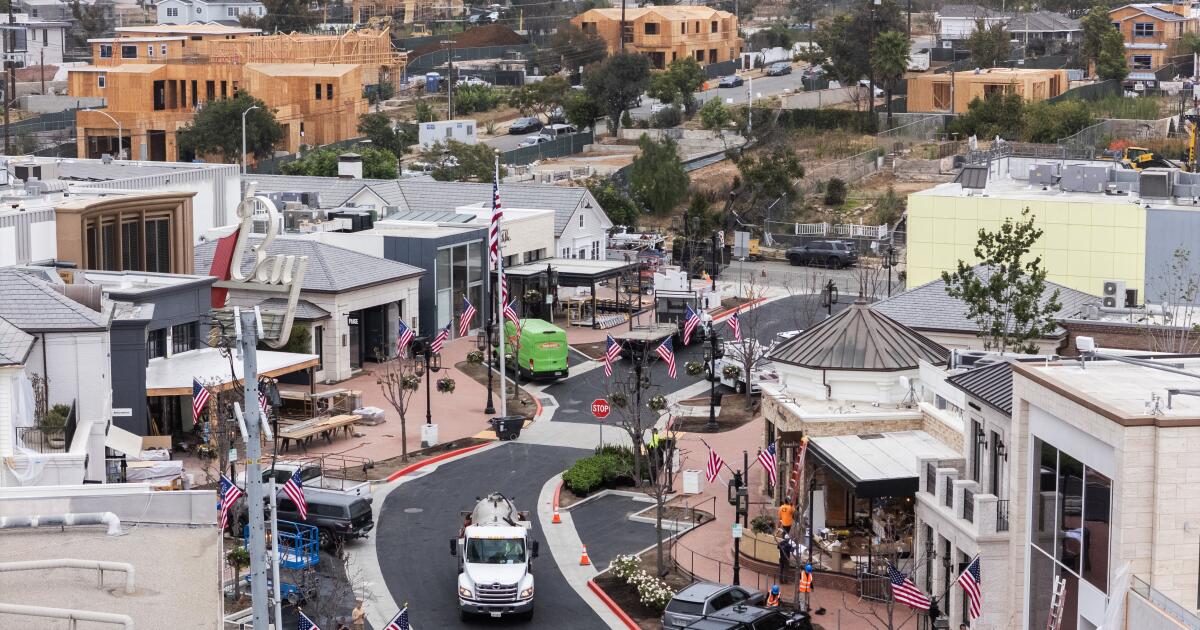
The luxury shopping center in Pacific Palisades will reopen next month after more than $100 million in renovations forced by the January 2025 wildfire that devastated the Los Angeles neighborhood.
Palisades Village will reopen Aug. 15, owner Rick Caruso announced Wednesday. The outdoor center survived the blaze that destroyed homes and other businesses but needed refurbishment to eliminate contaminants that the fire could have spread.
Crews are putting finishing touches on mall buildings after tearing them down to the studs, treating the wood and rebuilding the walls, Caruso said.
“Everybody’s working, and stores are moving their products in,” he said. “It’s a really cool feeling that people have really locked arms and are working together.”
An electrician installs lighting for a restaurant at Rick Caruso’s Palisades Village on Thursday. The shopping center is scheduled to reopen mid-August.
(Myung J. Chun / Los Angeles Times)
Pacific Palisades resident Allison Polhill, who is rebuilding the home of 30 years that her family lost in the blaze, said she is “thrilled” at the prospect of returning to the mall she used to frequent. Its comeback is a boost for the community, she said.
“Every single step that we make to reopen our commercial corridors is going to bring more people back into the Palisades,” said Polhill, who expects to move back into her home at the end of August.
A total of 6,822 structures were destroyed in the Palisades fire, including more than 5,500 residences and 100 commercial businesses, according to the California Department of Forestry and Fire Protection.
Caruso previously attributed the mall’s survival to the hard work of private firefighters and the fire-resistant materials used in the mall’s construction.
The $200-million shopping and dining center opened in 2018 with a movie theater and a roster of upmarket tenants, including Erewhon, which may be the only grocer in the heart of the fire-ravaged neighborhood when it opens.
Caruso’s company was able to fill the mall with tenants despite the long shutdown.
Palisades Village is 99% leased, with the majority of tenants returning, said Jackie Levy, chief financial and revenue officer. Nearly one-third of the shops and restaurants are new to the property.
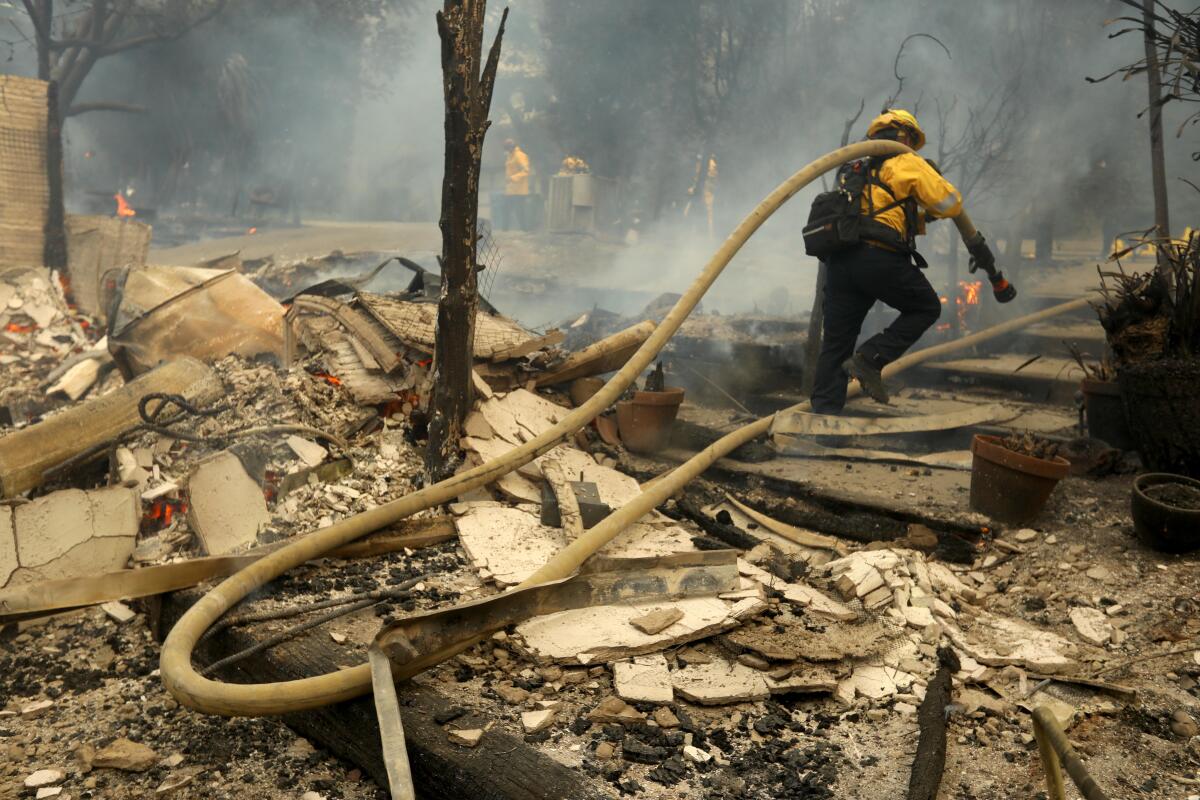
A firefighter carries a hose back to his rig while walking through a destroyed home from the Palisades fire in Pacific Palisades on Jan. 7, 2025.
(Genaro Molina / Los Angeles Times)
Last year, Pacific Palisades-based fashion designer Elyse Walker said she would reopen her eponymous store in Palisades Village after losing her 25-year flagship location on Antioch Street to the inferno.
Other neighborhood shops destroyed in the fire that are reopening at the mall include K Bakery and Loomey’s Toys, which caters to children up to age 12 and used to be across the street from Palisades Elementary Charter School.
“It’s been a journey and I’m excited because I wasn’t sure that there was going to be a place to come back to,” said toy store owner Amanda Rastegar. “Hopefully we can bring some of that magic back.”
Rastegar’s home in the Palisades survived but was damaged by the fire. The family returned about eight weeks ago. Her last memory of the fire was a burning supermarket.
“I just couldn’t wrap my brain around what was happening,” she said. “By the time I left, Gelson’s was on fire.”
Among the returning tenants is Angelini Ristorante & Bar. Well-known Los Angeles chef Gino Angelini said he will be in the kitchen next month for a return of the Italian restaurant.
“We won’t do a big celebrity open,” he said. “We want to have a very soft opening and see our customers come back.”

Construction takes place at Rick Caruso’s Palisades Village on Thursday. The shopping center is scheduled to reopen mid-August.
(Myung J. Chun / Los Angeles Times)
An elaborate celebration would not feel “correct for me,” Angelini said, because the devastation has been “very sad” for so many.
Other new tenants include local chef Nancy Silverton, who has agreed to move in with a new Italian steakhouse called Spacca Tutto. Women’s activewear retailer LESET will open its first West Coast location.
Caruso said he is optimistic that customers will return to the center, even though many Pacific Palisades residents are still dispersed. One tracking system estimated that about 30% of the Village’s customer base was impacted by the fire, he said.
“That means 70% did not get impacted, so there’s a lot of customers still left out there,” Caruso said. Historically, the center drew customers from as far away as Beverly Hills and Calabasas, as well as Malibu, Brentwood and Santa Monica.
He also hopes many will be inspired to visit the revived mall.
“I believe in the goodness of people and I believe that people are going to want to support the Palisades,” he said. “They’re going to want to be there and support the businesses that have had the courage and the heart to reopen.”

Walmart is rapidly expanding its network of electric vehicle chargers designed for customers to use while they shop.
The network could help fill gaps in EV infrastructure in states with greater need for chargers. Walmart, which has more than 5,000 locations in the U.S. and hundreds in California, says more than 90% of Americans live within 10 miles of one of its stores.
The chargers also offer an incentive for customers to choose Walmart — Walmart Plus members will receive a 10% discount off an average price of $0.46 per kilowatt-hour of energy at the company’s chargers.
Walmart chargers are already available at more than 75 locations in 17 states, with Texas boasting the most charging stations, followed by Florida and Arizona.
Matthew Nelson, Walmart’s director of energy policy, said last week on LinkedIn that the network will soon reach 29 states, including California.
“We are delivering on the promise of affordable, reliable and convenient charging,” Nelson said in his post.
According to Walmart’s website, six charging stations are coming to California soon, though the company did not offer a specific timeline.
The chargers will be installed at stores in Antelope, Brea, Fresno, Stockton, Suisun City and Vallejo.
Most charging sites in California will include eight to 16 fast-charging stalls, said Walmart spokesperson Kelsey Bohl.
The company first announced plans in April 2023 to install its own EV chargers at Walmart and Sam’s Club stores, with a goal of installing thousands of chargers by 2030. Partnering with ABB E-Mobility and Alpitronic, it added 25 new charging sites this past May and six more in June.
“Walmart is building a leading retail-integrated EV fast-charging network, focused on delivering an affordable, reliable and convenient charging experience where customers already shop,” Bohl said in an emailed statement. “Customers can charge while they shop, access stations through the Walmart app they already use, and benefit from affordable pricing.”
The charging stations already available include 612 individual charging stalls using 400-kilowatt chargers. Each stall has a dual charging cord with both Combined Charging System and North American Charging Standard connectors. The standard connectors, designed by Tesla, are smaller and lighter than the combined systems.
The primary way to pay for the chargers is through the Walmart app, but the company is also experimenting with built-in credit card readers to allow those without the app to use the stations.
Customers can check charger availability on the Walmart app. The company said the chargers will be available 24 hours a day.

Robotaxis could be turning into robocops.
A self-driving Waymo reported two teens to San Mateo, Calif., police on Monday after they were found drinking alcohol and shooting toy guns in the back of the vehicle.
According to a social media post from the San Mateo Police Department, officers detained two 15-year-olds after the Waymo they were riding in contacted the department and stopped in a parking lot until law enforcement arrived.
“Parents do you know where your teens are?” the San Mateo Police Department wrote on Facebook following the incident. “Waymo does!”
Officers removed both teens from the vehicle and determined they were using toy guns to shoot Orbeez out the windows. Orbeez are small, water-absorbing beads sold at toy stores.
“Toy guns, water guns, and BB guns all pose real dangers, especially to an untrained eye,” the Police Department said. “The simple handling of them can cause fear in [passersby].” “
A video posted on Facebook shows at least five officers and a police dog responding to the scene and approaching the Waymo with their weapons raised.
Waymo did not immediately respond to a request for comment.
Waymo vehicles have internal cameras and microphones that may be used in an emergency or to “promote safety and security,” according to Waymo’s online support page.
The cameras are also used to ensure the vehicles are clean and to help find lost items, according to the support page.
The company said it does not use facial recognition or other biometric identification technologies to identify individuals.
“In more urgent circumstances, support may access live video during a trip,” the Waymo page said.
The San Mateo Police Department’s Facebook post has garnered nearly 60 comments, with one user accusing Waymo of “snitching.”
“At least they got a designated driver?!” one user commented.
-
 Science18 seconds ago
Not everyone is leaving California. A new commercial battery maker just landed in Sacramento
-
 Sports3 minutes ago
Mookie Betts’ eighth-inning single gives Dodgers the win over the Rockies
-
World15 minutes ago
From sewers to swimming sites: how Europe's cities reclaim their rivers
-

 News45 minutes ago
Three more people charged with damaging Reflecting Pool after Trump’s multimillion-dollar restoration | CNN Politics
-

 Los Angeles, Ca2 hours ago
Loved ones search for missing 34-year-old Southern California woman
-

 Detroit, MI2 hours ago
Chickens, geese found at vacant home after nonprofit reports them stolen
-

 San Francisco, CA3 hours ago
What’s next for San Francisco Giants as MLB trade deadline approaches?
-
 Dallas, TX3 hours ago
Dallas millionaire files lawsuit against groundwater district

