News
Communities launch cleanup after severe weather and tornadoes churn across Midwest
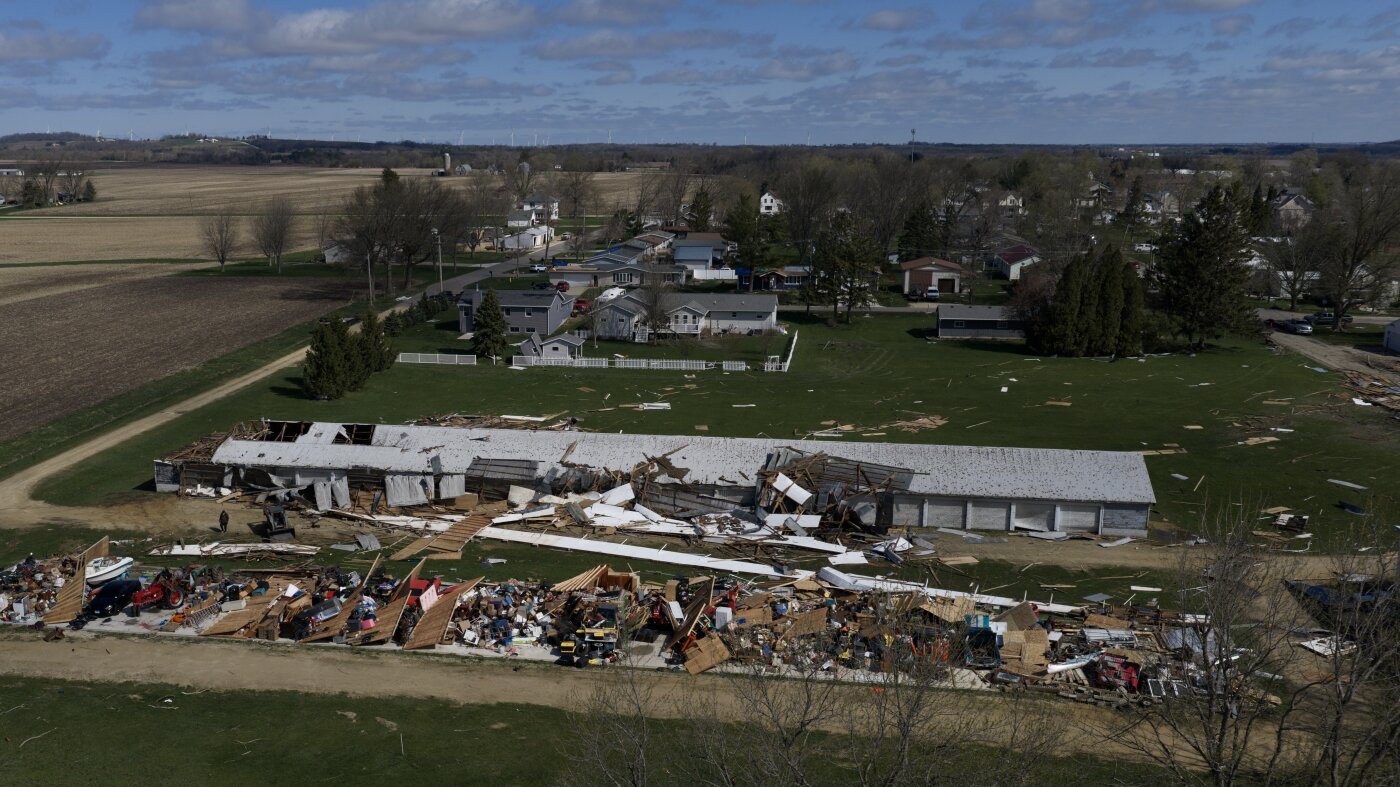
An aerial view shows damage from a tornado, on Saturday in Lena, Ill.
Scott Olson/Getty Images
hide caption
toggle caption
Scott Olson/Getty Images
Communities across the Upper Midwest are cleaning up after tornadoes and severe weather impacted the region over the weekend, damaging and destroying dozens of homes and knocking out power for tens of thousands.
“Numerous” severe storms were tracked across parts of Iowa, Illinois and Missouri on Friday, according to the National Weather Service. At least 66 tornado reports were submitted in multiple states including Oklahoma, Illinois, Missouri, Wisconsin and Iowa, the NWS Quad Cities IA/IL office said Sunday.
No deaths have been reported from the severe weather and tornado outbreak.

In Marion Township in Minnesota, about 30 homes were damaged and a dozen have significant damage because of a tornado, according to the Olmsted County Sheriff’s Office. The tornado also damaged at least 20 homes in Stewartville and there is a temporary shelter in Rochester for people displaced by the storms, according to MPR News.
“Tornado disaster recovery continues to occur at full speed,” the Olmsted County Sheriff’s Office said on Saturday.
In Illinois, McClean County officials declared a disaster emergency because of severe storms in Bloomington. “At this time, no injuries have been reported, and emergency response agencies remain actively engaged to ensure public safety and continuity of essential services,” officials said in a statement.
But further north in the village of Lena, an EF-2 tornado caused the “most significant damage” where “many homes and outbuildings were damaged, trees uprooted, and power lines downed,” the NWS said. Numerous roads have also been blocked by debris, the Stephenson County Sheriff’s Office also said.
People continue to clean up following a tornado, on Saturday in Lena, Ill.
Scott Olson/Getty Images
hide caption
toggle caption
Scott Olson/Getty Images
There have been no fatalities and no reports of serious injuries associated with the storm, Chief Deputy Andy Schroeder from the Stephenson County Sheriff’s Office told NPR on Sunday.
More than 43,000 customers lost power in Illinois but power was restored to almost all of them by Saturday night, according to electric utility ComEd.
Several tornadoes also occurred across Wisconsin, according to the NWS office in La Crosse. Twenty-six tornado warnings were issued by the office on Friday, the most in one day since the weather service office was built in 1995.
In one Marathon County town, 75 homes were destroyed by a tornado, according to Ringle Fire Chief Chris Kielman.
“It took out a whole residential area,” Kielman said, according to Wisconsin Public Radio.
The American Red Cross of Wisconsin said volunteers are helping those impacted by the storm with meals, shelter and support.
Parts of the state are still dealing with multiple rounds of severe weather and tornadoes from earlier in the week that brought flooding to some communities.
News
Video: Tornado Rips Through Rural Community in Nebraska
new video loaded: Tornado Rips Through Rural Community in Nebraska
By Jackeline Luna
May 19, 2026
Watch Today’s Videos
Severe Weather Threatens Tens of Millions in Midwest
0:39
A Hunger Crisis in Somalia Is Being Worsened by the Middle East War
1:21
Tornadoes and Thunderstorms Damage Hundreds of Buildings in Mississippi
0:16
Severe Storm Pummels Texas With Golf Ball-Sized Hail
0:32
Deadly Storm Brings Tornadoes and Severe Weather to North Texas
1:02
Tornado Strikes an Air Force Base in Oklahoma
0:52
Today’s Videos
U.S.
Politics
Immigration
NY Region
Science
Business
Culture
Books
Wellness
World
Africa
Americas
Asia
South Asia
Donald Trump
Middle East Crisis
Russia-Ukraine Crisis
Visual Investigations
Opinion Video
Advertisement
SKIP ADVERTISEMENT
News
Minnesota becomes first state to ban prediction markets
Minnesota has enacted the most far-reaching crackdown on massively popular services like Kalshi and Polymarket.
Steve Karnowski/Associated Press
hide caption
toggle caption
Steve Karnowski/Associated Press
Minnesota Gov. Tim Walz has signed the nation’s first law banning prediction market sites from operating in the state, and in response, the Trump administration has sued, teeing up a legal battle over the most far-reaching crackdown on popular services like Kalshi and Polymarket.
It comes as states confront a growing standoff with the Trump administration over how to regulate the industry, which allows people to bet on virtually anything.

The new state law makes it a crime to host or advertise a prediction market, which it defines as a system that lets consumers place a wager on a future outcome, like sports, elections, live entertainment, someone’s word choice and world affairs.
The prohibition extends to services supporting prediction markets, like virtual private networks, that could allow consumers to disguise their location and get around the ban.
It would force prediction market sites like Kalshi and Polymarket to leave the state, or face possible felony charges. The law takes effect in August.

“We as a state should decide how best and what regulations we think should attach to gambling, to protect public safety, to protect our kids,” said Minnesota Rep. Emma Greenman, the Democrat who introduced the measure.
The law has a carve-out for event contracts that serve as an insurance policy in the event of “harm, or loss sustained” and for the purchase of securities and other commodities.
The Commodity Futures Trading Commission’s lawsuit seeks to block the law before it starts, arguing the prediction market industry should be exclusively regulated by federal officials.
“This Minnesota law turns lawful operators and participants in prediction markets into felons overnight,” said CFTC Chairman Michael Selig. “Minnesota farmers have relied on critical hedging products on weather and crop-related events for decades to mitigate their risks. Governor Walz chose to put special interests first and American farmers and innovators last.”
Besides Minnesota, bills cracking down on the prediction market industry have been introduced in seven other states, according to the National Conference of State Legislators. Two of those states, Hawaii and North Carolina, have pending bills seeking to ban the industry statewide.

Experts say the cloud of legal uncertainty hanging over prediction markets apps have not slowed their rapid growth.
“The states are using any tactic they can to go after the prediction market companies,” said Melinda Roth, a professor at Washington and Lee University’s School of Law, who studies the industry. “But they’ve embarked on a too big to fail strategy and have become quite mainstream,” she said. “It will be hard to put that genie back in the bottle.”
A legal fight over the Minnesota ban is expected. Questions over whether states or the federal government should oversee the prediction market industry have already triggered more than 20 lawsuits. One of those cases, in Nevada, led to Kalshi pausing its sports betting in the state after a judge found it “indistinguishable” from state-regulated sports gambling.
The Commodity Futures Trading Commission has filed federal lawsuits against five states, including Arizona, Wisconsin and New York, attempting to override state regulators’ attempts to rein in the betting sites.

The CFTC has argued it has exclusive jurisdiction over prediction markets, even though former CFTC members and legal experts say bets on football games, words President Trump might say during a press conference and whether Ricky Martin will make an appearance at the Super Bowl are matters far outside its traditional scope.
In a statement to NPR, Kalshi spokeswoman Elisabeth Diana said banning prediction markets is a “blatant violation” of the law.
“Minnesota banning prediction markets is like trying to ban the New York Stock Exchange,” said Diana, adding that “this actively harms users because it reduces competition and drives activity offshore.”
A Polymarket spokesman told NPR that Minnesota’s ban runs counter to the federal government’s “established framework” for regulating prediction markets.
Tribal-owned casinos operate in Minnesota, but online gambling and sports betting are not legal in the state.
Prediction markets like Kalshi and Polymarket have given access to sports betting to people in states where the activity is prohibited, since the Trump administration regulates the sites as a type of “event contract,” rather than gambling, which typically is overseen by state gaming authorities.
Nonetheless, sports gambling powers the sites. On Kalshi, for instance, more than 85% of trading activity is related to a sporting event, some of those trades being “parlays,” high-risk wagers that multiple things, points scored, fouls, passes, will all happen.

Bettors on the sites are making billions of dollars in trades every week, even as questions around insider trading and how the markets can create perverse incentives for people to manipulate real world outcomes continue to vex the companies.
Minnesota Public Radio News reporters Dana Ferguson and Peter Cox contributed reporting to this story.
News
Video: Deal Ends Long Island Rail Road Strike
new video loaded: Deal Ends Long Island Rail Road Strike
transcript
transcript
Deal Ends Long Island Rail Road Strike
The Long Island Rail Road strike ended after transit officials and union representatives reached a deal. Tuesday’s commute was expected to be disrupted even as regular train service resumed.
-
No contract, no trains. No contract, no trains. No contract, no trains. It has been absolutely awful. It’s been three and a half hours to get to work because I work in the South Bronx. It was actually smoother than I had anticipated. It was just longer. I got on the bus in five seconds. We took off about two minutes later, so that was great. But the problem was the traffic was crazy. So as a union worker, I stand for the union. I think that for three years they knew this was up and coming. I just felt like there should have been better preparation. I’m a teacher and I’m a union member. I also pay monthly fares and they’re expensive so I can see both sides. I don’t really want to play the blame game on it.
By McKinnon de Kuyper, Michael Anthony Adams and Jiwoong Hong
May 19, 2026
-
Iowa3 minutes ago
Gov. Kim Reynolds signs Iowa law restricting mail-order abortion pills
-
Kansas9 minutes agoSheriff: Colorado couple jailed in Kansas for transporting drugs
-
Kentucky15 minutes agoTrump-endorsed Ed Gallrein unseats Rep. Thomas Massie in Kentucky GOP primary
-
Louisiana21 minutes agoLouisiana run-rules Marshall, advances to Coastal rematch
-
Maine27 minutes agoSouth Portland discusses use of Flock cameras in city
-
Maryland33 minutes agoNew York man sentenced to 40 years for injuring Maryland deputy during pursuit
-
Michigan39 minutes agoAnti-Semitism increasingly targeting Southeast Michigan communities
-
Massachusetts45 minutes agoMissing Holyoke man identified after body found in Connecticut River