Business
Don't call them 'extras.' For one night, Hollywood's background actors are the real stars


Striking a distinguished look in a gray suit with coiffed white hair, Vincent Teixeira stepped up to the podium, standing in front of fellow film and TV actors who filled the house at the 99-seat Eastwood Performing Arts Center in East Hollywood.
Like an old-timey silent movie performer, he then began gesturing with his arms and soundlessly mouthed words.
He paused for effect, before delivering the punchline. “Oh, we get to speak tonight,” he said, to laughs and applause from the crowd.
Teixeira’s joke especially resonated with this particular audience — nominees and supporters of the annual Los Angeles Union Background Actors Awards. People came dressed in tuxedos and full-length gowns, though others were in jeans and casual button-downs, to honor a category of performer better known for fading into the edges of the frame than seizing the spotlight.
For seven years, background actors have been recognizing their own at the ceremony — a show not televised or affiliated with the Screen Actors Guild-American Federation of Television and Radio Artists, many were careful to say, though all of the nominees must be SAG-AFTRA members and several union representatives were in attendance.
The coveted prize? A mini Oscar-esque statuette known as a Blurry.
There are Blurries for best first responder look, best background actor ensemble and favorite casting director. The group even handed out a lifetime achievement award honoring Patrick Harrigan, a longtime background actor who has worn many hats over the years and got his start as a 12-year-old in the 1969 film “Hello, Dolly!”
Attendees had appeared in shows such as Netflix’s “A Man on the Inside,” medical drama “Doctor Odyssey” and FX thriller “Grotesquerie,” though they’d be far from household names. They gathered in the lobby of the theater, taking photos on the small red carpet in front of a backdrop bearing the award show’s name, or catching up while buying drinks and munchies from the small snack bar. Inside the theater, the stage was sparse, with only a floor-to-ceiling screen with the show’s logo.
The Blurries are, at times, tongue-in-cheek, as presenters poked fun at Hollywood and themselves, but the humor belies a more serious point — these are actors who desire respect, both from their colleagues and the industry.
“It’s part of Hollywood,” Harrigan told The Times. “We’re also in front of the camera, and we’re an important part of TV and film.”
The role of a background actor is intentionally subtle.
Actors attend the Los Angeles Union Background Actors Awards on Sunday, Feb. 16, 2025, in Los Angeles.
(Jason Armond / Los Angeles Times)
They populate film and TV sets to make the on-screen world more vibrant and real. Their silent but purposeful presence gives energy to the principal actors, helping to create an environment where they can inhabit their roles. They’re the other patrons at the “Friends” coffee hangout Central Perk; the other drinkers at the “Cheers” bar; the nonsinging and dancing Munchkins who gathered to greet Dorothy in “The Wizard of Oz.”
Years ago, the awards committee tossed around names like the “Backie” — a nod to “background actor” — but it was the Blurry that stuck. After all, that’s what background actors are.
“It’s our job to be blurry. We don’t stand out,” said Vincent Amaya, chair of the awards committee, who has been a background actor for 17 years. “I get more work the blurrier I am. If I’m featured, I’m not on that show again, unless it’s as the same character.”

Vincent Amaya, co-chair of the Los Angeles Union Background Actors Awards: “It brings recognition to background actors. We need to show we are professionals, and we are needed.”
(Jason Armond / Los Angeles Times)
The homegrown awards show subsists entirely on ticket sales, which range from $20 to $40, depending on the time of purchase — and the occasional donation — and has never turned a profit, he said. Regardless, the show goes on.
“It brings recognition to background actors,” said Amaya, who has helped run the event for years. “We need to show we are professionals, and we are needed.”
In some ways, the background actor awards are not unlike the efforts from other categories of actors, such as stunt performers, to demand more respect from the industry. And like many in Hollywood, background actors have faced a difficult last few years.
First, there was the COVID-19 pandemic, which shut down productions and limited acting opportunities. In 2023, they endured the dual writers’ and actors’ strikes, where many of them picketed alongside their more recognizable colleagues.
More recently, the Southern California fires destroyed homes and disrupted their livelihoods. Looming over everything is the constant stream of productions moving out of L.A. to other states and countries.
“I’m sure the locusts are on the way,” quipped show host Mike Siegel, a stand-up comedian who has hosted shows on HGTV and TBS, and poked fun at himself for his own anonymity.
But his onstage remarks quickly took a more serious tone.
“We’re celebrating people here who show up,” he said during his monologue. “Don’t let anyone demean what you do.”
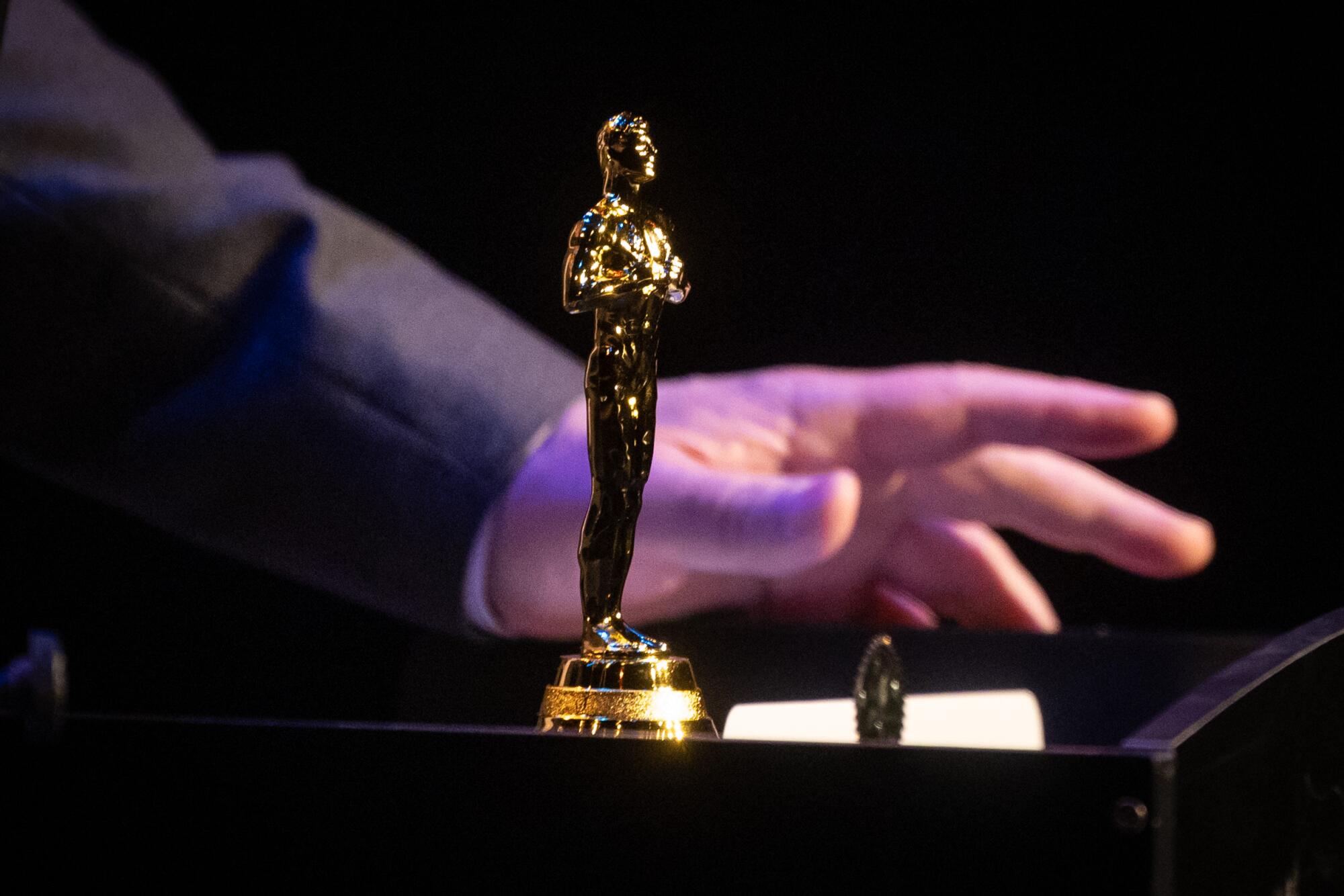
When the awards committee tossed around names for the statuette years ago, Blurry was the one that stuck. “It’s our job to be blurry. We don’t stand out,” background actor Vincent Amaya said.
(Jason Armond / Los Angeles Times)
Unlike a typical awards show, the acceptance speeches didn’t include laundry lists of thank yous to studio heads. Instead, winners often thanked their fellow nominees or other crew members for helping them get jobs, reiterated the importance of their work or took the moment to address specific concerns for their profession.
For some, that starts with addressing the colloquial term for background actors — “extras” — which some bristle at.
“Can we please stop calling each other ‘extras’?” Karen Shelton Brown, who won for best female background actor, said during her acceptance speech. “I am not an extra. We all are actors.”
Harrigan, the lifetime achievement award recipient, called for a very public sign of respect: a star on the Hollywood Walk of Fame for background actors.

Patrick Harrigan wins the Lifetime Achievement Award at the Los Angeles Union Background Actors Awards in February 2025.
(Jason Armond / Los Angeles Times)
“We’ve been in front of the camera for over 100 years. But we’re not really recognized,” he said. “I know it sounds really weird … but, you know, stranger things have happened.”
Even that small piece of recognition would be a start for folks taking on such an unglamorous, anonymous role. Early morning call times, 14-hour days and performing in inclement weather are all part of the gig.
Wendy Alter, 65, remembered a five-day shoot on the set of the NBC drama “This Is Us,” where she and other actors filmed near a pool in Long Beach in 40-degree weather, while it was raining.
“It was absolutely freezing,” she said. The producers, crew and cast “were trying to be as good as they could to us, but it’s not easy.”
Originally from Beaumont, Texas, Alter first got into background acting to learn her way around L.A. and meet people. That was in 1998, and she has been doing it since. A full-time background actor, she spent six years with “This Is Us” and nine years on the sitcom “Modern Family,” where she also worked as a stand-in for Rico Rodriguez, who played Manny Delgado, and Ariel Winter, who starred as Alex Dunphy.
“I enjoy the aspect of watching the creation come through with actors and set dressing and our producers and just the whole aspect of this industry,” said Alter, who worked as an executive vice president of a jewelry store chain before coming to Hollywood. “Every day is like a new day; it’s never the same.”
Alter later presented the award for best male background actor, a title that rewarded the performer with a quiet but masterful presence, she said onstage, who helped create a world that was “genuine” and “alive.”
Nominees were judged on their professionalism by a secret committee that has, on average, more than 20 years of experience in background acting.
Past categories have included best time period look, an award for background actors who are older than 18 but whose youthful looks mean they can play teenagers (crucial for high school shows); and one for special ability, which can include any unique skill such as archery, juggling, bowling or a musical instrument. After all, every movie with a rock concert needs a drummer.
Last year, Scott Perry and his fellow background actors from the Disney+ “Star Wars” hit “The Mandalorian” won for best ensemble. In true showbiz fashion, the event’s bartender came out with the rest of the attendees to accept the award.
This year, Perry won for best featured background actor for his work in the sitcom “Night Court.” Though he didn’t utter a word, the chance to stand toe-to-toe with public defender Dan Fielding, played by actor John Larroquette, in front of a live studio audience was “unreal,” he told The Times.
“I’ve grown out my beard, so I’m a lot more distinct-looking … a lot less background-y,” he said, with a laugh, gesturing to the bushy salt-and-pepper facial hair that accentuated his black tuxedo. “When I do get hired, I’m actually featured a lot more often.”
Marketing and consulting work pays the bills for Perry, who is in his 50s, so background acting is his secondary gig. But he puts in the hours to improve his craft, taking classes at the SAG-AFTRA Los Angeles Conservatory and learning everything he can about the business.
He’s concerned about the future implications of artificial intelligence in production, but such technology — at least for now — is expensive. Background actors are a lot cheaper, he said. (In the most recent SAG-AFTRA contract, the union negotiated a provision to put guardrails on usage of digital replicas of actors, which included additional protections for background actors.)

Wendy Alter presents the best male background actor award at the Los Angeles Union Background Actors Awards in February.
(Jason Armond / Los Angeles Times)
“Maybe that’s our salvation right now,” he said.
Despite the challenges, the mood at the awards show was congenial, with attendees shouting out to one another onstage, in the lobby and from their cars as they pulled into the parking lot. Winners such as Farrah Hines, 48, collected hugs along the theater’s stairs after receiving awards onstage.
Winning the Blurry for best female single-cam stand-in was especially meaningful for Hines, who said she commuted from Las Vegas to L.A. every week for four years to get acting work and maintain health insurance for her kids.
She got her start as a stand-in on the Tia and Tamera Mowry sitcom “Sister, Sister” in 1998 but eventually took a 15-year break from the business to raise a family. (Stand-ins substitute for actors to help the crew with lighting, camera blocking and other behind-the-scenes work so the shoot can stay on time and budget; stand-ins on multi-camera sitcoms will also deliver lines to see whether the jokes land as written.)
After her children grew into teenagers and she finalized her divorce, she chose to get back into acting. She’s a full-time stuntwoman, in addition to her stand-in work, which includes ABC procedural “High Potential” and a previous gig on Disney’s “Ahsoka,” standing in for Rosario Dawson. In February, she and her kids moved to Redondo Beach, ending her multi-hour weekly commutes.
“As long as I can stand up, I will stand in,” Hines said during her acceptance speech. The audience, free to make noise, applauded.


The luxury shopping center in Pacific Palisades will reopen next month after more than $100 million in renovations forced by the January 2025 wildfire that devastated the Los Angeles neighborhood.
Palisades Village will reopen Aug. 15, owner Rick Caruso announced Wednesday. The outdoor center survived the blaze that destroyed homes and other businesses but needed refurbishment to eliminate contaminants that the fire could have spread.
Crews are putting finishing touches on mall buildings after tearing them down to the studs, treating the wood and rebuilding the walls, Caruso said.
“Everybody’s working, and stores are moving their products in,” he said. “It’s a really cool feeling that people have really locked arms and are working together.”
An electrician installs lighting for a restaurant at Rick Caruso’s Palisades Village on Thursday. The shopping center is scheduled to reopen mid-August.
(Myung J. Chun / Los Angeles Times)
Pacific Palisades resident Allison Polhill, who is rebuilding the home of 30 years that her family lost in the blaze, said she is “thrilled” at the prospect of returning to the mall she used to frequent. Its comeback is a boost for the community, she said.
“Every single step that we make to reopen our commercial corridors is going to bring more people back into the Palisades,” said Polhill, who expects to move back into her home at the end of August.
A total of 6,822 structures were destroyed in the Palisades fire, including more than 5,500 residences and 100 commercial businesses, according to the California Department of Forestry and Fire Protection.
Caruso previously attributed the mall’s survival to the hard work of private firefighters and the fire-resistant materials used in the mall’s construction.
The $200-million shopping and dining center opened in 2018 with a movie theater and a roster of upmarket tenants, including Erewhon, which may be the only grocer in the heart of the fire-ravaged neighborhood when it opens.
Caruso’s company was able to fill the mall with tenants despite the long shutdown.
Palisades Village is 99% leased, with the majority of tenants returning, said Jackie Levy, chief financial and revenue officer. Nearly one-third of the shops and restaurants are new to the property.

A firefighter carries a hose back to his rig while walking through a destroyed home from the Palisades fire in Pacific Palisades on Jan. 7, 2025.
(Genaro Molina / Los Angeles Times)
Last year, Pacific Palisades-based fashion designer Elyse Walker said she would reopen her eponymous store in Palisades Village after losing her 25-year flagship location on Antioch Street to the inferno.
Other neighborhood shops destroyed in the fire that are reopening at the mall include K Bakery and Loomey’s Toys, which caters to children up to age 12 and used to be across the street from Palisades Elementary Charter School.
“It’s been a journey and I’m excited because I wasn’t sure that there was going to be a place to come back to,” said toy store owner Amanda Rastegar. “Hopefully we can bring some of that magic back.”
Rastegar’s home in the Palisades survived but was damaged by the fire. The family returned about eight weeks ago. Her last memory of the fire was a burning supermarket.
“I just couldn’t wrap my brain around what was happening,” she said. “By the time I left, Gelson’s was on fire.”
Among the returning tenants is Angelini Ristorante & Bar. Well-known Los Angeles chef Gino Angelini said he will be in the kitchen next month for a return of the Italian restaurant.
“We won’t do a big celebrity open,” he said. “We want to have a very soft opening and see our customers come back.”

Construction takes place at Rick Caruso’s Palisades Village on Thursday. The shopping center is scheduled to reopen mid-August.
(Myung J. Chun / Los Angeles Times)
An elaborate celebration would not feel “correct for me,” Angelini said, because the devastation has been “very sad” for so many.
Other new tenants include local chef Nancy Silverton, who has agreed to move in with a new Italian steakhouse called Spacca Tutto. Women’s activewear retailer LESET will open its first West Coast location.
Caruso said he is optimistic that customers will return to the center, even though many Pacific Palisades residents are still dispersed. One tracking system estimated that about 30% of the Village’s customer base was impacted by the fire, he said.
“That means 70% did not get impacted, so there’s a lot of customers still left out there,” Caruso said. Historically, the center drew customers from as far away as Beverly Hills and Calabasas, as well as Malibu, Brentwood and Santa Monica.
He also hopes many will be inspired to visit the revived mall.
“I believe in the goodness of people and I believe that people are going to want to support the Palisades,” he said. “They’re going to want to be there and support the businesses that have had the courage and the heart to reopen.”

Walmart is rapidly expanding its network of electric vehicle chargers designed for customers to use while they shop.
The network could help fill gaps in EV infrastructure in states with greater need for chargers. Walmart, which has more than 5,000 locations in the U.S. and hundreds in California, says more than 90% of Americans live within 10 miles of one of its stores.
The chargers also offer an incentive for customers to choose Walmart — Walmart Plus members will receive a 10% discount off an average price of $0.46 per kilowatt-hour of energy at the company’s chargers.
Walmart chargers are already available at more than 75 locations in 17 states, with Texas boasting the most charging stations, followed by Florida and Arizona.
Matthew Nelson, Walmart’s director of energy policy, said last week on LinkedIn that the network will soon reach 29 states, including California.
“We are delivering on the promise of affordable, reliable and convenient charging,” Nelson said in his post.
According to Walmart’s website, six charging stations are coming to California soon, though the company did not offer a specific timeline.
The chargers will be installed at stores in Antelope, Brea, Fresno, Stockton, Suisun City and Vallejo.
Most charging sites in California will include eight to 16 fast-charging stalls, said Walmart spokesperson Kelsey Bohl.
The company first announced plans in April 2023 to install its own EV chargers at Walmart and Sam’s Club stores, with a goal of installing thousands of chargers by 2030. Partnering with ABB E-Mobility and Alpitronic, it added 25 new charging sites this past May and six more in June.
“Walmart is building a leading retail-integrated EV fast-charging network, focused on delivering an affordable, reliable and convenient charging experience where customers already shop,” Bohl said in an emailed statement. “Customers can charge while they shop, access stations through the Walmart app they already use, and benefit from affordable pricing.”
The charging stations already available include 612 individual charging stalls using 400-kilowatt chargers. Each stall has a dual charging cord with both Combined Charging System and North American Charging Standard connectors. The standard connectors, designed by Tesla, are smaller and lighter than the combined systems.
The primary way to pay for the chargers is through the Walmart app, but the company is also experimenting with built-in credit card readers to allow those without the app to use the stations.
Customers can check charger availability on the Walmart app. The company said the chargers will be available 24 hours a day.

Robotaxis could be turning into robocops.
A self-driving Waymo reported two teens to San Mateo, Calif., police on Monday after they were found drinking alcohol and shooting toy guns in the back of the vehicle.
According to a social media post from the San Mateo Police Department, officers detained two 15-year-olds after the Waymo they were riding in contacted the department and stopped in a parking lot until law enforcement arrived.
“Parents do you know where your teens are?” the San Mateo Police Department wrote on Facebook following the incident. “Waymo does!”
Officers removed both teens from the vehicle and determined they were using toy guns to shoot Orbeez out the windows. Orbeez are small, water-absorbing beads sold at toy stores.
“Toy guns, water guns, and BB guns all pose real dangers, especially to an untrained eye,” the Police Department said. “The simple handling of them can cause fear in [passersby].” “
A video posted on Facebook shows at least five officers and a police dog responding to the scene and approaching the Waymo with their weapons raised.
Waymo did not immediately respond to a request for comment.
Waymo vehicles have internal cameras and microphones that may be used in an emergency or to “promote safety and security,” according to Waymo’s online support page.
The cameras are also used to ensure the vehicles are clean and to help find lost items, according to the support page.
The company said it does not use facial recognition or other biometric identification technologies to identify individuals.
“In more urgent circumstances, support may access live video during a trip,” the Waymo page said.
The San Mateo Police Department’s Facebook post has garnered nearly 60 comments, with one user accusing Waymo of “snitching.”
“At least they got a designated driver?!” one user commented.
-

 Mississippi20 seconds ago
Ben Crump seeks independent autopsy in Nolan Wells death
-

 Missouri6 minutes ago
Missouri politicians champion unity, diversity on America’s 250th
-

 Montana13 minutes ago
Montana signs onto data center energy cost protection pledge
-

 Nebraska16 minutes ago
Gov. Jim Pillen calls for budget cuts, hiring freeze in new memo
-

 Nevada21 minutes ago
UNR tests whether cow manure can help restore Nevada landscapes after wildfires
-

 New Hampshire28 minutes ago
New Hampshire’s boutique Centennial Hotel sold to Lord Hotels
-

 New Jersey31 minutes ago
7 On Your Side helps man recover his stolen iPhone from safe pickup site
-
.jpg?w=400&resize=400,240&ssl=1 "Ex-Barcelona defender takes over as new Mexico boss as Javier Aguirre leaves after England defeat | Goal.com US")
.jpg?w=80&resize=80,80&ssl=1 "Ex-Barcelona defender takes over as new Mexico boss as Javier Aguirre leaves after England defeat | Goal.com US") New Mexico36 minutes ago
New Mexico36 minutes agoEx-Barcelona defender takes over as new Mexico boss as Javier Aguirre leaves after England defeat | Goal.com US

