Business
Column: Is UCLA 'a failed medical school'? Debunking a dumb right-wing meme

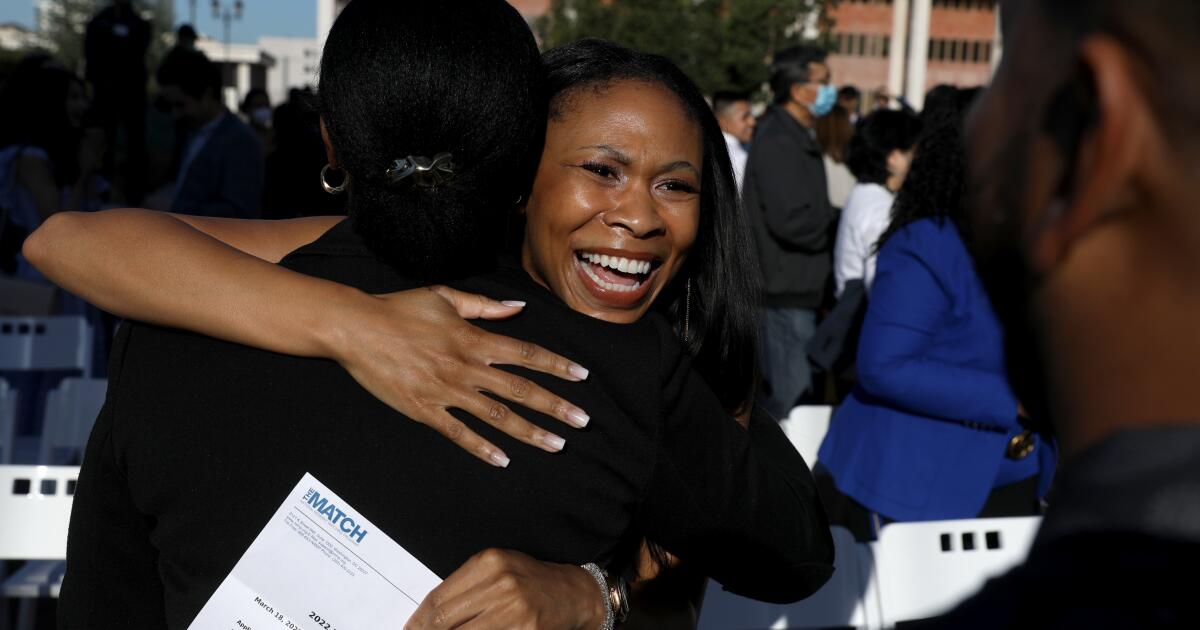
The right-wing and Republican project to eradicate diversity and inclusiveness from American society has become more absurd with every passing day, but it will be hard for anyone to produce a more vapid and fatuous effort than a recent article labeling UCLA’s David Geffen School of Medicine as a “failed medical school.”
The reason for that label, according to the right-wing Washington Free Beacon, which published the article, is that UCLA has “prioritized diversity over merit, resulting in progressively less qualified classes that are now struggling to succeed.”
To its perverse credit, the Beacon doesn’t conceal the racist import of its claims; on the contrary, it announces it outright, citing the school’s “race-based admissions” and quoting one of its anonymous sources (there is no other category) as saying, “We want diversity so badly, we’re willing to cut corners to get it.”
We’re not backing off from diversity, equity and inclusion in our medical school curricula. It’s really intended to train the next generation of physicians to respond appropriately to a rapid growth in diversity.
—
Steven Dubinett, dean, UCLA School of Medicine
An admissions officer is quoted anonymously as grousing, “All the normal criteria for getting into medical school only apply to people of certain races. For other people, those criteria are completely disregarded.”
The article purports to rely on complaints from eight of the school’s faculty members. The medical school’s full-time faculty numbers more than 2,000, with an additional 2,000 to 2,500 part-timers or adjuncts. That should give you a clue to how deeply the Beacon delved into the facts before issuing its eye-catching conclusion.
But that’s only one aspect of a piece that trips over its supposed “facts” at almost every turn, openly cherry-picks data to confirm its biases, and treats every factoid as an artifact of the quest for diversity. Its author doesn’t even appear to understand the difference between the student admissions process and the process of accepting residents, who are medical school graduates, many if not most of whom received their medical education elsewhere.
“I consider it to be fact-free,” Steven M. Dubinett, the school’s dean, told me about the Beacon article. He’s being kind.
Before delving into the article itself, a few words abut the Washington Free Beacon. The Beacon was founded in 2012 with funding from, among other conservatives, hedge fund billionaire Paul Singer. Its first editor was co-founder Matthew Continetti, who is a son-in-law of conservative pundit Bill Kristol.
The Beacon’s driving impulse appears to be “owning the libs,” as shown by its preening over its role in advancing the criticism of former Harvard President Claudine Gay for what many in the academic community regard as trivial cases of plagiarism.
That scandal-mongering was basically the handiwork of right-wing attack dog Christopher Rufo, who carried the theme further by accusing other Harvard figures of plagiarism; curiously, as the Harvard Crimson notes, they were all Black women, like Gay.
The Beacon’s tone was described as “puckish” by a Washington Post writer who apparently doesn’t know what “puckish” means; he praised it in the same article as standing a hair above other right-wing websites, which strikes me as a bit like trying to identify the best “Sharknado” movie. The basis of his praise was that the Beacon “does significant reporting of its own.” But if “significant” means “cogent,” that quality isn’t much in evidence in the article about UCLA.
So let’s pick up our endoscopes and take a look inside.
The main target of the article is Jennifer Lucero, who became associate dean for admissions in June 2020. The article posits that her arrival in that post, and her focus on diversity, led to a precipitous drop in the quality of incoming students. More on that in a moment.
The article’s empirical assertions, such as they are, start with the annual medical school rankings of U.S. News and World Report. These have been controversial for years, in part because their methodology is suspect. As a result, many of the top-ranked schools have stopped cooperating with them, though the University of California still participates.
The article’s author, Aaron Sibarium, wrings his hands over the fact that UCLA’s ranking in “research” has fallen to 18th from sixth place in just the first three years after Lucero’s arrival.
Couple of problems there. One is that research ranking tracks the activities of faculty members, not students. It has nothing to do with the record of the incoming class. Dubinett says that one reason UCLA may have fallen in the rankings is that it has assigned more faculty to clinical education rather than research, so the grant level per faculty has naturally declined.
But that’s not the only measure of research quality. Consider the grant approvals by the National Institutes of Health, the nation’s leading source of public grants in medicine. UC as a whole has consistently been a top recipient of NIH grants — ranking first in the nation since at least 2000 and probably for much longer than that. For most of that period, UCLA has been the second-largest recipient among UC campuses behind the research powerhouse of UC San Francisco.
From 2010 through 2019 and again in 2022 UCLA fell to third behind UCSF and narrowly behind UC San Diego, but for three of the four years of Lucero’s tenure it’s been second. There’s no sign there of a decline in research stature.
Sibarium, who did not respond to a request for comment, deserves an F in that category but an A for cherry-picking. On the other metric that U.S. News uses consistently, primary care, UCLA has risen in rank since 2020, to 10th in the nation from 11th. And in other categories, the school’s ranking has risen since 2020 — for example to seventh from 10th in internal medicine and sixth from 12th in pediatrics.
Sibarium’s other “gotcha” concerns the UCLA students’ records on shelf exams, which are given after each clinical rotation. He asserts that their failure rates have risen precipitously during the Lucero era: “As the demographics of UCLA have changed,” he writes, “the number of students failing their shelf exams has soared.” He quotes a professor, anonymously, saying, “Faculty are seeing a shocking decline in knowledge of medical students.”
But as he acknowledges, UCLA dramatically changed its academic schedule in 2020. Along with many other top schools, it moved students out of the classroom in the second of their four years of education, instead of waiting for the third. That deprived students of a full year of clinical training before they took the shelf, so of course they did worse. But the official chart illustrating Sibarium’s article shows that the failure rate on most clinical specialties has fallen as the students progressed from Year 2 to Year 3.
“The challenge of moving the exams earlier has been written about,” Dubinett says. But the trend lines show that by the end of their third year, well more than 90% of UCLA’s students are passing the shelf exams in almost every clinical discipline.
The Beacon’s brief against Lucero is tied to its evident resentment of diversity programs. Sibarium points to a required first-year course titled “Structural Racism and Health Equity,” which comprises “three to four hours every other week,” as though a twice-monthly course is supposed to be an unsupportable burden to medical students.
Is there a point to that sort of training? Of course there is: “We’re cognizant that more than 80% of health is based on social determinants,” Dubinett says, pointing out that the phenomenon was very much on display in racial and ethnic disparities in treatment and outcomes during the pandemic.
“These inequities result, in large part, from racial and ethnic minority populations’ inequitable access to health care, which persists because of structural racism in health care policy,” according to a 2022 paper in Health Affairs.
“We’re not backing off from diversity, equity and inclusion in our medical school curricula,” Dubinett says. “It’s really intended to train the next generation of physicians to respond appropriately to a rapid growth in diversity.” In few other places are the impacts of inattention to social conditions more evident than in Los Angeles, he says. “We can look no further than what’s outside our front door — if I drive 15 minutes to the south from my office, life expectancy falls by 15 years.”
The Beacon even states that diversity efforts at UCLA may be illegal or unconstitutional, since the state’s voters outlawed racial preferences at public institutions in 1996 and the U.S. Supreme Court overturned them nationwide last year.
To support this absurd claim, Sibarium turns to Adam Mortara, the lawyer who represented the plaintiffs in the Supreme Court case. Asking for information about an applicant’s race when “no lawful use can be made of it” is “presumptively illegal,” Mortara said. He added, “You can’t have evidence of overt discrimination like this and not have someone come forward” as a plaintiff.
The problem here is that there’s no evidence that the medical school has applied racial or ethnic standards to its applicants. Sibarium admits as much: The application committee “for students does not see the race or ethnicity of applicants,” he writes. So where’s the beef?
Sibarium insinuates that Lucero has exercised undue influence over residency acceptances. But he finds that she’s a member of the hiring committee only for anesthesia residents (anesthesia is Lucero’s medical specialty). Couple of issues here. One is that almost no one gets hired for a medical residency anywhere without an interview, either in person or by zoom, which is designed to give the committee a holistic sense of the applicants’ character and personality, not just their test scores.
Another is that by the author’s own admission, Lucero hasn’t been especially effective in instituting diversity tests for anesthesia residents. He cites one case in which she advocated that a white candidate be ranked downward and another in which she “insisted that a Hispanic applicant who had performed poorly on her anesthesiology rotation in medical school should be bumped up.” As it happened, he reports, “neither candidate was ultimately moved.”
(As for a case Sibarium mentions in which Lucero supposedly pushed to admit a Black student whose grades and test scores were below the UCLA average, he doesn’t say whether the student was admitted.)
It’s true that the UCLA entering medical school class has become more diverse over time. Figures issued by UCLA and published by the Beacon show that from 2019 through 2022, the number of whites in the 173-member class declined to 46 from 49, the number of Black students rose to 25 from 22, Hispanic students rose from 25 to 37, a catchall “other” category grew to 20 from eight, and American Indians, Hawaiians and other Pacific Islanders went from zero to three. The number of Asian students declined to 55 from 84.
Does this validate the article’s claim, voiced by an anonymous source, that “a third to a half of the medical school is incredibly unqualified”?
The math doesn’t pencil out. As blogger and statistics maven Kevin Drum notes, given that the number of nonwhite and non-Asian students increased by only 30 ion three years, even if “every single one of these students was woefully unqualified, that’s about 17% of the class. How do you get from there to ‘a third to a half’?”
By the way, the median grade point averages and scores on the Medical College Admission Test of accepted applicants haven’t declined at all since 2020 — the MCAT average in 2023 was the same as in 2020, and the GPA rose by a hair.
In emails to the medical school class, Dubinett and his fellow deans have reinforced their commitment to merit-based admissions and diversity training. “Students and faculty members are held to the highest standards of academic excellence,” they wrote. “Highly qualified medical students and trainees are admitted … based on merit in a process consistent with state and federal law.” That said, “we are enriched by the diverse experiences each of you brings to our community.”
UCLA, then, is standing firm against the right wing’s drive to pretend that racial and ethnic discrimination doesn’t exist in our society and to undermine efforts to wipe it out. Would that more institutions took that stand, instead of capitulating to a dishonest, braying mob.


Surcharges that California homeowners have been hit with statewide by insurers defraying the costs of Los Angeles County’s wildfires were ruled legal in a decision released late Tuesday.
L.A. County Superior Court Judge Tiana Murillo turned down a petition by advocacy group Consumer Watchdog to halt the charges, which insurers began levying last year after the state’s insurer of last resort couldn’t pay all its January 2025 fire claims.
The California FAIR Plan, financially backed and operated by the state’s licensed home insurers, needed a $1-billion bailout from the insurers after it was hit with some $4 billion in claims.
Under a deal Insurance Commissioner Ricardo Lara worked out with the FAIR Plan in 2024, the insurers could seek state approval to surcharge their residential policyholders for up to half of any assessment totaling $1 billion in case the plan needed a bailout in an “extreme worst case scenario” — as it turned out it did.
A total of 105 insurers, including State Farm General — California’s largest home insurer — Farmers and Mercury sought and received approval for the surcharges.
Because the FAIR Plan assessed its member insurers based on their share of the state’s home insurance market, the policyholder surcharges were in the same ballpark. The median fee for homeowners was $28, according to the department of insurance.
The fee can be more or less according to the size of a homeowner’s premium and is split into monthly payments that insurers can spread over one or two years. Condo owners and renters on average were surcharged less.
In a court filing, Consumer Watchdog said $420 million in surcharges were approved.
In its April 2025 lawsuit filed against Lara, the Los Angeles group made a series of arguments in seeking to overturn the residential surcharges, which it deemed an industry bailout. It did not sue over related commercial surcharges.
Consumer Watchdog contended in its lawsuit that the surcharges violated Proposition 103 — the 1988 measure that governs insurer rate hikes — because the proposition does not allow for them.
It also claimed Lara did not follow regulatory protocol in promulgating the new policy.
The group further alleged that the FAIR Plan’s governing statutes do not give Lara the authority to permit the surcharges — and that the statutes require insurers to share in the plan’s profits and losses, and not shift losses to policyholders.
Murillo, and another judge who previously heard the case, turned down all of the consumer group’s arguments in separate rulings, the last of which Murillo issued Tuesday night.
Lara celebrated his legal victory over Consumer Watchdog, which has accused Lara of having close ties to insurers and sought to oust him from office. His terms ends in January.
“This victory sends a loud and clear message: The era of allowing special interests to derail consumer choice is over. We have the momentum, we have the authority, and we will continue to fight until every Californian has access to the coverage they deserve,” Lara said in a statement.
Attorney Will Pletcher, litigation director of Consumer Watchdog, said the group disagreed with the decision and would “consider all options to move this forward.”
“It’s important to try to protect California consumers from these surcharges that we think are in pretty clear conflict with both Proposition 103 and the FAIR Plan,” he said.
Hilary McLean, a spokesperson for the plan, said in a statement it did not have any position on the ruling, given the plan “does not have a role in determining how insurers manage costs associated with assessment.”
Denni Ritter, vice president of state government relations for the American Property Casualty Insurance Assn., a major industry trade group, said the decision rejected “the reckless lawsuit brought by the self-interested group Consumer Watchdog…”
“This ruling preserves a vital tool to protect the stability of the California insurance market. Blocking cost recovery would have undermined the state’s last-resort coverage option,” she said in a statement.
The 2024 policy was issued in response to the rapid growth of the plan due to a series of wildfires over the last decade that prompted multiple insurers to retreat from the state’s home insurance market.
The plan had 264,000 homeowners on its rolls in September 2022, a figure that rose to 452,0000 in the months before the fires — and its residential policyholders have since increased to 663,000 as of March.
The FAIR Plan offers policies that typically cost more than those issued by regular insurers while offering less coverage.
A Times analysis last year found that in the Palisades and Eaton fire zones, the plan’s rolls nearly doubled to 28,440 from 2020 to 2024.
That concentration of policyholders led to the plan’s large losses during the Jan. 7 wildfires, which damaged or destroyed more than 18,000 structures, killing at least 31 people.
It’s been estimated that the insured losses for the wildfires could ultimately total as much as $40 billion, exceeding any past wildfires worldwide. Ritter said that so far insurers have paid $23.7 billion in claims.
The 2025 wildfires were not the only time the FAIR Plan has needed a bailout, though it is the first time its member insurers surcharged policyholders.
In 1993, it assessed carriers after fires in Altadena and Malibu, and in 1994 it did so after the Northridge earthquake. The assessments totaled $260 million.
The plan received approval this year from the insurance department for a 29% rate increase for its homeowner dwelling policy that will take effect in October.

An electric Tesla Semi truck crashed into two vehicles in Dayton, Nev., over the weekend, killing two people and raising questions about the truck’s safety features.
The Lyon County Sheriff’s Office responded to a major collision around 7 a.m. on Sunday at the intersection of Highway 50 and Traditions Parkway about 40 miles east of Reno, the office said.
The office confirmed a semi-truck was involved in the accident, and footage of the scene shows it was a Tesla Semi.
It is the first known crash involving a Tesla Semi, an electric Class 8 truck that Tesla is building in Nevada and plans to ramp up production of. As interest in Tesla’s electric passenger vehicles wanes, the company is betting on the truck to give it a needed boost.
The trucks do not have the Full Self-Driving mode available in Tesla cars, but Tesla’s website says they come standard “with active safety features that pair with advanced motor and brake controls to deliver traction and stability in all conditions.”
According to the Lyon County Sheriff’s Office, preliminary statements obtained at the scene suggest the truck driver may have fallen asleep behind the wheel.
The crash is under investigation by the Nevada State Police Highway Patrol, which said additional information may be released next week.
The Record-Courier identified the victims as Sergio and Jennifer Villanueva, a couple who got married in 2022.
Tesla has not clarified if its semitruck has an automatic emergency braking system. Federal regulators are currently weighing a mandate for emergency braking systems in vehicles more than 10,000 pounds.
Decades of Hollywood empire-building ended with a quake in 2017 when Australian media mogul Rupert Murdoch decided to sell much of his Fox entertainment holdings amid the rise of Netflix and other tech giants.
This week, another titan who has been instrumental in shaping American media and telecommunications began to unwind his Hollywood holdings.
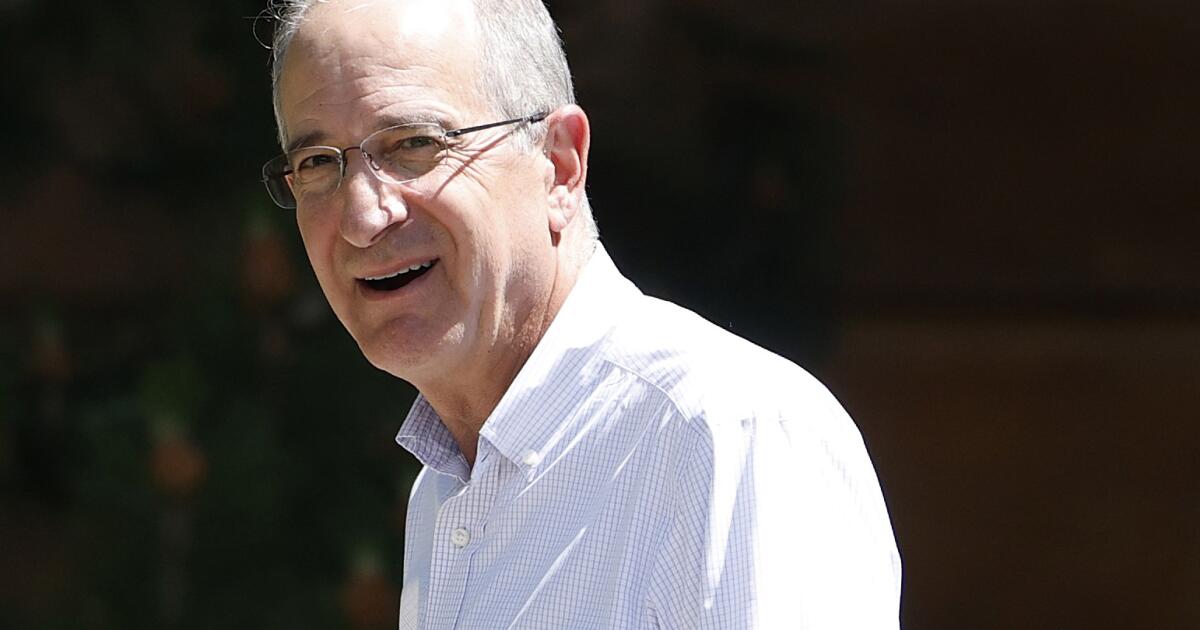
Brian L. Roberts — who with his father built Comcast into a cable TV and internet colossus — announced his company would spin off its prestigious NBCUniversal unit into a separate publicly traded company sometime next year.
The move reverses Roberts’ purchase of NBCUniversal in 2011 — a bold bet that created a behemoth with popular programming and cable pipes to pump that content into consumer homes.
Comcast’s breakup marks the close of a Hollywood era, one dominated for 40 years by a class of maverick moguls: Murdoch, CNN founder Ted Turner, Viacom’s Sumner Redstone, cable titan John Malone and the Philadelphia-based Roberts family.
Now, a new crop of leaders has emerged, reflecting Silicon Valley’s vast influence over the film and and TV business, which has been upended by streaming and, now, artificial intelligence.
“There was a time that Murdoch, Malone and Brian were really industry leaders who could affect change,” said Bank of America managing director Jessica Reif Ehrlich in an interview. “That’s not true any longer.”
Analysts widely believe Monday’s announcement is a prelude to eventual sales of both Comcast and NBCUniversal, a theory that Comcast rejects.
Roberts, 67, told analysts he will remain involved in both NBCUniversal and Comcast after the separation. Still, he plans to relinquish his chief executive role after 25 years and a half century at Comcast. Roberts has picked trusted associates to run each firm, and his family will continue to hold controlling shares of both companies.
But the shift underscores a dramatic loss of clout by Comcast and other traditional media enterprises. Netflix, Apple, Amazon and Google’s YouTube have diminished the industry’s financial pillars — box office receipts and cable programming fees — and given consumers control over when and how they watch programming.
Murdoch was the first to flee. In 2014, he was rebuffed in his $80-billion bid to beef up his 21st Century Fox by buying HBO, CNN and other Time Warner assets. Murdoch’s defeat led to the Fox asset sale to Walt Disney Co.
Last fall, Comcast made a run for the same properties with a plan to unite NBCUniversal with Warner Bros.
Instead, 43-year-old tech scion David Ellison — with help from his billionaire father, Oracle software co-founder Larry Ellison — scooped up the prize for a staggering $111 billion.
The pending blockbuster merger of Ellison’s Paramount Skydance and Warner Bros. Discovery is expected to reshape the industry and leave NBCUniversal increasingly vulnerable to a takeover.
“It looks like Comcast’s NBCUniversal was left standing on the dance floor without a partner,” MoffettNathanson media analyst Robert Fishman wrote in a Tuesday note to investors.
Paramount’s play for Warner Bros. came a month after Ellison finalized his family’s purchase of cash-strapped Paramount from Shari Redstone. The one-two acquisition punch would propel the Ellison family to top-tier moguls with influence over CNN, CBS News, HBO, Turner Classic Movies and two historic Hollywood studios.
“It’s a flagging industry. … The industry will have to consolidate to survive,” said C. Kerry Fields, a USC Marshall School of Business economics professor. “Those who have content plus [streaming] distribution are going to be the winners.”
Roberts knows distribution. His father in 1963 bought his first cable TV system in Tupelo, Miss. It was a quirky bet for Ralph Roberts, who figured his belts and suspenders business would soon be toast as beltless polyester pants became the rage.
Brian Roberts joined Comcast as a high school intern, setting up supermarket promotions. In 1975, he became a trainee cable installer, climbing poles and stringing cables. He joined Comcast full time in 1981 after graduating the Wharton School at the University of Pennsylvania.
For more than 30 years, he worked in tandem with his dad. With key associates, they built the nation’s foremost cable TV service — then the entertainment gateway — and grew stronger by offering internet, phone and then wireless service.
Analysts credit the 2011 purchase of NBCUniversal as a huge success; Comcast rescued a company that was on the ropes due to General Electric’s under-investment.
Over the years, Comcast rebuilt NBC and Spanish-language Telemundo, writing big checks for the best sports rights, including the FIFA World Cup, NFL, NBA and Major League Baseball.
Comcast also recognized value in theme parks and invested heavily, building Universal Studios as a formidable rival to Disney. NBC finished the season in first-place among traditional TV broadcasters and its L.A. film studio is an industry leader.
But the world has changed.
“One of the defining characteristics of this company has always been our willingness to look ahead, embrace change, and position ourselves for the future,” Roberts told analysts during a Monday call.
Reif Ehrlich, the Bank of America analyst, said Comcast needed to do something — or watch its stagnant stock sink farther.
Wall Street has punished the company amid steep losses in its cable TV and broadband internet units, and because NBCUniversal has historically generated its biggest profits from its cable channels.
In January, Comcast spun off those networks, including CNBC, MS NOW, USA Network and Golf Channel, to create a new entity called Versant.
But the move failed to boost Comcast’s battered stock, which dropped 3.3% on Wednesday to $23.73.
Five years ago, Comcast stock topped $50 a share.
“It was just a very challenged market on both sides, and it’s getting worse, not better,” Reif Ehrlich said.
Comcast faces competitors beyond traditional telecommunications firms, including AT&T and T-Mobile. SpaceX’s Starlink provides satellite internet service.
NBCUniversal must jockey alongside other well-capitalized players, including Amazon, Netflix and Disney. NBC’s streaming service, Peacock, has struggled to get traction. It counted 46 million paying subscribers as of the first quarter, a fraction of Netflix’s 325 million and the nearly 132 million subscribers of Disney+.
“It’s kind of a subscale player,” Reif Ehrlich said. “It’s just a real battle, and NBC has expensive sports rights.”
Roberts conceded the difficult landscape on the analyst call.
“The world is changing faster than ever,” Roberts said. “Technology, consumer behavior, competition, capital requirements are all evolving at an unprecedented pace … When we acquired NBCUniversal, more than 15 years ago, the industry looked very different.”
He will retain control for at least three years. The NBCUniversal spin-off is envisioned as a tax-free transaction for shareholders, providing a short-term buffer from deal-making to preserve that structure.
NBCUniversal could be up for grabs by 2029 — a pivotal year when the NFL is expected to open negotiations for a new round of broadcast rights. That auction is expected to draw heavy interest from Amazon and other streamers — not just veterans Fox, NBC, Disney’s ESPN and Paramount’s CBS.
“Brian Roberts has already proven his willingness to play the long game and with continued control should be the end decision maker,” Fishman said.
Much like Murdoch, who is now 95 and partially retired.
“Rupert was the smartest guy in Hollywood — he got out at the top,” Reif Ehrlich said.
He entrusted power to his 54-year-old son, Lachlan, who has been busy remaking Fox after the 2019 sale to Disney, which included Fox’s film and TV studios, streaming service Hulu and the FX and National Geographic channels. Fox also unloaded its regional cable sports networks — a savvy move before that business cratered.
The Murdochs kept Fox Sports, the Fox broadcast network, TV stations, Fox News Channel and the studio lot.
The company has been expanding. Lachlan Murdoch led Fox’s purchase of Tubi, which provides free TV channels and movies for smart televisions, keeping Fox in the streaming game. The company launched Fox News and weather products, and subscription service Fox One, which streams the company’s sports and news.
Earlier this month, Lachlan Murdoch stunned the industry by agreeing to pay $22 billion for Roku, a leading streaming platform that reaches 100 million viewers worldwide. Murdoch called the proposed purchase “a defining moment for Fox.”
-
 Lifestyle1 minute ago
L.A. Affairs: He wanted L.A. I wanted New York. A panic attack changed everything
-
 Politics5 minutes ago
Trump refashions America’s 250th as a celebration of himself
-
 Sports19 minutes ago
How Dodgers’ Max Muncy, vying for his third All-Star selection, continues to evolve
-

 World32 minutes ago
Germany’s Merz defends NATO spending after Trump calls it ‘ridiculous’
-
 News54 minutes ago
Oregon ER doctors win a ‘David and Goliath’ battle against a national company
-

 Videos2 hours ago
Iran gets ready for Khamenei’s funeral • FRANCE 24 English
-

 Los Angeles, Ca2 hours ago
2 arrested after 3 LASD deputies injured during East L.A. World Cup celebration
-

 Detroit, MI3 hours ago
Ex-girlfriend in custody after Taylor man found fatally stabbed, police say

