Business
How China Could Wield Its Control of Rare Earths Against Trump


As President Trump prepares to meet China’s top leader at a summit in Beijing this week, one of the most pressing issues facing the United States, the European Union and Japan lies in China’s restrictions on exports of rare-earth metals and magnets essential to advanced manufacturing.
Manufacturers of commercial aircraft, electronics, cars, semiconductor manufacturing equipment and military hardware are facing acute shortages of rare earths, many of which are refined almost exclusively in China. Prices for some of these metals have soared as much as a hundredfold since Beijing halted most exports in early April last year.
China announced on Oct. 9 that it planned to impose sweeping new restrictions on exports of rare earths and products containing even trace amounts of Chinese rare earths. Three weeks later, Xi Jinping, China’s top leader, agreed at a meeting with Mr. Trump to postpone those measures for a year, though the restrictions issued in April remained in place.
A senior administration official said Sunday that the United States was in frequent contact with China about rare earths, and that it remained unclear whether this week’s summit would produce an agreement to extend the one-year reprieve. But the official, speaking on the condition of anonymity before the diplomatically sensitive meeting, said he was confident the two sides would reach an extension before the postponement expired.
Beijing has offered few hints about its intentions. Asked about rare earths at a news briefing last month, Mao Ning, a Chinese Foreign Ministry spokeswoman, said that “the two sides need to jointly deliver on the important common understandings between the two presidents, and provide greater stability to China-U.S. economic and trade cooperation.”
Business groups are pressing for immediate clarity, warning that Beijing’s restrictions are already disrupting manufacturing outside China and that companies need time to get ready for any tougher measures.
“How do you prepare? We simply don’t know what’s going to happen,” said Jens Eskelund, president of the European Union Chamber of Commerce in China, at a news briefing in Beijing last month.
The American Chamber of Commerce warned in a report released Monday that the rare-earth restrictions were part of a broader effort by China to tighten its grip on global supply chains.
“As China’s control over critical inputs and technologies expands, so, too, does its ability to weaponize this leverage,” the report said.
China’s Ministry of Commerce has said the export-license requirements it imposed last spring on seven categories of rare earths and related magnets are not intended as a tool for leverage in trade or geopolitical disputes, but are necessary because the materials have both military and civilian applications.
But Beijing announced the licensing rules just two days after Mr. Trump imposed steep “Liberation Day” tariffs on China and other countries. China has also linked its control over rare earths to demands that the European Union ease its tariffs on imported Chinese electric vehicles. And after a dispute with Japan over Taiwan in November, Beijing tightened limits on rare-earth shipments to Japan.
Even without the postponed additional restrictions, China has severely reduced exports of rare earths such as samarium, yttrium and dysprosium, which are already in critically tight supply outside China. Samarium, used in commercial aircraft, fighter jets and missiles, sells for about $2 a kilogram inside China but $50 to $500 a kilogram abroad, depending on the level of processing.
China has all but stopped exporting it.
“The aerospace industry is in critical need of samarium,” said Ilya Epikhin, a senior rare-earths specialist at the consulting firm Arthur D. Little. ”It can significantly impact the commercial aircraft production.”
In a statement, Airbus said it “does not buy rare earths or magnets directly, but they are used in our supply chain and we are closely engaging with our suppliers to ensure resilience.” Boeing said that it was working with its suppliers and that it did not see “a near-term impact.”
Yttrium is also scarce outside China, although industry specialists said Beijing had allowed a few shipments to the United States in recent weeks. The Chinese authorities have not explained the decision, which has been interpreted either as a good-will gesture before the summit or a delayed result of China’s pledge in October to permit some exports.
Yttrium is prized as a heat insulator. It is used in semiconductor manufacturing equipment to prevent excess heat from leaking between the tightly packed lasers that cut computer chips, and in jet engines and missiles to shield electronics and other systems from extreme heat.
Dysprosium is widely used in magnets for automotive systems, including brakes, steering and electric motors, as well as drones, including military models. China has restricted exports of dysprosium, which sells for about $200 a kilogram domestically but commands far higher prices overseas, according to Argus Media, a London-based commodity market data firm.
MP Materials, which owns the only rare-earths mine in the United States at Mountain Pass, Calif., said on its earnings call last week that it had begun work on the initial stages of refining the types of rare earths that China had restricted. The company currently produces easier-to-process rare earths at its Mountain Pass mine and refinery.
James Litinsky, MP’s chairman and chief executive, said in an interview that the company would not make the substantial investments needed for the later stages of purifying rare earths, such as yttrium, without long-term purchase commitments from customers. Western manufacturers, however, have been reluctant to sign contracts for fear that China could resume exports of far cheaper material.
Chinese refineries retain a major cost advantage because they process enormous volumes of rare earths each year, much of them used for electric car production. This gives them economies of scale.
Beijing also has some reasons to continue postponing expanded restrictions, which are slated to take effect in November and December. Two weeks after the U.S. midterm elections on Nov. 3, the presidents, prime ministers and other leaders of 21 Asian and Pacific economies are set to gather in Shenzhen, a Chinese metropolis next to Hong Kong, for their annual summit. Chinese officials may not want that meeting overshadowed by global economic difficulties tied to China’s export controls.
If Mr. Trump and Mr. Xi fail to reach an agreement this week, they may have another chance in the coming months. Officials have discussed a possible visit by Mr. Xi to the United States this year to reciprocate Mr. Trump’s trip to China.
Ruoxin Zhang contributed research.



Netflix is going bite-sized. In a pivot toward the short-form content dominating TikTok and YouTube, the streaming giant announced it will start hosting three- to 20-minute videos from top digital publishers right on its homepage starting Aug. 3.
The streamer said U.S. customers will see “fan-favorite videos” from brands run by digital publishers, including BuzzFeed Studios, Condé Nast, Hearst Magazines, PMX (a subdivision of Penske Media), People Inc. and Tastemade. The videos will cover a variety of topics, including gardening tips, travel and celebrity profiles.
The rollout comes as Netflix competes for audience time from YouTube and social media platforms such as TikTok that have viral videos that can occupy users for hours. By bringing series such as BuzzFeed Celeb’s “30 Questions,” on which celebrities provide answers, or Vanity Fair’s “Lie Detector,” on which celebrities are hooked up to polygraph machines, Netflix users can learn more information about the people they already watch on the streamer, but in shorter videos.
“Members don’t just want to watch a show or film and move on. They want to keep exploring the stories and personalities they love long after the final credits roll,” said John Derderian, a Netflix vice president overseeing the initiative. “These partnerships help us deepen fandom and create more ways for members to carry those stories with them throughout their day.”
Netflix said it will offer licensed archival and ongoing series, including Harper’s Bazaar’s “Burning Questions,” Billboard’s “24 Hrs With” and People’s “My Life in Pictures” that provide an inside look at celebrities.
The videos from digital publishers will also be available to Netflix customers in Canada, the United Kingdom, Ireland, Australia and New Zealand on Aug. 3.
The Los Gatos, Calif., streamer over time has been expanding its library of content, adding games, live programming such as boxing matches and football games, alongside movies and TV shows.
Business
Commentary: While Trump declares that U.S. is enjoying ‘best economy ever,’ manufacturing jobs have been disappearing
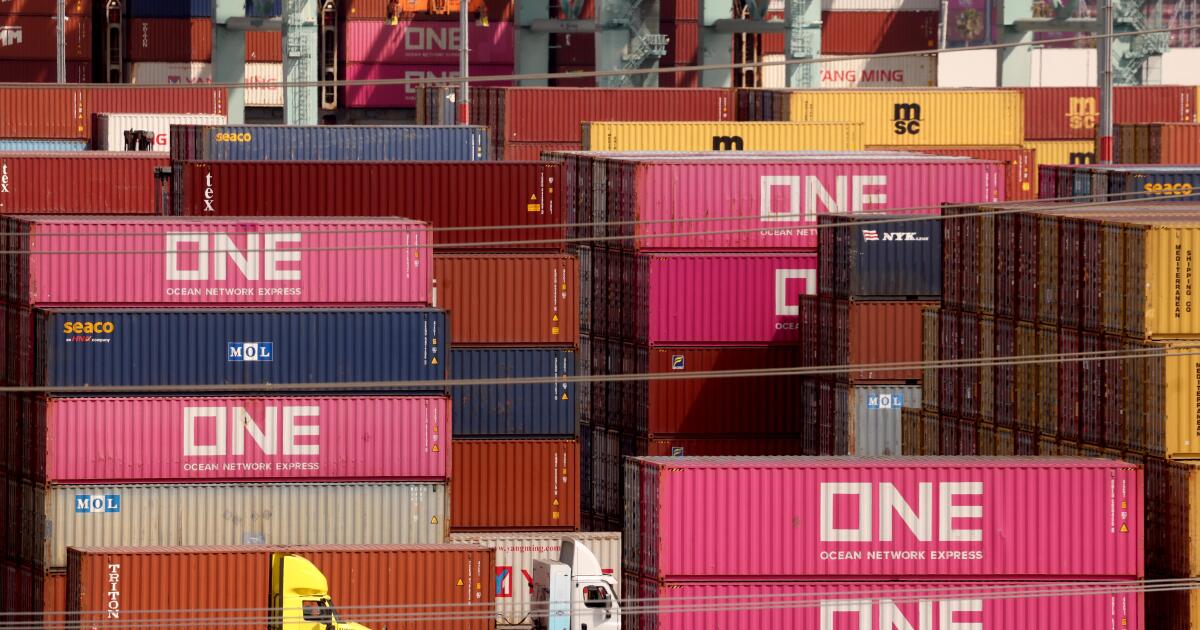
Based on the words of President Trump, America is well on the way to becoming a “global superpower in manufacturing” — indeed, as he declared in a Father’s Day social media post, we are already experiencing the “BEST ECONOMY EVER.” (Capitalization’s his.)
Here’s what the government’s own statistics tell us: Manufacturing investment has crashed during his watch, with construction spending in the manufacturing sector down 26.4% from Trump’s inauguration through May, to $174.8 billion. That’s the lowest figure since February 2023, when the economy was in the midst of a post-pandemic recovery.
White House spokesman Kush Desai told me by email that “the last two jobs reports” showed manufacturing job growth. The Bureau of Labor Statistics reported a seasonally-adjusted decline of 2,000 manufacturing workers in May and a gain of 3,000 in June. But the June 2026 figure was 38,000 jobs, or about 0.3% below the level in June 2025, and 75,000 or about 0.6% below the level in January 2025, when Trump took office.
Desai said that “thanks to President Trump’s proven agenda of tariffs, deregulation, and tax cuts, American manufacturing will continue to rebound.”
There’s little mystery about what has come between Trump’s ambition and the real world. To a large extent it’s Trump’s economic program, particularly his tariff policies and, more recently, his war with Iran. Those have injected a level of uncertainty for corporate managements pondering whether to spend money on expansion that they haven’t had to confront in years.
From where we’re standing, we are not seeing signs of a manufacturing renaissance in the U.S.
— Didi Caldwell, Global Location Strategies
The tariffs and the war have driven up manufacturers’ costs for raw materials and overseas shipping. The general economic atmosphere doesn’t help. U.S. gross domestic product growth came in at a 2.1% annualized rate in the first quarter of this year, but the Federal Reserve Bank of Atlanta expects it to have fallen to 1.3% in the second quarter ended June 30.
Meanwhile, the University of Michigan consumer confidence index reached 44.8 in May, its lowest level ever (though it improved to 49.5 in June). Wages have been rising modestly, according to the Bureau of Labor Statistics, but those gains have been eaten up by higher prices, especially for gasoline and food.
To put things another way, the actual figures show the U.S. economy to be sputtering, and the “vibe economy” as measured by consumer confidence is doing even worse.
Now that Trump’s second term is about to reach its 18-month mark, let’s unpack the factors causing the discrepancy between his ambitions and claims, and the reality.
Trump declared economic victory just as his term was starting. On March 20, 2025, he proclaimed a “manufacturing renaissance” in the U.S. That was based on what he said were “trillions of dollars in new investments” he had “already secured in tech-based manufacturing.”
A White House statement said “the list of manufacturing wins is endless.” The provided list was a roster of announcements, not groundbreakings, much less completed ventures.
Business executives quite properly have taken these pledges with mounds of salt. “Announcements are what people say they’re going to do, but dollars spent is what’s actually happening,” Didi Caldwell, chief executive of a firm that helps companies find factory sites, told the Financial Times. “From where we’re standing, we are not seeing signs of a manufacturing renaissance in the U.S.”
Indeed, at least some of these announcements have had the flavor of performative efforts to satisfy Trump’s amour propre and extract government concessions.
For example, Apple Chief Executive Tim Cook appeared with Trump at the White House in August to announce a $600-billion U.S. spending plan to take place over four years. That was a $100-billion increase over its previously-announced program.
More to the point, however, it incorporated spending with suppliers that Apple had been working with for years. Mentioned in the news announcement was a commitment to buy cover glass for iPhones from Corning. But Corning has been supplying that glass since the first iPhone appeared in 2007. In any case, the announcement appeared to secure a commitment from Trump to exempt Apple from tariffs imposed on imported chips.
Apple’s announcement Wednesday that it will spend $30 billion to buy chips from Broadcom was similarly ambiguous. The announcement didn’t provide details about the terms of the commitment or the timing of its expenditures. I asked Apple for details and whether the deal was related to a desire to remain in Trump’s favor, but didn’t hear back.
A similar phenomenon occurred during Trump’s first term; Trump had built much of his 2016 presidential campaign on a promise to increase manufacturing jobs in the United States. He blamed shrinkage in the manufacturing sector on trade agreements such as NAFTA and the policies of the Chinese, and took credit when an American manufacturer agreed to create or save jobs in the United States.
As I reported in 2019, many of those arrangements turned out to be exaggerated or bogus, or predated Trump’s claim. Some disappeared as soon as public attention turned elsewhere, or were outweighed by job cuts made elsewhere by the same companies.
Trump’s tariffs appear to have had a direct effect on manufacturing employment in the U.S. Since Trump’s inauguration, the manufacturing sector has shed about 75,000 jobs, or 0.6%. After April 2, 2025, when he announced global “liberation day” tariffs supposedly as a response to years of unfair treatment of American exports, the decline picked up pace, with a shrinkage of 68,000 manufacturing jobs.
The Supreme Court invalidated those tariffs in February, but others are still in place, including tariffs on imported steel and aluminum and on goods from China. Nor has he ceased threatening partners with trade wars. As recently as Tuesday, he said he would cut off all trade with Spain because of that country’s disagreement with him over its defense spending and its criticism of his Iran war.
As it happens, Spain is one of the few countries with which the U.S. has a trade surplus. That means that any cutoff, which trade experts think will be unlikely, would come at a cost to the U.S.
One might have hoped that Trump had learned a lesson from his first-term trade war with China. That conflict provoked a sharp contraction in the manufacturing economy, with the Institute for Supply Management’s purchasing managers index falling to 49.1 by mid-2019. (A reading below 50 signifies contraction.)
The ISM index began to recover toward the end of Trump’s term but fell again during the pandemic. Lately it has been falling again, to 53.3 in June from 54 in May.
The Iran war is another deadweight on domestic manufacturing. That’s partially the consequence of blockages of the Strait of Hormuz, the crucial thoroughfare not only for middle eastern oil, but also for such industrial inputs as fertilizer and aluminum. Cement, concrete, olive oil and spices are also among commodities produced in the region that use the strait as an outlet to reach the outside world.
Uncertainties in the region, tensions between the U.S. and China, and heightened concerns over the safety of shipping overall have driven up shipping costs between the far east and the U.S. The price of shipping a benchmark 40-foot container from China to the West Coast has nearly quadrupled to $6,687 now from about $1,700 just before the Iran war began, according to an index maintained by the cargo firm Freightos — even though shipping prices typically decline during this time of year.
There can be little doubt that the U.S. would benefit from an industrial policy — if it’s coherent. China supplanted America as the world’s leading exporter of manufactured goods in 2010, and the gap has only widened since then. China’s dominance may be hard to reverse, as it’s built on lower labor costs and transport infrastructure that enjoys focused government investment.
Tariffs could be a component of a new industrial policy, but Trump’s tariffs aren’t rationally geared to protecting domestic industries that need protection. They’re expressions of his whims, and as such they’re totally ineffective. If there are government investment policies targeting industries that need assistance, they’re not apparent to economists or industrialists.
Trump can talk as much as he likes about a golden age for U.S. manufacturing, but from his first term through this one, it’s nothing but talk. And talk, of course, is cheap.

Walt Disney Co.’s “Moana” lost its way at the box office this weekend as the company’s latest live-action remake opened to a sluggish $43 million in the U.S. and Canada.
The domestic haul for “Moana” underperformed studio expectations, which ranged from $60 million to $65 million. Globally, the film brought in a total of $95 million on a production budget of about $250 million.
Despite its lackluster debut, the film still came in first at the box office during a weekend where it had few new competitors in the family film space.
The “Moana” franchise has been a box-office and streaming juggernaut. The original 2016 animated movie brought in more than $643 million worldwide and is the most-watched movie on Disney+, while a 2024 sequel grossed more than $1 billion at the global box office. On the merchandise side, more than 22 million “Moana”-themed toys have been sold. “Moana” also appears in the Disney theme parks.
But the theatrical reception for the live-action film may signal that audiences think there’s been too much “Moana” in just 10 years. (The 2024 film sequel was originally set to be a streaming series before it was moved to Disney’s theatrical calendar.)
Most of Disney’s previous live-action remakes have come decades after the original animated movie, such as 2025’s “Lilo & Stitch,” which arrived 23 years after its animated predecessor and grossed more than $1 billion in worldwide box office receipts.
The theatrical haul for the latest “Moana” may also have suffered from poor reviews — the film got a 34% on aggregator Rotten Tomatoes, with several critics highlighting its nearly frame-by-frame similarity to the original film. The audience score on Rotten Tomatoes, however, was 90%.
Still, as the last of this summer’s major family films, “Moana” could see a longer tail in theaters, particularly with many children still on break from school. Disney’s live-action “Mufasa: The Lion King” opened in 2024 to a middling $35 million, but ended up grossing more than $722 million globally through the holiday season.
Universal Pictures and Illumination’s “Minions & Monsters” came in second at the domestic box office this weekend with $20.5 million. Disney and Pixar’s “Toy Story 5” continued its strong run with an $18.5-million haul, enough for third place and contributing to a total global gross of $879.1 million.
Warner Bros.’ “Evil Dead Burn” ($13.7 million) and Angel Studios’ “Young Washington” ($6.4 million) rounded out the top five.
Also notable this weekend: Lionsgate’s musical biopic “Michael” crossed $1 billion in worldwide box office revenue, the first time that the studio has reached that milestone and the second film this year after “The Super Mario Galaxy Movie” to hit that mark.
-

 Denver, CO2 minutes ago
New ice cream shop with a ‘waffle theater’ bets big on downtown Denver
-

 Seattle, WA8 minutes ago
Seattle weather: Sunny skies and warmer temperatures Tuesday
-

 Milwaukee, WI20 minutes ago
Milwaukee cooling centers, heat advisory tips; what to know
-

 Atlanta, GA26 minutes ago
Warnock, Dickens talk about new housing legislation
-

 Indianapolis, IN38 minutes ago
Indiana heat index to hit 100 as hot, dry pattern holds | July 14, 2026
-

 Pittsburg, PA44 minutes ago
Another stretch of high temperatures in the 90s hitting the Pittsburgh area this week
-

 Augusta, GA50 minutes ago
Flash flooding impacts multiple areas across Columbia County
-

 Washington, D.C56 minutes ago
ARCO Design/Build Deepens Its Presence in Washington, D.C. Market

