Sports
Michigan holds off UConn to capture first men’s basketball national title since 1989


NEWYou can now listen to Fox News articles!
The Michigan Wolverines are finally national champions once more in men’s basketball, taking down the UConn Huskies, 69-63, to finish a thrilling NCAA Tournament in style at Lucas Oil Stadium on Monday night.
This is the first time Michigan has won since 1989, and just the second time in program history they’ve called themselves champions.
Meanwhile, the Huskies were looking to win their third title in the last four tournaments, but their shooting failed them in the end.
Elliot Cadeau celebrates during the first half of the 2026 NCAA men’s basketball national championship game against UConn at Lucas Oil Stadium in Indianapolis, Indiana, on April 6, 2026. (Michael Reaves/Getty Images)
While both teams’ offenses came into this game working like a machine, it was a low-scoring affair to kick off this game. Michigan only owned a 33-29 first-half lead by the buzzer, but it wasn’t Yaxel Lendeborg leading the way in the points department for the Wolverines.
The Michigan star, who is playing on a sprained left MCL and left ankle, which came during the win over Arizona in the Final Four, was just 1-of-5 shooting for four points in the first half. It was Morez Johnson Jr. (10 points) and Elliot Cadeau (seven points) finding some rhythm for the Wolverines.
UCONN’S DAN HURLEY HEARS BOOS AFTER FINAL FOUR WIN OVER ILLINOIS
But it didn’t help that Michigan was scoreless from beyond the arc and shooting just 37% from the field. Meanwhile, UConn wasn’t doing themselves any favors either.
The Huskies shot just 33% in the first half, with Alex Karaban hitting two of his five three-point attempts. Solo Ball, who was spotted in a walking boot entering the game with “some type of foot sprain,” according to head coach Dan Hurley, had eight points on 3-of-4 from the field.
While they were down, UConn was certainly playing the type of game they wanted against Michigan – a rugged battle, especially on the glass. Michigan has shown its prowess of taking momentum and sprinting with it offensively, dominating opponents all year long, including this NCAA Tournament.
Yaxel Lendeborg of the Michigan Wolverines dribbles during the first half against the UConn Huskies in the National Championship of the 2026 NCAA men’s basketball tournament at Lucas Oil Stadium in Indianapolis, Indiana, on April 6, 2026. (Michael Reaves/Getty Images)
However, the Huskies know their scratching and clawing abilities for 40 minutes allow them to never let an opponent feel comfortable. Just ask the Duke Blue Devils what happened in the Final Four.
The Huskies had that same demeanor in the second half, though it didn’t help they took a page out of the Wolverines’ first-half playbook – they couldn’t find the stroke from range. UConn was desperate to hit a three-pointer, but despite open looks, they couldn’t get one to fall as the Michigan lead eventually got to 11 points after Cadeau finally broke the seal for his squad on the opposite end, burying a three-pointer to get to a double-digit lead.
But Hurley was firing up the crowd as the Huskies never quit, cutting the lead to five with less than nine minutes to play in the game. Lendeborg, though, after shaking his head on the bench as he wasn’t having the game he hoped for in the national championship, stepped up when he checked back in.
Lendeborg saw a sweet pass from Cadeau in transition and got the lead back to 11 with a tough layup, making it 56-45 with less than six minutes to play. He would also come in the clutch with another two points following a Braylon Mullins three-pointer.
Once again, the Huskies wouldn’t quit, as Mullins finally found his shot beyond the arc, knocking that Michigan lead back to single digits with a follow-up three-pointer again to Lendeborg’s layups. But, just as gritty as the Huskies played, the Wolverines seemed to always have the answer in this hard-fought contest.
Head coach Dan Hurley of the UConn Huskies reacts during the first half of the NCAA men’s basketball national championship game against the Michigan Wolverines at Lucas Oil Stadium in Indianapolis, Indiana, on April 6, 2026. (Michael Reaves/Getty Images)
A key example of that was, after Karaban buried a three-pointer to cut the Michigan lead to six, Trey McKenney stepped back and drilled a 26-footer with 1:49 left in the game to get the lead back to nine points. The Wolverines faithful in the crowd went ballistic, knowing how much that basket meant considering what UConn has been able to do in this tournament.
With 37 seconds left in the game, Ball got some help from the backboard, making a three-pointer to cut the lead to 67-63 for the Wolverines. Roddy Gayle Jr. made things more interesting in this game, as he couldn’t knock down his two free throw attempts for Michigan. But Karaban didn’t have another clutch three-pointer in him, coming up short with 13 seconds left.
That was it for UConn’s desperation attempt, and Michigan celebrated their win.
In the box score, Cadeau led all scorers with 19 points on 5-of-11 shooting and 8-of-9 from the free throw line. Lendeborg was just 4-of-13, though he still had 13 points. Johnson had a double-double with 12 points and 10 rebounds for the Wolverines as well.
Cadeau was named the Most Outstanding Player of the Final Four.
CLICK HERE TO DOWNLOAD THE FOX NEWS APP
Michigan was just 2-of-15 from the three-point line, and head coach Dusty May even noted after the game getting dominated on the glass, as they were out-rebounded by UConn, 46-39.
The Huskies, though, couldn’t find it offensively. Karaban finished with 17 points and 11 rebounds, but shot just 4-of-14 and 3-of-10 from three-point territory. Tarris Reed Jr. had a double-double as well with 13 points and 14 rebounds, while Mullins, the hero against Duke with his half-court shot, was only 4-of-17 for 11 points.
Follow Fox News Digital’s sports coverage on X and subscribe to the Fox News Sports Huddle newsletter.



NEWYou can now listen to Fox News articles!
When will Team USA lose in the 2026 FIFA World Cup? Or, will it not lose at all?
Let’s check out the odds for the Americans’ stage of elimination at FanDuel Sportsbook, as of June 11.
Team USA — Stage of elimination odds
Last 32: +170 (bet $10 to win $27 total)
Last 16: +220 (bet $10 to win $32 total)
Group stage: +500 (bet $10 to win $60 total)
Quarterfinals: +500 (bet $10 to win $60 total)
Semifinals: +1200 (bet $10 to win $130 total)
Runner-up: +2800 (bet $10 to win $290 total)
Outright winner: +6000 (bet $10 to win $610 total)
This page may contain affiliate links to legal sports betting partners. If you sign up or place a wager, FOX Sports may be compensated. Read more about Sports Betting on FOX Sports.
The outlook appears to be … ho-hum?
If the odds ring true, the Americans are expected to make it out of the group stage but fall in the first knockout stage game.
How would that result stack up against previous results? Well, at the 2022 World Cup, Team USA made it to the Round of 16, which was viewed as a stellar accomplishment.
The U.S. men’s national team currently has 60-1 odds to lift the 2026 FIFA World Cup trophy this summer (Photo by Omar Vega/USSF/Getty Images).
In 2018, the USA did not qualify for the World Cup, and in 2014 and 2010, the Americans also made it to the Round of 16. Their best result this century occurred in 2002, when the Americans made it all the way to the quarterfinals before being eliminated.
In 1998, Team USA lost in the group stage, in 1994, it fell in the Round of 16, and in 1990, it also fell in the group stage.
With the expanded World Cup format, 32 teams will advance to the knockout stage (out of 48), giving teams a much better chance of getting out of the group stage than in previous tournaments. In past years, only 50% of the field advanced to the knockout round, but now 66.6% of teams will move on.
With that being said, anything less than a knockout round appearance on home soil would be viewed as a major failure this summer for Team USA.
The second result on the oddsboard is the “Last 16,” meaning the USA would make it out of the group stage and win one knockout stage game, before falling in the second knockout stage game. The third result is that the Americans failed to make it out of the group stage, and the fourth is that they made it to the quarterfinals, meaning they won two knockout stage games.
Making the semis, losing in the championship game and winning the championship are the three results with the longest odds.
The U.S. begins its World Cup journey on Friday as the Stars and Stripes face Paraguay at Los Angeles Stadium. Getting off to a fast start in the group is crucial for the team’s World Cup dreams of making a deep run this summer.
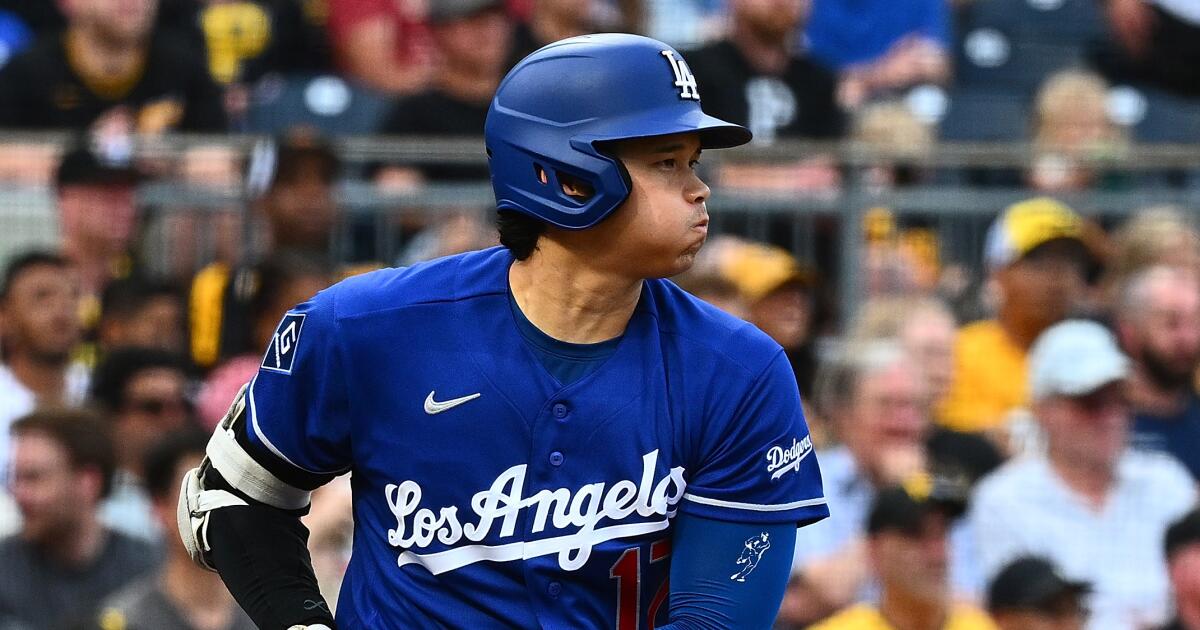
PITTSBURGH — The Dodgers couldn’t have asked for better timing, as Shohei Ohtani’s leadoff spot came back around.
They were clinging to a two-run lead in the top of the seventh inning against the Pirates on Thursday. With one out and runners on first and second, the Dodgers superstar, who had already reached base four times, was due up.
Instead, Santiago Espinal stepped up to the plate as a pinch-hitter.
Ohtani left the game with inflammation in his left knee, the Dodgers announced. They did not immediately offer an explanation for the injury.
Before leaving, Ohtani hit a solo home run — his second homer in as many games — a single and drew two walks.
It was an impressive performance, coming a day after he took on two-way duties. On the mound Wednesday, he allowed three earned runs in 6⅔ innings.
Earlier in the game Thursday, Dodgers starting pitcher Justin Wrobleski exited with a bruised right hamstring, the team said.
The fifth inning had already begun to spiral on him. After throwing four scoreless innings, he surrendered two solo home runs to Rafael Flores Jr. (the first of his major-league career) and Brandon Lowe.
Then Bryan Reynolds hit a line-drive comebacker off Wrobleski’s leg. The ball ricocheted to the edge of the infield grass, where first baseman Freddie Freeman picked it up.
Wrobleski was already racing toward first base. But after turning to catch the throw, he missed the base and stumbled backward into Reynolds, who tripped over Wrobleski’s extended left foot.
Wrobleski limped away, and an athletic trainer followed him, circling back to the mound. But as he was setting up to throw a warm-up pitch, manager Dave Roberts came out to make a pitching change.

NEWYou can now listen to Fox News articles!
Seven-time NBA champion Robert Horry has some simple advice for Caitlin Clark: Fight back.
Horry, 55, was asked about the criticism the Indiana Fever star has gotten for complaining to the referees, and Horry said Clark needs to protect herself.
“You think about when you when you’re the best, everybody want to knock you out. And I think a lot of people are going after her and for me, just play the game,” Horry told Fox News Digital at The World Cup 2026 Kickoff Party Blue Carpet at the Los Angeles Memorial Coliseum.
Indiana Fever guard Caitlin Clark waits for play to resume during the fourth quarter against the Golden State Valkyries at Chase Center in San Francisco, Calif., on May 28, 2026. (David Gonzales/Imagn Images)
“Some other players around the league didn’t protect themselves, and the (harassment) went on, so my best advice (for) her is protect yourself. Don’t let nobody try to punk you.”
Horry played with Basketball Hall of Famer Shaquille O’Neal and cited him as an example of a player who fought back.
“I think I (played) with one of the greatest players (in) Shaquille O’Neal, he got hammered. I know he’s bigger and stronger than Caitlin, but he got to a point where he just started fighting back. You know, someone (elbowed him), you elbow him back.”
Clark has taken some hard fouls during her three seasons in the WNBA, with many fans wondering if the treatment from her competitors is intentional. The 24-year-old frequently pleads her case to the referees after contact, which has drawn the ire of fans who say she complains too much.
ZERO BS. JUST DAKICH. TAKE THE DON’T @ ME PODCAST ON THE ROAD. DOWNLOAD NOW!
Caitlin Clark of the Indiana Fever reacts after a foul was called during the first half against the Portland Fire at Moda Center in Portland, Oregon, on May 30, 2026. (Ali Gradischer/Getty Images)
Fever fans at least weren’t complaining when Clark buried a game-winning 3-pointer to help secure a 78-76 win over the Washington Mystics on Monday. Clark had 19 points, five assists and three rebounds in the win.
The Fever have had a tumultuous start to the season, but are over .500 at 6-5. In 10 games, Clark has averaged 18.7 points, 8.7 assists and 4.5 rebounds per game.
Horry played in the NBA for 16 seasons. He began his career with the Houston Rockets, spending four and a half seasons with them and being a key part of their championship-winning teams in the 1993-94 and 1994-95 seasons. The Alabama native was then traded to the Phoenix Suns, where he spent half a season before signing with the Los Angeles Lakers.
CLICK HERE TO DOWNLOAD THE FOX NEWS APP
Robert Horry and Candice Horry pose on the blue carpet for the World Cup 2026 Kickoff Party at the Los Angeles Memorial Coliseum on June 9, 2026. (Kirby Lee/Imagn Images)
Horry was a key contributor during the Lakers’ three-peat from 1999-2001 and earned his third, fourth and fifth career NBA titles. After spending seven seasons with the Lakers, Horry joined the Spurs, where he won two more championships in 2004-05 and 2006-07.
In 16 seasons, Horry averaged 7 points, 4.8 rebounds and 2.1 assists per game.
Follow Fox News Digital’s sports coverage on X, and subscribe to the Fox News Sports Huddle newsletter.
-

 Indianapolis, IN12 seconds ago
IMPD’s Great Camp: Building connections and steering kids away from violence
-

 Pittsburg, PA7 minutes ago
The South Side Street Fest is coming to Pittsburgh this summer. Here’s what to know.
-

 Augusta, GA10 minutes ago
Scheraun King takes over the throne of North Augusta girls basketball
-

 Washington, D.C15 minutes ago
If and when Trump’s name is removed from the Kennedy Center, you can watch it live – WTOP News
-
 Cleveland, OH22 minutes ago
East Cleveland teams up to stop illegal dumping
-

 Austin, TX25 minutes ago
Texas’ Pack, Cozart earn national honors after standout freshmen seasons
-

 Alabama30 minutes ago
East-West Classic at Rickwood Field also a reunion for the Hairston family
-

 Alaska37 minutes ago
Alaska election official threatens to disqualify challenger Dan J. Sullivan in race against Sen. Dan Sullivan | CNN Politics

