Connect with us

Midwest

Jewish leaders want Chicago mayor to create antisemitism task force

Published

on

Jewish leaders want Chicago mayor to create antisemitism task force
NEWYou can now listen to Fox News articles!

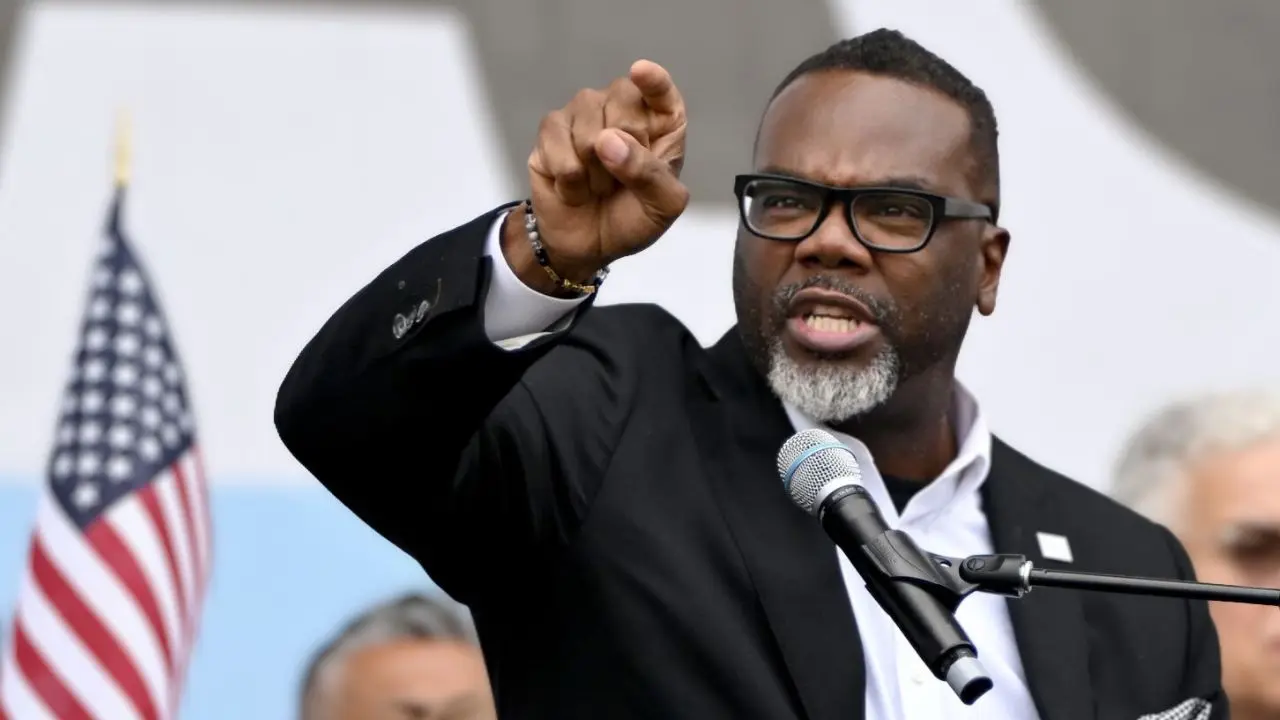
Jewish leaders are pressuring Chicago Mayor Brandon Johnson to establish an antisemitism task force, because they believe he’s not doing enough to protect the Jewish community, Fox News Digital has learned.

“There was a 58% rise in hate crimes,” Rebecca Weininger, the senior regional director of the Anti-Defamation League (ADL) Midwest, told Fox News Digital, specifically referring to anti-Jewish hate crimes. “So to be clear, that’s not hate incidents. It’s hate crimes, bias-motivated crimes against Jews in the city of Chicago.”

The Chicago Commission on Human Relations in July last year found that the Jewish community experienced a 58% increase in hate crimes from 2023-2024. Other groups experienced a decline. 

Jewish leaders are pressuring Mayor Brandon Johnson to establish an antisemitism task force, because they believe he’s not doing enough to protect their community, Fox News Digital has learned. (Scott Olson/Getty Images)

Advertisement

FOX NEWS ‘ANTISEMITISM EXPOSED’ NEWSLETTER: FEAR AND LOATHING IN THE BIG APPLE

The ADL held a press conference on Monday to demand that Johnson adopt recommendations of the Chicago Commission on Human Relations.

Among those recommendations is a task force to protect Jewish members.

“Establish the task force your commission recommended, name a leader accountable for this work, set timelines, make progress public,” Chicago Sinai Congregation Rabbi Amanda Greene told ABC 7.

The Chicago Commission on Human Relations in July last year found that the Jewish community experienced a 58% increase in hate crimes while other groups experienced a decline. (Beata Zawrzel/NurPhoto via Getty Images)

Advertisement

NYC ANTISEMITIC INCIDENTS NEARLY TRIPLE DESPITE OTHER CRIMES REACHING RECORD LOWS

“The taskforce would be very similar to other task forces that the mayor’s office already has in other marginalized communities. It would be populated by the mainstream Jewish community as a way to give information to the mayor about the lived experience of Jews in Chicago right now,” Weininger told Fox News Digital. 

Weininger continued, “To help inform other executive policies that he could adopt that would be immediately beneficial to the mainstream Jewish population.”

The ADL held a press conference on Monday to demand that Johnson adopt recommendations of the Chicago Commission on Human Relations. (Anti-Defamation League )

CHICAGO MAYOR BRANDON JOHNSON PUTS ICE ‘ON NOTICE’ WITH EXECUTIVE ORDER SEEKING PROSECUTION OF AGENTS

Advertisement

Other task forces Chicago established are the Task Force on Missing and Murdered Chicago Women, which focuses on policy changes to address violence against women, and the Reparations Task Force. Chicago also established a Task Force on Black Immigrants that investigates social and economic conditions for Black immigrants in Illinois.

Johnson’s office declined to comment when reached by Fox News Digital.

CLICK HERE TO DOWNLOAD THE FOX NEWS APP


Read the full article from Here

Advertisement

Illinois

Missing Illinois dad Dan Davis found dead after months of ‘agony’ for family searching for him

Published

on

Missing Illinois dad Dan Davis found dead after months of ‘agony’ for family searching for him


A missing Illinois father was found dead more than three months after a car crash in which he refused medical treatment and was later dropped off at work by police before disappearing.

The body of Daniel “Dan” Davis was discovered at around 3 p.m. on Monday in a wooded area next to train tracks along the border of the Chicago suburbs of Blue Island, the Chicago Police Department confirmed.

The 59-year-old’s cause of death is still under investigation.

Daniel “Dan” Davis’ body was found at around 3 p.m. on Monday in a wooded area next to train tracks along the border of the Chicago suburbs of Blue Island after he was last seen on Nov. 26, 2025. Facebook./wendy.davis

His daughter, Wendy Davis, confirmed her family received word that her father’s remains had been found after “three and a half months of agony” searching for the beloved patriarch

Advertisement

“It’s an eerie feeling – thank god this terrible chapter of constant unknown is finally over,” she wrote in a heartbreaking Facebook post Tuesday.

Witnesses last spotted Davis wandering around the entertainment complex where he worked at a bar at about 1:15 a.m. on Nov. 25. He had been involved in a car crash hours earlier, but refused medical attention, People reported.

“Daniel Davis was evaluated by paramedics and refused medical treatment. Sheriff’s police did not detect any observable signs of impairment or injury,” a Cook County Sheriff’s Office spokesperson told the outlet.

Police feared Davis may have suffered a head injury in the wreck, which left his car totaled.

“Davis was given a ride to his workplace at approximately 12:30 a.m. due to the fact that his vehicle was undrivable,” the department said.

Advertisement
Daniel Davis with his daughter, Wendy Davis. Facebook./wendy.davis

Home security footage later captured Davis appearing disoriented as he walked through the Chicago suburbs and exited a local church at 6:30 p.m. on Nov. 26.

“Since his disappearance, sheriff’s police K9 units have assisted in the search at the request of Merrionette Park Police and will continue to assist in any way possible,” the Cook County Sheriff’s Office added.

Wendy said the footage appeared to show her father’s face drooping, noting that he also tripped over a curb and had his sweatshirt on inside out.

security footage later captured Davis appearing disoriented as he walked through the Chicago suburbs and exited a local church at 6:30 p.m. on Nov. 26. Facebook/FIND DAN DAVIS

“We’re watching that footage and we noticed some symptoms that are not normal to Dan,” his daughter told People in December.

She said footage from before the crash showed Davis trying to enter homes in his neighbors’ apartment complex, sparking fears he had a medical episode before the accident.

Advertisement

“The accident definitely didn’t make it better,” she told People. “He probably got a concussion in the accident, too. We don’t know for sure.”

In the wake of her father’s body being found, Wendy thanked law enforcement and the community for helping in the search and said she is now starting a “new terrible chapter without my smarter, goofier, and relentlessly selfless other half.”

“This is the news we’ve all been expecting in a way, but nothing really prepares you for it. I’ve never laughed harder with anybody than I have with my dad. And I can’t wait to do it again someday,” she wrote in her post.

“Not a single gesture went unnoticed. I am so glad dad is so loved,” she concluded.

Advertisement


Source link

Continue Reading

Indiana

Indiana AG pushes back against court effort to halt student ID voting ban before 2026 election

Published

on

Indiana AG pushes back against court effort to halt student ID voting ban before 2026 election


(INDIANA CAPITAL CHRONICLE) — State attorneys are urging a federal judge to reject a request to block Indiana’s ban on using college identification cards to vote, arguing in new court filings that the law does not target young voters or make it harder for them to cast ballots.

The Indiana Attorney General’s Office, representing Secretary of State Diego Morales and other state defendants, asked Indiana’s Southern District Court on Friday to deny a preliminary injunction sought by student and voting rights groups challenging the policy.

The plaintiffs — Count Us IN, Women4Change Indiana and Indiana University student Josh Montagne — are trying to halt enforcement of a 2025 law that explicitly bars student college IDs from being used as voter identification at the polls.

A February request by the plaintiffs for a preliminary injunction is still pending. A status conference in the case is scheduled for June 9, but a ruling is likely to come before the upcoming May primary.

Advertisement

The state has argued that concerns about voter fraud, as well as the variety of student IDs, justify the ban. Their most recent filing maintains that the challengers have not shown the law violates the U.S. Constitution or that they will suffer irreparable harm before the case is resolved.

“SB 10 does not burden the right to vote,” state attorneys wrote in a new 43-page memorandum opposing the injunction. They argued that any burden created by the change is “minimal,” adding that only a small number of voters who previously relied on student IDs would be affected.

The underlying lawsuit was filed in May 2025 after Indiana lawmakers amended the state’s voter ID statute to explicitly exclude identification issued by educational institutions.

For years before that change, student IDs issued by several public universities could be used at polling places if they met state requirements. Those earlier rules allowed student IDs to be used if they included the prospective voter’s name, photo and a valid expiration date.

Voting rights advocates argue that eliminating student IDs disproportionately affects younger voters, who are less likely to possess driver’s licenses or other forms of identification.

Advertisement

In October, a federal judge rejected the state’s attempt to dismiss the lawsuit, allowing the constitutional claims to move forward.

Dispute over burden on voters

The plaintiffs argue the law — enacted last year as Senate Enrolled Act 10  — targets students and young voters by eliminating one of the “most accessible” forms of identification they commonly use.

They contend the change violates the First and Fourteenth Amendments and the Twenty-Sixth Amendment, which prohibits voting discrimination based on age. 

Their February motion asked the court to temporarily block enforcement of the ban before the May 2026 primary election.

State lawyers, however, countered that the requirement to present other forms of identification is not a “meaningful” barrier.

Advertisement

“Obtaining valid voter ID is not a severe burden on the right to vote,” the state argued in the filing, noting that Indiana voters can use multiple forms of identification that satisfy the law’s requirements, including an Indiana driver’s license, a state identification card issued by the Bureau of Motor Vehicles, a U.S. passport or passport card, or certain other government-issued photo IDs that meet state criteria.

State attorneys added that voters who lack ID can receive one “at no cost,” and that the state also provides a provisional ballot process for voters who appear at the polls without identification. Those voters would have to later visit the county election office to verify their identity.

The state also disputes the claim that the law targets students or younger voters.

“SB 10 does not increase the burden on the right to vote, nor does it target students or young people,” attorneys wrote.

The attorney general’s office argued that voter participation is driven more by “motivation,” rather than administrative barriers like identification requirements.

Advertisement

“It is voter motivation, not the need to obtain a photo ID, that is the decisive factor in voter participation,” the state wrote, citing decades of academic research on voting reforms that found “negligible effects on turnout.”

Attorneys pointed to testimonies from the student plaintiffs, arguing that neither of the two Indiana University students deposed in the case had taken steps to obtain a driver’s license or state ID. 

“For both students, the obstacle is not time, money, or lack of access to documents,” the filing said. “They simply don’t want to be responsible for keeping their identifying documents secure.”

State cites election administration interests

Indiana officials also defended the change as a policy decision intended to address concerns about the consistency and reliability of student identification cards.

They argued that state lawmakers had legitimate reasons for excluding student IDs from the list of acceptable voter identification.

Advertisement

“Student identification cards are not issued under any statewide election or motor vehicle legal standard, do not require proof of citizenship, lawful presence, or Indiana residency, and vary significantly by institution in format, security features, and issuance procedures,” the filing said.

Indiana’s voter ID law, though, is meant only to verify identification.

According to the state, the law advances several interests, including improving “uniformity” in acceptable voter IDs and simplifying election administration.

Attorneys also said the plaintiffs’ claims that the law was designed to “suppress” student voting are unsupported.

The state further argued that courts should be cautious about altering election rules close to an election — invoking the so-called “Purcell principle,” a 2006 U.S. Supreme Court doctrine which warns against late judicial changes to voting procedures that could confuse voters and election officials.

Advertisement

State lawyers also questioned whether the organizations bringing the lawsuit have the legal standing required to pursue the claims. They argued the groups have not demonstrated that anyone they serve will be unable to vote because of the law.

The attorney general’s office contends, too, the sweeping relief requested by the plaintiffs — a statewide order preventing enforcement of the law — would be improper.

Their filing argues that the groups “have not identified a single person who lacks another form of ID or will be unable to obtain another form of ID” because of the law.

Pending further action from the court, a full trial in the case is scheduled for January 2027.

Advertisement


Source link

Continue Reading

Iowa

When is tornado season in Iowa? See what forecasters expect this year

Published

on

When is tornado season in Iowa? See what forecasters expect this year


play

Stormy weather may be ahead, folks.

Over the past two years, Iowa has seen the two extremes of tornado season. A record-setting 125 tornadoes occurred in 2024. But in 2025, just 32 tornadoes were recorded, a number well below average.

Advertisement

Iowa typically averages around 50 tornadoes a year, according to a National Weather Service summary by meteorologist Brooke Hagenhoff.

Here’s what to expect for 2026’s tornado season.

What’s the forecast for tornadoes in Iowa in 2026?

The atmosphere in Iowa will favor thunderstorms more than tornadoes due to the quick exit of La Niña, according to AccuWeather meteorologists.

“Cooler air will likely limit severe weather farther in the northern Plains and Midwest until late April and May,” said AccuWeather Meteorologist Alex Duffus.

Advertisement

But as spring progresses, tornado activity will increase in Iowa and surrounding states.

Long-range forecasters predict 1,050 to 1,250 tornadoes across the United States this year, which would be in line with historical averages.

When is tornado season in Iowa?

Tornado season usually peaks in June or July in the upper Midwest, including Iowa, the Dakotas, Nebraska and Minnesota, according to the National Weather Service.

Advertisement

AccuWeather’s forecast calls for the highest tornadic activity in Iowa to occur in April and May.

For Iowa, July 2025 was the busiest time of year for tornadoes, surpassing April and May.

Even though tornadoes can happen any time of the year or at any time of day, they often occur between 4 and 9 p.m.

How many tornadoes hit Iowa in 2025?

Iowa saw 32 tornadoes in 2025. The state saw the most tornadoes in a day on July 11, when 12 tornadoes occurred.

How many tornadoes hit Iowa in 2024?

In contrast to 2025, Iowa saw 125 tornadoes in 2024, making it a record year. In April and May alone, there were 98 tornadoes recorded.

Advertisement

On April 16, there were 18 tornadoes in a single day across the state. April 2024 saw 49 tornadoes. This beat the previous record set in 2001 of 40 tornadoes in April.

How do you stay safe during a tornado?

play

What you need to know to stay safe during a tornado

Advice from the National Weather Service on how to stay safe during a tornado

During a tornado, the National Weather Service recommends:

  • Get as low as possible. A basement below ground level or the lowest floor of a building offers the greatest safety.
  • Put as many walls between yourself and the outside as possible.
  • Avoid windows.

Remember, tornadoes can move across hills and even bodies of water, so always seek shelter if one is nearby – your elevation or proximity to water are not natural sources of protection.

Stay informed. Get weather alerts via text.

Lucia Cheng is a service and trending reporter at the Des Moines Register. Contact her at lcheng@gannett.com or 515-284-8132.

Advertisement


Source link

Continue Reading

Trending