San Francisco, CA
San Francisco schools to be closed Monday


The San Francisco Unified School District announced Friday all schools across the district will be closed on Monday.
The news came as negotiations between the teachers’ union and the school district are expected to continue over the weekend.
The union is calling for fully funded healthcare, an increase in wages and more stable staffing.
SFUSD Superintendent Maria Su said she believes the proposal presented during Thursday’s negotiations was a win-win; however, the union saw it differently.
“The proposal that we received tonight did not reflect what we understood to have been that intent, it falls very short of that issue and doesn’t address some of our other key issues as well, UESF President Cassondra Curiel said on Thursday.
“I want families to know how deeply we value our educators and committed I am to avoiding a strike,” Superintendent Maria Su said during a news briefing on Friday. “While I am very disappointed these negotiations did not result in an agreement last night, my team and I are prepared to bargain the entire weekend. I do not want a strike.”
This would be the first teachers strike in San Francisco since 1979.
The announcement came along with the district’s “learning resources” in case of a strike. Those can be accessed here.
Bay City News contributed to this report



Few things are more valuable in the Bay Area than real estate. In San Francisco, the median house price is now over $2 million. Last month, at least seven houses in the city sold for $1 million over the asking price, and buyers regularly offer to pay in cash or waive contingencies to stay competitive. Yet there is one thing that remains even more valuable than a house, and possibly more valuable than money itself: stock in Anthropic or OpenAI.
Last week, 160 Noe Street, an Edwardian home in San Francisco’s desirable Duboce Triangle neighborhood, was listed for sale at $2.9 million—or the equivalent amount in Anthropic or OpenAI shares, as based on those companies’ current valuations. Rachel Swann, the listing agent, says she was inspired to set these unusual terms after meeting several Anthropic employees at an open house for a different property. “These people have a lot of paper wealth, but they don’t always have the liquidity to do things they want,” Swann says. Some of these employees were expecting to come into as much as $50 million from their Anthropic shares, and wondered if they could use that as leverage to buy a house, according to Swann. “This kept coming up over and over again.”
Swann’s listing is unconventional, but not singular. In April, an investment banker named Storm Duncan offered to exchange his Mill Valley home and an adjacent parcel of land for Anthropic shares. And in May, Vijay Chattha, who owns an agency that does PR for tech companies, listed his Healdsburg home for $2.5 million, or $2 million in Anthropic stock. “I want to sell my house, and I want to invest in Anthropic,” Chattha says. “Why not combine the two?
Chattha’s house—a three bed, three bath with a pool and a bocce court in a part of Sonoma County that abuts some of the region’s most famous wineries—also comes with coveted short-term rental status, allowing the owner to list it on platforms like Airbnb. Only a handful of properties in Healdsburg come with that status, and only about a dozen come up for sale in a given year.
Chattha is offering a $500,000 discount to Anthropic employees because he believes the value of Anthropic shares will grow faster than any other investment, and his vacation home in wine country is the best bargaining chip he has to try to access them. “If you look at Anthropic’s growth last year, it’s insane,” he says, noting the $380 billion valuation the company claimed in February. “Now they’re raising at $965 billion. That’s three X in like three months.” He added that he was open to exchanging the house for shares in Anthropic, but not OpenAI, because he prefers using Anthropic’s products.
The real estate listings come at a time when investors are salivating at the record-high valuations of Anthropic and OpenAI, and even those considered wealthy by Bay Area standards are feeling FOMO about the affluence that could come from these companies’ debuts on the stock market. (On Monday, Anthropic submitted paperwork for its initial public offering; OpenAI is also reportedly preparing to file in the coming months.) Despite the unprecedented valuations of these companies, many people believe their stock prices will only go up, and that anyone who gets a piece now could win the jackpot.
People are clamoring to buy equity in OpenAI and Anthropic on the secondary market, leading to a frenzy of transactions that may or may not be legitimate. As a result, Anthropic updated its policy around “unauthorized Anthropic stock sales” this spring, which notes that “if someone purports to sell Anthropic shares without proper board approval, that transaction is invalid.” A spokesperson for Anthropic pointed back to this policy when asked about the possibility of exchanging company shares for real estate.

Welcome to our running tally of Election Night results. Or, as this is California, well beyond tonight, as results continue to trickle in.
The first batch of results should arrive at 8:45 p.m., with three more to follow tonight. The Department of Elections has the breakdown.
San Francisco is voting in three special elections, for District 2 and District 4 supervisors and for a Board of Education member. Both supervisor races are referendums on housing, especially District 2, while the main backdrop of the D4 race is all the hot feelings around the fate of the Sunset Dunes Park (nee Great Highway).
The winners of all three special races will have to compete again in November for their seats.
Keeping it local, SF is also voting on four ballot measures. Prop A is for a bond to pay for an emergency water-system. B is for term limits. C and D are dueling measures related to the “overpaid CEO” tax. (Links go to our reporting on each race or issue; or click here for our Election 2026 page.)
Vote local, think national: Which two candidates will advance to the November election to replace Nancy Pelosi?
Statewide races include the primaries for governor, education superintendent, lieutenant governor, and much more.
Polls close soon. If you haven’t voted yet, find your polling station here.
Tuesday, June 2, 5:40 p.m.
Two and a half hours until our polls close. Before we go down the local rabbit hole, a reminder that other states have primary action today: New Jersey, Iowa, New Mexico, South Dakota, and Montana.
Why does it take so long to get results in California? CalMatters has you covered on that story. We shouldn’t expect a call tonight on the governor’s race.
The last big election was November 5, 2024. (Remember?) Ten days later, there were still races to call in San Francisco.
So if you’re waiting for the pundits (and maybe even us) to tell you What It All Means, you might have to wait a while.
More from The Frisc…
San Francisco, CA
San Francisco voters to decide on dueling measures on Top Executive Pay Tax changes

San Francisco voters weighed in Tuesday on two competing measures that seek to change the Top Executive Pay Tax, with one of the measures also including a change to the Gross Receipts Tax.
Should both measures pass, the one with the most votes will take effect, according to the propositions’ legal text.
Currently, the measures state that most businesses with San Francisco gross receipts up to $5 million are exempt from the Gross Receipts Tax. And businesses that use more than half of their city payroll for in-house administrative and management services pay an Administrative Office Tax instead of a Gross Receipts Tax.
The Top Executive Pay Tax is a tax some large businesses pay if their highest-paid managerial employee earns more than 100 times the median pay of their San Francisco employees. Businesses that have city gross receipts up to $5 million and are not subject to the Administrative Office Tax are exempt.
Proposition C
Proposition C states it would increase the number of businesses that could be exempt from the Gross Receipts Tax and would stop any further increases to the “Top Executive Pay Tax” after a final rate bump.
The proposed measure says it would raise the Gross Receipts Tax exemption ceiling to $7.5 million. The $7.5 million ceiling would also apply to the Top Executive Pay Tax exemption.
As for changes to the Top Executive Pay Tax, Proposition C states it would implement the 2028 tax rate increase in 2027, but then stop any future increases.
Supporting Proposition C are Rodney Fong, CEO of the San Francisco Chamber of Commerce, and Chris Wright, senior vice president of Advance SF, an organization of companies, which includes Bank of America, OpenAI, Waymo, the SF Giants CEO and others.
Fong and Wright, in their argument for the measure, say giving businesses more tax breaks would help keep more employees on payroll and would give companies the ability to “contribute to city services in a predictable and balanced way.”
Critics of Proposition C, such as the San Francisco Tenants Union, slam the measure as “billionaire-backed” and argue it would kill the Top Executive Pay Tax and would hand out more tax breaks to businesses at a time when the city is in a budget deficit and faces cuts to essential services.
Proposition D
Proposition D also seeks to change the Top Executive Pay Tax, which is collected from some large businesses where the highest-paid managerial employee earns more than 100 times the median compensation paid to other employees.
If approved, the measure would change the calculation of the tax using the compensation of all employees, not just employees based in San Francisco. Top Executive Pay Tax rates would also be increased for San Francisco gross receipts and payroll.
Supporters have billed the measure as a way to counteract federal cuts to Medicaid. A report by the City Controller’s Office said the measure could result in $250 million to $300 million in additional revenue.
“Proposition D is the solution to our budget deficit. It asks large corporations — not small businesses, not working families — to contribute a little more,” supporters said in the city’s official voter guide.
The measure has the backing of most of the Board of Supervisors, along with labor unions and Rep. Nancy Pelosi.
Opponents, including Mayor Daniel Lurie and state Sen. Scott Wiener, have argued Proposition D would negatively impact the city’s recovery following the COVID-19 pandemic.
“San Francisco is already one of the most expensive cities in the country to live and do business. Adding extreme and unpredictable tax increases risks driving employers away just as we are trying to bring jobs, workers, and foot traffic back downtown,” said Supervisor Matt Dorsey in the city’s voter guide.
-
 Lifestyle1 minute ago
Vintage-obsessed millennial parents are driving L.A.’s booming kids’ clothing resale market
-
 Politics6 minutes ago
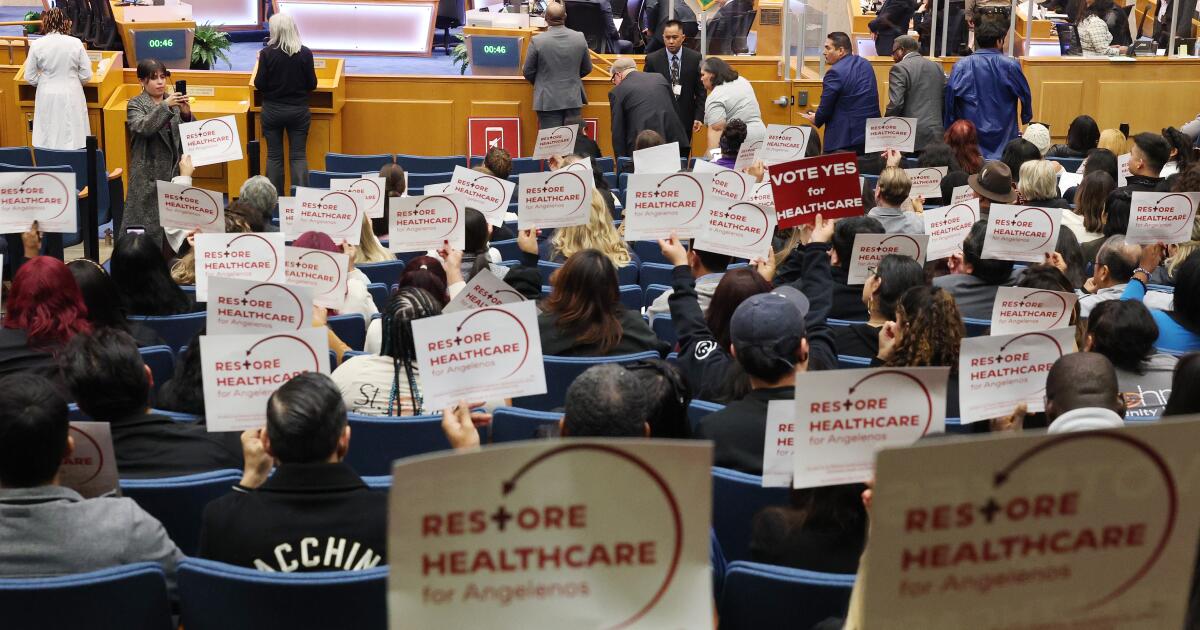
Early returns indicate L.A. County voters have doubts about healthcare sales tax measure
-
 Sports16 minutes ago
Nelly Korda, Michelle Wie West and more: Who to watch at U.S. Women’s Open
-

 World28 minutes ago
EU launches major tech push to break US and China dependence
-
 News51 minutes ago
California’s primary for governor is undecided as candidates vie to be in the top two
-

 Los Angeles, Ca2 hours ago
California primary election results: governor and L.A. mayor races
-

 Detroit, MI3 hours ago
Another bribery scandal hits Detroit. It involves the People Mover
-

 San Francisco, CA3 hours ago
What’s Worth More Than Cash in San Francisco Real Estate? Anthropic Stock

