
⚽ Get the latest World Cup news
Receive updates on the 2026 FIFA World Cup


Can I hear just a few positive things in 2026? Amanda Gutierres of the new women’s soccer team, Boston Legacy FC, at Gillette Stadium. Boston Legacy
For one year — just one year! — What if we all tried to be Mass. boosters, rather than Mass. criticizers, Mass. fault-finders or plain old Massholes?
What if we made that a New Year’s Resolution that we actually stick with until December?
If you’re a resident of Massachusetts, you can undoubtedly add to this list of problems that our state has: high taxes, pricey housing, unreliable public transit, bad traffic, cold weather, elected officials emitting hot air and residents voting with their feet by moving.
But if there was ever a year to look at the Dunkin’ cup as half full, I’d argue that 2026 is it.
A partial list of good stuff we could be bragging about would include:
• An NFL team that won its first playoff game with a quarterback who could be the season’s MVP, and an NBA team that surprisingly has a solid chance of making it to the playoffs.
• Boston is continuing to get better at enjoying winter, with Frostival and Winteractive. A Ferris wheel on the Greenway? A “street snowboarding” contest on City Hall Plaza? I’ll be there!
• The inaugural season of Boston Legacy FC, our new National Women’s Soccer League team, opens in March.
• Seven FIFA World Cup games will be held in Foxborough in June.
• Marking the 250th anniversary of the Declaration of Independence on the Fourth of July and other Revolutionary happenings throughout the year.
• Later in July, a fleet of tall ships from around the world arrives in Boston Harbor for Sail Boston.
• Worcester and Auburn are getting ready to celebrate the 100th anniversary of the birth of modern rocketry, with Robert Goddard’s early tests in 1926. In other nerdy news, the MIT Museum has plans to mark the 50th birthday of the biotech industry in Cambridge. Just two of many major industries born in Massachusetts.
Most residents of other states would view two or three of those things as opportunities to boast or back-pat.
They’d invite friends and relatives from all over to come for a visit, and see it as an opportunity to show off their state’s positives — or at least to appreciate the work it took to bring these things together in a single year.
Maybe we should, too.
Traffic will be bad at times. Hotel and Airbnb prices will skyrocket.
And you could live up to the stereotype by bemoaning that. Or you could see 2026 as a pretty great year to live in Massachusetts.


A Massachusetts high school is under investigation after “several” teachers have been diagnosed with breast cancer or precancerous conditions.
The state Department of Public Health is set to visit Uxbridge High School on Thursday to “conduct a series of air quality tests,” to determine whether the multiple cases are potentially connected.
Superintendent David Ljungberg and Principal Michael Rubin alerted families and district staff on Monday of the “sombering news,” after Uxbridge High School’s graduation over the weekend.
“We are writing to inform you about a concern we are investigating at Uxbridge High School,” Ljungberg and Rubin stated in the letter. “Several female teachers have been diagnosed with breast cancer or precancerous conditions over the past few years.”
“It is, of course, possible that these multiple cases are not connected to one another,” the leaders added, “but out of abundance of caution, we are looking into any environmental factors at the school that may be a factor in their diagnoses.”
The 123,000-square-foot school, with an enrollment of roughly 600, was constructed in 2012 at a cost of $45 million, including a $22-million state reimbursement.
Uxbridge school leaders say they notified the state Department of Health and local health board as soon as they became aware of the cases, seeking “counsel about how best to proceed.”
“Massachusetts DPH officials have indicated that there is no evidence of immediate danger in the building and no reason to limit access to or use of the facility at this time,” they wrote in their letter. “In fact, the public health officials have commended our decision to approach them with these concerns, our readiness to partner with them in support of the evaluation process.”
Health officials are assessing the school’s interior and exterior to “ensure there are no issues with the infrastructure that would present risks (including electrical, plumbing, mechanical, HVAC, and other systems)” and the indoor and outdoor air quality on campus.
The superintendent and principal said that state officials have ruled out water supply as a “risk factor” after “thorough testing.”
“The team has reached out to the women who have been diagnosed, requesting data to evaluate whether there may be a connection among their cases,” Ljungberg and Rubin wrote. “We are grateful for their cooperation.”
They added that the state has said discovering an environmental “smoking gun” is “rare” in workplace investigations.
“However, even if a direct causal link is not established,” the leaders wrote, “the administration is utilizing this process to rigorously test the building and guarantee that it meets all safety standards moving forward.”

Local News
Massachusetts lawmakers are considering a measure that would allow cities and towns to temporarily extend bar and restaurant hours during the summer, as the state prepares to host FIFA World Cup matches and celebrations marking the nation’s 250th anniversary.
The legislation (H.5465) filed by state Rep. Carole Fiola, would allow licensed establishments to sell alcohol one hour later than their normal closing time, up to 3 a.m., between June 1 and Aug. 31, 2026. The bill would also allow communities to establish designated public consumption districts where alcohol could be consumed in approved public spaces.
In a press release announcing the bill, Fiola said the summer’s threefold events lineup — the World Cup, Tall Ships, and July 4th — is an economically significant moment that the state should take advantage of.
“We should capitalize on these events that will generate economic benefits for small businesses and the state as a whole. It’s a local opt-in idea worth exploring that’s being done in other states,” Fiola said.
The proposal has received support from Boston Mayor Michelle Wu and most recently Gov. Maura Healey, who submitted written testimony Monday to the Joint Committee on Economic Development and Emerging Technologies urging lawmakers to advance the measure.
“Massachusetts is planning for a once-in-a-generation summer,” Healey wrote, according to the Boston Globe. “In 2026, we will celebrate the 250th anniversary of our nation’s founding, welcome tall ships from around the world to Boston Harbor for Sail Boston, and host seven FIFA World Cup matches in Foxborough, along with watch parties across the Commonwealth.”
The governor argued that the added flexibility could help local economies benefit from an influx of visitors.
“That flexibility can help communities capture more visitor spending, support jobs, keep downtowns active, and strengthen Massachusetts’ image as a dynamic destination ready to host the world and a place our residents, including our young professionals, are proud to call home,” Healey wrote.
She also urged lawmakers to move the legislation forward, saying it will “help Massachusetts meet the full economic and cultural opportunities for the summer ahead.”
In Rhode Island, a similar bill to allow bars and restaurants to remain open until 4 a.m. during the World Cup was signed into law on Friday.
Fiola’s bill remains before the Joint Committee on Economic Development and Emerging Technologies. Any final version would require approval from both the House and Senate before reaching Healey’s desk.

Receive updates on the 2026 FIFA World Cup

The meteor responsible for a loud boom heard in Rhode Island and Massachusetts Saturday afternoon was approximately 5 feet in diameter and weighed more than 12,000 pounds, according to NASA.
The object entered Earth’s atmosphere at roughly 42,000 mph, a NASA spokesperson said. It then traveled through the atmosphere from northwest to southeast for 26 miles before breaking up and producing a meteorite fall into Cape Cod Bay.
The energy released when the object broke up at an altitude of 31 miles is estimated to be equivalent to about 230 tons of TNT, according to NASA.
Professor Ralph Milliken of the Department of Earth, Environmental, and Planetary Sciences at Brown University spoke with NBC 10’s Mike Cerullo. (WJAR)
While it’s not very common to experience a 5-foot-wide meteorite, there is a significant amount of debris from space that reaches Earth.
“The estimates are that we probably have about 5,000 tons of cosmic dust and material and meteorites landing on Earth. The vast majority of that is super tiny stuff, we’re talking things that are smaller than a grain of sand, or the thickness of a human hair,” said Professor Ralph Milliken of the Department of Earth, Environmental, and Planetary Sciences at Brown University. “For something of this size a few feet across, it’s not that common, but a few a year. Most of these would occur over uninhabited areas, over the ocean, and we wouldn’t be able to see them, but they are detected.”
Because of its size, a meteorite with a 5-foot diameter is difficult to track before it enter Earth’s atmosphere.
“It’s virtually impossible to kind of know in advance of this size object coming,” Milliken said.
The area where a meteorite crashed in Cape Cod Bay. (WJAR)
Scientists are, however, able to track much larger space objects. NASA has been developing technology to try to deflect larger objects if needed.
Events like what occurred in New England over the weekend are recorded. Although other fireballs enter Earth’s atmosphere throughout the year, many of them materialize over water and uninhabited areas.

Vintage-obsessed millennial parents are driving L.A.’s booming kids’ clothing resale market
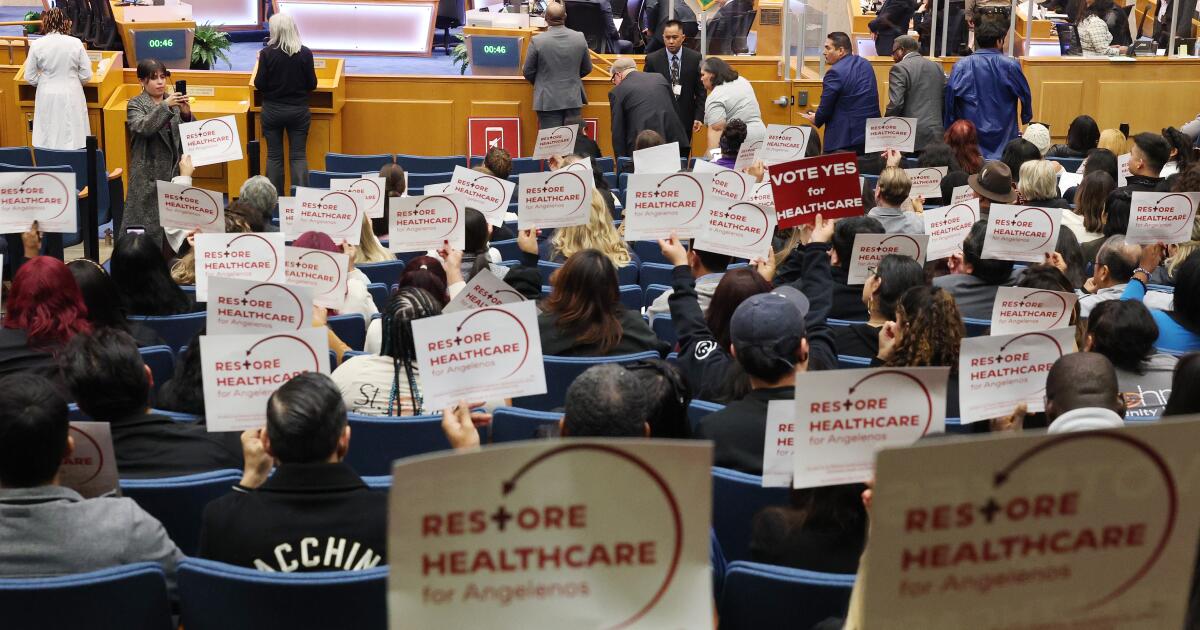
Early returns indicate L.A. County voters have doubts about healthcare sales tax measure

Nelly Korda, Michelle Wie West and more: Who to watch at U.S. Women’s Open


EU launches major tech push to break US and China dependence

California’s primary for governor is undecided as candidates vie to be in the top two


California primary election results: governor and L.A. mayor races


Another bribery scandal hits Detroit. It involves the People Mover


What’s Worth More Than Cash in San Francisco Real Estate? Anthropic Stock

