News
Trump says he’s been assured Tehran has stopped killing protesters as Iran reopens its airspace – live


Opening summary
Welcome to our continuing live coverage of the crisis in Iran.
Donald Trump says he has been assured that the killing of Iranian protesters has been halted, adding when asked about whether the threatened US military action was now off the table that he will “watch it and see”.
The president said at the White House that “very important sources on the other side” had now assured him that Iranian executions would not go ahead. “They’ve said the killing has stopped and the executions won’t take place,” Trump said. “There were supposed to be a lot of executions today and that the executions won’t take place – and we’re going to find out.”
Earlier, Iranian foreign minister Abbas Araghchi told Fox News that executions executions were not taking place and there would be “no hanging today or tomorrow”. “I’m confident that there is no plan for hanging.”
The family of Erfan Soltani, the first Iranian protester sentenced to death since the current unrest began, has been told his execution has been postponed.
Here are some of the other latest developments:
-
Trump said Iranian opposition figure Reza Pahlavi “seems very nice” but expressed uncertainty about whether Pahlavi would be able to muster support within Iran to eventually take over. “I don’t know how he’d play within his own country,” Trump told Reuters in the Oval Office. “And we really aren’t up to that point yet. I don’t know whether or not his country would accept his leadership, and certainly if they would, that would be fine with me.”
-
Iran has reopened its airspace after a near-five-hour closure that forced airlines to cancel, reroute or delay some flights.
-
The United Nations security council is scheduled to meet on Thursday afternoon for “a briefing on the situation in Iran”, according to a spokesperson for the Somali presidency. The scheduling note said the briefing was requested by the US.
-
Some US and UK personnel have been evacuated as a precaution from sites in the Middle East. The British embassy in Tehran has also been temporarily closed.
-
Spain, Italy and Poland advised their citizens to leave Iran. It followed a call by the US urging its citizens to leave Iran, suggesting land routes to Turkey or Armenia.
-
Araghchi insisted the situation was “under control” and urged the US to engage in diplomacy. “Now there’s calm,” the Iranian foreign minister said. “We have everything under control, and let’s hope that wisdom prevails and we don’t end up in a situation of high tension that would be catastrophic for everyone.”
-
The death toll in Iran from the regime’s crackdown stands at 2,571 people, according to the US-based Human Rights Activists news agency. More than 18,100 have been arrested, it said.
-
Foreign ministers from the G7 group said they were “prepared to impose additional restrictive measures” on Iran over its handling of the protests, and the “deliberate use of violence, the killing of protesters, arbitrary detention and intimidation tactics”.
Key events
AI-generated videos purportedly depicting protests in Iran have flooded the web, researchers say, as social media users push hyper-realistic deepfakes to fill an information void amid the country’s internet restrictions.
US disinformation watchdog NewsGuard said it identified seven AI-generated videos depicting the Iranian protests – created by both pro- and anti-government actors – that had collectively amassed about 3.5m views across online platforms.
Among them was a video shared on Elon Musk’s X showing women protesters smashing a vehicle belonging to the Basij, the Iranian paramilitary force deployed to suppress the protests, reports Agence France-Presse.
One X post featuring the AI clip – shared by what NewsGuard described as anti-regime users – garnered nearly 720,000 views. Anti-regime X and TikTok users in the US also posted AI videos depicting Iranian protesters symbolically renaming local streets after Donald Trump.
The AI creations highlight the growing prevalence of what experts call “hallucinated” visual content on social media during major news events, often overshadowing authentic images and videos.
Tensions between the US and Iran have appeared to ease as Donald Trump adopted a more measured tone towards Tehran and suggested a pause in his decision on threatened US military action. As you can read in our fresh full report, Trump had spoken repeatedly in recent days about coming to the aid of the Iranian people over the ruling regime’s crackdown on protests that a human rights group says has now killed at least 3,428 people and led to the arrest of more than 10,000.
But as mentioned earlier, Trump said in a surprise announcement at the White House that he had received assurances from “very important sources on the other side” that Tehran had now stopped the use of lethal force on protesters and that executions would not go ahead.
Asked if US military action was now off the table, Trump responded: “We’re going to watch it and see what the process is.”
You can read the full report here:
Moving for a moment to Australia, protesters have staged a rally outside the Iranian embassy in Canberra to demand regime change in Iran. About 100 demonstrators chanted “democracy for Iran” and “King Reza Pahlavi”, a reference to the last Iranian shah’s exiled son – a key figure in the anti-government protests.
James Younessi, a Sydney doctor who spoke at the demonstration, said he would happily move back to his home country if the regime was overthrown, Australian Associated Press has reported.
But he was hesitant about more American intervention in the Middle East, saying:
I don’t want Iran to be indentured to any foreign nation the moment anybody interferes. But if it means saving one life for it, we want a measured response that we can have this bloodshed ended.
Another protester, Omid Fakhri, who hadn’t heard from his family in Iran because of the internet blackout, was more positive about US military action.
“We don’t care which military, just a military is fine, as long as they can go in and stop the massacre,” he said. Foreign minister Penny Wong said Australia continued to urge people not to travel to Iran, and warned the security situation could deteriorate rapidly.
A little more now on Iran’s reopening of its airspace to flights after a near-five-hour closure that forced airlines to cancel, reroute or delay some flights.
Iran closed its airspace to all flights except international ones to and from Iran with official permission at 10.15pm GMT on Wednesday, according to a notice on the US Federal Aviation Administration website.
The notice was removed shortly before 3am GMT, according to tracking service Flightradar24, which showed five flights from Iranian carriers Mahan Air, Yazd Airways and AVA Airlines were among the first to resume over the country.
The price of oil dropped on Thursday after concerns over instability in Iran were eased by comments from Donald Trump, and gold and silver prices also dipped.
West Texas Intermediate fell 3.0% to $60.16 a barrel while Brent crude was down 2.93% to $64.57.
The plunge came after the US president said he had been told the killings of protesters in Iran had been halted.
Reaction across Asian markets has been mixed as trading got under way on Thursday. Hong Kong, Shanghai, Taipei, Wellington, Mumbai and Kuala Lumpur fell, while Sydney, Seoul, Bangkok and Manila posted minimal gains. Concern that the Iran situation could restrict supplies of crude had caused oil prices to rise about 1.5% on Wednesday.
India has advised its citizens to leave Iran by any transport possible.
The Indian embassy in Tehran said in a post on X: Indian nationals who are currently in Iran (students, pilgrims, business persons and tourists) are advised to leave Iran by available means of transport, including commercial flights.
The embassy also advised its citizens to be cautious and “avoid areas of protests or demonstrations”.
The US, Germany and Spain are among the counties reported to have earlier advised their citizens to leave Iran.
Welcome to our continuing live coverage of the crisis in Iran. Donald Trump says he has been assured that the killing of Iranian protesters has been halted, adding when asked about whether the threatened US military action was now off the table that he will “watch it and see”.
The president said at the White House that “very important sources on the other side” had now assured him that Iranian executions would not go ahead. “They’ve said the killing has stopped and the executions won’t take place,” Trump said. “There were supposed to be a lot of executions today and that the executions won’t take place – and we’re going to find out.”
Earlier, Iranian foreign minister Abbas Araghchi told Fox News that executions executions were not taking place and there would be “no hanging today or tomorrow”. “I’m confident that there is no plan for hanging.”
The family of Erfan Soltani, the first Iranian protester sentenced to death since the current unrest began, has been told his execution has been postponed.
Here are some of the other latest developments: Trump said Iranian opposition figure Reza Pahlavi “seems very nice” but expressed uncertainty about whether Pahlavi would be able to muster support within Iran to eventually take over. “I don’t know how he’d play within his own country,” Trump told Reuters in the Oval Office. “And we really aren’t up to that point yet. I don’t know whether or not his country would accept his leadership, and certainly if they would, that would be fine with me.”
Iran has reopened its airspace after a near-five-hour closure that forced airlines to cancel, reroute or delay some flights.
The United Nations security council is scheduled to meet on Thursday afternoon for “a briefing on the situation in Iran”, according to a spokesperson for the Somali presidency. The scheduling note said the briefing was requested by the US.
Some US and UK personnel have been evacuated as a precaution from sites in the Middle East. The British embassy in Tehran has also been temporarily closed.
Spain, Italy and Poland advised their citizens to leave Iran. It followed a call by the US urging its citizens to leave Iran, suggesting land routes to Turkey or Armenia.
Araghchi insisted the situation was “under control” and urged the US to engage in diplomacy. “Now there’s calm,” the Iranian foreign minister said. “We have everything under control, and let’s hope that wisdom prevails and we don’t end up in a situation of high tension that would be catastrophic for everyone.”
The death toll in Iran from the regime’s crackdown stands at 2,571 people, according to the US-based Human Rights Activists news agency. More than 18,100 have been arrested, it said.
Foreign ministers from the G7 group said they were “prepared to impose additional restrictive measures” on Iran over its handling of the protests, and the “deliberate use of violence, the killing of protesters, arbitrary detention and intimidation tactics”.
Oil prices plunge as Iran instability fears ease
India latest country to urge its citizens to leave Iran
Opening summary


Lionel Messi #10 of Argentina celebrates scoring his team’s second goal during their World Cup match against Egypt in Atlanta on Tuesday.
Elsa/Getty Images
hide caption
toggle caption
Elsa/Getty Images
They looked beaten. And out. Argentina, the defending World Cup champion and No. 1-ranked team, was down 2-0 late against Egypt.
Then, in a span of 13 remarkable minutes, Argentina scored not once, not twice, but three times, capping a comeback for the ages and leaving Egypt stunned and shellshocked.
For much of the game in Atlanta, Egypt was in control, hobbling Argentina early. The Egyptian attack began almost immediately with a stunning header goal delivered by Yasser Ibrahim in the 15th minute. After that, Egypt’s defense closed ranks, making it practically impossible for Argentina to equalize.
It was downhill from there for the Argentines: team captain Lionel Messi failed to convert a penalty kick, and in the 67th minute, Egypt got a second goal from Mostafa Ziko (after an earlier Egyptian goal had been disallowed after a video review). It looked like Argentina was finished. On the brink of elimination.
But no one told the Argentine players that.
In the 79th minute, Lionel Messi began doing his thing. He fired a cross near the Egyptian goal, and Cristian Romero headed it in. Messi was not done. Four minutes later, he powered a shot past the Egyptian keeper. It was his eighth goal of this tournament, the most of any player. The score was 2-2.
Then, in stoppage time, yet another Argentina header and another goal, this time from Enzo Fernandez.
“This is the World Cup for you,” said Messi after the game. “It wasn’t easy to come back from two goals down. But as I always say, this group never gives up. We always try to fight until the end.”
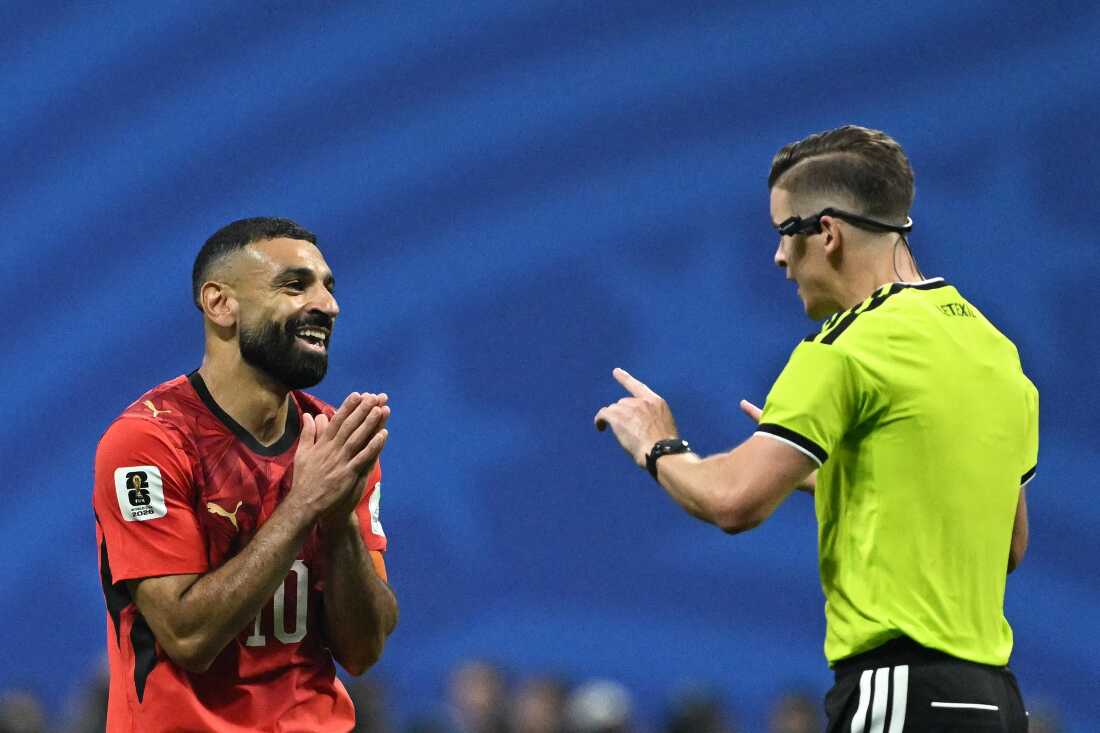
French referee François Letexier speaks with Egypt forward Mohamed Salah during the World Cup Round of 16 match between Argentina and Egypt in Atlanta.
Roberto Schmidt/AFP via Getty Images
hide caption
toggle caption
Roberto Schmidt/AFP via Getty Images
Afterward, Egypt coach Hossam Hassan complained about the French referee and the officiating. “I am not convinced. I am not convinced with this outcome. I’m not convinced with the way things unfolded during this match,” said Hassan in a post-match news conference. “We have been treated unfairly today. We have suffered injustice.”
“We would have deserved to earn this win, but we are leaving with honor, with pride, regardless of this defeat,” said Hossan.
African soccer teams have been the stars of this World Cup. Morocco has yet to lose a game. Cape Verde qualified for the first time in its history and stymied Spain, Uruguay and Saudi Arabia. Argentina barely beat them in a nail-biter of a match.
For Egypt, getting this far in the tournament is historic in itself: it’s the first time the team has made it this far. For Argentina, it was a terrifying yet relieving victory: several players, including Messi himself, cried after the game.
Next, they move to the quarterfinals and will play the winner of today’s Switzerland-Colombia match.

Top Senate Democrats are pushing for answers on whether a provision in a controversial settlement agreement between President Trump and his own administration applies to companies co-founded by or affiliated with the Trump family.
As part of a deal struck in May by the Justice Department to resolve a lawsuit brought by Mr. Trump, the Internal Revenue Service is permanently barred from pursuing claims against Mr. Trump, his oldest sons Don Jr. and Eric, and the Trump Organization based on prior tax returns.
In a one-page document signed by Acting Attorney General Todd Blanche and dated May 19, the Justice Department said the defendants in the president’s lawsuit — the IRS and the Treasury Department — are “FOREVER BARRED and PRECLUDED” from “prosecuting or pursuing, any and all claims” arising from tax returns filed before the settlement took effect. Blanche also wrote that the settlement applies to “parties including trusts, parent, sister, or related companies, affiliates, and subsidiaries.”
Now, Senators Elizabeth Warren of Massachusetts, Senate Minority Leader Chuck Schumer of New York, and Ranking Member of the Senate Finance Committee Ron Wyden of Oregon are pushing 11 businesses and organizations with ties to the Trump family to get answers for the “significant questions” the settlement raises relating to the tax audit provision, and whether the companies are included in the deal.
“Under the guise of a so-called legal settlement, the Trump administration has attempted to decree that the President, his family, and their entire business empire — potentially including entities with even the vaguest ‘affiliation’ to the family — are to face zero consequences if they have committed a range of financial crimes or misdeeds — regardless of the severity of the violation,” the senators wrote in letters transmitted to the companies Monday night.
The letters were sent to mining company Kaz Resources, defense firm Powerus, cryptocurrency companies World Liberty Financial and American Bitcoin, robotics startup Foundation Future Industries, investment firm 1789 Capital, private aviation company Tag Air, and prediction markets Polymarket and Kalshi.
All of the companies either were founded by Mr. Trump and his two adult sons, or list members of the Trump family as advisers, board members, or partial owners. Donald Trump Jr. sits on Polymarket’s advisory board and 1789 Capital, where he’s a partner, has invested in Polymarket. Days before Mr. Trump took office for his second term, Kalshi also announced Trump Jr. would be a strategic adviser.
The Democrats, who are in the minority, lack subpoena power, so Mr. Trump, his children and his companies can’t be forced to answer the questions posed by the senators.
According to recent financial disclosures, the president earned more than a billion dollars from cryptocurrency ventures alone last year, including from his meme coin business and World Liberty Financial, his family’s cryptocurrency firm.
Separately, the senators also asked the Trump Organization in a separate letter if it believes it has “immunity from all audits, civil penalties or federal prosecution” for any crimes that could have occurred before the settlement.
Trump Media and Technology Group, which is majority owned by a trust that lists Mr. Trump as the sole beneficiary and operates the Truth Social platform he uses daily, also received a letter from the Democratic senators.
“The public deserves transparency about the scope of this get-out-of-jail free card for Trump-aligned businesses, and about whether you intend to rely on this settlement as a free pass for any possible violations of the law,” the senators continued in their letter, which also seeks any communications that executives at the companies have had with the Justice Department and White House leading up to or after the settlement was signed.
The settlement was announced months after Mr. Trump and two of his sons and the Trump Organization accused the IRS and Treasury Department of unlawfully allowing a government contractor to leak tax returns to media outlets in 2020.
In a statement, a Justice Department spokesperson said “the IRS routinely provides releases as part of resolving taxpayer reviews and audits. This settlement follows that same standard practice.”
The spokesperson did not provide specific information about which companies are covered by the audit provision, or whether the Trump Organization and Trump family are the only entities covered by that addendum.

Charles De Ketelaere #17 of Belgium celebrates after scoring his team’s second goal during the World Cup Round of 16 match against the United States on Monday in Seattle.
Alex Grimm/Getty Images
hide caption
toggle caption
Alex Grimm/Getty Images
SEATTLE — This time was supposed to be different.
The U.S. men’s national team came into this FIFA World Cup with a lineup full of players with key roles in Europe’s top leagues. They had the name-brand coach — Mauricio Pochettino, of Tottenham, PSG and Chelsea fame. And they had homefield advantage, with every game on U.S. soil for the first time in three decades.

For weeks, the hype seemed like it might be real: The team’s three wins over Paraguay, Australia and Bosnia-Herzegovina were the most ever by a U.S. men’s squad in a World Cup. A new generation of American fans filled stadiums by the tens of thousands and tuned in on TV by the tens of millions.
But in the end, the Americans’ exit was the same as it ever was: Eliminated yet again in the Round of 16 at the hands of a European team — this time, Belgium, by a score of 4-1.
From the moment they stepped onto the Seattle field, the U.S. was outclassed by their opponent, No. 9-ranked Belgium. Countless turnovers and defensive lapses were seized on by the Belgians, who needed only nine minutes to take a 1-0 lead.
Then, once the Americans equalized on a free kick by midfielder Malik Tillman, Belgium scored yet again in barely a minute of play. Belgian forward Charles De Ketelaere scored both his team’s first-half goals.
After halftime, came an embarrassing nail in the coffin that silenced the Seattle sellout crowd for good — a 57th minute roll-in by Hans Vanaken after a slip-up by goalkeeper Matt Freese outside of the penalty area left the goal unguarded. Belgian forward Romelu Lukaku added a stoppage-time goal to seal the final score at 4-1.

Malik Tillman #17 of the United States celebrates scoring his team’s only goal during their World Cup match against Belgium. In what was one of the few bright spots of the game, the U.S. pulled even with Belgium at 1-1. The tie lasted less than two minutes before Belgium scored again.
Luke Hales/Getty Images
hide caption
toggle caption
Luke Hales/Getty Images
“It stinks,” said U.S. midfielder Tyler Adams. “Tonight was not a good performance overall. It’s not what we look to achieve. There [were] a lot of things that we could have done better.”
The U.S. had entered Monday’s game under a cloud of controversy around their striker Folarin Balogun, who was shown a red card in last week’s Round of 32 match against Bosnia-Herzegovina. An automatic one-game suspension was set to sideline Balogun, the Americans’ leading scorer at the World Cup, for Monday’s game.
Then, the day before the game, a FIFA disciplinary panel took the highly unusual step of delaying Balogun’s suspension by a year to allow him to participate. Then, news broke that President Trump had personally called FIFA president Gianni Infantino to encourage him to review the red card.
The Royal Belgian Football Association said it would protest Balogun’s inclusion in the lineup. But even at full strength, the U.S. were never real contenders in Monday’s game.
U.S. defender and team captain Tim Ream said the controversy swirling around the team had no impact. “We were fully focused on us as a group and as a team and fully focused on the game and not really worrying about what was being said or debated in the outside world.”
Belgium will advance to the quarterfinals for the third time in the past four World Cups, where it will face Spain on Friday in Los Angeles.

Mauricio Pochettino, Head Coach of the United States, walks down the touchline during the Round of 16 World Cup match between the USA and Belgium in Seattle on Monday.
Carl Recine/Getty Images
hide caption
toggle caption
Carl Recine/Getty Images
-

 Alaska4 minutes ago
Opinion: Alaska’s whale-strike risk is growing while regulators keep studying the obvious
-

 Arizona11 minutes ago
Arizona Lottery Mega Millions, Pick 3 Evening results for July 7, 2026
-
Arkansas13 minutes ago
Arkansas Lottery Mega Millions, Cash 3 winning numbers for July 7, 2026
-

 California25 minutes ago
California still hasn’t released Newsom’s Baby2Baby diaper contract as lawmakers weigh longer public records delays
-

 Colorado28 minutes ago
Colorado River, public lands reopen as Snyder Fire containment increases
-

 Connecticut34 minutes ago
Opinion: A lifeline in CT’s childcare desert
-

 Delaware40 minutes ago
Talk & Film Bring Delaware’s Revolutionary Story to Life at Archives’ First Saturday Program – State of Delaware News
-
 Florida43 minutes ago
Heat alerts expand across Florida as dangerous temperatures return

