News
Trump threatened to invoke the Insurrection Act (again). What is it?

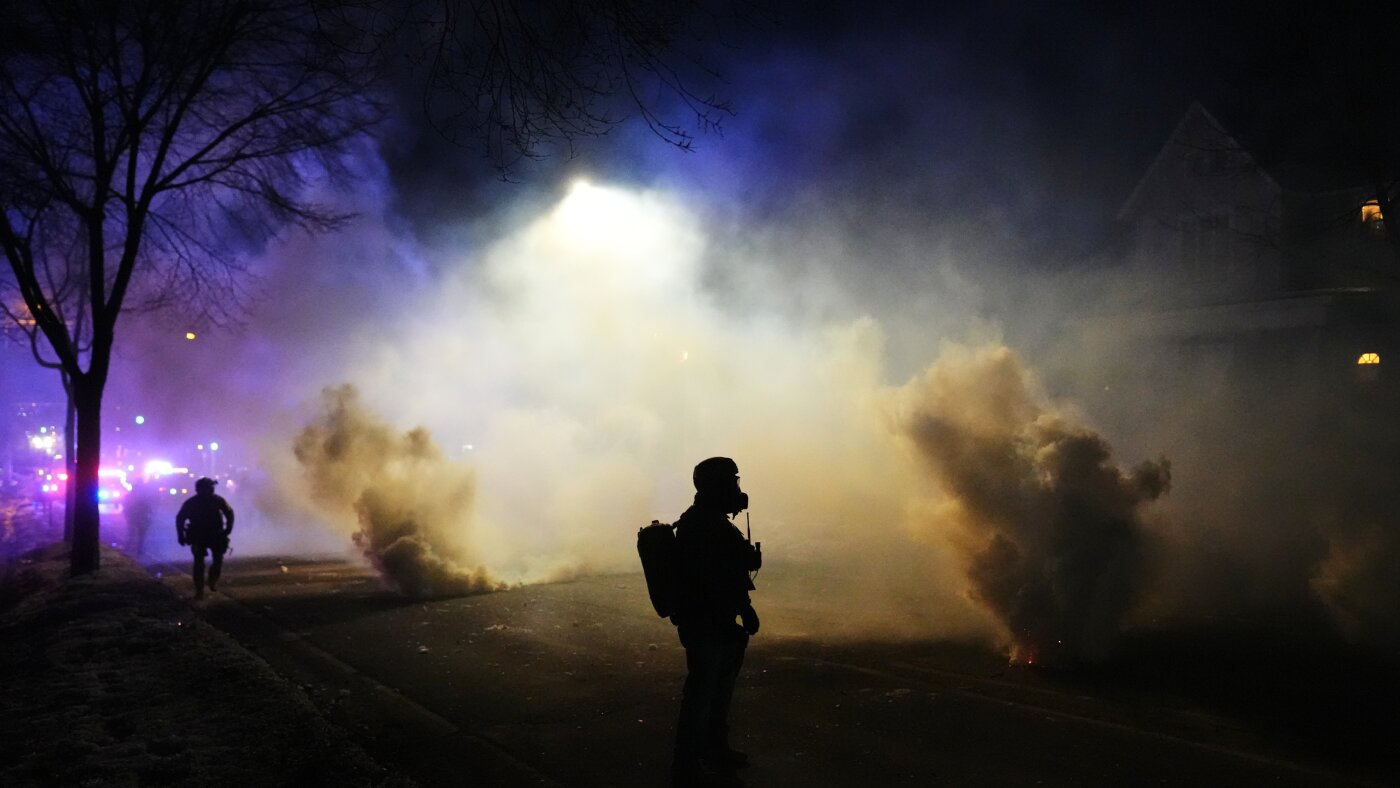
Law enforcement officers stand amid tear gas at the scene of a shooting Wednesday in Minneapolis.
Adam Gray/AP
hide caption
toggle caption
Adam Gray/AP
President Trump on Thursday threatened to invoke the Insurrection Act to suppress protests in Minnesota, a week after an ICE agent fatally shot a 37-year-old Minneapolis woman.
The shooting death of Renee Macklin Good sparked protests nationwide against ICE’s continued presence in Minnesota and across the country.
Protesters were further incensed on Wednesday evening when ICE agents in Minneapolis shot a Venezuelan immigrant in the leg during an attempted arrest.

Writing on Truth Social, Trump said: “If the corrupt politicians of Minnesota don’t obey the law and stop the professional agitators and insurrectionists from attacking the Patriots of I.C.E., who are only trying to do their job, I will institute the INSURRECTION ACT, which many Presidents have done before me, and quickly put an end to the travesty that is taking place in that once great State.”
The act is one way the president can send troops to states to restore law and order. But unlike in Trump’s National Guard deployments in 2025, the Insurrection Act would allow armed forces to carry out law enforcement functions, such as making arrests and conducting searches.
The law could open the door to significantly expanding the military’s role in quelling protests, protecting federal buildings and carrying out immigration enforcement, which some of Trump’s aides have suggested he do.
Since Thomas Jefferson signed it into law in 1807, the Insurrection Act has only been invoked about 30 times. The last instance was over three decades ago. During his second term, Trump has repeatedly brought up the idea of invoking the statute.
“If people were being killed and courts were holding us or governors or mayors were holding us up, sure I’d do that,” he told reporters back in early October.
Trump has also erroneously claimed that nearly half of all U.S. presidents have invoked the law and that it was invoked 28 times by a single president, as he said during an interview with CBS’ 60 Minutes in late October.
In reality, only 17 out of 45 presidents — or 37% — utilized the law, according to the Brennan Center for Justice, a nonpartisan law and policy organization that in 2022 tracked all Insurrection Act invocations. The group also did not find a president who invoked the emergency powers more than six times, as Ulysses S. Grant did during the Reconstruction era.
The White House did not release a statement on the president’s threat.
Here’s what to know.
How would the Insurrection Act get used?
There are three ways that the president can invoke the Insurrection Act, according to the Brennan Center for Justice.
The first is at the request of a state’s legislature or governor facing an “insurrection.” The law itself does not elaborate on what qualifies as an insurrection, but legal scholars generally understand the term as referring to a violent uprising of some kind.
In the second path, the president does not need a state’s consent to deploy troops when “unlawful obstructions, combinations, or assemblages, or rebellion” makes it “impracticable” to enforce federal laws.
The third path also does not require the affected state’s support. In this case, the president can send in the military to suppress an insurrection that “hinders the execution of the laws” or “opposes or obstructs the execution of the laws of the United States or impedes the course of justice under those laws.”
Before invoking the Insurrection Act, the president must first order the “insurgents” to disperse within a limited amount of time.
How would troop deployments differ under the Insurrection Act?
So far during Trump’s second term, National Guard troops have been called into Los Angeles, Chicago and Portland, Ore., under a statute known as Title 10, which places the force under federal control. The operations in Memphis and Washington, D.C., were authorized under Title 32, meaning they were under state command. (The situation in D.C is unique since the federal district is not a state and therefore does not have a governor.)

Under these deployments, Guard forces are subject to the Posse Comitatus Act, which generally prohibits federal military personnel from acting as police on American streets. It’s rooted in one of the nation’s founding principles, which opposes military involvement in civilian affairs.
The Insurrection Act, however, is a key exception to the law.
The controversial emergency powers were last used during the 1992 Los Angeles riots after the acquittal of four police officers in the beating of Rodney King.
Former President George H.W. Bush invoked the law at the request of then-California Gov. Pete Wilson, who was worried that local law enforcement could not quell the unrest alone.
But that deployment also showed the risks of using military personnel as law enforcement. In an infamous moment, LA police officers asked a group of Marines to “cover” them as they approached a house. The Marines interpreted their request as asking them to open fire, while the police officers actually wanted them to stay on guard.

“The Marines then lay down suppressing fire. The police were completely aghast,” Mick Wagoner, a retired Marine Corps lieutenant colonel, told NPR earlier this year.
How much power does the Insurrection Act give the president?
Some of the Insurrection Act’s power comes from what’s not actually in it.
Terms like “insurrection,” “rebellion” and “impracticable” are loosely defined and give broad deference to the president, according to William Banks, professor emeritus of law at Syracuse University and an expert in national security and emergency powers.
“It’s incredibly open-ended and grants him a dramatic amount of discretion to federalize an incident,” he added.
The law also does not mention time constraints on the troop deployments. Nor does it involve Congress in the process to maintain checks and balances, Banks added.
The Insurrection Act has also been rarely tested in the courts. Trump himself described the Insurrection Act as providing legal cover.

“Do you know that I could use that immediately and no judge can even challenge you on that. But I haven’t chosen to do it because I haven’t felt we need it,” he said during the October 60 Minutes interview.
Despite its broad language, legal experts argue that historical precedent matters when it comes to the Insurrection Act.
If Trump were to invoke the law to address crime or enforce immigration laws, it would represent a sharp departure from past uses and would likely face legal challenges, according to Laura A. Dickinson, a professor at The George Washington University Law School who focuses on national security.
“ While it seems very broad on its face, it’s not a blank check,” she said.


Lionel Messi #10 of Argentina celebrates scoring his team’s second goal during their World Cup match against Egypt in Atlanta on Tuesday.
Elsa/Getty Images
hide caption
toggle caption
Elsa/Getty Images
They looked beaten. And out. Argentina, the defending World Cup champion and No. 1-ranked team, was down 2-0 late against Egypt.

Then, in a span of 13 remarkable minutes, Argentina scored not once, not twice, but three times, capping a comeback for the ages and leaving Egypt stunned and shellshocked.
For much of the game in Atlanta, Egypt was in control, hobbling Argentina early. The Egyptian attack began almost immediately with a stunning header goal delivered by Yasser Ibrahim in the 15th minute. After that, Egypt’s defense closed ranks, making it practically impossible for Argentina to equalize.
It was downhill from there for the Argentines: team captain Lionel Messi failed to convert a penalty kick, and in the 67th minute, Egypt got a second goal from Mostafa Ziko (after an earlier Egyptian goal had been disallowed after a video review). It looked like Argentina was finished. On the brink of elimination.
But no one told the Argentine players that.
In the 79th minute, Lionel Messi began doing his thing. He fired a cross near the Egyptian goal, and Cristian Romero headed it in. Messi was not done. Four minutes later, he powered a shot past the Egyptian keeper. It was his eighth goal of this tournament, the most of any player. The score was 2-2.
Then, in stoppage time, yet another Argentina header and another goal, this time from Enzo Fernandez.
“This is the World Cup for you,” said Messi after the game. “It wasn’t easy to come back from two goals down. But as I always say, this group never gives up. We always try to fight until the end.”

French referee François Letexier speaks with Egypt forward Mohamed Salah during the World Cup Round of 16 match between Argentina and Egypt in Atlanta.
Roberto Schmidt/AFP via Getty Images
hide caption
toggle caption
Roberto Schmidt/AFP via Getty Images
Afterward, Egypt coach Hossam Hassan complained about the French referee and the officiating. “I am not convinced. I am not convinced with this outcome. I’m not convinced with the way things unfolded during this match,” said Hassan in a post-match news conference. “We have been treated unfairly today. We have suffered injustice.”
“We would have deserved to earn this win, but we are leaving with honor, with pride, regardless of this defeat,” said Hossan.
African soccer teams have been the stars of this World Cup. Morocco has yet to lose a game. Cape Verde qualified for the first time in its history and stymied Spain, Uruguay and Saudi Arabia. Argentina barely beat them in a nail-biter of a match.
For Egypt, getting this far in the tournament is historic in itself: it’s the first time the team has made it this far. For Argentina, it was a terrifying yet relieving victory: several players, including Messi himself, cried after the game.
Next, they move to the quarterfinals and will play the winner of today’s Switzerland-Colombia match.

Top Senate Democrats are pushing for answers on whether a provision in a controversial settlement agreement between President Trump and his own administration applies to companies co-founded by or affiliated with the Trump family.
As part of a deal struck in May by the Justice Department to resolve a lawsuit brought by Mr. Trump, the Internal Revenue Service is permanently barred from pursuing claims against Mr. Trump, his oldest sons Don Jr. and Eric, and the Trump Organization based on prior tax returns.
In a one-page document signed by Acting Attorney General Todd Blanche and dated May 19, the Justice Department said the defendants in the president’s lawsuit — the IRS and the Treasury Department — are “FOREVER BARRED and PRECLUDED” from “prosecuting or pursuing, any and all claims” arising from tax returns filed before the settlement took effect. Blanche also wrote that the settlement applies to “parties including trusts, parent, sister, or related companies, affiliates, and subsidiaries.”
Now, Senators Elizabeth Warren of Massachusetts, Senate Minority Leader Chuck Schumer of New York, and Ranking Member of the Senate Finance Committee Ron Wyden of Oregon are pushing 11 businesses and organizations with ties to the Trump family to get answers for the “significant questions” the settlement raises relating to the tax audit provision, and whether the companies are included in the deal.
“Under the guise of a so-called legal settlement, the Trump administration has attempted to decree that the President, his family, and their entire business empire — potentially including entities with even the vaguest ‘affiliation’ to the family — are to face zero consequences if they have committed a range of financial crimes or misdeeds — regardless of the severity of the violation,” the senators wrote in letters transmitted to the companies Monday night.
The letters were sent to mining company Kaz Resources, defense firm Powerus, cryptocurrency companies World Liberty Financial and American Bitcoin, robotics startup Foundation Future Industries, investment firm 1789 Capital, private aviation company Tag Air, and prediction markets Polymarket and Kalshi.
All of the companies either were founded by Mr. Trump and his two adult sons, or list members of the Trump family as advisers, board members, or partial owners. Donald Trump Jr. sits on Polymarket’s advisory board and 1789 Capital, where he’s a partner, has invested in Polymarket. Days before Mr. Trump took office for his second term, Kalshi also announced Trump Jr. would be a strategic adviser.
The Democrats, who are in the minority, lack subpoena power, so Mr. Trump, his children and his companies can’t be forced to answer the questions posed by the senators.
According to recent financial disclosures, the president earned more than a billion dollars from cryptocurrency ventures alone last year, including from his meme coin business and World Liberty Financial, his family’s cryptocurrency firm.
Separately, the senators also asked the Trump Organization in a separate letter if it believes it has “immunity from all audits, civil penalties or federal prosecution” for any crimes that could have occurred before the settlement.
Trump Media and Technology Group, which is majority owned by a trust that lists Mr. Trump as the sole beneficiary and operates the Truth Social platform he uses daily, also received a letter from the Democratic senators.
“The public deserves transparency about the scope of this get-out-of-jail free card for Trump-aligned businesses, and about whether you intend to rely on this settlement as a free pass for any possible violations of the law,” the senators continued in their letter, which also seeks any communications that executives at the companies have had with the Justice Department and White House leading up to or after the settlement was signed.
The settlement was announced months after Mr. Trump and two of his sons and the Trump Organization accused the IRS and Treasury Department of unlawfully allowing a government contractor to leak tax returns to media outlets in 2020.
In a statement, a Justice Department spokesperson said “the IRS routinely provides releases as part of resolving taxpayer reviews and audits. This settlement follows that same standard practice.”
The spokesperson did not provide specific information about which companies are covered by the audit provision, or whether the Trump Organization and Trump family are the only entities covered by that addendum.

Charles De Ketelaere #17 of Belgium celebrates after scoring his team’s second goal during the World Cup Round of 16 match against the United States on Monday in Seattle.
Alex Grimm/Getty Images
hide caption
toggle caption
Alex Grimm/Getty Images
SEATTLE — This time was supposed to be different.
The U.S. men’s national team came into this FIFA World Cup with a lineup full of players with key roles in Europe’s top leagues. They had the name-brand coach — Mauricio Pochettino, of Tottenham, PSG and Chelsea fame. And they had homefield advantage, with every game on U.S. soil for the first time in three decades.

For weeks, the hype seemed like it might be real: The team’s three wins over Paraguay, Australia and Bosnia-Herzegovina were the most ever by a U.S. men’s squad in a World Cup. A new generation of American fans filled stadiums by the tens of thousands and tuned in on TV by the tens of millions.
But in the end, the Americans’ exit was the same as it ever was: Eliminated yet again in the Round of 16 at the hands of a European team — this time, Belgium, by a score of 4-1.
From the moment they stepped onto the Seattle field, the U.S. was outclassed by their opponent, No. 9-ranked Belgium. Countless turnovers and defensive lapses were seized on by the Belgians, who needed only nine minutes to take a 1-0 lead.
Then, once the Americans equalized on a free kick by midfielder Malik Tillman, Belgium scored yet again in barely a minute of play. Belgian forward Charles De Ketelaere scored both his team’s first-half goals.
After halftime, came an embarrassing nail in the coffin that silenced the Seattle sellout crowd for good — a 57th minute roll-in by Hans Vanaken after a slip-up by goalkeeper Matt Freese outside of the penalty area left the goal unguarded. Belgian forward Romelu Lukaku added a stoppage-time goal to seal the final score at 4-1.

Malik Tillman #17 of the United States celebrates scoring his team’s only goal during their World Cup match against Belgium. In what was one of the few bright spots of the game, the U.S. pulled even with Belgium at 1-1. The tie lasted less than two minutes before Belgium scored again.
Luke Hales/Getty Images
hide caption
toggle caption
Luke Hales/Getty Images
“It stinks,” said U.S. midfielder Tyler Adams. “Tonight was not a good performance overall. It’s not what we look to achieve. There [were] a lot of things that we could have done better.”
The U.S. had entered Monday’s game under a cloud of controversy around their striker Folarin Balogun, who was shown a red card in last week’s Round of 32 match against Bosnia-Herzegovina. An automatic one-game suspension was set to sideline Balogun, the Americans’ leading scorer at the World Cup, for Monday’s game.
Then, the day before the game, a FIFA disciplinary panel took the highly unusual step of delaying Balogun’s suspension by a year to allow him to participate. Then, news broke that President Trump had personally called FIFA president Gianni Infantino to encourage him to review the red card.
The Royal Belgian Football Association said it would protest Balogun’s inclusion in the lineup. But even at full strength, the U.S. were never real contenders in Monday’s game.
U.S. defender and team captain Tim Ream said the controversy swirling around the team had no impact. “We were fully focused on us as a group and as a team and fully focused on the game and not really worrying about what was being said or debated in the outside world.”
Belgium will advance to the quarterfinals for the third time in the past four World Cups, where it will face Spain on Friday in Los Angeles.

Mauricio Pochettino, Head Coach of the United States, walks down the touchline during the Round of 16 World Cup match between the USA and Belgium in Seattle on Monday.
Carl Recine/Getty Images
hide caption
toggle caption
Carl Recine/Getty Images
-

 Alaska2 minutes ago
Opinion: Alaska’s whale-strike risk is growing while regulators keep studying the obvious
-

 Arizona9 minutes ago
Arizona Lottery Mega Millions, Pick 3 Evening results for July 7, 2026
-
Arkansas12 minutes ago
Arkansas Lottery Mega Millions, Cash 3 winning numbers for July 7, 2026
-

 California24 minutes ago
California still hasn’t released Newsom’s Baby2Baby diaper contract as lawmakers weigh longer public records delays
-

 Colorado27 minutes ago
Colorado River, public lands reopen as Snyder Fire containment increases
-

 Connecticut32 minutes ago
Opinion: A lifeline in CT’s childcare desert
-

 Delaware39 minutes ago
Talk & Film Bring Delaware’s Revolutionary Story to Life at Archives’ First Saturday Program – State of Delaware News
-
 Florida42 minutes ago
Heat alerts expand across Florida as dangerous temperatures return

