West
Oregon election system faces scrutiny as state moves to address 800,000 inactive voters: ‘Astounding’

NEWYou can now listen to Fox News articles!
Oregon election officials are set to begin removing hundreds of thousands of inactive voters from the state’s registration rolls, a move that comes after years of inaction, mounting public pressure, and lawsuits filed against the state in recent months.
Oregon’s Democratic Secretary of State Tobias Read, in a press release Friday, outlined two new directives he said will “restart” the “routine cleanup of outdated, inactive voter registration records” in accordance with state law to address the roughly 800,000 inactive voter records that are being maintained by election officials.
The first directive orders counties to immediately cancel long-inactive voter registrations that already met the legal requirements for removal before 2017. These are registrations where election mail was returned as undeliverable, voters failed to respond to official notices, and they did not participate in multiple federal elections. State officials estimate roughly 160,000 registrations fall into this category and should have been removed years ago.
The second directive changes how the state handles inactive voters going forward. It updates the language on voter confirmation cards to clearly warn voters that their registrations will be canceled if they do not respond or vote within the required time frame. State officials say this step restores a process that allows routine cleanup of inactive registrations under federal law.
FEDERAL JUDGE BLOCKS TRUMP ADMINISTRATION FROM ENFORCING MAIL-IN VOTING RULES IN EXECUTIVE ORDER
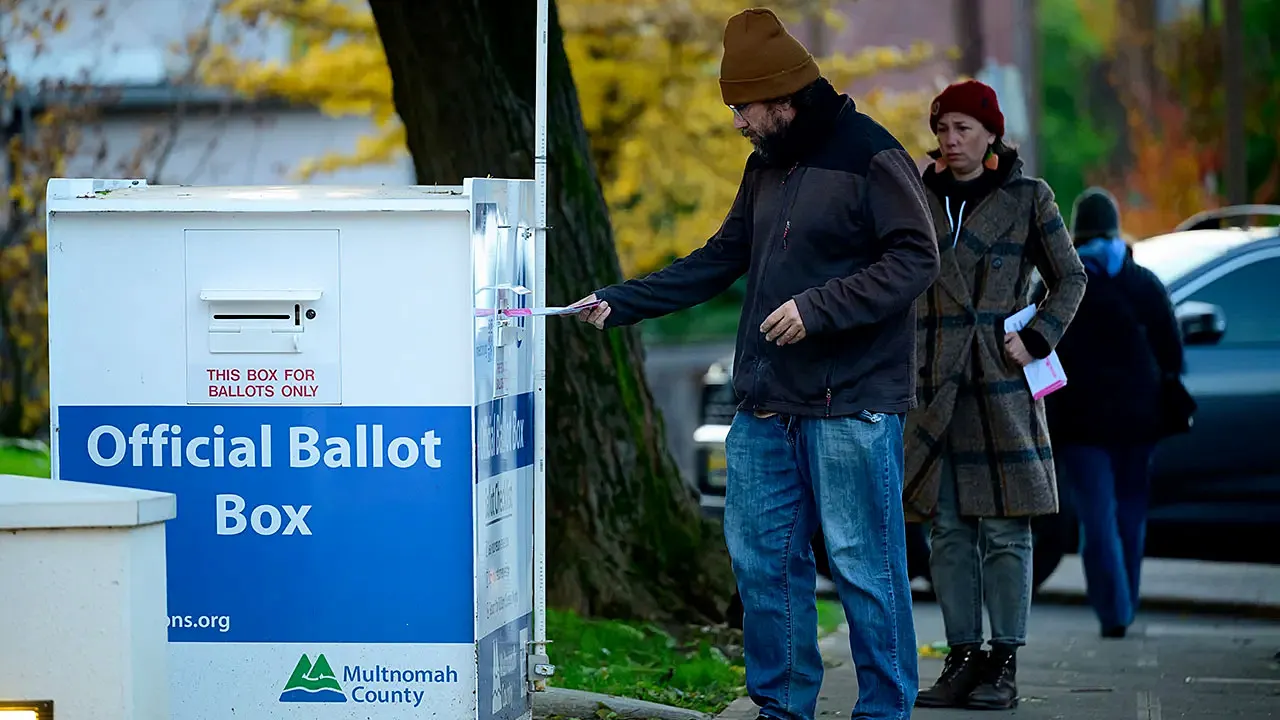
Voters cast their ballots at official ballot boxes on Nov. 8, 2022, in Portland, Oregon. (Mathieu Lewis-Rolland/Getty Images)
Together, the directives are designed to address a backlog of inactive records and restart regular voter-roll maintenance after Oregon paused removals in 2017.
“These directives are about cleaning up old data that’s no longer in use so Oregonians can be confident that our voter records are up-to-date,” Read said. “From day one, our goal was clear: run elections that are secure, fair, and accurate. This move will strengthen our voter rolls and reinforce public trust in our elections.”
State officials acknowledge there are about 800,000 inactive registrations total, roughly 20% of Oregon’s voter rolls, though they stress multiple times in the press release that inactive voters do not currently receive ballots, saying at one point, “again, none of the individuals associated with these records will receive ballots, and these inactive records have no impact on Oregon elections.”
Being marked “inactive” in Oregon means you’re still listed as a registered voter, but you aren’t receiving ballot mail from the state until you reactivate your registration.
MARYLAND DODGES SPECIFICS IN ILLEGAL IMMIGRANT VOTER-ROLL CASE AS CONGRESS VOWS TO KEEP DIGGING
Oregon State Capitol Building (Getty Images)
However, inactive voters are still counted in the official voter roll totals, included in public records, and many experts have made the case that accurate rolls should reflect real, current voters, not people who moved years ago or can’t be located. Leaving outdated records in place increases the risk of mistakes, an expert on the subject told Fox News Digital.
“First of all, it’s astounding that they haven’t been removing anybody from the voter force in almost a decade because this is very basic 101 level election administration,” said Jason Snead, executive director of the Honest Elections Project.
Snead explained that voter rolls naturally change every year as people move, die, lose eligibility due to felony convictions, or leave the state, creating constant churn that must be managed. When states fail to keep up, Snead says, voter rolls become bloated and outdated, making elections harder to administer and increasing the risk of errors and abuse.
Snead emphasized that the problem is especially serious in mail-in voting states like Oregon. He argues that automatically mailing ballots while failing to routinely clean voter rolls makes it more likely that ballots will be sent to people who are no longer eligible, including those who have moved or died. Even if state officials say inactive voters don’t receive ballots, Snead says Oregon’s recent administrative failures, including the suspension of its automatic voter registration program in 2024 after non-citizens were mistakenly registered, justify skepticism about whether safeguards are consistently working as claimed.
CLICK HERE TO DOWNLOAD THE FOX NEWS APP
An election worker tabulating a ballot. (Patrick T. Fallon/AFP via Getty Images)
“I think there’s clearly a degree of skepticism that’s warranted, and I think that it really speaks to the need to always be focused on the basics of election administration,” Snead said. “Cleaning of the vote rolls is really one of the most foundational, important things that a secretary of state should be doing.”
Oregon has been slapped with several lawsuits in recent months related to its handling of voter rolls, from Judicial Watch, Public Interest Legal Foundation, as well as Trump’s Department of Justice, and Snead suspects the timing of the Secretary of State’s announcement is “probably to some degree” related to that.
“There’s an almost pathological resistance on the left to cleaning up the voter rolls, they call it voter purge, and they say that this is going to disenfranchise voters,” Snead said. “We’ve heard of all of the various statements. You know, lots of different ways and lots of different examples. But then when you actually bring litigation over this, sometimes that forces their hand.”
In a statement to Fox News Digital after publication, an Oregon SOS spokesperson said, “We can’t comment on pending litigation. I can say that getting this done was a priority for Secretary Read before he even took office, and he took this step because it’s the right thing to do. He wants his office focused on the details. We know this won’t satisfy those bad actors trying to undermine our free, fair, secure American elections, but the average Oregon voter can rest assured we are doing the hard work of running accurate and transparent elections.”
“Furthermore, the DOJ lawsuit is not related – it’s about whether we have to hand over Oregonians’ private voter data. Which we have no intent of doing.”
Cleaning up voter rolls has become an increasingly politicized issue in recent years, with Republicans pushing for more oversight in the name of election integrity and Democrats accusing Republicans of attempting to “disenfranchise” voters.
“Democrats support normal list maintenance and reasonable efforts to keep voter rolls up to date and in compliance with federal law,” DNC Spokesperson Albert Fujii told Fox News Digital. “The contrast could not be clearer: Donald Trump and the Republican Party are pushing aggressive voter purges to systematically disenfranchise eligible voters across the country, especially voters of color.”
In a statement to Fox News Digital, RNC National Press Secretary Kiersten Pels said, “Oregon’s Democrat Secretary of State has presided over one of the most bloated voter rolls in the country, with more than 800,000 inactive registrations.”
“Democratic states have allowed their voter rolls to spiral out of control, especially in mail-in voting systems like Oregon’s. The RNC is taking action nationwide to ensure states are cleaning their voter rolls as required by law.”
Read the full article from Here



San Francisco, CA
Discovery Bay driver arrested for San Francisco fatal vehicle collision | Contra Costa Herald

Killed pedestrian, struck 3 more people
By San Francisco Police Department
On May 25, 2026, at approximately 12:13 am, San Francisco Police officers responded to the area of 16th and Mission Streets regarding a vehicle collision.
Officers were advised that a collision occurred between a vehicle and a pedestrian.
Officers arrived on scene and located a pedestrian victim being treated by paramedics for life threatening injuries. Paramedics transported the victim to a local hospital.
Despite lifesaving efforts of medical staff, the victim was later declared deceased at the hospital.
A preliminary investigation revealed that a vehicle collided with a pedestrian and struck three additional victims.
The three victims were medically assessed on scene for non-life-threatening injuries.
Through the course of the investigation, officers located the suspect vehicle and detained the occupant of the vehicle.
The Traffic Collision Investigations Unit (TCIU) responded to scene and conducted their investigation.
Through the course of the investigation, TCIU investigators developed probable cause to arrest the driver identified as 57-year-old Samuel Powell of Discovery Bay on June 30, 2026.
Powell was arrested and charged for vehicular Manslaughter 192(c)(2) PC and the driver’s responsibility to exercise due care for the safety of any pedestrian within the roadway 21955(b)(3) CVC.
Although an arrest has been made, this remains an open and active investigation. Anyone with information is asked to contact the SFPD at 415-575-4444 or text a tip to TIP411 and begin the message with SFPD.

After an extended wait of no activity from the Denver Nuggets in this year’s free agency period, the team has finally made its first new signing.
That signing just so happens to be the No. 2 pick from the 2018 NBA Draft, Marvin Bagley III.
According to ESPN‘s Shams Charania, the Nuggets and Bagley have agreed to a one-year, veteran minimum deal for the 2026-27 season, effectively providing some solid depth in the frontcourt.
Free agent center Marvin Bagley III has agreed to a one-year deal with the Denver Nuggets, sources tell ESPN. A critical frontcourt addition for the Nuggets. pic.twitter.com/enHBVxgfYl
— Shams Charania (@ShamsCharania) July 2, 2026
With Denver’s first free agency signing now officially in the books, here’s what the move to bring in Bagley might mean for the Nuggets moving forward into free agency and this offseason, as well as entering next season.
Marvin Bagley Brings Frontcourt Depth to Denver’s Lineup
Bagley split his time between the Washington Wizards and Dallas Mavericks this past season to put together one of his better years of production in recent memory.
In the 60 combined games he played, Watson averaged 10.5 points, 6.1 rebounds, and 1.4 assists while shooting a career-high 61.8% from the field and 46.2% from three on a little less than one attempt per game.
Bagley’s a big who’s game centers more around his offensive skillset. He spent most of his time shooting last season at the rim or in the mid-range, shooting a stout 64.1% on two-pointers last season that can bring a bit of an interior presence into Denver’s frontcourt.
Defensively, he leaves a little bit more to be desired. And he’s still not quite the most impressive three-point shooter, even coming off his most efficient season from deep.
But for the cost of a veteran minimum contract, he acts as a nice budget-friendly addition who can shoulder some of the load offensively, and has shown value as an offensive rebounder as well. It’s tough to find much better for the price Denver’s paying.
While entering the league slotted in primarily as a power forward, it’s been in the past few seasons that Bagley’s settled in more as a full-time five; having spent 95% of his minutes during the 2025-26 campaign playing at the five.
That might give you a bit of a hint as to how the Nuggets plan to use him this next season, though they might also have some stretches where he’s placed alongside Nikola Jokic at the four for a bit of a larger frontcourt lineup.
The Writing’s On the Wall for Jonas Valanciunas
Looking at what Bagley’s addition might mean for the Nuggets’ current roster, no one in the picture gets more impacted by Jonas Valanciunas.
Valanciunas was Denver’s primary backup behind Jokic at the five last season following his trade from the Sacramento Kings, and entered this offseason with an uncertain future because of his contract situation.
The veteran big man has an expiring $10 million contract heading into the 2026-27 season, but one that’s not fully guaranteed, giving the Nuggets the opportunity to release him and save $8 million, while incurring a dead cap hit of $2 million that can be stretched over multiple years.
Such a move can give the Nuggets further cap flexibility that they’ll need this offseason to re-sign key pieces like Peyton Watson and Spencer Jones, which to this point haven’t been done, but becomes a bit easier now that Denver can take that next step in pivoting off of Valanciunas.
Perhaps Denver might also look deeper into a trade involving Zeke Nnaji, now that they’ve got a cheaper option in Bagley that might even sit ahead of him on the initial depth chart. However, it remains to be seen if the Nuggets have any takers on the two years remaining on his contract. To this point, they haven’t found anyone to bite.
When factoring in Valanciunas and Nnaji though, Bagley’s addition now brings the Nuggets to a total of 10 players signed onto traditional contracts for the 2026-27 season.
That leaves them with four open spots left to utilize in the days and weeks ahead. How they decide to use that space remains to be seen, but at the very least, the Nuggets’ long-awaited first offseason signing has now officially come to light.
Sign up for our free Denver Nuggets On SI newsletter, and get breaking Nuggets news delivered to your inbox daily!
 Add us as a preferred source on Google
Follow

(2024 reader photo of fireworks damage on Nino Cantu SW Athletic Complex turf)
Here’s the annual announcement from Seattle Parks – we’ve excised the non-local parks:
Seattle Parks and Recreation will turn on field lighting on ballfields throughout the city on the evening of Friday, July 3 and Saturday, July 4 to protect the surfaces. The ballfield lights will be turned on at approximately 9 PM.
The lights will be turned on to discourage the use of fireworks. Fireworks are illegal in the city of Seattle and will destroy the artificial turf on the fields or surrounding facilities. The approximate replacement cost for the synthetic surface based on per average full-size field (110,000 square feet) is $1.2 million. All the fields have been renovated in the past several years and benefit field users including soccer, football, baseball, ultimate frisbee and lacrosse.
The fields will be monitored from 9 PM to 3 AM
Lights at the following synthetic fields will be turned off at 3 AM on July 3 and 4:
Delridge Playfield, 4458 Delridge Way SW
Hiawatha Playfield, 2700 California Ave. SW
South Park Playfield, 8319 8th Ave S
Walt Hundley Playfield, 6920 34th Avenue SWLights will be turned off at the following grass fields at 11 PM on July 3 and 4:
West Seattle Stadium, 4432 35th Ave. SW
Comparing this to last year’s announcement, the lights will be on longer the night before the 4th, and the “monitoring” will be an hour later.
-

 Politics5 minutes ago
The Many Ways Trump Is Trying to Tip the Scales for the Midterms
-

 Lifestyle35 minutes ago
Map: See Taylor Swift’s NYC Hotspots Ahead of Her MSG Wedding
-

 Education40 minutes ago
Opinion | 13 George Washington Interpreters on Embodying an Icon
-

 Technology47 minutes ago
Mystery box shows are complicated for everyone — even the actors
-

 World50 minutes ago
After 1,000 days of war: Many Israeli children carry trauma into summer break
-

 Politics1 hour ago
Trump admin axes ‘Green New Scam’ appliance rules as Europe bakes in brutal heat
-

 Health1 hour ago
5 of America’s greatest medical breakthroughs revealed as the nation marks 250 years
-

 Sports1 hour ago
USA World Cup star calls lack of appeal process for teammate’s red card ‘bogus’

