Nearing the end of December, the streams are shrouded in ice. The trout are there, but they are lethargic and in a state of semi-hibernation. From the middle of November, I spend my weekends cutting, splitting and stacking logs for the woodstove; that is, when I’m not plowing snow off the long dirt drive that snakes off the macadam like a woodland stream, winding through hardwoods and coming to rest beside our home.
I could pay Don from the auto shop to do the plowing and we can heat our home with oil, but the effort to clear the drive and keep the stove full is an excuse to spend time outdoors, which keeps me active and sane throughout the winter months and provides the illusion of self-sufficiency.
By the third week of February, the banks of snow have melted along the dirt drive and on either side of the walk leading into our house. Some hardpack remains under the dogwood tree or in the lee of the outbuildings scattered around the 12 acres surrounding our home.
Advertisement
My jeans bear oil stains that Trish has been unable to remove. The strings from the frayed bottoms trail behind the rubber heels of my felt-packed Sorels like a dry fly reeled against the stream’s current. The fingers of my inexpensive work gloves are worn through in a few places, and I have wrapped them with duct tape to keep the lining from falling out.
This morning, I’m wearing a heavy shirt with a stiff canvas exterior over a long-sleeve T-shirt. The words “Oquossoc Marine” are stitched in black across the front of my cap, the letters rising upward through a grease stain like boulders in a lake around which smallmouth bass might school.
Neatly stacked hardwood inside the lean-to, ready to keep the home warm for months to come. Credit: Courtesy of Bob Romano
I walk the short distance across the yard to a small shed, the lawn crunching under my boots. The morning frost glistens like tiny diamonds sprinkled among the blades of matted grass as the sun edges over a line of spruce to reveal a flawless blue sky.
Lifting the latch, I open the door. The smell of grease and oil hangs in the cold stillness. I reach past the chainsaw and grab the maul from the corner of the shed, walking back outside, passing the near-empty lean-to that contains the remains of two cords of stovewood. By this time of year, the pieces that remain are stacked against the back wall, some littering the floor, a few wedged into the corners.
Throughout November and the early part of December, the sound of my chainsaw fills the air as I down trees, hauling them from the woodlot across the earthen dam of our little pond and cutting them into stove-sized pieces. By January, I’m spending my time splitting the 12-inch logs, allowing them to season in the open air throughout spring and summer until the following fall when I stack them, row upon row, under the eaves of the empty lean-to.
Advertisement
When I was younger, I split wood from morning until three or four in the afternoon, breaking only for lunch, a mountain of billets rising quickly, leaving the remainder of the winter for feeding birds, exploring the woods, tying flies. These days, I wear a back brace and work for no more than three hours a day, taking an entire winter of weekends to raise my mountain of split wood.
I can rent a gas-powered log splitter and form the pile of logs in days instead of months, but where is the honor in that? No, I prefer this six-pound maul, the one I now cradle in my hands, the same maul I have used to create 40 winters’ worth of firewood. Once, I replaced the shaft when an errant blow splintered it against the side of a stump, only later learning a trick used by hockey players to protect their sticks — duct tape wrapped around the base of the blade.
This morning, I stopped at the three chopping blocks frozen to the ground in front of the rising summit of wood. Chinks and grooves cut into the edges of each stump wherever the maul’s sharp blade has powered through a log. The bark has fallen away, lying in shreds, mixed into sawdust with pieces of kindling, wood chips, shavings and twigs, creating a ligneous gazpacho.
On either side lies a pile of logs, mostly sugar maple, white oak, shagbark hickory and ash; the type of hardwood that splits easily and burns slowly, providing an efficient source of heat for the woodstove. There is a smaller amount of soft wood that is stringy, more difficult to split and faster burning like poplar and tulip.
I like the smell of the resin, the feeling of the sawdust, spongy under my boots, the maul, familiar in my hands, but it is the sight of the growing mountain that I most enjoy, with its base of split logs, ridges of sticks and crags of twisted branch.
Advertisement
Feet spread apart, I grasp the maul, my left hand around the bottom of the shaft, my right around its base. I take pleasure in the power that spreads from my legs up through my shoulders and down through my arms, the motion of the heavy blade as it swings through the air, the crack of the log as it splits in two. After 20 minutes, I unbutton the canvas shirt, remove the baseball cap and run a hand through my thinning hair.
A few feet from the woodpile a chickadee flits among the branches of an ironwood tree. Landing on the metal rung of the tube feeder, the little bird cocks its head sideways, its black eye looking like a tiny plastic bead. As the bird flies off with a seed, a titmouse appears with its gray breast feathers puffed outward, a little dun-colored pompadour shooting up as it chirps a complaint.
I swing the maul down, the blade striking off center. A quarter of the log splits away while the remaining piece falls over on its side. While the titmouse plucks a seed from the feeder, two goldfinches and a nuthatch impatiently chatter from the branches of a nearby sugar maple.
Clouds have moved in from the west and without the sun there is a chill in the air. Even so, I’m sweating. I hang the outer shirt from a nail hammered into the side of the woodshed and roll up the long sleeves of my T-shirt.
The next swing of the maul fails to split the log. Aiming for a fracture, I try again, causing a chunk of wood to fly end over end across the frozen ground.
Advertisement
I develop a rhythm — bend, pick up a log, split. Bend, pick up a log and split. There is ample time for reflection. Today, I fancy myself an aging samurai, past my prime, without a lord to follow or battle to fight, but still able to wield a weapon with grace and skill. After a while, I stoop down, tossing the scattered billets toward the top of the pile, the mountain growing high under the ashen clouds.
When snow begins to fall, I remove the canvas shirt from the nail and slip it back on. The flakes are light, dry. They settle on my shoulders, the chopping blocks, the woodpile, covering the branches of the ironwood tree and sticking to the ground.
The birds are now darting back and forth grabbing seeds without hesitation. In the stillness of the afternoon, I hear the flutter of their wings.
Join Girl Scouts of Maine for a sweet summer stop you won’t want to miss!
We’re popping up at local ice cream shops around Maine for our Ice Cream Socials—fun, casual events where families can enjoy a free treat and learn more about Girl Scouts.
Here’s what to expect: 🍦 One FREE kid-sized cone per family when you stop by and connect with us 🌱 Hands-on activity for kids (like a planting activity or fidget spinner craft) 💬 A chance to chat with our team and learn how Girl Scouts builds confidence, friendships, and unforgettable experiences
Whether you’re curious about joining, looking for activities for your child, or just want to enjoy a sweet treat, we’d love to meet you!
Advertisement
✨ Open to all families—no registration required. Just stop by, say hello, and enjoy some ice cream with us.
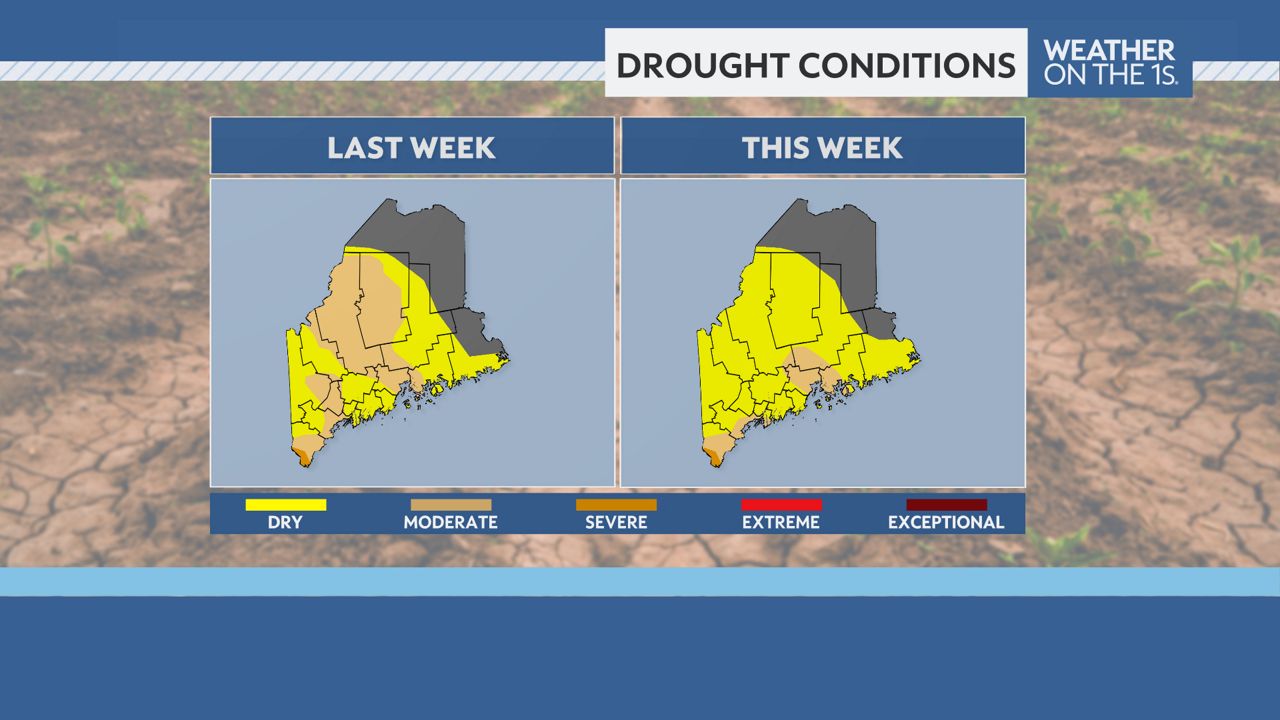
The recent rain in Maine is easing the drought that parts of the state have been experiencing since the fall.
Scott Dean, a Spectrum meteorologist, said much of Maine has been at least “dry” for several months. Parts of the state, including Portland, Bangor and Bar Harbor, are under a “moderate” drought.
Much of the country is also experiencing a drought, Dean added. The Southeast is seeing extreme levels of drought, and the West coast has been under a drought for years. There are many factors that go into this, including climate change, weather patterns like El Niño and La Niña and other factors.
And, when an area does experience drought, it can become a feedback loop. With less moisture in the ground and atmosphere, the drought can “feed upon itself,” Dean said.
Advertisement
“It takes a while to get into a drought and it also takes a while to get out of one,” Dean said.
But, the rainy days in Maine have been alleviating the drought, Dean said. And, the trend is likely to continue — the forecast is predicting above average levels of precipitation for the next three to four weeks.
“Hopefully, we are continuing to head in the right direction as the drought has eased in these areas,” Dean said.
In fact, if these rains do continue, Maine could come out of the drought sometime this summer.
STANDISH – Craig J. Ahlemeyer, 48 of Standish, passed away unexpectedly, Saturday, June 13, 2026.A memorial service will be held at 1 p.m., Saturday, June 27 th at Standish Congregational Church, 25 Oak Hill Road in Standish. A reception will follow.To see Craig’s full obituary, share a memory or leave the family an online condolence, please visit http://www.athutchins.com.