Entertainment
The 5 best science books of 2025

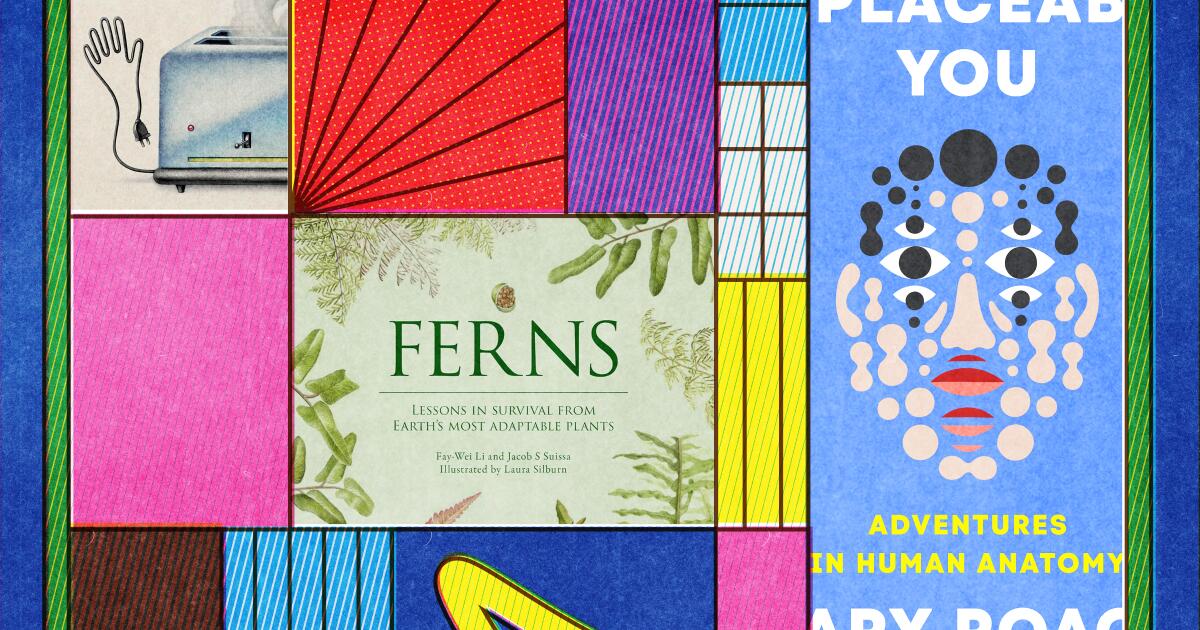
It’s been an uneasy year for science. While there were significant milestones, like breakthroughs in gene editing for rare diseases and novel insights into early human evolution (including fire-making), the U.S. science community at large was rocked by institutional challenges. Drastic federal cuts froze thousands of research grants, and the Trump administration began actively working to dismantle the National Center for Atmospheric Research. Meanwhile, fraudulent scientific research papers are on the rise — casting a shadow over academic integrity.

Our picks for this year’s best in arts and entertainment.
Thankfully, we can still turn to our bookshelves — and podcasts — to ground us. We tapped science doyenne Alie Ward, the host of the funny cult favorite “Ologies” podcast, to share her picks for the best science books of 2025.
Spanning fascinating subjects from bees to human anatomy, Ward’s insightful list reminds us that books remain a timeless vessel for truth and knowledge.

“Ferns: Lessons in Survival From Earth’s Most Adaptable Plants”
By Fay-Wei Li and Jacob S. Suissa
Hardie Grant Books: 192 pages, $45
“Dr. Li is the botanist of our dreams… the way he talks about ferns and why he loves them, and about growing up in Taiwan (in essentially a fern forest), and how the sexual reproduction of ferns has been a great way to draw attention to the LGBTQ and nonbinary community is so charming and funny. They even named a whole genus after Lady Gaga because they were listening to ‘Born This Way’ a lot in the lab and also because there are sequences in their DNA that are ‘GAGA.’
“Laura Silburn’s illustrations are gorgeous — they really put a lot of texture into some of these plants that are really tiny. Every page is like looking at a botany poster. As we’ve seen so much science research being underfunded, especially in the last year, there’s this big question by the culture at large of why does it matter? Why does studying the fern genome matter? It has real-world impacts — that’s fewer pesticides on your crops because we figured out something from a foreign genome. I always love when something is overlooked or taken for granted and because of someone’s passion and their dedication to studying it, we learn that it can change our lives.”

“The ABCs of California’s Native Bees”
By Krystle Hickman
Heyday: 240 pages, $38
“Krystle is an astounding photographer and an incredible visual artist. Her passion for native bees is infectious. A lot of people, when they think of bees, they think of honeybees. And honeybees are not even native to North America. They’re not native to L.A. They’re not native to this country. They’re feral livestock. What I love about her book is it opens your eyes to all of these species that are literally right under our noses that we wouldn’t even consider — and that a lot of people wouldn’t even identify as bees.
“The other reason why I love this book is that she puts these essays into it that are about her experiences going to find the bees. So you’re getting to see these gorgeous landscape pictures. You’re getting to see what it took to find the bee, how to look for it, and more about this particular species. It’s organized in these ABCs that you can pick up at any chapter and check out a bee you’ve never heard of before.”

(Little, Brown and Company)
“Humanish: What Talking to Your Cat or Naming Your Car Reveals About the Uniquely Human Need to Humanize”
By Justin Gregg
Little, Brown: 304 pages, $30
“Justin is hilarious. He is such a good writer, and his voice is really, really approachable. The way that he writes about science is through such a wonderful pop culture and pop science lens. You feel like you’re reading a friend’s email who just has something really interesting to tell you.
“This book is all about anthropomorphizing everything from our toasters to why we like some spiders but hate other spiders. This is a discussion that is so important in this time when we literally have bots on our phones that are like, ‘I’ll be your best friend.’
“Justin speaks to human psychology and our need to want to be friends or villainize objects —or technology or animals — and project our own humanity onto them in ways that are sometimes helpful and sometimes dangerous.
“As a science communicator, you can tell people the most fascinating facts and can give them the best stories. But unless you can give people a takeaway, then a lot of times it doesn’t stick or the interest isn’t there. He really addresses the question of ‘Well, what does this mean for my life?’”

“Replaceable You: Adventures in Human Anatomy”
By Mary Roach
W.W. Norton & Co: 288 pages, $28.99
“I’m a long term simp for Mary Roach.
“The humanity that she brings is such a wonderful base for how our bodies fail us sometimes and what we are trying to do to bring them back. From her being present during orthopedic surgeries and the way that she describes the sound of hammer on bone (and just the kind of jovial atmosphere in an operating room that, as a patient, you would never be clued in about because you are passed out half dead on a slab). She really soaks up a vibe that you would never have access to. She goes to Mongolia to learn about eye surgery there in yurts. She takes you to places you would never be able to go. She’s rooting around in archives and old papers — she just makes anything interesting.
“Mary really is both an ally and an outsider, and I think that that’s a really beautiful thing in her book.”

“The Double Tax: How Women of Color Are Overcharged and Underpaid”
By Anna Gifty Opoku-Agyeman
Portfolio: 256 pages, $29
“Anna Gifty Opoku-Agyeman is an absolute force. I’ve followed her work in economics and in equity for years, and I was really excited for this book to come out. We did an episode on kalology, which is the study of beauty standards, years ago and I have always loved the conversation of how different members of society have a certain tax on them — these extra resources that they are expected to provide.
“I was really excited to read about specifically women of color, because that is something that I don’t feel is discussed at large. Anna combines the sociology of it with the reality of her experience and other women of color. Because she is so deft when it comes to policy and economics, she also considers, ‘What can we do about this?’ It’s not just enough to discuss this, but what can be done?
“She has totals of what the gender gap is and what the double tax is, and it’s written up like a receipt. This book really addresses the double tax in a way that, even if you have no insight or it’s something that you haven’t thought about — or you are someone who hasn’t experienced this — it’s laying it out economically in a way that is really accessible and has a lot of impact.”
Recinos is an arts and culture journalist and creative nonfiction writer based in Los Angeles. Her first essay collection, “Underneath the Palm Trees,” is forthcoming in early 2027.


Surrealism is not my favorite film genre, but I will make a massive exception if it’s in the hands of Boots Riley. Not unlike his debut, Riley’s latest feature, I Love Boosters, is a weird, vibrant, funny, thoughtful, hopeful thesis on collective action and workers’ rights. At a time when satire is almost impossible (an episode of The Boys where the key villain announced that he was God aired just days after the president of the United States posted an AI meme of himself as Jesus), Riley manages to create something just bonkers enough actually feels like it has something to say, and is bright and colorful enough to demand your attention.
Corvette (Keke Palmer) is struggling to get where she wants to be in life, so poor that she’s squatting in a closed chicken restaurant. She and her friends, Sade (Naomi Ackie) and Mariah (Taylour Paige), steal clothes from the high-end boutique Metro and resell them at a lower price to people in their community. As part of their desire to get better at boosting, the three take jobs at Metro, hoping to figure out how to clear out an entire store.
But one day, while they are being reprimanded by Grayson for wearing last year’s Metro line from designer Christie Smith (Demi Moore), they leave the meeting to discover that someone has beaten them to emptying the store. They track down Jianhu (Poppy Liu), a Chinese woman who has a teleporting device that allows her to send the clothes back to China, where they are manufactured, hoping to force Christie to give them better wages and safer working conditions. They realize that they need to work together if they are going to see the changes they are striving for.
Also, LaKeith Stanfield plays a character who is so sexy, I can never watch this movie with my family.
At a time when so many trailers give away the entire movie, I Love Boosters is so wholly unique that if someone explained every plot point to you, you would still need to see it in order to fully grasp everything happening on screen. Like Corvette’s full-to-bursting pink tracksuit, this movie is stuffed with ideas and colors and characters, but it somehow all manages to stay together, creating an absolute feast for your eyes and ears.
The performances in this are absolutely spectacular from top to bottom. Keke Palmer sparkles, even as we see her running away from a literal ball of her problems. Demi Moore gets to play the opposite side of her role in The Substance, this time as the person trying to amass more wealth at the expense of those beneath her, primarily other women, and she tears it up. Don Cheadle is almost unrecognizable as Dr. Jack, a man Sade idolizes for his Friends Being Friendly pyramid scheme. Will Poulter is absolutely hilarious as Grayson, a Metro manager who has fully embraced everything Christie Smith is selling.
One thing you can glean from the trailer is the film’s overall look. Christie works in monochrome, so each location is filled with a single color. But even so, the colors are bright, not like the relentless desaturation that we are cursed with right now. Even when we are taken to the sweatshops in China, everything is bright and colorful. We are drenched in color and unique styles in I Love Boosters, but it is always singular, which is a fascinating way to show the uniformity that is often the hallmark of a hyper-capitalist society that is torn between conformity and individuality.
What makes this movie special is that in the midst of all of the hilarity, bright-but-monochromatic costuming, and a sex demon, there lies a deep philosophical examination of capitalism through the lens of dialectical materialism. This complex ideology isn’t dumbed down in any way, but is instead told to us through a magical device that is able to show us the world beneath the glitz and glamor of the fashion world. And sometimes what is underneath the literal skin of some of the people seeking to prop up the system as it is.
There are some issues with this film that don’t quite come together. The whole LaKeith Stanfield arc is very funny, but doesn’t quite fit with the rest of the movie. Taylour Paige is fantastic in her role, but there is more depth between Sade and Corvette, leaving less for Paige’s Mariah to do. But the messiness is so minor compared to the rest of I Love Boosters that it tends to get swept away in the maximalist filmscape that Riley has created.
Throughout the movie, Christie Smith has a lot to say about creating art and how her clothes allow people to become art themselves. At one point, someone tells her that people don’t want to be art, they want to make art. And that feels very much at the heart of this film. Most people want to create something beautiful that helps their community, but are constantly chased by the pressure to simply survive. To put a roof over your head, food on the table, clothes on your back. I Love Boosters says this dream is possible, but we might have to significantly change how we look at things and recognize that we’re stronger together than apart.
I Love Boosters is now in theaters.
Learn more about the film at the IMDB site for the title.
You might also like…

Two years ago, Gary Oldman found himself in Yorkshire for the wedding of his oldest son, Alfie. As Oldman’s other sons, Gulliver and Charlie, were there too, along with his wife, Gisele Schmidt, and his stepson, William, Oldman thought it’d be a lark to make the hourlong drive through the countryside to the York Theatre Royal, where he began his acting career in 1979.
The boys were intrigued, as they had heard stories over the years. Before Oldman burst on the film scene in the 1980s playing punk rocker Sid Vicious in “Sid & Nancy” and British playwright Joe Orton in Stephen Frears’ “Prick Up Your Ears,” he had turned heads in a run of plays throughout England. Then he was, as he puts it, “kidnapped by cinema.” Wanting to see their father’s career origin story, the family piled into a couple of cars and headed out.
“It was a lovely kind of homecoming, a debt paid, really,” Oldman tells me in a Zoom conversation from London. We’ve talked a great many times over the years, and while I wouldn’t call him nostalgic, Oldman most definitely is a sentimental man, especially when it comes to family.
That day, walking around the York Theatre Royal, thinking he needed to pinch himself because, really, how could it be 45 years since he first took that stage (“It all feels last week,” he thought), Oldman met Paul Crewes, the theater’s chief executive. “Do you think you might want to ever return to the stage,” Crewes asked Oldman, “and if so, where might that be?” Oldman thought for a moment and replied: “I think I’m standing on it.”
Sure enough, last year, in between filming seasons of his acclaimed Apple TV spy series “Slow Horses,” Oldman starred in Samuel Beckett’s “Krapp’s Last Tape,” playing a 69-year-old man who sits alone and listens to the recorded memories of his younger self. Everyone was so happy with it that Oldman was asked to reprise the role at London’s Royal Court Theatre this May, which is why he stayed in England after wrapping the seventh season of “Slow Horses.”
Gary Oldman as Jackson Lamb in “Slow Horses.”
(Jack English / Apple TV)
“It all fell into place,” Oldman says of his return to the theater, “and once we started, I was really champing at the bit to have the first preview. I was that wound-up. And it was a very nice thing for the family to come and see their papa up there onstage. It all feels quite harmonic.”
Having just celebrated his 68th birthday, Oldman is only a year removed from Krapp, though unlike Beckett’s character he isn’t disillusioned or lonely.
“I don’t know if I’ve worked out who I am, but I feel a little easier in my skin and happier than I’ve ever been,” he says. He attributes much of that bliss to his marriage to Schmidt, an art curator, writer and photographer whom he wed in 2017. “At this point in my life, I’m with someone who gets me and understands what I do. You have to incubate, and Gisele doesn’t take it personally. It’s a big part of who I am, the quiet and isolation needed to work on a character. I’m very lucky to have found someone.”
Musing about couples who have been together for decades, Oldman brings up Kevin Bacon and his long marriage to Kyra Sedgwick. “That’s a fantastic love story,” he marvels.
Everyone’s journey is different, I offer. For Oldman, sober since 1997 and married five times (“Maybe I’m a romantic or an optimist or just ‘never say never,’” he once told me), he found his own love story. And the feeling appears mutual.
“I might be the fifth one, but I am the one,” Schmidt says playfully off-camera. Oldman smiles and repeats it in case I didn’t hear her. “It’s a lovely thing,” he adds.
Oldman feels the same way about “Slow Horses,” which has broken through at the Emmys the last two years, winning awards for writing and directing. Its fifth season aired in the fall. Two more seasons are in the can. And as author Mick Herron continues to write new books in the Slough House series, there’s no immediate end in sight.
“I mean, if I go to Book 10, 11 or 12, I’ll have to be in a walker,” Oldman jokes. “They’ll have to get a stair lift.”
He’s still sporting the facial scruff we associate with “Slow Horses’” unkempt master spy, Jackson Lamb, and as he noted last year at a SAG-AFTRA Foundation event I moderated, he still carries a few extra pounds around the midsection, the consequence of having to portray Lamb’s greasy, takeaway-container diet onscreen.
“I hadn’t seen Gary — I’d seen him on the telly — and it happened that we were filming around the same time, and I went into the makeup trailer and I [said], ‘Bloody hell!’” jokes Oldman’s “Slow Horses” co-star, Jonathan Pryce. “I thought he had a fat suit on. I didn’t realize his dedication to his craft.”
“You have to realize it’s five seasons, and it’s murderous,” Oldman answers. “It’s French fries and hot dogs and hamburgers and ice cream. It’s disgusting, isn’t it?”
The menu hasn’t changed, and neither has Lamb, still cynical and lazy, but also brilliant when he puts his mind to it, abrasive and cruel to his team, but also loyal and protective of the “losers” in his charge. Yes, outwardly, Lamb is, as Herron writes, a “sentient grease stain,” but Oldman believes he possesses a “strong moral and ethical compass.”
Over the years, Oldman has compiled what he calls a “small bible,” a journal of things that he believes may have happened to Lamb that aren’t found in Herron’s books. In fact, the most memorable scene in Season 5, where Lamb recalls a harrowing story of one of his “joes” being tortured by the East German secret police, alongside a pregnant woman, wasn’t in the book. Lamb later insists he made the whole thing up, though we learn at least some of what he said was true in the season finale.
“When you do something like that, I have to decide whether it’s true or false and then just play the scene with enough sincerity,” Oldman says. “Remember, Lamb’s a spy and a very good liar. The thing that struck me about it came at the very end. He says, ‘Well, they never got any information out of him. They wanted a name. But he never knew the f— name.’ That always struck me as an honest declamation.”

Gary Oldman.
(Jennifer McCord / For The Times)
Oldman loves returning to “Slow Horses” every year and says that as long as Apple is willing to “keep writing those checks, I’m not ready to hang up my dirty raincoat just yet.”
“Most people I meet, including one of the royals, ask me, ‘Are you going to be doing more?’” he says. “They can’t get enough of it.”
One of the royals?
Oldman pauses. “Her majesty Queen Camilla is a keen viewer.”
How do you know this?
Another pause. “She … told me,” Oldman offers. “Long story for another time, perhaps.” Schmidt then fills in the blanks. They met the queen two years ago when Oldman performed at a Shakespeare celebration for the Queen’s Reading Room charity.
So perhaps there will be a Season 8, though with two unaired seasons still to come later this year and next, asking for more feels greedy. In the meantime, there are grandchildren to dote on. Last week, Oldman and Schmidt spent the day with their 18-month-old granddaughter, Ottilie.
“I do miss the baby stage, their character developing,” Oldman says. “Ottilie is already such a character. We just had a day of laughing with this innocent little soul.”
“But it’s that old story,” Oldman adds, smiling. “As a grandparent, you know you can love them and spoil them and then give them back.” He laughs. “It’s a good gig.”

(Jennifer McCord / For The Times)

Here’s a thriller that Maurice Escher could have production designed, with Salvador Dalí decorating the sets and Stanley Kubrick behind the camera directing.
Not that Youtube phenom turned horror filmmaker Kane Parsons is the new Kubrick. But in turning his “Backrooms” found footage horror video series into a feature film, he and his production designer Danny Vermette (“Longlegs”) and art director Alan Derksen summon up not just cinematic horror imagery of the past, but of the most disturbing painters in the canon.
A visual essay in the sinister possibilities of a minimalist unknown becomes something deeper with nightmarish echoes of Heironymous Bosch and Dalí pasted on a yellow on yellow settings that could have been inspired by Mondrian.
This summer’s “Blair Witch Project” horror phenomenon is about a stressed, divorced furniture store owner who stumbles into an alternate reality by stepping through the walls of the basement of his bland ’90s surburban warehouse store.
Clark (Chiwetel Ejiofor, bringing the “real”) never seems to have any customers, which only adds to the bitter edge his drinking has taken on.
“Cap’n Clark’s Ottoman Empire” is a badly-named “cheap particle board” furniture warehouse store which Clark tries to advertise with DIY commercials of himself dressed as a furniture pirate. The whole “pirate” or “sultan” branding doesn’t work and even his young dead-end employees (Lukita Maxwell and Finn Bennett) get that they don’t “get it.”
It’s only with his therapist (Renate Reinsve of “Sentimental Value” and “The Worst Person in the World”) that Clark gets into the reasons for his anger. He lost his house in a divorce to his perpetual law-student wife.
“I hurt people,” he confesses. “It’s just the way I”m wired.”
Role-playing the “big fight” that ended his marriage doesn’t help, and we wonder if published author Dr. Mary has a clue about how to get Clark “forging a new path” to better mental health.
The dude’s sleeping in his furniture store, after all. He’s got almost nowhere to go but up. But will he?
Something about this yellow wallppaper and yellowish carpet milieu of vast rooms, empty sections, cubicles with no one in them, wonky wiring and PA and CCTV systems gives him and us as viewers the creeps.
Poking around in the basement has him poking a wall because he hears something, and then freaking out when his arm and indeed his entire body go right through it.
Horror films that cast really good actors are the ones that manage the proper level of “This can’t be happening” shock and awe at what transpires. Clark absorbs the shock. Then he “explores” this beyond-the-basement-wall realm — mysterious piles of what looks like furniture, but “make no sense” as chairs or desks or what have you.
Half-buried manikin parts protrude, Dalí style, out of the floor. An advertising standee with a pirate on it chirps away greetings in a parade of languages. Walls recede into some pointed forced perspective and shafts and tunnels present themselves to Clark, who knows there’s someone or something in there with him. It’s just that he can’t help but come back.
Trying to explain to his therapist this “New York Subway System…massive” maze of rooms and corridors gets him nowhere. And rounding up his two employees to join him for this “expedition” to video what they find seems a mistake. It always is.
“Backrooms” is primarily a triumph of horrific tone, with a handful of grim and gruesome shocks to sate viewers who like their horror violent and bloody.
The look and the psychological mystery at the heart of it feed into the chill that sets in early and rarely leaves your mind. Horror conventions such as a character being snatched out of the frame and “Slenderman” like figures — and a dwarf — are tucked into this “Everything Everywhere All at Once” universe of an underworld.
The finale is entirely too conventional and pat to fit the general weirdness of all that’s preceded it. And as we ponder the puzzle what connects these people to that place — literal or mental — we have to consider what indie cinema icon Mark Duplass might be playing and what Reinsve is getting at as we see and hear her struggle to emote or even hit the right word emphasis in sentences in English.
But Ejiofor is the casting coup here, an actor who buys in and makes us join him as he utters even the most exhausted lines in horror — “Look, I know this sounds crazy.” Because it is. Until it starts to make sense, almost in spite of all the over-explaining that dominates the closing scenes.
Rating: R, violence, profanity
Cast: Chiwetel Ejiofor, Renate Reinsve and Mark Duplass.
Credits: Directed by Kane Parsons, scripted by Will Soodik, based on the Kane Parsons video series. An A24 release.
Running time: 1:50

-

 Nebraska3 minutes ago
Nebraska’s season ends with losses to Ole Miss and Arizona State
-

 Nevada6 minutes ago
Nuns invested in automaker blast ties to Nevada lithium mine: ‘Injury after injury’
-

 New Hampshire11 minutes ago
New Hampshire Cub Scouts clean up community – Boston News, Weather, Sports | WHDH 7News
-

 New Jersey18 minutes ago
Following Fire, Harry’s Daughter Reopening Their Jersey City Restaurant | Jersey Digs
-

 New Mexico21 minutes ago
Rail Yards Market showcases New Mexico’s indigenous culture
-

 North Carolina26 minutes ago
North Carolina investigators use drone to arrest man in fatal shooting of Virginia deputy
-

 North Dakota33 minutes ago
North Dakota voters to decide on single subject rule for ballot measures
-

 Ohio36 minutes ago
Was a rare bird just spotted in Ohio for the first time?

