Sports
California lawmakers flag concerns about World Cup visas, ban threats and ticket prices


WASHINGTON — With the World Cup just six months away and the tournament draw unfolding Friday, members of California’s congressional delegation are expressing concern about preparations for what will be the largest and most complex single-sport competition in history.
The tournament, which will feature 48 teams playing 104 games across the U.S., Mexico and Canada, offers a once-in-a-generation opportunity for the 11 U.S. host cities to both showcase themselves to the world and grab a slice of what FIFA estimates will be a $30.5-billion economic impact. But to take full advantage of that opportunity, organizers need government assistance on issues ranging from visas to security while also dealing with ticket prices far beyond the means of the average fan.
The tournament draw will take place Friday morning at the Kennedy Center in Washington, D.C., where the 42 countries that already qualified will be randomly assigned to one of 12 groups for the tournament’s opening round. That’s the last major hurdle for a World Cup that will open June 11 in Mexico City and end July 19 in East Rutherford, N.J.
After that comes the Herculean task of putting on the first World Cup in the U.S. in 32 years, one that will require bipartisan government cooperation on multiple levels. Get it right, and the upside is enormous. Get it wrong, and the damage to U.S. prestige will be significant.
The FIFA World Cup trophy is displayed during a panel discussion at The Kennedy Center on Wednesday in Washington.
(Dan Mullan / Getty Images)
And so far, the politicians say, the Trump administration has proven to be as combative as it has been cooperative.
“There’s so many layers to the economic engine that is the World Cup. It’s going to be successful. I’m highly confident of that,” Sen. Alex Padilla (D-Calif.) said. “But to ensure its success — not just on an economic front, but on a logistical and security front — the best thing that we can all do is focus on the task at hand.
“Focus on federal government, state government and local government collaboration.”
Rep. Sydney Kamlager-Dove (D-Los Angeles) also is optimistic but guardedly so, given the work still to be done.
“You’re talking about visas, you’re talking about infrastructure, you’re talking about transportation, you’re talking about national security,” said Kamlager-Dove, whose district abuts Inglewood and SoFi Stadium, site of eight World Cup games. “You’re actually also talking about morale and a brand. People don’t want to buy a brand that sucks, or that’s losing or that isn’t inclusive.
“We can’t afford to have that happen for the World Cup.”
According to a November study by the consulting firm Tourism Economics, 1.24 million foreign visitors are expected to come to the U.S. for the World Cup, less than half what FIFA, the tournament organizer, projected. Still, that reverses a trend in which international tourism dropped more than 6% this year. Nearly 2 million World Cup tickets have been sold, with most going to people in the three host countries. More seats will go on sale next Thursday.
Fans in 209 other countries and territories also bought tickets, according to FIFA, and many of those fans will need visas to use them. Getting those documents has proven difficult.
Last spring Congress warned the State Department that its visa-processing system — which required applicants in some countries to wait more than a year simply for an appointment — needed to be streamlined. Three weeks ago the Trump administration rolled out the FIFA Prioritized Appointment Scheduling System, or PASS, which will allow applicants with World Cup tickets to apply for an expedited visa interview.
The administration doubled down on that Thursday, instructing embassies and consulates to prioritize visa applications for foreigners planning to attend the World Cup or the 2028 L.A. Olympics. Secretary of State Marco Rubio said the administration added more than 400 consular officials around the globe to handle the demand.
“All attention should be on our outstanding athletes, not bureaucratic backlogs,” said Rep. Young Kim (R-Anaheim Hills), who partnered with Kamlager-Dove to urge the State Department to expedite visa processing. “The administration has made clear that these major sporting events are a top priority.”
Yet while players and coaches are clear to come, some World Cup fans are ineligible even for the expedited visa process. In June the Trump administration, citing safety concerns, blocked or restricted travel to the U.S. for citizens of 19 countries — including Iran and Haiti, whose countries qualified for the World Cup — and is considering expanding the ban to another dozen nations following the shooting of two National Guard troops in Washington last month.

Iran qualified for the 2026 World Cup but is among the countries whose fans face restricted access traveling to the United States for the tournament.
(Mohamed Farag / Getty Images)
That isn’t exactly in line with the philosophy behind the tournament, which FIFA says is to bridge cultural, political and social divides. The ban also clashes with what President Trump said during his first term in 2018, when he promised FIFA in writing that fans from all countries would be able to enter the U.S. without discrimination.
“When we made the bid to host, we were taking on the responsibility of making sure that every country that qualified would be able to travel and play,” said Rep. Eric Swalwell (D-Livermore), who attended college on a soccer scholarship. “I don’t like what it says about us as a host country, if we’re just denying visas and excluding countries.
“We’ve dramatically increased the number of teams who qualify. And that model cannot work if you have a host country that is making political decisions that affect who is eligible and who’s not.”
Swalwell worries about the long-term effects of such bans if the U.S. effectively determines which qualified teams can compete in the tournament.
“We will never have the World Cup again,” he said. “We will be permanently banned, essentially, from hosting. We will so tarnish our reputation.”
The congressman isn’t naive to the potential dangers the Trump policies are supposed to address. He is a member of the Task Force on Enhancing Security for Special Events, which focuses on oversight of security preparations for the World Cup as well as the 2028 Olympics and other international sporting events.
“The response, to me, is not to deny teams from playing,” Swalwell said. “It’s to surge resources and have security conditions and requirements for countries that are riskier.”
“There has to be proper security, vetting for folks coming in from other countries,” Padilla agreed. “Los Angeles is no stranger to these large-scale events, from prior Olympics that we’ve hosted, Super Bowls that we’ve hosted. State and local officials in California know what we’re doing. We just need the federal government to do its part.”
Some help was included in the so-called “Big Beautiful Bill,” which passed Congress in July. It includes $625 million for a grant program to help U.S. host cities fund measures such as enhanced background checks and cybersecurity. The bill also sets aside an additional $500 million in grants to counter the threat of drone attacks, which have become a key worry for organizers of large events.
“We’ve had, obviously, Super Bowls. But the World Cup is going to be multiple Super Bowls happening at once,” said a legislative aide for Congressman Michael McCaul (R-Texas), the chairman of the security task force. “We’ve never had this number of people coming in for this many events over two months, essentially.”
In addition to the threats from outside, human rights groups and Congressional representatives also raised fears that dispatching National Guard troops and Immigration and Customs Enforcement agents, who have been sent to the streets of at least 17 major U.S. cities — including seven World Cup markets — will send the wrong message by militarizing the games.
“Scaring the bejesus out of people unnecessarily, who are scared that if they go to a game, somebody’s going to jump out of a dumpster and snatch them and put them in a U-Haul van and deport them to Liberia, that’s not how you boost ticket sales,” said Kamlager-Dove, whose concerns are shared by Padilla, Swalwell and others in the California congressional delegation.

SoFi Stadium in Inglewood will host eight matches during the 2026 World Cup.
(FREDERIC J. BROWN/AFP via Getty Images)
Ticket distribution, which is managed by FIFA, also has become a concern amid brisk sales. For the first time, FIFA stepped into the lucrative secondary market for World Cup tickets, taking a 30% cut — in two separate 15% transactions — from every resale, a markup many scalpers would consider excessive. On a ticket resold for $1,000, for example, FIFA takes $150 from the seller (who receives $850) and charges the buyer an extra $150 (who pays $1,150 total), resulting in a $300 profit for FIFA.
In previous World Cups, resale prices were capped at face value and FIFA charged fees of 10% or less. Not so this year, with one seller reportedly asking $44,000 for a ticket to July’s final while FIFA’s lowest price for a private suite to that game is $199,000.
Yet there’s a waiting list to pay that.
By comparison, the most expensive ticket for the World Cup final in Qatar four years ago was $1,607, a 46% increase from 2018.
“They have to get a little more transparent about why they’re charging so much,” Kamlager-Dove said. “Why does it feel like price gouging?”
Finally, there’s the uncertainty that descends over World Cup cities every time Trump, who will attend Friday’s draw, muses about taking games out of places like Seattle, Boston and the San Francisco Bay Area, a warning he last made just three weeks ago. While FIFA officials dismissed the threats, they are difficult to ignore — especially for fans about to spend tens of thousands of dollars to travel to those cities.
The distractions, Swalwell said, are ones the World Cup doesn’t need less than 200 days from the opening game.
“It’s a real opportunity for America to shine. That’s appealing,” he said. “We have an opportunity to show that we’re open for business, we’re open for sport. I hope the president embraces that rather than sabotage the Americans who would suffer if he gets this wrong.”
Kim, like Padilla, is confident the tournament will be a historic success and says the president will deserve credit for that.
“This summer’s World Cup, along with the upcoming L.A. 2028 Olympics, is a once-in-a-generation opportunity for Southern California to shine — bringing in billions in economic activity, millions of visitors, and showcasing the very best of our communities,” she said. “We can’t afford to take our eye off the ball. We must meet the moment and be prepared to welcome fans, athletes and media from around the globe.
“I have no doubt President Trump will continue driving this effort forward to make these games not just successful, but the greatest America has ever hosted.”



NEWYou can now listen to Fox News articles!
All eyes were on Caitlin Clark on Wednesday night as she made her anticipated return from injury in a road matchup in Los Angeles.
But instead of a triumphant comeback, the Fever spent the entire night chasing the Sparks as Clark’s rough return fueled a 106-92 rout.
The superstar never found a groove, looking completely out of sync in her return from a back injury.
STEPHANIE WHITE GIVES CAITLIN CLARK STATUS UPDATE AHEAD OF FEVER-SPARKS, BUT HER NEXT MOVE RAISES QUESTIONS
Caitlin Clark huddles with teammates as the Indiana Fever battle the Sparks. (Photo by Katelyn Mulcahy/Getty Images) ((Photo by Katelyn Mulcahy/Getty Images))
Much of that disjointed performance falls squarely on head coach Stephanie White, who kept Clark on a ridiculously tight leash by limiting her to just 16 minutes. The stop-and-go approach could have sabotaged any chance for the phenom to establish a rhythm.
Clark finished with just 9 points, 4 rebounds and 3 assists. Her minus-16 plus-minus told the story.
The Los Angeles Sparks were severely shorthanded, taking the floor without stars Kelsey Plum and Cameron Brink.
MERCURY’S NOW-DELETED SOCIAL MEDIA POST MOCKING CAITLIN CLARK DRAWS SCRUTINY AFTER STAR’S INJURY
Yet while a depleted Sparks roster played to win, Indiana spent the night over-managing its biggest asset.
With Clark on a minutes restriction and Aliyah Boston out of the lineup, Kelsey Mitchell was forced to shoulder the entire offensive burden.
Mitchell did her part, pouring in 29 points while shooting 5-of-9 from beyond the arc.
Caitlin Clark orchestrates the Fever offense as Indiana battles the Los Angeles Sparks in primetime action. (Photo by Katelyn Mulcahy/Getty Images) ((Photo by Katelyn Mulcahy/Getty Images))
But one hot hand couldn’t stop an efficient LA squad.
The Sparks shot 45% from three-point range, going 9-of-20 from deep to cruise to the 106-92 victory.
White’s next move is to sit Clark against the Mercury on Thursday while Boston returns.
CLICK HERE TO DOWNLOAD THE FOX NEWS APP
After Wednesday’s loss to a shorthanded Sparks team, it’s fair to question whether Indiana’s cautious approach is working. The Fever dropped to 12-9.
Caitlin Clark and Dearica Hamby face off as Fever and Sparks battle at Crypto.com Arena in Los Angeles. (Photo by Tyler Ross/NBAE via Getty Images) ((Photo by Tyler Ross/NBAE via Getty Images))
Send us your thoughts: alejandro.avila@outkick.com / Follow along on X: @alejandroaveela
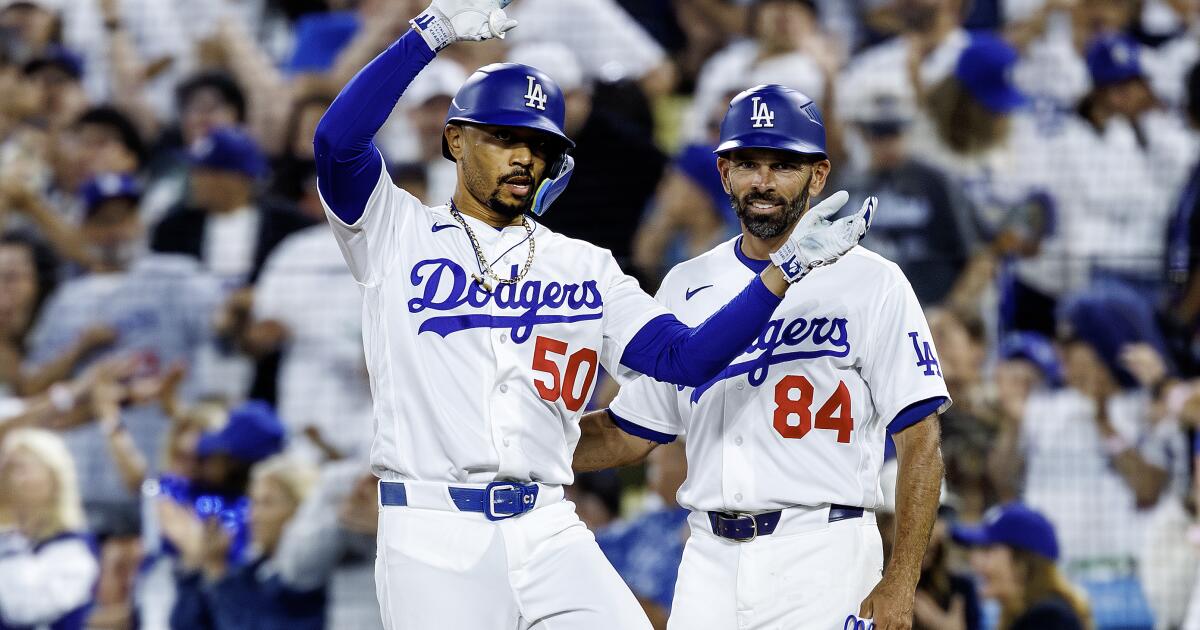
Mookie Betts’ first hit this series against the Rockies couldn’t have come at a more opportune time. With the crack of the ball against his bat, Tommy Edman scored from third, giving the Dodgers the lead.
And as Betts reached first, he pointed to Freddie Freeman, whose single put Edman in scoring position. It had taken a team effort to overcome another middling start from Roki Sasaki, and Betts, who had little to show before his game-winning hit, took the chance to highlight the joint contribution in the Dodgers’ 4-3 rubber-match win over Colorado (38-56).
“It feels great,” Betts said of his nine-pitch battle. “Helping the boys win, that’s really all it is. We play the game to win, and coming through in a big moment is kind of what, when you’re a kid, playing in the backyard, getting that hit is what you always strive to do, and fortunately, I was able to do it.”
Given a three-run lead in the first inning, brought to the Dodgers by a wild pitch and Kyle Tucker’s two-run, line-drive single to left field, Sasaki seemed set up for success.
Still, he gave away the lead as quickly as it came. In the second inning, he left a fastball too far over the plate, and third baseman Kyle Karros drove the ball over the left-center wall. The slider he dealt two batters later to second baseman Edouard Julien also crossed the zone too far over the plate, and Julien rounded the bases with another homer. In the third, a sacrifice fly by Mickey Moniak evened the scored, 3-3.
Sasaki’s troubles this season have been hard to pin down since his last win on May 23, as Sasaki tries to claw back the triple-digit velocity that’s escaped him as of late.
Against the Rockies, his fastball topped out at 99.1 miles per hour before steadily dropping to 98. He had managed five strikeouts in his six innings when manager Dave Roberts replaced him with Jack Dreyer, though the three earned runs couldn’t be ignored.
But Roberts also acknowledged the possibility that the pitcher had been tipping his pitches, possibly since he was playing in Japan, and Sasaki has tried to address it after a three-inning, six-run start last week. Even if he had fully self-corrected, his control issues remain. In the third inning, he walked the tying runner, Brett Sullivan.
“I’ve been working on a lot of things like the tipping stuff,” Sasaki said through interpreter Kensuke Okubo. “Also, I need to make quality pitches.”
Sasaki regained some of his confidence in the fourth when he worked out of a two-base jam with two strikeouts and a flyball to right, something that didn’t go unnoticed by Roberts.
“You can see the demeanor walking off the mound, the confidence,” Roberts said. “For me, it was more of let him end on a high note, feeling good about his outing, and then go from there.”
The Dodgers’ problems were compounded by Alex Call wasting the team’s two challenges in his at-bat in the first inning when the team had already taken the lead. And maybe it would’ve been excusable if Call had driven in the runners on first and second, but instead he ended the inning on a strikeout, stranding both. Roberts called the situation an “outlier” and didn’t feel as though he needed to have a conversation with Call regarding the situation.
After the three-run first, the Dodgers (61-33) remained hitless until Max Muncy laced a double down the right-field line in the sixth, though to little avail. As the innings ticked forward, Colorado’s chances seemed to increase. The Rockies hold the best league batting average (.297) in the eighth and ninth innings (the Dodgers are fourth with .268). And the Dodgers relievers, within the same constraints, have a 3.83 ERA — not bad, but not in the top 10 either.
Third baseman Max Muncy can’t get his glove on a line-drive double by Kyle Karros in the fourth inning.
(Gina Ferazzi/Los Angeles Times)
So when Alex Vesia struggled against the Rockies in the eighth inning and Muncy suffered a throwing error, Colorado seemed in position to score with the bases loaded and one out. Vesia struck out TJ Rumfield and Edgardo Henriquez (4-0), his replacement, retired Karros on a fly ball to right.
After Betts’ single allowed the Dodgers to take the lead, Tanner Scott (13) shut down the Rockies with back-to-back strikeouts, avoiding the team’s eighth series loss of the season.
“Didn’t feel great,” Roberts said. “Fortunately, we won a series, but that’s not the kind of way you want to do it.”
Sports
Justin Verlander announces he will retire after this season: ‘I’ve realized that time has come’

NEWYou can now listen to Fox News articles!
One of the greatest pitchers in the history of baseball will be hanging up his cleats after this season.
Three-time Cy Young Award winner Justin Verlander announced on Wednesday that the 2026 season will be his last.
Amid an injury-riddled season with the Detroit Tigers, Verlander decided it’s time to go.
Detroit Tigers pitcher Justin Verlander watches from the dugout during a game against the Chicago White Sox at Comerica Park in Detroit June 21, 2026. (David Rodriguez-Munoz/USA Today Network via Imagn Images)
“This season has challenged me in ways I haven’t experienced before, both physically and mentally. I’ve always believed that as long as I could compete at the level I expect of myself, I’d keep playing. I never wanted to retire because of a milestone, a number, or a date on the calendar. I wanted the game to tell me when it was time. Over the last several months, I’ve realized that time has come,” Verlander said in a social media post.
“While I’m fully committed to giving my team everything I have for the rest of this season, I’ve decided this will be my last. It’s fitting that I get to finish where it all started – with the Detroit Tigers, the organization that drafted me and gave me my first opportunity.”
Verlander inked a one-year deal with the Tigers, with whom he spent his first 12½ seasons before being traded to the Houston Astros, in the offseason. In Houston, he returned to dominance, winning both of his World Series titles and two of his Cy Young Awards.
“Baseball has given me more than I could have imagined. It taught me discipline, resilience, and the value of continuing to adapt and evolve. I’ve been fortunate to play with and against incredible players, for outstanding organizations, and compete in-front of fans who deeply appreciate the game,” Verlander added in his announcement.
Justin Verlander of the Houston Astros celebrates after the Astros defeated the Philadelphia Phillies in Game 6 of the 2022 World Series at Minute Maid Park Nov. 5, 2022, in Houston, Texas. (Mary DeCicco/MLB Photos via Getty Images)
PHILLIES STAR SAYS ‘BS RULE’ IS KEEPING HIM FROM BEING NAMED ALL-STAR IN FRONT OF HOME CROWD
“To every teammate, coach, player, clubhouse attendant, and fan who has been part of this journey – thank you. It’s been a privilege to share the field with you. To my family, especially my wife Kate, thank you for standing beside me through every season, every rehab, and every high and low. I couldn’t have done this without you. It’s time for the next chapter. But first, I’m excited to finish this season the only way I know how – with everything I’ve got.”
Verlander is the active leader with 3,554 strikeouts, which is good for eighth all-time. He needs 21 to surpass Don Sutton and 87 to pass Tom Seaver.
The 43-year-old made his MLB debut in 2005 and won the American League Rookie of the Year Award the following season in what was just a small glimpse of what was to come.
Verlander was a Cy Young Award finalist on four other occasions, consistently near the top of the leaderboard in just about every pitching stat. MLB Commissioner Rob Manfred gave Verlander a legend’s exemption to this year’s Midsummer Classic, making him a 10-time All-Star.
One could argue that Verlander should have at least one more Cy Young Award on his mantle, but he is on the fast track to Cooperstown and very much in the conversation to join Mariano Rivera as the only player unanimously elected to the Hall of Fame.
Verlander’s best season came in 2022, when he pitched to a career-best 1.75 ERA along with a 0.829 WHIP. However, that came after he missed the entire 2021 season due to Tommy John surgery for an injury he suffered after pitching just one inning in the abbreviated 2020 season.
Houston Astros starting pitcher Justin Verlander throws against the Boston Red Sox during the first inning Aug. 22, 2023, in Houston. (AP Photo/Michael Wyke)
CLICK HERE TO DOWNLOAD THE FOX NEWS APP
He won his first Cy Young Award in 2011, when he was also awarded the MVP Award, and his second in 2019. Verlander’s 11 seasons between his first and final Cy Young Awards are the second-most behind Roger Clemens, who had 18 seasons between his first and seventh.
Verlander led the majors in innings and WHIP four times while recording the most strikeouts in three seasons.
Follow Fox News Digital’s sports coverage on X, and subscribe to the Fox News Sports Huddle newsletter.
-

 Technology2 minutes ago
Meta is reportedly working on smart glasses that would be recording all the time
-

 World9 minutes ago
Trump says ‘Iran lies and cheats’ as IRGC emerges as dominant force in negotiations with US
-

 Politics12 minutes ago
Who is Valli Geiger? Meet the Maine Dem that Platner urged to run for Senate
-

 Health17 minutes ago
Deadly Legionnaires’ disease outbreak sparks concern in major US city: Know the symptoms
-

 Sports24 minutes ago
Caitlin Clark’s return falls flat after Fever coach limits her in loss to shorthanded Sparks
-
Business32 minutes ago
Commentary: Trump wants to let companies make fewer disclosures, thus keeping investors in the dark
-
 Entertainment39 minutes ago
Justin Baldoni and wife break silence after ‘It Ends With Us’ legal battle with Blake Lively
-
 Lifestyle42 minutes ago
A meal with an animated Mona Lisa? Immersive dining goes high tech — but will L.A. eat it up?

