Lifestyle
L.A. Affairs: During my year of yes, could I find love at LACMA’s jazz night?


We were invited to Los Angeles County Museum of Art’s jazz night by our mutual friends, Rich and Nicole. I, the self-appointed queen of snacks, brought a plethora of goodies and drinks from my Sherman Oaks apartment. This was one of my very first forays back into the world post-COVID-19 vaccine, and I was mostly ready to mix and mingle again with the masses.
Nicole waved me over to the chairs up front, coveted seats that Alex had saved by getting there an hour early on the bus. I said “Hi” and extended my apologies for being late.
“Tho thsorry,” I sighed with a slight lisp from my new Invisaligns. (I would later learn Alex thought my orthodontia-induced speech impediment was pretty cute.) “I parked so far away I might as well be in the Valley.”
Alex chuckled.
I would soon learn that this die-hard Westsider had not owned a car since his 2001 Cadillac DeVille’s transmission blew up on the 5 Freeway four years ago. I passed out thimbles of sake I brought to share and noticed a woman sitting next to Alex. She was smiling at the group. I asked her if she’d like some too.
I thought Alex was pretty cute in his light maroon jacket — the kind that’s perfect for those May gray evenings — and one that highlighted his wispy blond hair. But I figured the smiling sake lady and he were together.
The next two hours were filled with chitchat in between sets: Nicole’s end-of-school-year frenzy, Rich’s musician thoughts about those sweet drum riffs and where we should all go to grab a bite after. The Grove or Canter’s? Alex and I were seated at opposite ends in our row. I passed down snacks and at some point noticed the woman who was sitting next to him was no longer there.
Maybe, that wasn’t his girlfriend. Could it be that he was unattached?
After the concert, we strolled on Fairfax Avenue. I learned that Alex was originally from Long Island, N.Y., and asked him to break out an accent like “The Sopranos.” He gave me a dutiful “fuhgeddaboudit.” As a Midwestern transplant, I found this hilarious. We stopped for ice cream at Wanderlust.
Conversation was easy. After all, we had each known Rich and Nicole for years. Somehow, though, Alex and I had never met at the Friendsgivings or birthday get-togethers. We would later recount the almosts and the maybes in our nearly 20 years in Los Angeles. At one point, he was staying at a motel just a five-minute walk from my first apartment near Hollywood Boulevard and Western Avenue.
Could we have run into each other at the nearby Ralphs? Maybe it was just not the right time — till now.
The next month, the four of us met up for another jazz club and wandered again to Wanderlust. A few weeks later, I got a text from Alex asking if we should keep jazz club going while Rich and Nicole were on their honeymoon.
This was my self-proclaimed, post-isolation year of yes, and I made a promise to myself to be more open by saying more yeses to things. I texted him back: Yes!
I was unsure if this was a date, but I packed my summer picnic bag full of yummy snacks and once again headed over the hill to Mid-Wilshire. When I got there, Alex had saved two seats, and I realized it would just be the two of us for two hours of jazz. I offered him a Trader Joe’s drink and reminded myself that I was in my 40s now and that it was OK to just be myself. With the background of those sweet drum riffs and a little liquid courage, Alex and I shared how we both ended up in L.A. Turns out we were both in search of a new life path — one that wasn’t already figured out for us back home.
After the concert, we headed toward our routine haunt but then opted to make a new memory at the Original Farmers Market, where we ordered a couple of coffees and doughnuts before Bob’s Coffee & Doughnuts closed.
As I swiveled on my diner stool, the butterflies started to grow.
We strolled back to my car, and I offered him a ride. He declined, but I couldn’t quite fathom how he was going to get home so late at night. (Two years later, I would opt in to Alex’s car-free lifestyle too.)
In my teacher-voice, I insisted.
He hopped in the car and extended the seat, his 6-foot-2 frame expanded like an accordion. I unabashedly asked him to hand me my night-driving glasses. He calmly said, “I don’t know where those are.”
I was so comfortable with him already that I forgot we didn’t really know each other yet. As I opened the glove compartment, our hands slightly brushed each other’s, and there was a moment of excitement. Per his request, I dropped him near La Cienega and Santa Monica boulevards. He would catch the No. 4 bus home, which runs all night on Santa Monica Boulevard, and I would take the Canyon over the hill back to my place.
We said our goodbyes as we watched a sedan make a left and get stuck in the middle of the median. Never a dull moment out west.
Our second date at the Getty summer concert yielded a third date at SoFi Stadium, where the Red Hot Chili Peppers sang our song: “Sometimes I feel like I don’t have a partner / sometimes I feel like my only friend is the city I live in, the City of Angels / Lonely as a I am, together we cry.”
As we kissed, I knew that this would be something special, a gift that only L.A. could offer.
The author lives with her boyfriend, Alex, on the Westside. They are car-free and still take the No. 4 bus to jazz club at the LACMA every summer.
L.A. Affairs chronicles the search for romantic love in all its glorious expressions in the L.A. area, and we want to hear your true story. We pay $400 for a published essay. Email LAAffairs@latimes.com. You can find submission guidelines here. You can find past columns here.


Dr. John Henry Cook III hadn’t meant to appear bare-chested on Sylvia Rosemarie Auton’s iPhone when he called her for a chat last July. It was 7:45 a.m., and Cook, who was home alone with his dog in Leesburg, Va., was having trouble facing the day.
“I was lying in the bed my wife had died in,” he said. “I was feeling busted by sorrow, and I just wanted to talk to Sylvia.” An accidental push of the FaceTime button sent more than his voice through the ether.
Auton, who was visiting her daughter at the time in Phoenix, Md., was taken aback.
“He said, ‘Good morning, Love,’” she recalled. “I was stunned.” She was equally stunned a day later when, hours after their first kiss, he proposed.
Auton, 85, and Cook, 90, first met in May 2011, when Auton and her late husband, Forrest Hanvey, became patients at Cook’s concierge medical practice in Leesburg. Hanvey, who died in 2024, had known Cook since the 1950s, when both were midshipmen at the U.S. Naval Academy. A friendly relationship between the former classmates soon extended to their wives, Auton and Agnes diZerega Cook, whom friends knew as Di.
Both couples would routinely see each other at U.S.N.A. alumni events, and after Cook retired from medicine in 2017, they met up occasionally for group lunches with Navy friends.
“I got to know Di, who was a wonderful watercolor artist and wonderful person,” Auton said. When Di died in April 2025 of cardiac arrest, the friendship between the two surviving spouses deepened.
Auton is an author and educator. Before she moved to Fairfax, Va., in 1969 with her first husband, a nuclear physicist named David Auton, she lived in Chicago, where she grew up. Her bachelor’s degree in mathematics and master’s in mathematics education are from the University of Chicago. Her doctorate in mathematics education and statistics is from the University of Maryland.
Auton and David, who died of a cerebral hemorrhage in 2003, raised a daughter, Alyson Russo, now an anesthesiologist at the Johns Hopkins Hospital and the mother of Auton’s two grandsons, ages 6 and 2. The Autons also had a son, Timothy Lee, who died in 2014.
Auton taught in Chicago classrooms before she was promoted to her first position in educational leadership in the late 1970s. In 2005, she retired as director of staff development for Fairfax County Public Schools.
Auton now teaches personal finance classes at the Osher Lifelong Learning Institute, part of George Mason University. She also advises women on beginner stock market and investment strategies.
Her advice extends to navigating romance and relationships, too. “The Last Embrace: Caregiving for a Beloved Spouse,” a self-published 2025 book, was written after she spent a protracted period caring for Hanvey, who died after a fall at home in Fairfax Station. “The Wondrous Embrace: Finding Love in the Sunset Years,” also self-published in 2025, is meant to inspire hope among older people who may be souring on the chances of finding love.
Auton met Hanvey when she was well into her 60s and he was 70 in January 2005. They married the same year, in September. “One thing I do not want is for anyone to feel discouraged,” when it comes to love or otherwise, she said.
Before Cook earned his medical degree from Yale, he was a Polaris submarine commander in the U.S. Navy. During the Cold War, he served in nuclear submarines. He married Di in 1957, the day after he graduated from the Naval Academy.
Military service had been a Cook family legacy. His father was a Marine first lieutenant; he was born at Marine Corps Base Quantico in Virginia. With Di, he had a daughter, Elizabeth, and two sons, John and Harrison. His five grandchildren range in age from 24 to 30.
When Hanvey was declining in 2024, Auton wasn’t always certain she understood his needs. In those moments, she would ask Hanvey if he wanted to talk with someone else. “Invariably, it would be, ‘I want to talk with Jack,’” she said. Cook picked up the phone every time.
On May 17, 2025, Cook held a memorial for Di at St. James’ Episcopal Church in Leesburg, where they had married almost 70 years earlier. Soon after she died, Auton sent the family a condolence card and tucked a printout of the 1934 poem “Immortality,” by Clare Harner, inside. “I thought it might comfort Jack,” she said.
At the memorial, he told her how much he liked it. But Auton knew his grief was of a depth poetry could do little to assuage. “I saw the pain he was in,” she said.
Less than two weeks later, she was surprised when he texted her a handwritten poem. “He had taken the original poem I sent him and created a poem as if Di were reading it to him,” she said. “I was so taken with that I sent a poem back to him as though Forrest were writing to me.” Both poems touched on how they shouldn’t feel alone, how their spouses’ spirits wouldn’t leave them.
Auton was planning a June 2025 celebration of life for Hanvey at the time. “Jack had done such a wonderful job with Di’s, I asked him if he would come over and look at my ideas,” she said. Over lunch, the effects of his loss were as apparent as they had been at the memorial for Di.
“He was still zombielike with grief,” she said. Compassion and a sense of hopefulness about helping him through his pain led to a shift toward tender new feelings.
On June 29, as Cook was leaving the celebration of life for Hanvey, he bent down to hug her and whispered “I love you” in her ear. “What was astonishing is that, without a moment of hesitation, I responded ‘I love you, too,’” she said.
The next morning, he sent her a text message: “Bravo Zulu,” a Navy term for “well done.” She asked herself if his declaration of love at the service meant little more than appreciation for the celebration honoring his friend.
They didn’t speak again until July 11, when Auton was preparing to get in the shower at her daughter’s house and Cook was shirtless and in bed. Auton checked that only her face was visible when she answered the early morning call. They hung up with a plan to meet for lunch the next day, at Auton’s house in Fairfax Station.
“At 1 o’clock, there he was, holding a mini orchid plant” as a gift, she said. “He stepped into the foyer, stepped into my arms and gave me a long, deep kiss.” Two hours later, on a deck overlooking a lake on the property, he proposed.
At the memorial for Hanvey, Cook’s feelings for Auton had taken him by surprise. “When you’ve been in a long-term, loving marriage, you always have your feelers out” for your spouse, he said. When the spouse dies, “those feelers that had been intertwined wither away.” For Cook, maintaining hope that they would one day regenerate and intertwine with someone else had been a challenge.
But “the moment I kissed her, it’s almost like I put the key in the lock,” he said. “My life started again.”
On May 9, Cook and Auton married at St. James’ Episcopal Church. Rev. Chad Martin officiated a traditional Christian ceremony for 90 guests.
Auton wore a dusty rose ankle-length dress from her closet — the same dress she had worn to marry Hanvey. “It brought back loving memories,” she said. Cook wore a dark gray suit with a multicolored tie and his trademark red socks. Both had entered the church from a side door, then sat in chairs arranged in front of the altar, standing only to say their vows.
“At our age, stability is an issue,” Auton said. “I wobble well, but I didn’t want to wobble up a long aisle.”
After a kiss to mark the start of their married life and a careful recess to the church parish for a buffet lunch, they reflected on the resilience of the heart.
“Even if the days ahead are few, both of us would like others to have hope for the future,” Auton said. Since he and Auton fell in love, Cook said, “life has been delightful.”
“Beauty and music surround us all,” he added. “If you listen for it, you’ll hear it. If you don’t, you’ll miss it.”
On This Day
When May 9, 2026
Where St. James’ Episcopal Church, Leesburg, Va.
Church Finest The reception in the church parish was catered by Tuscarora Mill, a local restaurant whose owner Cook has known for years. On the menu were prime rib and roast chicken. The lively spring décor, including bright florals, pink napkins and white tablecloths, had been set up by the church sexton and came as a surprise to Auton. “People came up to us to say they had never seen the church look so lovely,” she said.
A Past Worth Preserving Cook will move into Auton’s home in Fairfax Station. He recently sold the 16-acre Leesburg farm he and Di lived on for over 40 years, known as Historic Rock Spring, to the City of Leesburg, to be used as a park. “It was important to Di that the land be preserved,” he said.
Accidental Vintage Auton’s wedding dress was at least 21 years old, she estimated, and Cook’s suit was more than 30. “We were not in today’s fashions by any means,” she said, unapologetically.
Gratitude The day after the wedding, Auton and Cook sent thank-you emails and texts to each of their guests. “At 85 and 90, we wake up each day with a sense of profound thanks-giving: for you, for our health and for the joy of hoping to continue to be of value in this world,” they wrote. They signed their first correspondence as husband and wife with, “Many thanks from two wrinkly, creaky, wobbly but very grateful people.”
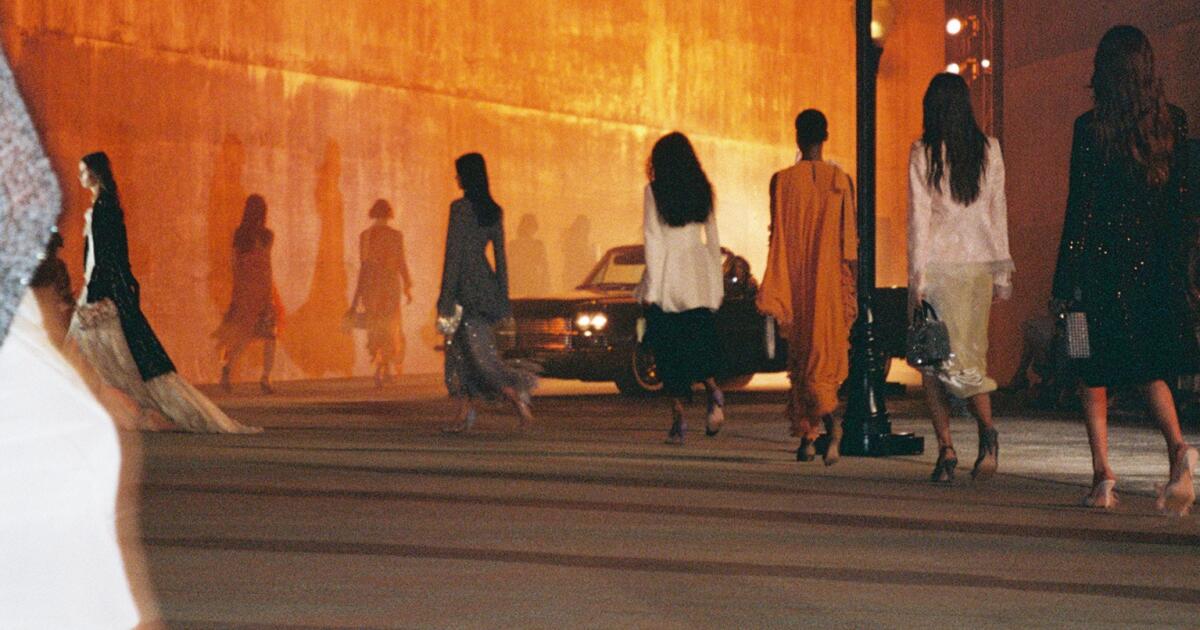

L.A. is proof that sometimes all you need is a car, a streetlamp and that orange light to make something really special happen. Jonathan Anderson presented his first Dior Cruise show in L.A. under the fluttering shadows cast by Peter Zumthor’s new Brutalist building at LACMA, and the whole thing felt like the equivalent of sending a text after hours of getting ready, buzzing with anticipation: “I’m OMW.”
At the base of the David Geffen Galleries, anchored by classic American cars in colors like bubblegum and butter, where models sat inside sucking lollipops and talking close, was “an illusion of L.A., in L.A.,” so say the show notes. The scene mirrored the energy of a film set, all drama and specific lighting and smoke billowing from mysterious corners, honoring the house’s relationship with cinema. The show notes also came in the form of a film script — titled “Wilshire Boulevard” — opening with the “No Dior, No Dietrich!” of it all and followed by Anderson’s thoughts on escapism and dreaming. Today’s Hollywood stars — Taylor Russell, Greta Lee, Anya Taylor-Joy, Alison Oliver, Jisoo, Maude Apatow, Jeff Goldblum, Sabrina Carpenter, to name a few — were in attendance.
The looks that walked down the runway also called upon the dream, soundtracked by a score that included blues icon John Lee Hooker and beloved French band Air. A new iteration of the Dior Saddle bag was car-inspired, sharing DNA with John Galliano’s 2001 Dior Cadillac bags, featuring car paint surfaces and motor key charms. There were the bespoke Philip Treacy hats that revisited a technique the milliner has honed for years, with feathers forming typography in words like “Buzz” and “Flow,” worn with some of the men’s looks. There was Anderson’s take on the bar jacket that Christian Dior made for Marlene Dietrich to wear in Alfred Hitchcock’s “Stage Fright,” white with a geometric black collar. A grey flannel coat was inspired by film noir, featuring a stripe detail that took inspiration from Venetian blinds. A red velvet dress with a rosette was Anderson’s way of playing with Christian Dior’s practice of putting a red dress partway through a show “simply to wake people up.”


As polished-glam and old-Hollywood as the references were, there were moments that also felt sleazy and fun in the way that Hollywood in 2007 did, when getting photographed pouring out of a car on the way into the club was a rite of passage and full of its own twisted promise. Denim was intentionally pilled and embroidered with fine silver chains in the rips, replacing frayed strands of cotton (“the everyday becomes couture,” the show notes say). Leather pants were worn with oversized rhinestone-rimmed sunglasses. A fuzzy coat in almost a wood grain-like pattern was worn slipshod over a shoulder with a black dress. Shirts were made in collaboration with L.A. artist Ed Ruscha, worn by models with messy long hair and hands in their pockets, sporting the kind of attitudinal walk that the skater boy-actor-model working at your local coffee shop has perfected. “When I think of L.A., I think of Ruscha’s work, which has a fascinating sense of the mundane and how it relates to the city’s grandeur,” Anderson wrote in the notes.
A resort collection is all about the destination, and in L.A. a destination can be the most quotidian, normal-ass place. For example, even the rarest piece in your closet is first experienced by your car, or your backyard, or the courtyard of a county museum. L.A. people get that the mundane is the destination because our version of mundane is anything but.


Cut to the afters at the Chateau Marmont. It was a blur of champagne, full sized In-N-Out cheeseburgers, chic ushers wearing Dior uniforms with snug grey sweaters and slacks that pooled perfectly at the leg. Oh, and also, a collective fear that someone would slip and fall into the gleaming turquoise pool (but isn’t that the intrusive thought that hangs over every Chateau party?). Faces like Teyana Taylor, Mikey Madison, Paul W. Downs, Role Model and Dominic Fike, all in Dior, were soaking in the ambiance.
As the night waned and we piled into big black SUVs with an emblematic “CD” on the windows that were there to take us home, one couldn’t help but call to mind a Hollywood trope, where in L.A., the journey was the destination all along.


Dior creative director Jonathan Anderson.

Taylor Russell and Mikey Madison.

Malcolm McRae and Anya Taylor-Joy.


Greta Lee and her parents.


Steven Yeun and Humberto Leon.


That spot did not go over well with many fliers, who voiced their disagreement on social media (it’s unclear that getting gussied up would solve the upset caused by delayed flights, increasingly tiny seats and other flying indignities). But it was merely a warm-up for the longer show, which has its debut next month on YouTube. This one features Duffy in a whole variety of dad outfits straight from the “Father Knows Best” closet of the American mind, with his family as supporting characters, down to their matching PJs.
There he is in the Oval Office, introducing his kids (and the show’s concept) to President Trump as white-collar dad in a Trumpian outfit of blue suit, white shirt and red-and-blue tie. There he is in snowy Montana, leading his gang on snowmobiles in coordinated snowsuits. In Philadelphia, he’s in a polo shirt and jeans, introducing his children to a role-playing Benjamin Franklin. He hangs out in a plaid shirt with Kid Rock, a scene that also features Duffy’s wife, Rachel Campos-Duffy, a Fox anchor, in an American flag sweater and matching American flag cowboy boots. (The two met on the reality show “Road Rules: All Stars.”) He wears a lot of shackets. And that’s just in the show’s four-minute promo.
In other words, this does not seem to be in the mode of the storied road trips of American pop-culture mythology, be they the grungy road trip of Peter Fonda and Jack Nicholson in “Easy Rider” or the existential one of Chloé Zhao’s Oscar winner “Nomadland.” It does not even seem to be modeled on the gaffe-filled comic road trip of the Griswold clan in “National Lampoon’s Vacation.”
It’s more like “Road Trip: The Suburban Nostalgia Version.” (See the cars, which include throwback station wagons redolent of “Leave It to Beaver” and a big, black Toyota SUV with Duffy, of course, in the driver’s seat.) It was conceived, presumably, to evoke the values — “wholesome,” “patriotic,” “joyful” — enumerated by Duffy in his post on X and meant to define the show and, by association, himself.
As such, it effectively brands him as the Everydad of the administration, complete with ur-weekend wardrobe. And when it finally airs next month, it may turn out to be less about actual reality (reality TV rarely is) than about heavily messaged reality. In other words: marketing for history.
-

 New York28 minutes ago
Questions Arise About Jack Schlossberg’s Readiness for Congress
-

 Los Angeles, Ca34 minutes ago
Los Angeles releases searchable list of worst rental properties
-

 Detroit, MI58 minutes ago
MLB News & Moments: Mets Gain Much-Needed Momentum by Sweeping Detroit
-

 San Francisco, CA1 hour ago
Where to Find Free Street Parking for Shows in San Francisco | KQED
-

 Dallas, TX1 hour ago
Dallas Stars Forward Would Be Perfect Trade Target for NY Rangers
-

 Boston, MA1 hour ago
JetBlue to pull out of N.H.’s largest airport amid capacity crisis, officials announce – The Boston Globe
-

 Denver, CO2 hours ago
Denver area events for May 15
-

 Seattle, WA2 hours ago
Friday Roundtable: Free Summer Shuttles