West
Conservative portion of blue state looking to break off and join neighboring red state

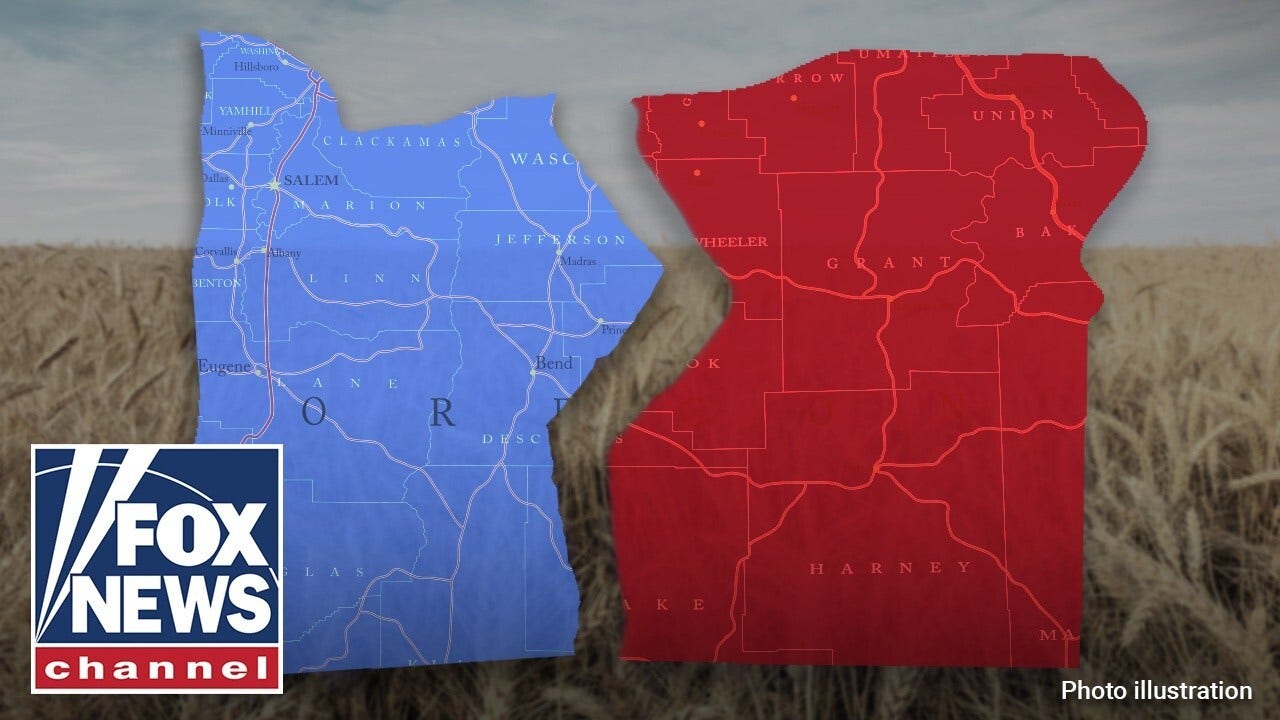
Oregon’s ideological fault lines exposed during the anti-police riots of 2020 are again coming to the fore, as the Greater Idaho movement looks to sever the conservative geographic majority of the state from the urban progressive movement.
“This movement has always been about the people of Eastern Oregon, getting their voice heard and helping those communities get the kind of state-level governance they actually want,” executive director Matt McCaw told Fox News Digital.
“If the Oregon Legislature truly believes in democracy, they will honor those voters’ wishes and move forward on making a border change happen.”
But similar attempts at secession have produced mixed results in U.S. history.
Earlier this month, state Rep. Mark Owens, R-Malheur, put forward HB 3844, the measure that creates and directs a task force to document the impacts of relocating the Idaho border to include about 13 eastern Oregon counties, and requires a report be presented to lawmakers in Salem. He did not respond to a request for comment.
GREATER IDAHO MOVEMENT GAINS MOMENTUM
The Greater Idaho movement began putting such measures up for votes in various localities in 2020, and efforts have intensified as several incidents and issues in the geographically smaller but denser-populated coastal region have caused political divisions.
During the anti-police riots of 2020, Oregon was front-and-center as protesters vandalized Portland and made a dayslong violent stand in front of the Mark Hatfield Federal Courthouse. But in the eastern two-thirds of Oregon, the conservative geographic majority of the state does not often ideologically align with their urban brethren.
Greater Idaho president Mike McCarter said of the new legislative development: “We are encouraged to see the representatives of Eastern Oregon coming together to advocate for their voters by bringing these bills to the Legislature. The people of Eastern Oregon have made clear they want to explore moving the border and joining Idaho.
“This movement has always been about the people of Eastern Oregon, getting their voice heard and helping those communities get the kind of state-level governance they actually want.”
By shifting the border, proponents believe both states have a “win-win” – in that the people living in each would better reflect the established political majority and lower political tension.
NY LAWMAKER CALLS FOR STATEN ISLAND TO SECEDE
In New York City’s Staten Island, there has been a movement afoot for decades seeking to break from the Big Apple. (AP Photo)
A report in the Central Oregonian noted an “interstate compact” is part of what is required to move the line, and cited other border-shifting bills in other states.
One would forward the cause of adding several rural Illinois counties that don’t see eye-to-eye with Springfield or Chicago to more closely aligned Indiana. Another in Iowa would allow the same movement for counties in the Land of Lincoln that are closer to the Hawkeye State line.
Idaho GOP Gov. Brad Little and Oregon Democratic Gov. Tina Kotek did not respond to requests for comment.
So far, only a few such movements regarding either secession or redrawing of state lines have been successful.
The now-55 counties of West Virginia voted to secede from the then-Confederate Virginia and independently ratified the U.S. Constitution on June 20, 1863.
A Washington Post story on the matter said Mountaineers split from Virginia as a way of “defending the ‘United States’… rather than the ‘seceded states’.”
In New York City’s Staten Island – the “forgotten borough” as many locals call it – there has been a movement afoot for decades seeking to break from the Big Apple.
Already geographically distant on the “New Jersey side” of the Hudson River, the borough is also separated from the Garden State by the Kill Van Kull and Arthur Kill.
Efforts to reestablish the reliably-red borough as the city of Richmond (after its coterminous county) or other names began with a favor from then-Gov. Mario Cuomo in the 1980s.
Cuomo enraged city leaders but endeared himself to the working-class voters on the island by approving state Sen. John J. Marchi’s push for a secession referendum.
Marchi, who died in 2006 and now has a Staten Island Ferry named in his honor, saw his borough vote nearly 2-1 to secede in 1993 – only to have their desires quashed by Albany’s Democratic majority.
And while the 1995 election of Mayor Rudy Giuliani calmed secession tensions, the drumbeat began anew in recent months.
“I think it’s time to secede,” Rep. Nicole Malliotakis, R-N.Y., told The New York Post as Gov. Kathy Hochul was touting her congestion-priced driving fee that now double-taxes Staten Island commuters.
“There’s no real value in being part of this city or the state. We didn’t vote for this mayor; we didn’t vote for this governor; and we didn’t vote for this president (then Joe Biden), but we’re always the ones getting screwed,” she said.
Read the full article from Here


San Francisco police officers arrested 20 people late Saturday night in SoMa after breaking up an unauthorized “Stud Alley” block party with hundreds of participants, according to the police department. It marked the second round of arrests of Pride attendees this weekend after police arrested five people at the tail end of the Trans March on Friday.
Police officers arrived near Kissling and 11th streets at 10:58 p.m. and “encountered an unsanctioned and unpermitted block party” that had about 300 participants and a D.J., according to a statement from the San Francisco Police Department. The following details are based on the department statement and social media videos; two participants reached by Mission Local declined to comment.
The department said that the large crowd “prompted the response of additional SFPD resources.” Social media footage shows dozens of officers marching through SoMa streets armed with batons, wearing riot helmets and carrying plastic zip-ties.
Officers then gave an order to disperse, the department said, and told the D.J. to leave the area. The D.J. left but the partygoers did not, the department said, and officers tried to “disperse the crowd.” Two people “resisted,” the department said, and officers arrested them.
Several people also “vandalized two vehicles passing through the area,” the department said, and made them “inoperable.” The two vehicles may have been Waymos: One online video shows two Waymos in the street blinking hazard lights, and appears to show one officer telling others that the Waymos had been vandalized.
The party then reformed a few blocks later at Washburn Street about two blocks away, the department said, with about 200 people; the police shut that gathering down as well.
Footage from the scene shows a line of officers in tactical gear advancing rapidly on the crowd, shoving people out of the alleyway before forming a cordon line to block the street. In total, 18 people were arrested on Washburn Street, the department said, for “obstructing or delaying a peace officer and unlawful assembly.”
The department said that “makeshift barricades” had been set up to keep officers at bay; at one point in a video, an officer moves several large rocks that were placed in the street. Two officers sustained minor injuries, the department said.
SoMa has been the site of unsanctioned “Stud Alley” parties on the Saturday evenings of Pride weekend for at least the past six years. The parties have made headlines in past years for graffiti, broken windshields and outraged neighbors.
The organizers of Stud Alley posted an announcement this year that they would not host a party, saying that the party had recently “outgrown itself,” but reminded past party-goers of the unofficial slogan that is frequently graffitied onto walls around the party: Every alley is Stud Alley.
Jesse, a bartender at the nearby bar the Willow, reported seeing cops “everywhere” after the Saturday incident, when people “fled” to the bar to escape. He did not report hearing of any incidents of violence between party-goers and police.
The arrests mark the second encounter between Pride-goers and police this weekend. On Friday, at the end of the Trans March, police officers arrested five marchers for alleged vandalism and assault after march-goers allegedly spray-painted several statues and a person.
On Sunday afternoon, Washburn and Kissling streets still bore signs of the party. Spray painted on the walls of buildings were “Fuck SFPD,” “No Cops at Pride,” and “Every Alley Stud Alley.”


The Mariners have made the first move in what’s sure to be a rip-roaring Trade Deadline season, acquiring INF Buddy Kennedy from the Giants in exchange for cash considerations.
Kennedy was designated for assignment by San Francisco earlier this morning as outfielder Heliot Ramos returned from the Injured List.
Advertisement
The 5’10” infielder has spent most of the season with Triple-A Sacramento, hitting well, even for the PCL. He’s in the 78th percentile for xWOBA, has a nearly identical K% and BB% (12.6%/12.1%) and rarely whiffs. This all has come out to a .322 batting average and a 152 wRC+. He’s made just a minimal impression in the bigs this season, with 8 plate appearances in 7 games, and zero hits.
Kennedy is likely to head to Tacoma. He can play 3B and 2B in a pinch, and will likely backfill Patrick Wisdom’s role if Wisdom is called up to take over right-handed pinch hitting duties from the currently-employed Rob Refsnyder.
The 27-year-old has not found much traction in the five years since his debut with Arizona in 2022. He’s amassed less than 200 plate appearances across 74 games, with a career 50 wRC+. On the mound, Kennedy has made one appearance this season, pitching one inning and giving up four runs, all earned.
-

 Politics1 minute ago
DOJ launches grand jury probe into Marxist mogul Neville Roy Singham’s funding of leftist groups
-

 Health8 minutes ago
America’s lifespan has doubled since 1776 — experts reveal what changed
-

 Sports11 minutes ago
Thekla embarrasses Stardom’s Starlight Kid after retaining AEW World Women’s Championship at Forbidden Door
-

 Technology16 minutes ago
AI may spot deadly heart risk in a routine ECG
-
 Business23 minutes ago
SpaceX IPO sparks race for luxury housing in Southern California
-
 Entertainment26 minutes ago
Movies, books, art and music to explore as America turns 250
-
 Lifestyle31 minutes ago
Mystery artist steps forward as future of iconic bird atop L.A. eyesore in doubt
-
Politics38 minutes ago
Gun owners may carry a weapon into stores, Supreme Court rules, rejecting a California law


