West
Crews rescue teen from 50-foot-deep California mineshaft: Watch
A teenager was rescued from a California mineshaft after he and his friends decided to explore the cave using household rope, officials said.
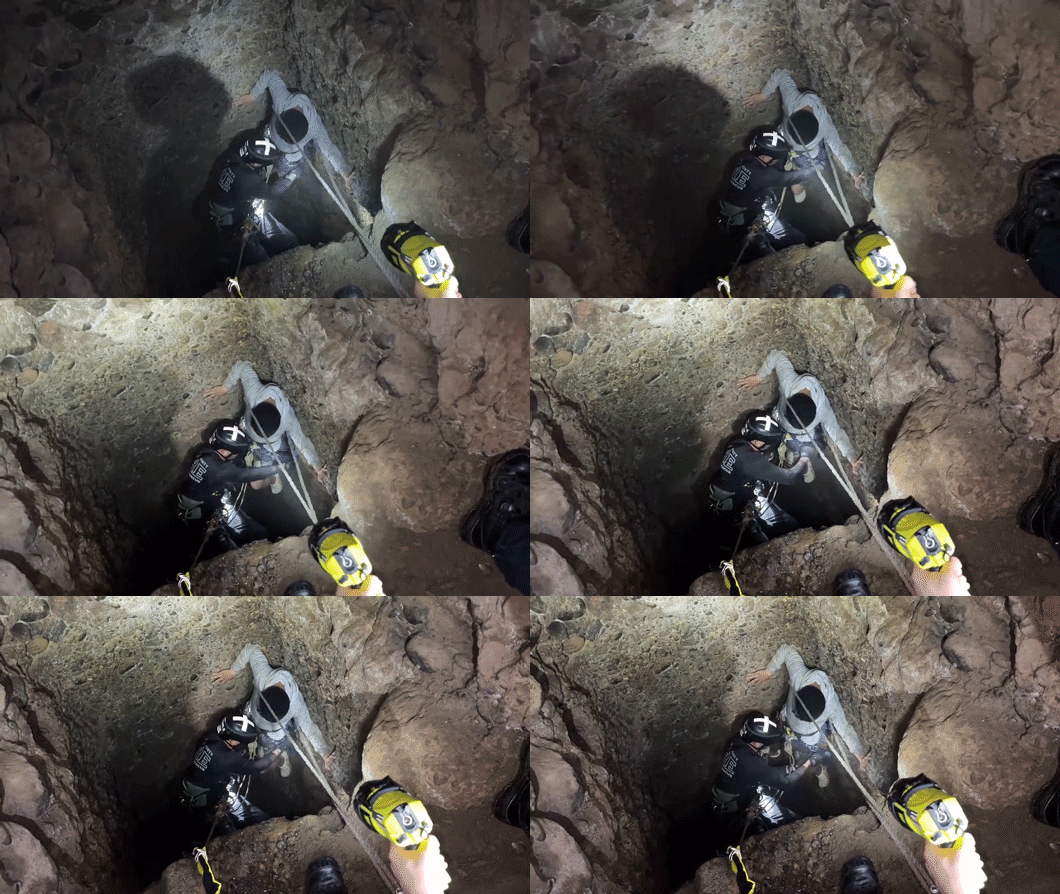
The Placer County Fire Department said crews, with the help of the Auburn City Fire Department, responded to a medical rescue on Feb. 10, for a 16-year-old boy who was stuck in a vertical mine shaft nearly 50 feet deep.
When crews arrived, they were led into the cave by the victim’s friends and learned that he and his friends had entered the shaft to explore, after hiking about 180 feet through a horizontal shaft into the side of a mountain.
CALIFORNIA HIKER PINNED UNDER BOULDER WEIGHING AT LEAST 6K POUNDS RESCUED AFTER 7 HOURS
California emergency crews rescued a teenager from a 50-foot-deep mineshaft. (Credit: CAL FIRE NEU /TMX)
Using household ropes, the three youths rappelled about 40–50 feet down a vertical shaft. But on their way back up, the rope broke, and the third victim fell about 30 feet down to the bottom of the shaft.
Officials said the victim attempted to climb his way out of the shaft but ultimately ran out of strength and positioned himself on a ledge while waiting for rescuers.
CALIFORNIA SHERIFF RELEASES IMAGE SHOWING RESCUE OF TEEN DANGLING 700 FEET UP ON STATE’S HIGHEST BRIDGE
California emergency crews rescued a teenager from a 50-foot-deep mineshaft. (Credit: CAL FIRE NEU /TMX)
When rescuers arrived, they set up a lightweight, yet complex rope system and established a system to monitor the air quality in the shaft.
The primary rescuer from the team then rappelled down to the victim’s location, secured him with a harness, and he was lifted out of the shaft to safety.
RUSSIA GOLD MINE RESCUE ‘DIFFICULT’ AS CREWS YET TO MAKE CONTACT WITH 13 TRAPPED MINERS, OFFICIAL SAYS
California emergency crews rescued a teenager from a 50-foot-deep mineshaft. (Credit: CAL FIRE NEU /TMX)
Once safe, the victim was taken to a local hospital to be treated.
CLICK TO GET THE FOX NEWS APP
“The Placer County Fire Department Rescue Team is one of the busiest teams in the north state and was able to facilitate this technical rescue in a very confined and austere environment 180 feet inside the mountain,” the fire department said in a press release. “This incident highlights the unique natural hazards ever present within our beautiful and rugged landscape in Placer County. Our commitment to public safety in these diverse scenarios using highly trained special operations teams is paramount in our service to the public.”
Read the full article from Here

California
HGTV names 2 Northern California towns amongst best suburbs in the U.S.
Five favorite walkable, bikable cities in America
USA TODAY 10Best readers voted these five cities as the most walkable in the nation. Check out the full list of 10 Most Walkable Cities on 10Best.com.
Scott L. Hall, USA TODAY
A lifestyle television network recently released a list on its website of the hottest suburbs in the city, with two in California
Home and Garden Television, or HGTV as it’s most commonly known, released its list of the 20 hottest suburbs in the country for those hoping to escape city life.
HGTV partnered with Suburban Jungle, a website that advises people move from cities to suburbs, to create the list.
The channel’s website cited entertainment, seasonal festivals and local theater programs as just a few perks to suburban living.
So, what are the best suburbs according to HGTV?
What are the best suburbs in the U.S.?
Among the list of the 20 hottest suburbs around the U.S., two California towns near San Francisco made the cut.
Mill Valley, a small town in Marin County, has an estimated population of about 13,904 as of 2024.
The city is just outside San Francisco and is known for its Mill Valley Film Festival amd live performances at Sweetwater Music Hall or Throckmorton Theater are available to residents.
“Mill Valley has a one-of-a-kind natural environment and access to nature: It borders Muir Woods National Monument, Golden Gate National Recreation Area, Mount Tamalpais State Park and the San Francisco Bay,” said Pam Goldman, head Bay Area strategist for Suburban Jungle to HGTV.
Redwood City was the second California town among the hottest suburbs in the country. It is located in the heart of Silicon Valley and about 27 miles from San Francisco, HGTV says.
The city has an estimated population of 82,982 as of 2024 and several tech companies. Despite the tech presence, the town maintains a close-knit feel and has several year-round community events on Broadway, as well as seasonal events such as Oktoberfest and Music on the Square, the home and garden website said.
“Redwood City has lots of energy and youthful vibes, and it’s also right between San Francisco and San Jose,” Goodman said.
Top 20 hottest suburbs, according to HGTV:
- Chappaqua, New York
- Larchmont, New York
- Summit, New Jersey
- Port Washington, New York
- Greenwich, Connecticut
- Westport, Connecticut
- Glencoe, Illinois
- La Grange, Illinois
- Needham, Massachusetts
- Winchester, Massachusetts
- Lafayette, Colorado
- Littleton, Colorado
- Bethesda, Maryland
- Fairfax, Virginia
- Boca Raton, Florida
- Wesley Chapel, Florida
- Mill Valley, California
- Redwood City, California
- Dunwoody, Georgia
- Milton, Georgia
Ernesto Centeno Araujo covers breaking news for the Ventura County Star. He can be reached at ecentenoaraujo@vcstar.com, 805-437-0224 or @ecentenoaraujo on Instagram and X.
Colorado
Colorado anglers fear drought will make it ‘hard to keep fish alive’ this summer
Colorado’s trout fisheries could face a difficult summer, impacting the state’s billion-dollar angling industry, as widespread drought conditions drive predictions that streamflows will be well below-average.
Kirk Klancke, the president of the Colorado Headwaters Chapter of Trout Unlimited, said he is concerned that the drought will stress fisheries this summer, especially if temperatures are anywhere near as elevated as they were this winter.
“If this summer is anything like this past winter was, the chances are pretty good that there’s going to be fish kills in our streams,” Klancke said. “It’s 100% given that, without some miracle monsoon season, we’re going to see (river) temperatures that threaten trout — and fishermen who care will be fishing in the mornings.”
Colorado, and much of the West, experienced one of the hottest, driest winters on record. In March, a climate change-fueled heatwave rapidly melted off the state’s already historically poor snowpack to record-low levels. With little snow left to melt, only about half the normal amount of water is expected to flow through most rivers this summer, and some rivers could see closer to a quarter of the normal flows, according to the latest Colorado Water Supply Outlook report.
Colorado’s angling industry generates nearly $2 billion in total economic output annually and supports over 15,000 jobs statewide, according to the state government. The state has 6,000 miles of streams, including over 360 miles that Colorado Parks and Wildlife has designated as Gold Medal trout fishing, and more than 1,300 lakes and reservoirs. Fly fishing, especially for rainbow and brown trout, is among the most popular forms of fishing in the state.
While every summer has its “ebbs and flows,” Patrick Gamble, a fly fishing guide for Straightline Sports in Steamboat Springs, said anyone visiting Colorado to fish this summer should expect the experience to be a little different that past years.
With the low flows, Gamble said he’s already called a number of his customers who had booked June trips on the Yampa River to reschedule for earlier in the spring, since he doesn’t expect the river to flow later in the summer. As temperatures get hotter heading into the summer, he said anglers should also plan to fish in the cool of mornings, rather than on hot afternoons, or at higher elevations to avoid harming trout populations.
“This year, when you have less water, there’s still as much pressure — just as many eagles, ospreys, more river otters than ever and angling pressure to boot,” Gamble said. “Coming off the lowest snowpack in recorded history, it’s definitely super concerning.”
Drought likely to stress trout populations
With most of Colorado’s rivers expected to experience extremely low streamflows, Klancke said, “we’re really worried this year is going to be really hard to keep fish alive,” especially if there are above-normal temperatures.
When rivers run low, the water is spread thin and warms faster, Klancke explained. That is a problem because hot water holds less dissolved oxygen, which cold-water species like trout — the primary targets of Colorado’s angling industry — need to breathe, he said.
“Your river is built like a solar collector,” Klancke said. “When your flows are depleted, it’s the same width of streambed, but the river spreads out over that width, and it’s very shallow. The rocks collect the heat because they are exposed when the river is shallow. That heats up the river.”
When water temperatures approach 71 degrees Fahrenheit, Colorado Parks and Wildlife public information officer Rachael Gonzales said trout become stressed and will feed less. If conditions are severe enough, Gonzales said the state wildlife agency can issue voluntary or mandatory closures of certain stretches of river. She said aquatic biologists are monitoring the rivers and will determine if actions are needed this summer.
Trout Unlimited and most Colorado fly fishing outfitters recommend anglers stop fishing for trout when water temperatures hit 68 degrees, so as not to harm the fish. Even during a year with a normal snowpack, Klancke said that some streams hit this threshold several days a year.
“At 68 degrees, we tell people to just quit fishing because you can catch a fish and have all the thrill of playing him, getting him in a net, releasing him properly, but when he swims away, he’s expended so much energy he can’t recover,” he said. “At 68 degrees, it really becomes catch and kill, instead of catch and release.”
Anglers stress ethical fishing during drought year

While anglers hope the period of wetter, cooler weather Colorado has seen over the last couple of weeks continues, long-term forecasts suggest the West could be in for a hot summer.
Over the next three months, western Colorado is likely to see above-normal temperatures and average to slightly-below average precipitation, according to the National Weather Service’s Climate Prediction Center.
“The most important message for this summer is, if you’re a catch-and-release fisherman, fish with a thermometer and know what temperatures threaten trout,” Klancke said. “It’s not just water conservation in a drought year, it’s how we handle our fisheries and keep these fish alive.”
Across Colorado, Trout Unlimited and other conservation groups are working to educate visitors about the drought conditions and how hot water can impact trout. This summer, Klancke said the Colorado Headwaters Chapter will launch into “high gear” radio and newspaper education campaigns and volunteers leaving flyers under the windshields of vehicles parked along rivers in Grand County on hot days.
The warmer it gets this summer, the fewer “easy-access” trout fishing locations there will be in the lower Yampa Valley, Gamble said. But that doesn’t mean there won’t be any fishing; it just means anglers may have to move to higher elevations, where temperatures are cooler.
“Being trout-centric in the state of Colorado, you definitely epitomize a hot summer day with a dry fly and searching a river bank with a grasshopper fly,” Gamble added. “But, sometimes that just means you need to be up at 9,000 feet, instead of down at a valley floor at 7,000 feet, to find water that releasing a trout in is ethical.”
Gonzales said that in addition to starting early and avoiding warm water, it is also important to not overcrowd an area. She suggested anglers also target warm-water species of fish, like pike, which face fewer impacts during hot weather.
Because the vast majority of Colorado’s fly fishing guides are ethical anglers and won’t fish in conditions that stress fish, Klancke said many fly fishing guides may work mornings only on hot days. If this summer sees extended periods of warmth, he said that could have ripple effects across the industry.
“This is particularly hard on our guides because our guides now are going to half day,” he said. “Think about it — they’re going to have their income cut in half. … To have your work hours cut in half is just really hard on professional guides.”
Hawaii
This Hawaii Flight Emergency Looks Different Over The Pacific
Many Hawaii-bound travelers now board with at least one power bank in their carry-on. We plug in our personal devices and then settle into a flight where the nearest runway may still be up to three hours away if something starts smoking in the cabin.
That risk is no longer theoretical. A passenger’s portable charger reportedly caught fire this week on a United flight between Zurich and Newark. The crew turned toward London, and the aircraft was on the ground at Heathrow about 35 minutes later. On a Hawaii flight, that clock runs very differently.
Hawaii flights are safe. The harder question is what happens when a cabin emergency involves the one item nearly everyone now brings onboard, and the nearest runway is hours away instead of minutes.
The flight diversion ended quickly.
According to The Aviation Herald, the aircraft was a United Boeing 767, and the passenger whose power back caught fire was seated in premium economy. Emergency vehicles at Heathrow met the aircraft after landing.
The aircraft was operating over Europe, surrounded by airports and densely packed airspace, with a runway available once the crew turned toward London. The Pacific almost uniquely changes that equation because even a safe, controlled diversion can still leave passengers and crew airborne for hours before reaching a runway.
Hawaii flights operate under a very different reality.
Hawaii routes operate under strict long-range overwater requirements, and airlines always remain within approved diversion ranges throughout flights. Pilots continuously monitor alternate airports, fuel burn, weather systems, and aircraft performance when crossing the Pacific to and from Hawaii, and modern aircraft are designed specifically around this type of flying.
A Hawaii flight halfway between California and Honolulu, or a redeye returning overnight to the mainland, can remain hours from landing after a diversion is called for. Anyone who flies to and from Hawaii likely has given this some thought.
After two hours in flight, we are already wondering whether we are closer to the mainland or to the islands. That is because when anything goes wrong, the airplane will be heading in one direction or the other.
By the third hour of an overnight to the mainland, most of the cabin is asleep, often with phones and tablets plugged into power banks around them. Bags are packed under seats. The map screen still shows water in every direction. That is the part of the flight where a smoke event becomes a multi-hour event, not a 35-minute one.
Why airlines worry so much about power banks now.
Lithium battery fires pose a different challenge from ordinary cabin fires because the battery itself can continue generating heat even after visible flames appear to be extinguished. This thermal runaway is a chain reaction inside the battery cell that can keep reigniting unless the device is cooled and isolated.
Hawaii routes have already seen their own reminders about just how this works. In 2024, Hawaiian Airlines Flight 26 between Honolulu and Portland experienced an onboard iPad fire, and the response in the air raised hard questions about how prepared crews actually are when a battery goes into thermal runaway in a packed cabin.
Flight attendants are trained not simply to put out the initial flare-up, but to continue monitoring and cooling the device for the remainder of the flight. Many airlines now carry thermal containment bags designed specifically for overheating electronics, and crews may spend significant time managing a single damaged battery after the initial emergency appears over.
The industry has also seen these incidents emerge through increasingly ordinary situations. That includes devices that slip into reclining seat mechanisms and become crushed during flight. Chargers overheat during continuous use. Damaged batteries continue being used after swelling or impact damage.
Airlines understand that the overwhelming majority of lithium batteries pose no problems. The concern is scale. Nearly every passenger now travels with multiple high-capacity batteries, and Hawaii flights combine long durations, overwater flying, overnight operations, and cabins filled with continuously charging electronics.
Three hours can feel very different than 35 minutes.
A smoke event onboard a European flight may mean the airplane is parked at the gate before passengers fully process what happened. On a Hawaii route, the same event can unfold under very different conditions, even when the crew responds perfectly, and the aircraft remains fully under control.
Picture a darkened overnight flight between Honolulu and the mainland, with the seatbelt sign illuminated above sleeping passengers. A faint smoke smell drifts into part of the cabin, nearby travelers begin looking around to understand where it is coming from, and flight attendants move quickly through the aisle carrying gloves, water bottles, and containment equipment.
Someone several rows away is told to unplug a device, while another passenger suddenly realizes the smell may be coming from a backpack pushed beneath a nearby seat. Outside the window, there are no visible city lights, highways, or coastline below, only darkness and open ocean stretching across the moving map screen.
Modern crews train extensively for exactly these situations, and commercial aviation remains remarkably safe. What changes is the sense of time, because passengers understand the airplane may still remain airborne for hours after the diversion decision happens.
The crew may be doing everything right and the battery may already be contained, yet the flight can still have hours left before anyone steps onto a runway.
Airlines are tightening the rules.
Airlines are becoming more aggressive about portable charger policies, especially on longer and overwater routes. Southwest already requires power banks to remain visible while in use, with no charging inside bags or overhead bins, and other carriers are thought to be moving quickly in the same direction.
As we covered previously in New Inflight Portable Charger Ban Reaches Hawaii Route December 15, airlines increasingly view portable power banks as one of the highest-risk personal items regularly brought onboard. Long, overwater flying is where much of that enforcement is appearing first, and travelers should expect more restrictions ahead, not fewer.
What this means for the next time you fly to Hawaii.
For most Hawaii travelers, the practical takeaway is simple. Carry fewer spare batteries and keep portable power banks where you can see them, rather than buried inside luggage. Editor Jeff likes to keep his visible in his seat pocket.
Recently, more announcements include something to the effect that if a device becomes unusually hot, starts swelling, smells odd, or slips into a seat mechanism, to tell a flight attendant immediately rather than trying to handle it privately. Cabin crews would far rather respond early to a small problem than discover it later after smoke appears in the cabin.
The crew wants exactly what passengers want on a Hawaii flight: a long, uneventful crossing where nothing memorable happens. Portable chargers offer a new type of concern that is just now being addressed.
Have you ever known of issues with portable chargers on a flight?
Get Breaking Hawaii Travel News
-
California6 minutes agoHGTV names 2 Northern California towns amongst best suburbs in the U.S.
-
Colorado12 minutes agoColorado anglers fear drought will make it ‘hard to keep fish alive’ this summer
-
Connecticut18 minutes ago
Percy Steinhart, Creator of the $1,000-Velvet-Slipper Brand Stubbs & Wootton, Restored This Connecticut Home
-
Delaware24 minutes agoMotorcyclist dies in Ogletown crash as traffic deaths surge in Delaware
-
Florida30 minutes agoVoting underway for HGTV Smart Home in Florida. When the contest ends
-
Georgia36 minutes agoTracking storm line headed to North Georgia
-
Hawaii42 minutes agoThis Hawaii Flight Emergency Looks Different Over The Pacific
-
Idaho48 minutes agoDuck powered parks: Idaho Falls celebrates new shelters at Heritage Park – East Idaho News