West
This woman bought a dream house with a creek. Her community turned it into a living nightmare

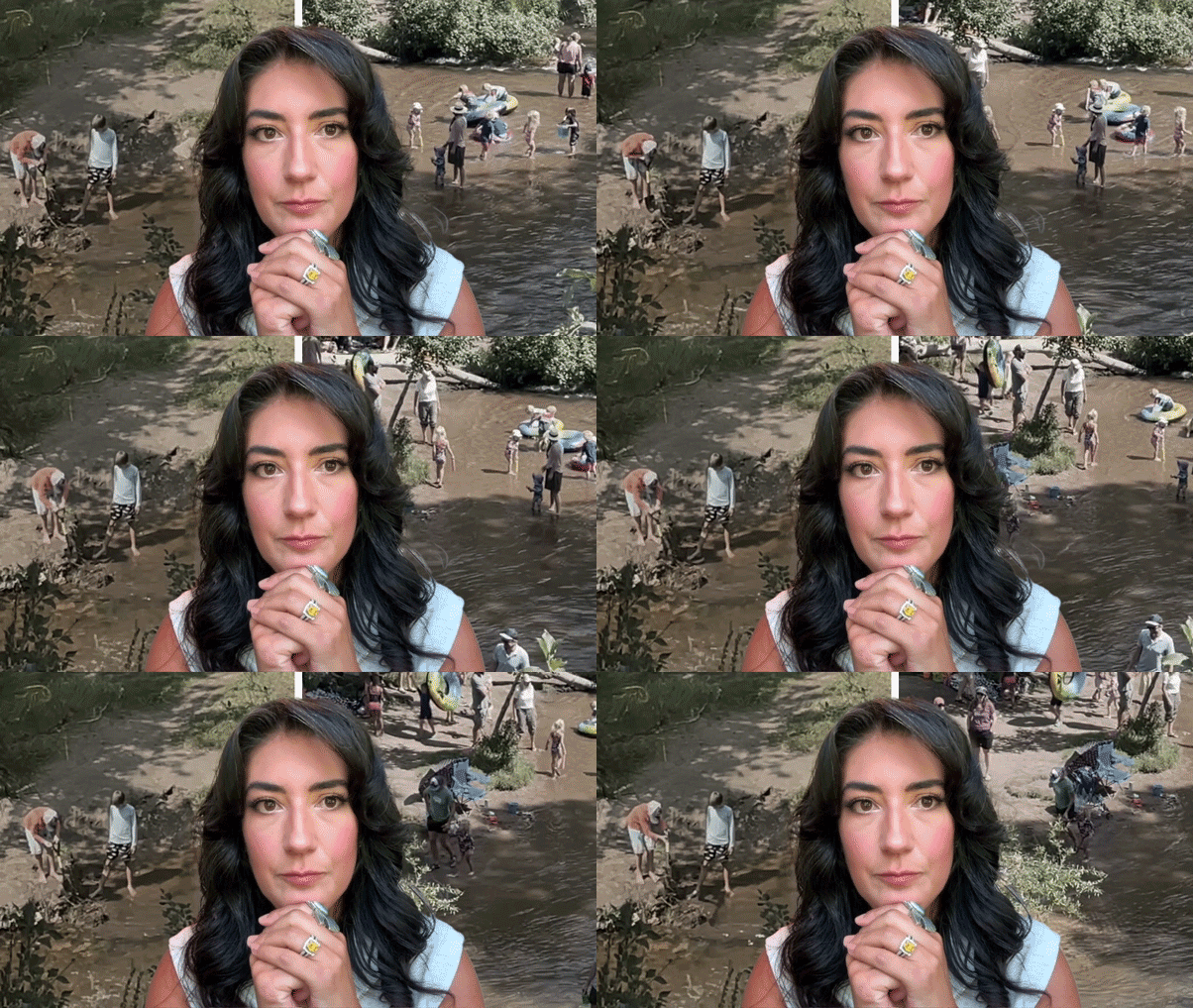
Editor’s note: This is the first story in a series about Taralyn Romero’s property rights battle in Kittredge, Colorado. Read part 2 on Sunday.
KITTREDGE, Colo.– The house next to Bear Creek looked like something out of a fairy tale, growing right out of the earth alongside towering pine trees. Snow covered the ground, pristine except for a few animal tracks. The stream, nearly frozen over, meandered through the piles of white.
“It was pure bliss,” Taralyn Romero recalled. A playground even sat on the other side of the creek that she pictured her partner’s daughter enjoying.
But as the weather started to warm, pure bliss turned into a nightmare. And Romero, pitted against her neighbors and the local government, would soon become the wicked witch of her fairy tale.
SUPREME COURT DECIDES CASE OF CALIFORNIA MAN CHARGED $23,000 BY COUNTY TO BUILD ON HIS OWN LAND
Taralyn Romero looks over Bear Creek toward Kittredge Park. Her house sat on the south side of the creek, with a small slice of property extending to the north bank of the water. (Courtesy of Taralyn Romero)
Romero is a native Coloradan and had been living in Denver when COVID hit. Like so many city dwellers at that time, she decided she wanted more space and rented a house in the mountains. When the lease was up, she wanted to stay rural.
Enter the house in Kittredge, an unincorporated community about 30 minutes outside of Denver with a population just over 1,300 people as of the 2020 Census.
She fell in love with the home on a small slice of property along Bear Creek and moved in along with her partner and his daughter in March 2021. At first, the only trespassers on her land were elk and other animals.
As the snow melted away, fishermen started wading into the portion of Bear Creek that looped through the edge of her property.
Then summer hit. A couple fishermen turned into dozens of people gathering in Kittredge Park as school let out. Families brought their coolers and floaties and spent the day playing in her creek.
They left behind solitary socks and dirty kids’ clothing strewn over logs and tree stumps, empty baby wipes containers, children’s water bottles and a red Hydro Flask adorned with a sticker of a turtle and the words “F— plastic.”
At first, Romero was perplexed. There was no fence or other boundary between the park and her property. Maybe people just didn’t know they were on private land.
So that first summer, Romero says she asked visitors what they were doing there. Some knew the creek — and land next to it — were private, but told her the previous owners had long granted public access to both. Others were driving more than an hour from surrounding areas to get to a park that had a creek next to it, she said, unaware that the water was on private property.
BRENTWOOD BLIGHT: HOW A SUPREME COURT CASE ALLOWED GOVERNMENTS TO SEIZE PROPERTY ON BEHALF OF DEVELOPERS
Romero said dozens of people descended on the portion of Bear Creek that ran through the edge of her property, eager to enjoy the water during the summer. Some told her they knew it was private land, but that the previous owners let the community use it. Others had no idea, she said. (Courtesy Taralyn Romero)
Romero’s immediate concern was potential liability, she said.
“Having a playground where kids are running back and forth and the parents are sometimes distracted on their phones, made me incredibly concerned that I was going to be dealing with a drowning at worst, or someone getting hurt and slipping on the rocks at best,” she told Fox News Digital.
And while most visitors were respectful, she was upset at the mess left behind each day when the crowds finally went home.
Kids and pets dug holes in the creek bank. People broke trees and left trash. Diapers, cigarettes and cans littered the ground.
Romero said she didn’t know what to do. She put up a “no digging” sign, and she set out a table and chairs with a placard reading, “Private Property: Residents and Invited Guests Only.” They went ignored.
Her family was new to a small town and didn’t want to make waves, she said.
“We wanted to make friends. We wanted to fit in,” she said. But even gentle reminders to people that they were on private property and requests to respect the land were met with aggression and “vitriol,” she said.
Uncertainty over property lines
The summer after Romero purchased the home, county officials told community members that they were researching where the property lines stood. The county believed the creek had likely moved since the plat map for Kittredge was created in 1920.
“We don’t know if the creek has meandered onto their property,” Matt Robbins, spokesman for Jeffco Open Space, told local media at the time.
At a September meeting with the Kittredge Civic Association board, Romero and her partner Michael Eymer clarified that the “Residents and Invited Guests Only” sign meant Kittredge residents. An attorney from a nearby community whose children played in Bear Creek said she was considering seeking a temporary restraining order so families could continue using the park until the county determined who the real owners were.
Meanwhile, hostilities continued to grow.
“I got maps thrown in my face. I got cussed out. I got screamed at,” Romero said. “I got threatened, and I got told that it wasn’t my land and that I had stolen it.”
Romero said “bad actors” and “bullies” quickly outnumbered the rest, coming into her backyard specifically to antagonize the family.
“They were not there to play with the kids. They were there solely to scream at us, to cuss at us and to harass us,” she said.
TEXAS GRANDMOTHER JAILED IN ALLEGED POLITICAL RETALIATION WINS AT SUPREME COURT
Taralyn Romero said she was frustrated at the destruction and mess left behind by some families who visited Bear Creek. (Courtesy Taralyn Romero)
‘People lost their damn minds’
After what Romero described as a “trial period” in which she tried to share the land with the community like the former homeowners had done, she was done playing nice.
She strung a rope across her property and put up no trespassing signs.
“When that rope went up, people lost their damn minds,” she said. “It catapulted this situation into a whole other stratosphere.”
She said people started conspiring online and collectively agreed to ignore the rope and “openly trespass.”
Romero felt like she was portrayed “as a villain… someone who didn’t want to watch children have fun.”
“Once it got on to Facebook, it really took off,” she said, escalating from a couple of hundred people to a “full on frenzy” of mob mentality. People from around the country now hated her.
“It really changed the course of my journey… and threw me into an enormous battle, not only with my community, but eventually with my government as well,” she added.
This is the first story in a series about Taralyn Romero’s property rights battle in Kittredge, Colorado. Read part 2 on Sunday.
Read the full article from Here


RYE, Colo. (KOAA) — Bishop Castle faces an uncertain, but hopeful, future as the Aspen Acres wildfire burns nearby and its caretaker recovers in the hospital following a fall.
Daniel Bishop, who cares for Bishop Castle — the landmark his father built brick by brick — was admitted to the hospital more than a week ago after a fall. Soon after, evacuation orders came, putting the beloved structure in the Aspen Acres wildfire red zone.
“The whole backdrop of my life just changing from one drastic nightmare to the next,” Daniel said.
His wife, Sage Bishop, described the toll the back-to-back crises have taken on the family.
“We’re used to being in the mountains and working with our hands and doing things and our lives have been turned upside down,” Sage said.
And while recovering, Bishop says he didn’t know what would come of the iconic Colorado landmark.
“By the time the whole scene was printed, it was a nightmare,” Daniel said.
Many people online have been asking whether Bishop Castle survived the fire. The Bishop Castle Facebook page posted that, according to the incident management team, Bishop Castle is still standing.
For Daniel, that news brings only partial relief.
“I generally don’t celebrate until I really know it’s time to celebrate. Until I lay my eyes on the property and know exactly what’s happened,” Daniel said.
He also said fires can be unpredictable, so getting excited about the condition of the castle feels too soon.
“The truth is the fire is still burning, and fires are very predictable, and it could turn around and come back from the other direction,” said Daniel.
But he did say there is some reassuring news on the ground.
“There are actual fire crews there doing their job to protect the castle, there are actually people in there. Boots on the ground and helping out,” Daniel said.
He said he still worries for the many people whose homes are nearby. People who continue to support the family.
“God bless the first responders for every piece of structure, everybody’s property that they managed to save, because we are the fortunate ones in all of this right now. There are so many that have lost everything they had,” Daniel said.
Even with the uncertainty, the family is definitely certain about one thing… Sage said the outpouring of concern from the public has meant a great deal to the family.
“The support from people that care about us is amazing,” Sage said.
The family says Daniel is progressing very well and appreciates the support and kind words from the community. He said he couldn’t get through this without those at Encompass Health Rehabilitation.
___
47,000 Acres, 0% Containment, and New Evacuations
The Aspen Acres Fire continues to rage out of control, growing to over 47,000 acres with zero containment. New mandatory evacuations have been issued for the Red Creek area as the fire threatens thousands of structures across multiple counties.
47,000 Acres, 0% Containment, and New Evacuations
News Tips
What should KOAA5 cover? Is there a story, topic, or issue we should revisit? Have a story you believe should make the light of day? Let our newsroom know with the contact form below.
____
Watch KOAA News5 on your time, anytime with our free streaming app available for your Roku, FireTV, AppleTV and Android TV. Just search KOAA News5, download and start watching.

HONOLULU (HawaiiNewsNow) – A woman has died after a crash that shut down the H-1 Freeway westbound in Honolulu Saturday.
According to the Honolulu Police Department, officers responded to a single-vehicle crash just before 6 p.m. near the Aala Street overpass.
Sources said a woman in her late 20s was pronounced dead at the scene.
First responders remain on scene, and the investigation is ongoing.
The city said via HNL Alert that all westbound lanes of the freeway near the Aala Street overpass are closed and access is restricted to emergency vehicles only.
Officials said those on the H-1 West are being diverted off the freeway at the North School Street cutoff.
Drivers are asked to avoid the area.
Copyright 2026 Hawaii News Now. All rights reserved.

IDAHO FALLS — After nearly two days of traveling, McKenna Christensen walked through the Chișinău International Airport in Moldova ready to change her life forever.
About six months before, Christensen, who was born in Moldova and adopted by an Idaho Falls couple, discovered shocking information about her adoption. She was never supposed to be adopted.
“There were a lot of illegal things going on (in Moldova) at the time with children. Children were very much a source of money,” Christensen told EastIdahoNews.com in December. “Pediatricians would tell parents, ‘Sorry, your child died, it was very sick.’ And then they would not release a body. This was a very common thing that happened over in the ’90s.”
For Christensen, she learned that her mother had been diagnosed with cancer while she was pregnant with her. She was very sick at the time of her birth, so the family was told that Christensen would be placed in a care facility while her mother regained her health.
But Christensen, who was originally named Marcela Ibrian, never saw her family again. Instead, she was apparently trafficked by the hospital, ending up at an orphanage and then adopted.
“I was targeted before I was even born. My mom checked into the hospital about a month before I was born, and the social services lady told her that she could leave me at the maternity ward to get some resources and to have some help while they navigated this diagnosis for her,” says Christensen. “At that moment, they actually put me into the system and said, ‘This baby is going to be available in February.’”
After discovering this life-changing information through her biological sister, whom she miraculously found through a Facebook group dedicated to reuniting separated Romanian families, Christensen traveled 5,750 miles across the world to find the people who had been looking for her for over 30 years.
“I was standing in the airport looking for a sign and my two sisters, literally out of nowhere, just clamored me,” says Christensen. “We stood there, and we were all, obviously, bawling. But then they walked me out, and there were probably like seven or eight other people waiting for me in the lobby. (They) had had balloons and flowers — all the guys had bouquets of flowers for me — and all of them were bawling … it was a lot, but it was so good.”
Christensen says it was overwhelming in the best way to finally meet people who shared her DNA, even though they had met many times on video calls.
“It’s different when you meet in person, it’s so different,” says Christensen.
During her stay, Christensen said she was taken care of by her biological family as if they’d known her forever, going to family dinners, getting ready with her sisters, dancing with the neighbors, and even watching home videos of her biological parents, who have passed away.
“It’s just like, (they) want to do everything for you. There is this added level because they’ve wanted to do all of these things for me for 30-plus years,” Christensen says.
Christensen’s family all live on the same street in the same village, making it a very tight-knit community. When she first arrived, Christensen says she was getting ready for dinner when her sisters began giving her gifts and helping her with her hair and dress, something she was not accustomed to.
“I had picked out a dress, and I showered and got out, and my one sister hands me a completely different dress that she had bought me,” says Christensen. “Then one sister proceeds to blow dry my hair, and the other one is putting slippers on my feet, and the other is trying to feed me a sandwich. It was so sweet, they just wanted to do all the things for me.”
The feeling of being pampered and fawned over was staggering for Christensen, though she knew much of it stemmed from her biological family not knowing what happened to her for so long and wanting to make up for lost time.
“I feel like you could really tangibly tell — or like feel in the air, and grab it — how badly they wanted this, which I was so happy to let them do all of that,” says Christensen. “I feel like a lot of this trip was so much for them, like more so for them than me, honestly, in some way. I’m just so glad that they got to have that.”
During the trip, Christensen says she noticed many similarities and shared traits between herself and her siblings, traits she never knew might be hereditary.
“For the Easter feast, I went over to my sister’s house just to kind of get away from people, and she was kind of setting up her feast. I remember she hopped on the counter to grab a dish that was on top of her fridge, and I remember thinking, ‘Oh my gosh, I do that!’” says Christensen. “We’re both really short, and we both get on the counter; it was little things like that. I was like, “Oh, I’m like these people.”
Throughout the trip, Christensen used AI headphones that translated Romanian, the main language in Moldova, into English so she could easily have conversations with locals.
“I had learned Romanian going into the trip, but they speak Russian Romanian, and there’s a Romani language that they speak as well,” Christensen says. “Amongst each other, they speak Romani, but if they’re speaking to a friend about something, they speak Russian. They would speak Romanian if they were talking directly to me, which I knew enough to get by.”
Through the technology and her own knowledge of the languages, Christensen was able to have conversations with people who knew her parents and were around when they lost her as a baby.
“People would just come up to me and cry when they saw me, because I think, some people told me on a translator, that I remind them of my mother, or I remind them of my father,” Christensen said. “They had heard so much about what happened to me, or people in the village and people that were related to me … people would just cry when they saw me, which was beautiful but also very overwhelming at the same time.”
After the first night, Christensen said she was overwhelmed with emotions of love and connection, needing to debrief and get lots of sleep before the rest of her incredible journey.
“I went back to the bedroom, called my husband, and bawled. I was just like, I don’t know, there is so much love with these people, and I have no idea how to give it back,” says Christensen. “I had never been taught how to receive so much love, and I was never told how to give it back. And that was both frustrating, but also I was just so grateful to them.”
Because she was in Moldova during Orthodox Easter, or Paștele Blajinilor (Easter of the Dead), as they call it there, Christensen got to experience her heritage and culture in ways she could’ve never imagined.
In what is often called the “most Moldovan tradition,” community members will gather at the cemeteries on the holiday to share large meals, clean graves, and exchange presents in honor of their deceased loved ones.
“Everyone in the village takes all these gifts, and you go to the cemetery with food and all these gifts, and you put them on the grave of your loved one. Then the father comes around, and he blesses all the graves like he did when they passed,” says Christensen. “You exchange gifts with people, but you do it in memory of the person that passed. So, people gave me T-shirts, cups, candy or dresses, and they’d be like, ‘This is in the loving memory of your mother.’ It’s so cool. It’s almost like the gifts are coming from your deceased loved one.”
At the cemetery one day, Christensen says she felt an overwhelming sense of calm as she studied her parents’ grave and thought about her ancestors.
“I recall this one moment that was really interesting. It may have only lasted a minute or so, but I stood there in front of (my parents’) graves, and I looked at my dad, and I feel like we look very similar. We have the same forehead, we have the same eyes. It’s like I was kind of noticing how we look alike. And then I panned over and looked at my mother, and I had this feeling like I knew who she was — not like from pictures, but almost like I had known her in a different time in my life, and I remembered it.”
Later in the trip, Christensen says her family showed her a video of her parents, which she says was fascinating to watch, as she had no memory of them.
“I look up at the screen, and they’re watching this video of my mom and dad, and everyone in the family hadn’t seen this video in years,” Christensen said. “It was just one of the big moments that was like, ‘Oh, we’re together as a family.”
Leaving Moldova was difficult, says Christensen, as she realized throughout her stay how different her life could’ve been if she had not been trafficked after birth.
“We all experienced our parents dying, and our outcomes were drastically different. My parents died, and I came to America and got an education, and I have a family,” says Christensen. “I never had to not know where my next meal was coming from. For them, their parents died, and their whole life fell apart for a while, and they really had to rebuild it.”
Though she says she deals with guilt over the differences in their situations, Christensen says she is focusing on returning to Moldova in the future, bringing her husband and children to meet her biological family.
“For a couple of days after I got home, I felt really guilty, almost, that I was able to have a good life, and they had to work so hard to have the life they have,” says Christensen. “I think I saw firsthand how hard their lives were, and I will never have a life that hard. And while I’m so grateful, I almost don’t know what to do with that information.”
As for now, Christensen says she feels a pull towards giving part of her life to helping trafficked adoptees connect with their families.
“I decided that the thing I want to do with the information that I have is dedicate a piece of my life to advocating for adoptees,” Christensen says. “These adoptees — whether their experience was good or bad, whether they’ve found their family or they haven’t — I always want to make sure that I’m a person who holds space for them in one way or another so they feel heard and understood. I don’t know what that will look like yet.”
The Key Takeaways for this article were generated with the assistance of large language models and reviewed by our editorial team. The article, itself, is solely human-written.
-
Colorado6 minutes ago
Bishop Castle is still standing as Aspen Acres wildfire continues to burn nearby
-
Connecticut11 minutes ago
Mary Ball Tomolonius Obituary
-

 Delaware18 minutes ago
Woman shot in parking lot of pizza shop in Delaware
-

 Florida21 minutes ago
1 dead, 3 injured after lightning strikes family off Florida beach
-
Georgia26 minutes ago
Georgia Lottery Powerball, Cash 3 results for July 4, 2026
-

 Hawaii33 minutes ago
Fatal crash closes H-1 West near Aala St. overpass
-

 Idaho36 minutes ago
Idaho woman reunites with biological family in Moldova after being kidnapped at birth
-

 Illinois48 minutes ago
Georgia man saved rare 1998 Lamborghini Diablo SV from Illinois just in time before it was destroyed


