News
They quit their day jobs to bet on current events. A look inside the prediction market mania


Logan Sudeith, 25, estimates he clocks about 100 hours a week on prediction markets.
Evan Frost for NPR
hide caption
toggle caption
Evan Frost for NPR
Ask Logan Sudeith how many bets he places in a week and he’ll laugh. It’s a comical line of questioning for the 25-year-old former financial risk analyst, who estimates he clocks about 100 hours a week on prediction markets Kalshi and Polymarket. After a while, understandably, some of the bets blur together. What are his net profits, though? That’s a number he’s got at the ready.
“Last month, I made $100,000,” said Sudeith, who does most of his trading from his laptop while bed-lounging in his Atlanta apartment. He’s executing so many orders on the sites, he says, that he has no time to cook. So he DoorDashes every meal.
“My last salary was $75,000 a year, so I left my job to trade full time,” he said
Some of his biggest hauls in recent months include lucrative stakes on Time Magazine’s person of the year ($40,236), the most-searched person on Google last year ($11,083) and a wager on the New York City mayoral race ($7,448). And of course, a couple thousand here, a couple thousand there on questions like, how many times will a sports announcer say “air ball”? And will President Trump use the phrase “drill baby drill” at an upcoming press conference? (Traders had $500,000 on the line on this market.)
“I’m not a fan of Trump, though I do spend most of my day listening to him and tracking what he is doing,” said Sudeith, noting that whatever candidate in the next presidential race is the most friendly to prediction markets has his vote. “I could be a single-issue voter. If they’re super-super heavy anti-prediction markets, it would be hard for me to vote for them.”

Sudeith says he made $100,000 last month on prediction market apps.
Evan Frost for NPR
hide caption
toggle caption
Evan Frost for NPR
The boom of online prediction markets is being driven by the Sudeiths of the world. He’s one of millions of traders logging on every day to services like Kalshi and Polymarket to place high-dollar and incredibly risky bets on the outcome of the world in real time, whether it’s an award host’s turn of phrase to the number of migrants the U.S. will deport this year.
Much like previous financial crazes around meme stocks and NFTs, true believers view prediction markets through a stick-it-to-the-man prism. It’s a movement against the elite establishment, they say, whether it’s the mainstream media, pollsters or government agencies. This growing group of renegade traders maintain that core truths emerge only after thousands of people express their opinions with their pocketbooks.

“Markets are the most efficient way to get to real information,” Sudeith said. “If you’re watching on election night, I think you’ll know who the winners are before the news can report it.”
While the industry may position itself an alternative to the mainstream, the mainstream is embracing it.
CNN and CNBC have struck deals to incorporate Kalshi prediction markets into coverage. The Wall Street Journal‘s owner, Dow Jones, is partnering with Polymarket, as did the Golden Globe awards this year, with announcers updating viewers on Polymarket odds before every commercial break.
Founders of the prediction markets apps say they enable people to turn their opinion into a financial hedge against things like inflation or a government shutdown, yet skeptics say that is twisty and self-serving logic.
“They are gambling sites no different than FanDuel or DraftKings, a corner bookie, or a casino in Las Vegas,” said Dennis Kelleher, chief executive of Better Markets, a nonprofit that pushes for Wall Street reform.
Kalshi says ‘there’s no house,’ not all agree
Traditional gambling often means wagering against “the house,” where the casino acts like the banker, extracting fees and maintaining a competitive edge.
Prediction markets like Kalshi say they’re different.
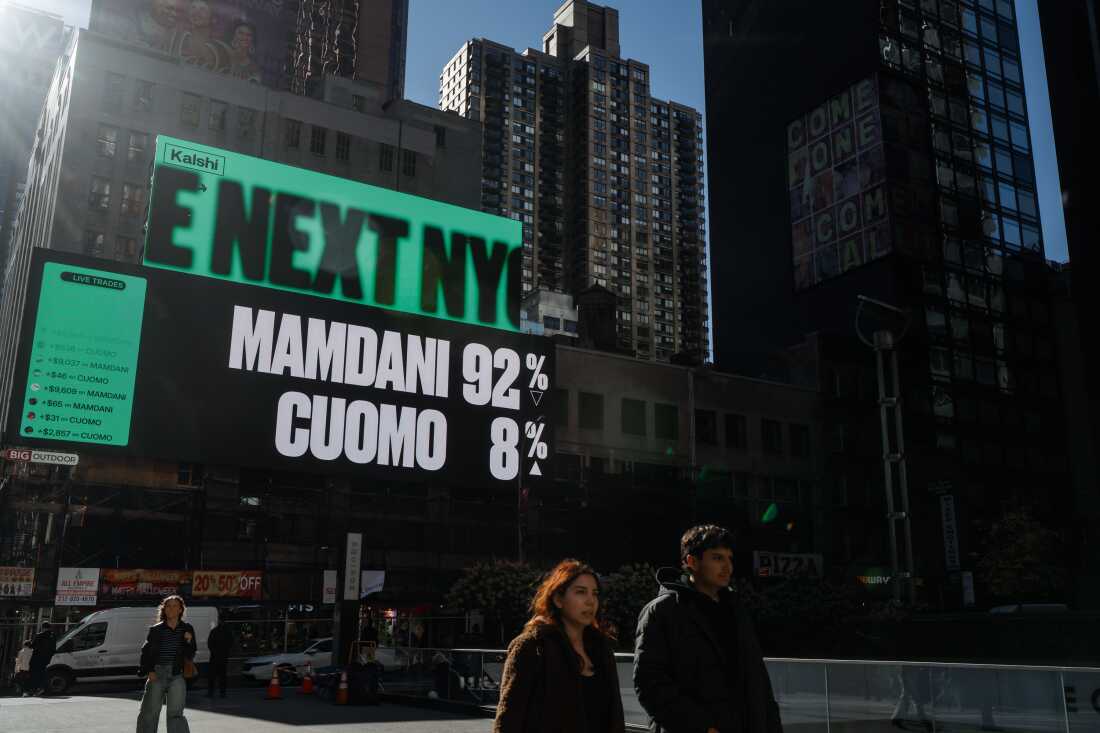
Advertisements by the company Kalshi predict a victory for Zohran Mamdani in the New York City mayoral election before the polls closed on Nov. 4, 2025.
Olga Fedorova/AP
hide caption
toggle caption
Olga Fedorova/AP
Here’s how they work: A staff member creates “a market,” often after one has been suggested by a user, like what will President Trump say at his next Oval Office briefing?
Then anyone can propose a “strike,” the lingo for a term that’s being bet on, whether, for instance, Trump will say “Greenland,” or “Minnesota,” or some other word or phrase.
Kalshi staff pick what terms will be bet on for both sides of that “yes” and “no” wager.

In order to work, however, there needs to be money on both the “yes” and the “no” side of the market, so Kalshi relies on institutional partners, like the hedge fund Susquehanna International, or everyday users with large enough portfolios to front the cash. This is called being a “market maker.” Kalshi provides financial perks and data access to traders who do this.
But because traders are competing with other traders, Kalshi argues there is no house involved in these transactions.
Several federal lawsuits against Kalshi have challenged this notion, claiming that the Wall Street firms that Kalshi taps are indistinguishable from a traditional “house.”
One suit filed this month in the Northern District of Illinois highlights that the company itself has a separate entity, Kalshi Trading, that supplies cash on the opposite side of trades.
“Thus, Kalshi users are betting against the house exactly the same way it would in a brick-and-mortar casino,” wrote lawyer Russell Busch in the complaint.
Kalshi denies this. Company spokeswoman Elisabeth Diana told NPR that market makers merely price bids and asks and do not have a competitive advantage.
“Market making is completely different from being a house, because a house has monopoly pricing power, whereas market makers compete with thousands of other market makers to take bids,” she said.
The Trump family invests in prediction markets. The administration is taking a friendly policy stance
While the Biden administration sought to rein in this industry, Trump’s regulators are breaking down barriers to allow it to flourish.
More than $2 billion is now traded every week on Kalshi, an amount the company says is 1,000% higher compared to the Biden years.
Polymaket, which was forced in 2022 to shut down in the U.S. for operating as an unlicensed betting site, recently won the Trump administration’s blessing to re-launch in the U.S.
The Trump family is also getting in on the action. The president’s son, Donald Trump Jr., is on the board of Polymarket, and his venture capital firm invests in the company. He is also a “strategic adviser” to Kalshi. Truth Social, the president’s social media site, is planning to launch its own prediction market called Truth Predict.

Donald Trump Jr. speaks during The Bitcoin Conference in Las Vegas on May 27, 2025.
Ian Maule/AFP via Getty Images
hide caption
toggle caption
Ian Maule/AFP via Getty Images
The explosive growth and permissive regulatory environment has ignited a debate about the underbelly of an industry that essentially turns many features of modern life into potential monetary wins and losses. Fears persist that when elections, politics and foreign invasions become a gamble that insiders could abuse their access for profit and market odds could influence what actually happens.
Then there’s the most prosaic, but perhaps more immediate worry: That the prediction markets gamify trading with slickly designed apps, one-click checking account deposits and constant push alerts, catering to compulsive online bettors. They’re not unlike other app-based trading platforms, but now almost anything is a potential betting opportunity, which economists and other financial experts say can enable a new generation of gambling addicts.
While individual bets on Kalshi are not public, the app has a leaderboard showcasing top profit winners.
That offers hope to some traders who turn to Discord and Reddit to discuss how losses have set them back.
“I’m down 2000 this week when I was up 1200 last week,” wrote a Kalshi trader who goes by Educational_Pain_407 on Reddit. “Lost it all and keep trying to claw it back. So I don’t know what to tell you but right now I don’t have enough to pay my bills in my bank account so I can’t bet even if I wanted to.”
There are three federal lawsuits against Kalshi seeking class action status alleging the apps have sucked young traders into gambling addiction.
Officials at Kalshi have said if traders “lose their shirt that’s on them,” and even the Reddit user behind on his bills concedes it’s a matter of personal responsibility: “Live and learn and pay for your mistakes. The consequences of being an adult,” he wrote recently.
While online sportsbooks and gambling are nothing new, the rapid speed, volume of cash and ease at which transactions flow across prediction market apps set them apart from other forms of betting, according to legal and financial experts.
“Like sports betting, these platforms can be addictive. It is the adrenaline rush that the target demographic is chasing,” said Melinda Roth, a visiting professor at Washington and Lee University’s School of Law who studies prediction markets. “I do believe this is a looming public health crisis.”
Decoding the lingo: ‘Mogged,’ ‘Fudded,’ ‘PMT’
Evan Semet, 26, is another diehard prediction markets trader who left his salaried position in finance as a quantitative researcher after he started raking in six figures a month on Kalshi.”I don’t feel the need for another job at the moment,” he said.
His first golden ticket came via bets on the number of Transportation Security Agency screenings that happen across a certain period on Polymarket.

Evan Semet quit his job in finance to do prediction market trading full time.
Meredith Nierman/NPR
hide caption
toggle caption
Meredith Nierman/NPR
Semet said he set up a dedicated server through Amazon Web Services to host statistical models that he runs to help him decide where to place bets.
“It was pretty modelable,” he said, noting that he leans on the finance savvy he gleaned at a trading firm to make money on predictions. “Most day traders draw some shapes on a chart and think it has some statistical significance but it’s really just astrology,” he said. “They’re old-school gamblers going off of intuition. I try to be driven by statistics.”
To stay tapped in, he’s often toggling between multiple live trades on one screen and following a discussion among other traders on the social network Discord.
Keeping up on what’s happening there requires understanding a hyper-specific type of lingo that’s a blend of Generation Alpha and Gen Z slang, repurposed finance terminology and a grab-bag of other cultural influences from gaming to crypto to the gutter humor of fringe sites like 4chan.
If you’ve been out-maneuvered by another trader, you’ve been “mogged.”
If a market has “fudded,” people are selling their positions out of fear, uncertainty and doubt. A “rulescuck” is someone who is a stickler for the rules of a betting market and will try to win on a technicality.
A “bondsharp” is a well-known community member who frequently puts up money on the other side of a bet.
These are just a handful of the terms required to stay apace of the chats on Discord, where PMTs are often discussing their full port (prediction market trader, and full portfolio, of course).
“It is a good amount of terminology. It’s borrowing lingo and terms from stuff I’ve heard at real trading firms mixed with online pop culture,” Semet said.

“Sometimes I prefer to not look at all and see how I did later,” Semet said.
Meredith Nierman/NPR
hide caption
toggle caption
Meredith Nierman/NPR
Prediction market trading can be a compulsive sport for many of them, who admit they can be dopamine junkies. Others prefer to avoid the pressure-cooker feeling of watching a bet win or lose live.
“It’s an antsy, gambling-like feeling watching it all happen live,” Semet said. “It’s intense, almost feels like the fog of war, trying to decide what to do,” he said. “Sometimes I prefer to not look at all and see how I did later.”
How predictions markets got into politics
Kalshi’s big day came, as it were, on Election Day in November 2020.
That’s when they got word that Trump’s Commodity Futures Trading Commission, which regulates futures contracts, greenlit it as a “designated contract market,” a blessing that essentially gave the platform a license to operate as a financial exchange.
It was a long time coming.
For years before that, Kalshi’s co-founders Tarek Mansour and Luana Lopes Lara, former Wall Street traders who met at MIT, had been battling a skeptical CFTC, which had long rejected similar applications over concerns that an events contract platform would operate a type of gambling outside the purview of state gambling commissions. Regulators also feared the bets invited insiders to rig the outcomes of events from sports to elections.

Tarek Mansour, (left) and Luana Lopes Lara are co-founders of Kalshi.
Alexey Yurenev/Bloomberg via Getty Images
hide caption
toggle caption
Alexey Yurenev/Bloomberg via Getty Images
As Kalshi hired lawyers and lobbyists leading up to their CFTC approval, another prediction market, where most are betting with cryptocurrencies, Polymarket, was exploding in growth. It, however, had not bothered to even try to receive federal buy-in. The Biden administration shut down the exchange for operating without a license. Now, Polymarket has the CFTC on its side, and is staging a U.S. comeback.
Two developments helped Polymarket’s return: the company acquired a little-known derivatives exchange QCX, which had already obtained CFTC approval. And the Trump administration’s CTFC and Justice Department abandoned investigations into Polymarket.
States, however, are on the attack. Massachusetts has sued to push Kalshi out of the state. Eight other states, including New York, New Jersey and Maryland, have sent the company cease and desist letters alleging that it is operating as an illegal and unlicensed sports gambling site. The motivation is clear: Gambling brings in serious tax revenue for states, while prediction markets bring in none.
For both Kalshi and Polymarket, one of the most controversial areas of prediction market trading is elections, an issue Biden-era regulators took Kalshi to court over.
Under the 1936 Commodity Exchange Act, which was updated in 2008 after the financial crisis, future event contracts cannot involve terrorism, assassinations or “games,” but political betting is not explicitly banned.

The Polymarket prediction market website is seen on a computer screen.
Wyatte Grantham-Philips/AP
hide caption
toggle caption
Wyatte Grantham-Philips/AP
Biden administration lawyers argued that placing wagers on races amounted to a game, a word that is not defined at all in the law. Election bets, the regulators contended, could turbocharge the spread of political misinformation and create financial incentives for voters to cast a ballot even when it’s contrary to a voter’s political views.
It also puts the CFTC in the awkward position of having to investigate news, whether real or fabricated, that moves a prediction market. Former CFTC officials told NPR that the agency has never been equipped to be “an election cop.”
The federal appeals court in Washington, D.C. rejected that framing and handed Kalshi a major victory. The court also pointed out that the harm these markets would cause the government was not “concrete” enough.
The Trump administration dropped the appeal, unleashing what is expected to be an unprecedented torrent of prediction market cash into this year’s midterm elections, which is raising alarms among those pushing for stricter regulations on this industry.
“AI, deepfakes, and other nefarious activities to attack candidates could easily impact the betting activity and odds, as well as the actual outcome of elections,” said Kelleher of Better Markets. “They don’t really care who wins or loses. They only care about the volume of bets and driving that volume as high as possible.”
Regulators appear unprepared. The CFTC usually has five commissioners but currently only has one. Meanwhile, Kalshi’s board includes former CFTC Commissioner Brian Quintenz, who was among the officials who gave the platform its federal approval in 2020.
Former CFTC Commissioner Kristin Johnson, who left the agency in 2025, said that lack of commissioners comes on top of high levels of turnover among the most senior staff lawyers.
“We’re essentially asking the CFTC to get involved in engaging and policing an element of our democratic process that we really haven’t thought carefully enough about,” Johnson said.
Insider trading scrutiny grows
Before a U.S. operation ousted Venezuelan leader Nicolás Maduro, one trader on Polymarket banked a nearly half-million-dollar profit on a bet Maduro would not remain president for long.
While the trader’s identity remains a mystery, speculation continues to rattle around the internet about whether the person had insider information. The episode has renewed scrutiny on how the companies ensure bets aren’t rigged.
On Discord, when traders see a large bet placed that immediately stands out as an outlier, cries of “the market is insidered” are common. Proving it is another matter.
As is often the case on the platforms, open-shut evidence of insider trading is elusive. Kalshi requires a government-issued ID to sign up in order to trace any possible market manipulation back to a real person. Polymarket does not, but it has yet to publicly re-launch its U.S. app. Internal and third-party surveillance tools, the companies say, are on the lookout for unusual activity.
Congress has begun to take notice. Following the Maduro trade, Rep. Ritchie Torres, D-NY, and 30 other Democrats, sponsored legislation banning federal officials from using prediction markets to trade on policies or political outcomes using non-public information.
Being up against an insider is always a risk, said full-time prediction markets trader Semet.
“There’s always going to be someone who has more information than you, unless you’re the insider,” he said. “There are certain accounts that miraculously have every single Google and OpenAI release date nailed perfectly, and it’s like, all right, just don’t fade those people,” he said using the slang word for voting against another trader.

Being up against an insider is always a risk, said full-time prediction markets trader Semet.
Meredith Nierman/NPR
hide caption
toggle caption
Meredith Nierman/NPR
When asked if he thinks Kalshi and Polymarket are doing enough to combat insider trading, he gave a blunt assessment: “F*** no,” Semet said. “I really don’t think they care.”
“Tailing,” or making a bet joining in on a suspiciously large bet is common on the platforms. Bloomberg on Monday reported on a new tool that allows traders to get alerts when anomalous transactions occur so they can potentially cash in on what could be a winning wager.
From the vantage point of these traders, nearly everything has a trading implication.
And that kind of thinking can fuel conspiratorial theories about why something did or did not happen.
Take, for instance, a recent White House press briefing in which press secretary Karoline Leavitt left the room seconds before hitting 65 minutes. To most, that was unremarkable.
Yet on Kalshi, that looked like a secret message, because many thousands of dollars in bets were at stake that she would cross the 65-minute mark.
The chatter about Leavitt was mentioned on CNBC, which got the attention of traders on Discord, who wondered if this or another incident will ever lead to a PMT, prediction market trader, testifying in Washington about rigging the markets.
“PMT getting called before Congress,” wrote a Discord user, whose handle is “permanent resident of hell,” they added: “Let’s get a market on it.”


Lionel Messi #10 of Argentina celebrates scoring his team’s second goal during their World Cup match against Egypt in Atlanta on Tuesday.
Elsa/Getty Images
hide caption
toggle caption
Elsa/Getty Images
They looked beaten. And out. Argentina, the defending World Cup champion and No. 1-ranked team, was down 2-0 late against Egypt.

Then, in a span of 13 remarkable minutes, Argentina scored not once, not twice, but three times, capping a comeback for the ages and leaving Egypt stunned and shellshocked.
For much of the game in Atlanta, Egypt was in control, hobbling Argentina early. The Egyptian attack began almost immediately with a stunning header goal delivered by Yasser Ibrahim in the 15th minute. After that, Egypt’s defense closed ranks, making it practically impossible for Argentina to equalize.
It was downhill from there for the Argentines: team captain Lionel Messi failed to convert a penalty kick, and in the 67th minute, Egypt got a second goal from Mostafa Ziko (after an earlier Egyptian goal had been disallowed after a video review). It looked like Argentina was finished. On the brink of elimination.
But no one told the Argentine players that.
In the 79th minute, Lionel Messi began doing his thing. He fired a cross near the Egyptian goal, and Cristian Romero headed it in. Messi was not done. Four minutes later, he powered a shot past the Egyptian keeper. It was his eighth goal of this tournament, the most of any player. The score was 2-2.
Then, in stoppage time, yet another Argentina header and another goal, this time from Enzo Fernandez.
“This is the World Cup for you,” said Messi after the game. “It wasn’t easy to come back from two goals down. But as I always say, this group never gives up. We always try to fight until the end.”

French referee François Letexier speaks with Egypt forward Mohamed Salah during the World Cup Round of 16 match between Argentina and Egypt in Atlanta.
Roberto Schmidt/AFP via Getty Images
hide caption
toggle caption
Roberto Schmidt/AFP via Getty Images
Afterward, Egypt coach Hossam Hassan complained about the French referee and the officiating. “I am not convinced. I am not convinced with this outcome. I’m not convinced with the way things unfolded during this match,” said Hassan in a post-match news conference. “We have been treated unfairly today. We have suffered injustice.”
“We would have deserved to earn this win, but we are leaving with honor, with pride, regardless of this defeat,” said Hossan.
African soccer teams have been the stars of this World Cup. Morocco has yet to lose a game. Cape Verde qualified for the first time in its history and stymied Spain, Uruguay and Saudi Arabia. Argentina barely beat them in a nail-biter of a match.
For Egypt, getting this far in the tournament is historic in itself: it’s the first time the team has made it this far. For Argentina, it was a terrifying yet relieving victory: several players, including Messi himself, cried after the game.
Next, they move to the quarterfinals and will play the winner of today’s Switzerland-Colombia match.

Top Senate Democrats are pushing for answers on whether a provision in a controversial settlement agreement between President Trump and his own administration applies to companies co-founded by or affiliated with the Trump family.
As part of a deal struck in May by the Justice Department to resolve a lawsuit brought by Mr. Trump, the Internal Revenue Service is permanently barred from pursuing claims against Mr. Trump, his oldest sons Don Jr. and Eric, and the Trump Organization based on prior tax returns.
In a one-page document signed by Acting Attorney General Todd Blanche and dated May 19, the Justice Department said the defendants in the president’s lawsuit — the IRS and the Treasury Department — are “FOREVER BARRED and PRECLUDED” from “prosecuting or pursuing, any and all claims” arising from tax returns filed before the settlement took effect. Blanche also wrote that the settlement applies to “parties including trusts, parent, sister, or related companies, affiliates, and subsidiaries.”
Now, Senators Elizabeth Warren of Massachusetts, Senate Minority Leader Chuck Schumer of New York, and Ranking Member of the Senate Finance Committee Ron Wyden of Oregon are pushing 11 businesses and organizations with ties to the Trump family to get answers for the “significant questions” the settlement raises relating to the tax audit provision, and whether the companies are included in the deal.
“Under the guise of a so-called legal settlement, the Trump administration has attempted to decree that the President, his family, and their entire business empire — potentially including entities with even the vaguest ‘affiliation’ to the family — are to face zero consequences if they have committed a range of financial crimes or misdeeds — regardless of the severity of the violation,” the senators wrote in letters transmitted to the companies Monday night.
The letters were sent to mining company Kaz Resources, defense firm Powerus, cryptocurrency companies World Liberty Financial and American Bitcoin, robotics startup Foundation Future Industries, investment firm 1789 Capital, private aviation company Tag Air, and prediction markets Polymarket and Kalshi.
All of the companies either were founded by Mr. Trump and his two adult sons, or list members of the Trump family as advisers, board members, or partial owners. Donald Trump Jr. sits on Polymarket’s advisory board and 1789 Capital, where he’s a partner, has invested in Polymarket. Days before Mr. Trump took office for his second term, Kalshi also announced Trump Jr. would be a strategic adviser.
The Democrats, who are in the minority, lack subpoena power, so Mr. Trump, his children and his companies can’t be forced to answer the questions posed by the senators.
According to recent financial disclosures, the president earned more than a billion dollars from cryptocurrency ventures alone last year, including from his meme coin business and World Liberty Financial, his family’s cryptocurrency firm.
Separately, the senators also asked the Trump Organization in a separate letter if it believes it has “immunity from all audits, civil penalties or federal prosecution” for any crimes that could have occurred before the settlement.
Trump Media and Technology Group, which is majority owned by a trust that lists Mr. Trump as the sole beneficiary and operates the Truth Social platform he uses daily, also received a letter from the Democratic senators.
“The public deserves transparency about the scope of this get-out-of-jail free card for Trump-aligned businesses, and about whether you intend to rely on this settlement as a free pass for any possible violations of the law,” the senators continued in their letter, which also seeks any communications that executives at the companies have had with the Justice Department and White House leading up to or after the settlement was signed.
The settlement was announced months after Mr. Trump and two of his sons and the Trump Organization accused the IRS and Treasury Department of unlawfully allowing a government contractor to leak tax returns to media outlets in 2020.
In a statement, a Justice Department spokesperson said “the IRS routinely provides releases as part of resolving taxpayer reviews and audits. This settlement follows that same standard practice.”
The spokesperson did not provide specific information about which companies are covered by the audit provision, or whether the Trump Organization and Trump family are the only entities covered by that addendum.

Charles De Ketelaere #17 of Belgium celebrates after scoring his team’s second goal during the World Cup Round of 16 match against the United States on Monday in Seattle.
Alex Grimm/Getty Images
hide caption
toggle caption
Alex Grimm/Getty Images
SEATTLE — This time was supposed to be different.
The U.S. men’s national team came into this FIFA World Cup with a lineup full of players with key roles in Europe’s top leagues. They had the name-brand coach — Mauricio Pochettino, of Tottenham, PSG and Chelsea fame. And they had homefield advantage, with every game on U.S. soil for the first time in three decades.

For weeks, the hype seemed like it might be real: The team’s three wins over Paraguay, Australia and Bosnia-Herzegovina were the most ever by a U.S. men’s squad in a World Cup. A new generation of American fans filled stadiums by the tens of thousands and tuned in on TV by the tens of millions.
But in the end, the Americans’ exit was the same as it ever was: Eliminated yet again in the Round of 16 at the hands of a European team — this time, Belgium, by a score of 4-1.
From the moment they stepped onto the Seattle field, the U.S. was outclassed by their opponent, No. 9-ranked Belgium. Countless turnovers and defensive lapses were seized on by the Belgians, who needed only nine minutes to take a 1-0 lead.
Then, once the Americans equalized on a free kick by midfielder Malik Tillman, Belgium scored yet again in barely a minute of play. Belgian forward Charles De Ketelaere scored both his team’s first-half goals.
After halftime, came an embarrassing nail in the coffin that silenced the Seattle sellout crowd for good — a 57th minute roll-in by Hans Vanaken after a slip-up by goalkeeper Matt Freese outside of the penalty area left the goal unguarded. Belgian forward Romelu Lukaku added a stoppage-time goal to seal the final score at 4-1.

Malik Tillman #17 of the United States celebrates scoring his team’s only goal during their World Cup match against Belgium. In what was one of the few bright spots of the game, the U.S. pulled even with Belgium at 1-1. The tie lasted less than two minutes before Belgium scored again.
Luke Hales/Getty Images
hide caption
toggle caption
Luke Hales/Getty Images
“It stinks,” said U.S. midfielder Tyler Adams. “Tonight was not a good performance overall. It’s not what we look to achieve. There [were] a lot of things that we could have done better.”
The U.S. had entered Monday’s game under a cloud of controversy around their striker Folarin Balogun, who was shown a red card in last week’s Round of 32 match against Bosnia-Herzegovina. An automatic one-game suspension was set to sideline Balogun, the Americans’ leading scorer at the World Cup, for Monday’s game.
Then, the day before the game, a FIFA disciplinary panel took the highly unusual step of delaying Balogun’s suspension by a year to allow him to participate. Then, news broke that President Trump had personally called FIFA president Gianni Infantino to encourage him to review the red card.
The Royal Belgian Football Association said it would protest Balogun’s inclusion in the lineup. But even at full strength, the U.S. were never real contenders in Monday’s game.
U.S. defender and team captain Tim Ream said the controversy swirling around the team had no impact. “We were fully focused on us as a group and as a team and fully focused on the game and not really worrying about what was being said or debated in the outside world.”
Belgium will advance to the quarterfinals for the third time in the past four World Cups, where it will face Spain on Friday in Los Angeles.

Mauricio Pochettino, Head Coach of the United States, walks down the touchline during the Round of 16 World Cup match between the USA and Belgium in Seattle on Monday.
Carl Recine/Getty Images
hide caption
toggle caption
Carl Recine/Getty Images
-

 Indiana6 minutes ago
Baby abducted in Marshall County found safe in northwest Indiana
-

 Iowa9 minutes ago
Iowa City Man who ran over people in homeless encampment sentenced to nearly two decades in prison
-
Kansas14 minutes ago
Kansas Lottery Mega Millions, Pick 3 winning numbers for July 7, 2026
-

 Kentucky21 minutes ago
US 51 Cairo bridge to remain closed for period of time
-

 Louisiana24 minutes ago
Heart of Louisiana: Lafitte Wetlands
-
 Maine29 minutes ago
Maine’s 10 most expensive home sales from June
-

 Maryland36 minutes ago
Maryland Lottery Mega Millions, Pick 3 results for July 7, 2026
-

 Michigan39 minutes ago
Michigan Supreme Court rules rape admission invalid due to LSD use

