Lifestyle
The world's largest wildlife crossing is finally standing. Here is what's coming next


• The Wallis Annenberg Wildlife Crossing now spans the 101 Freeway in Agoura Hills, but weather issues have pushed completion to sometime in 2026.
• Builders plan to cover the crossing with “engineered” soil inoculated with local microbes early next year so more than 5,000 native shrubs and wildflowers can be planted.
• But the crossing won’t be connected to the mainland until Stage 2, when many tons of earth must be moved to create a safe elevated passage over one of the state’s busiest freeways.
It doesn’t take a hawk eye to recognize that the Wallis Annenberg Wildlife Crossing over the 101 Freeway in Agoura Hills is not your normal Caltrans project.
For one thing, there’s the color. Most Caltrans structures are the light gray of natural concrete. But to reduce reflectivity and help the crossing blend in more with the surrounding land, the new crossing’s 27 million pounds of concrete have been colored a shade dubbed “dusty mocha” by the project’s lead designer, Robert Rock, a landscape architect for Chicago-based Rock Design Associates.
The official name, however, is Federal Standard Color 595-33105, a hue “inspired,” Rock said, by the soil around the crossing that will eventually provide wildlife safe passage between the Santa Monica Mountains to the south and the Simi Hills and Santa Susana Mountains to the north when the project is completed.
For the record:
9:23 a.m. Oct. 29, 2024An earlier version of this story incorrectly reported that Robert Rock works for Living Habitats. He now has his own firm, Rock Design Associates. It also incorrectly reported that Katherine Pakradouni was the founder of the project’s nursery. She was the former manager.
When the project began in 2022, the end date was projected to be late 2025, but severe rain and heat the past two years caused delays that have pushed completion to sometime in 2026, said Rock. Weather extremes can wreak havoc on construction projects, especially when they involve so much concrete, he added.
Concrete molds for new signage on the Wallis Annenberg Wildlife Crossing.
(Brian van der Brug / Los Angeles Times)
Nonetheless, there’s been plenty of progress. The crossing now spans the 101, and up on the deck — 21 feet and 8 inches above the freeway — there’s a marked difference from the noise on the ground, where the traffic is so loud it’s hard to have a shouted conversation (unless all you’re saying is “What?!”).
On Oct. 16, Caltrans senior bridge engineer Darwin Vargas led a group to the top of the structure, promising serenity once we stepped on the deck. He was right. At the top, the deck looks like a moonscape, and the roar of rushing cars and trucks was barely discernible, thanks to the thick, 12-foot-tall sound walls on either side of the structure, which is slightly wider than an American football field and about three-quarters its length.

Landscape designer Robert Rock looks down from the temporary stairs leading to the deck on the south side of the Wallis Annenberg Wildlife Crossing. The area where the stairs are now will be filled in with soil, covering a tunnel over Agoura Road to create a gradual slope off the crossing to the Santa Monica Mountains.
(Brian van der Brug / Los Angeles Times)
On that day, workers were using power tools (and even those sounds were muffled) to smooth the sides and surface of the concrete deck, preparing it for the next steps — waterproofing the concrete and covering it with heavy rubber sheets about 2 inches thick. After that will come a “giant mattress of gravel” 12 inches deep, Rock said, laced with perforated pipes to collect runoff and direct it into Liberty Canyon Creek.
It’s hard to tell as you’re driving underneath, but the crossing is slightly slanted, about two feet lower on the north end than the south to help drain off any moisture, because the last thing you want on a concrete structure is a lot of standing water.
This space will be off-limits to humans once the crossing is completed, with locked gates to keep people out and discreet fencing to guide wildlife away from nearby homes into the wild hills beyond. The crossing is designed to feel like an extension of the hills and valleys in the area to re-create the seamless corridor that existed before the noisy, busy freeway made passage so dangerous.

Senior bridge engineer Darwin Vargas pauses on the maintenance walkway on the east edge of the wildlife crossing, with one of the 12-foot-tall soundproofing walls to the right. The area between the walkway and sound wall will be planted; the wildlife will cross in the wide expanse on the other side of the wall.
(Brian van der Brug / Los Angeles Times)
Once the gravel is in place, the builders will add about 6,000 cubic yards of “engineered soil” to the structure, Rock said. It’s a sandy loam mixed with lightweight volcanic aggregate to provide the volume and moisture needed to support plant life while reducing the weight on the structure and allowing for easy drainage.
That quantity of soil is enough to cover three-quarters of an American football field in about 2.5 feet of soil, he said, but on the crossing, the “ground” will be higher in some places than others, contoured to mimic the dips and dents one might find on nearby hills.
The engineered soil will also be inoculated with mycorrhizal fungi spores collected within five miles of the crossing, the same spores added to the soils growing the 5,000-plus hyper-local native shrubs and wildflowers that will be planted on the crossing. The plants are considered “hyper-local” because they are grown from seeds that were collected within a five-mile radius of the structure, Rock said.

Soil scientist Ted Hartsig at the special nursery growing native plants for the Wallis Annenberg Wildlife Crossing.
(Brian van der Brug / Los Angeles Times)
“We’ve got to have the right microbes in order for these locally sourced seeds to flourish,” said Ted Hartsig, a soil scientist for the engineering company Olsson, one of many contractors working on the crossing.
If all this sounds a little fiddly, well, just understand that it’s tough to mimic Mother Nature. Success is in the details, and there are more than a 100 people led by Rock trying to ensure that every detail is done correctly.
After all the soil is in place, they plan to start planting early next spring, Rock said. The project has two nursery sites now: a seed bank near Paramount Ranch and the main nursery off Las Virgenes Road in Calabasas, where thousands of seeds have been planted in tiny flats and then repotted to grow large enough to be planted.

Jewlya Samaniego and Jose Campos, co-managers of the Wallis Annenberg Wildlife Crossing, prune one-gallon containers of white sage slated for planting on the crossing next year.
(Brian van der Brug / Los Angeles Times)
Those seeds were collected in 2022 by the nursery’s former manager, Katherine Pakradouni, who has since moved on to another position. The people who helped her set up the nursery, Jewlya Samaniego and Jose Campos, now run the site together and put in so many long hours that some people have questioned whether they live there. They don’t, Samaniego said laughing, but there are time it feels that way, especially during the heavy rains last winter and the scorching heat this summer.
Native plants don’t need much water once they’re established in the ground, but growing in little pots that dry out quickly, that’s another matter, Campos said. During the highest heat, they had to water the plants twice a day to keep them alive, and they finally created a shaded area to protect tender seedlings from the heat.
Most of the plants growing at the nursery will be planted on the structure next year: native shrubs such as white sage, California fuchsia, California buckwheat, sagebrush, purple sage, black sage, toyon and laurel sumac, along with a variety of native grasses.
The hope is that the plants will be robust enough — thanks to the beneficial microbes — to crowd out the black mustard and other invasive plants growing nearby, Rock said. Once established, the plants shouldn’t need much water, but the crossing will have an irrigation system installed that can be activated to wet down the crossing in the event of a wildfire.
Stage 2 involves creating a tunnel over Agoura Road to the south to create a gradual slope that will allow animals to wander off the crossing into the Santa Monica Mountains. To the north, a deep gash in the hill will also be filled with soil, to create a sloping entry from the Simi Hills onto the crossing.

Soil scientist Ted Hartsig holds a handful of soil teeming with beneficial mycorrhizal fungi that will be used to inoculate the wildlife crossing growing media.
(Brian van der Brug / Los Angeles Times)
Those areas will have similar plantings along with native oaks and other native trees, which can’t be planted on the crossing because their roots run too deep, Rock said.
The nursery is growing those plants from seed too. The plants have been moved to the growing area called the “seed bank” near Paramount Ranch, he said. The goal is to collect seeds from them until they’re ready to be moved to their permanent homes on the shoulders that link the crossing to the hills, which likely won’t be until 2026.
Rock said they’re doing the planting in stages so the plants on the crossing have a year to get established before wildlife can reach them. Otherwise, the young plants could be nibbled to death by hungry travelers.
The design work for Stage 2 is nearly completed, Rock said, but it will likely take a good part of 2025 to get the tunnel over Agoura Road completed.

A view of traffic on the 101 Freeway, looking west, from the top of the Wallis Annenberg Wildlife Crossing. Once the work is completed, the 12-foot-tall sound wall will obscure the sight and sounds of the freeway from animals crossing between the Santa Monica Mountains and the Simi Hills.
(Brian van der Brug / Los Angeles Times)
Then there will be lots of earth to move. Much will come from the north side of the crossing, where fill dirt was deposited from the 101 expansion in the 1950s and 1960s, said Rock.
The shoulders will have to be filled in slowly, a little at a time on each side, said Vargas. Too much soil on one side could destabilize the structure, causing it to topple, he said, “which would be really, really sad.”
Once the fill soil is in place, the builders will add a final layer of top soil, a rich mix that was dredged from the bottom of Malibu Lake 70 years ago and has been resting near Paramount Ranch ever since, teeming with the beneficial microbes so important to this project’s success.
All that won’t happen for another year at least. On Oct. 16, the only animals on the structure were human, but high above, circling in the brilliant blue sky, a hawk was keeping tabs.

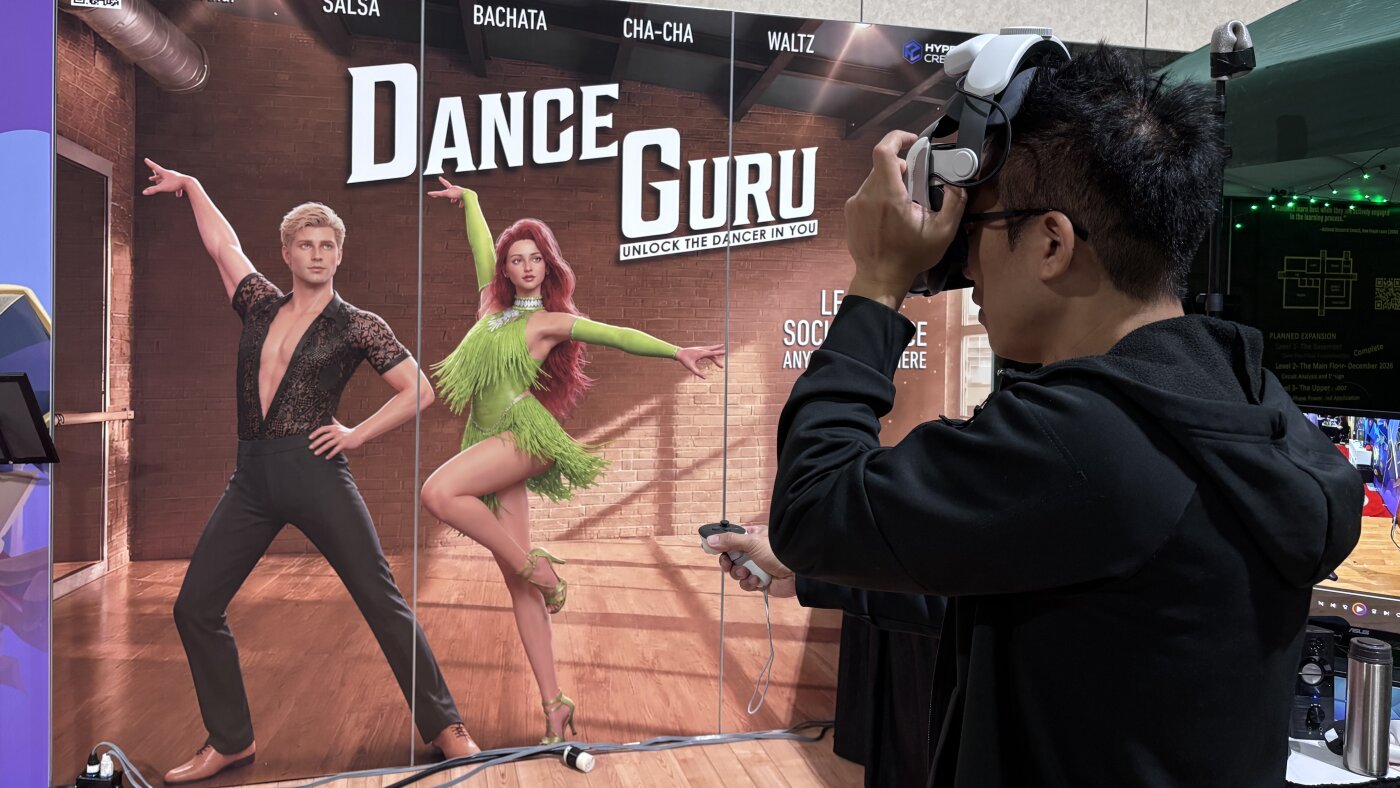
Entrepreneur David Huang tests out a VR headset while conducting demonstrations of the social dance lesson app Dance Guru at the Augmented World Expo in Long Beach, Calif., June 17, 2026.
Chloe Veltman/NPR
hide caption
toggle caption
Chloe Veltman/NPR
Wedding season is in full swing, bringing with it a familiar sense of dread for anyone who fears the dance floor.
But relief may finally be at hand with the help of a new app, Dance Guru, and a virtual reality (VR) headset.
The social dance instruction app transports users to a spacious, digital dance studio. Waiting inside is a computer-generated coach: a handsome, male avatar wearing a shirt open to his navel. He speaks with a slightly gravelly English accent.
“Watch me now,” he instructs at the start of a waltz lesson — which NPR tried out at the Augmented World Expo in Long Beach, Calif., an annual conference showcasing the latest developments in virtual and augmented reality.
The avatar then demonstrates a basic box step.
From there, the lesson becomes interactive. The coach tells the user to hold his hand while an electric pinging sound tracks the student’s foot placement.
“One, two, three, four, five, six,” the virtual teacher counts down.
When the user stumbles, he remains remarkably patient. “Do not worry, foundations take time. Let’s try that again. Work on grounding your steps more intentionally.”
Solving the beginner’s dilemma
Dance Guru creator David Huang said he came up with the idea for the app a couple of years ago out of frustration.
“I always wanted to learn to dance and I was always terrible at it,” Huang said. “And I always ended up stopping midway through the lessons.”
He soon realized that many beginners hit the exact same roadblocks.

“Private lessons are too expensive, and you feel like you’re always forgetting the dance steps,” Huang said. “You cannot find a partner to dance with. So I figured maybe I can create something like this.”
The Dance Guru platform currently offers tutorials in salsa, bachata, waltz, and cha-cha, in both lead and follow modes. To make the digital instruction feel authentic, Huang used motion-capture technology to record the movements of real-life dance teachers — with their permission.
Building on the legacy of online tutorials and video games
Dance Guru belongs to a small but growing wave of apps using VR to demystify social dance. At a nearby booth, conference attendee Victor Chen is testing out a competing app called Trip the Light. It currently offers salsa lessons, as well as freestyle options, where a user can dance with a partner without having to learn specific steps.

Trip the Light’s booth at the Augmented World Expo included posters of the app’s virtual instructors. Real-life performers, who gave Trip the Light permission to motion capture their movements, were used as a basis for these avatars.
Chloe Veltman/NPR
hide caption
toggle caption
Chloe Veltman/NPR
“A lot of times when you’re trying to learn a choreography, it’s watching a YouTube video and you have to pause it, rewind, and play it,” Chen said. “If you were to have a virtual avatar dancing in front of you and correcting for any parts that you missed, it might be a lot easier.”
Interactive video games like Dance Dance Revolution and Just Dance, and YouTube tutorials have been helping people improve their skills in private for years. But those games are mostly aimed at solo players. Unlike the new generation of immersive VR apps, they cannot simulate the mechanics or confidence required for partner dancing on a live dance floor.
The reality check
But this kind of app won’t work for every dancer.
“Everyone learns a little bit differently. And so unless you have a game that has lots of different ways of teaching, you’re going to have things that work for some people and don’t work for others,” said Ariana Katana, a trained contemporary dancer and dance content creator who’s active on YouTube, Twitch and other platforms. “Also, it’s hard to dance with a headset on.”
And then there’s the issue of not being able to physically feel a virtual partner’s hand or shoulder while dancing with them. Patrick Ascolese, the creator of Trip the Light, said the experience could become more tactile in the future. “Haptic suits and wearables will be coming, but I think we’re a little away from that,” he said.
Ascolese said even with their limitations, immersive tools like Trip the Light have immense potential as judgment-free training grounds — giving reluctant dancers the baseline confidence they need to eventually step onto the dance floor with real partners in the real world, including at weddings.
“Just like anything else, practice makes perfect,” said Ascolese. “So the more time you spend in VR with a virtual partner, it works towards helping you get over that social hurdle. We are teaching you the moves that you have to do in order to go out and have fun.”
Jennifer Vanasco edited the broadcast and digital versions of this story. Chloee Weiner mixed the audio.



For half a century, Deidre Hall has taken on every kind of disaster in the drama-packed town of Salem, Ill., as a star of “Days of Our Lives.”
There was the time — actually, it happened twice — when her character, Dr. Marlena Evans, was famously possessed by the devil and even levitated.

In Sunday Funday, L.A. people give us a play-by-play of their ideal Sunday around town. Find ideas and inspiration on where to go, what to eat and how to enjoy life on the weekends.
Or the time a serial killer, who was actually Marlena under hypnosis, seemed to kill several beloved characters. The long-running show’s storylines have become legendary, and in March, while promoting “Hail Mary,” actor Ryan Gosling even gave Hall a shout-out, admitting he was a fan, praising the hard work of soap opera actors and calling her an “OG acting inspiration.”
But Hall’s real life in Santa Monica is much quieter than her character’s, and she likes it that way.
“When I bought my house in Santa Monica, I didn’t realize how great it would be to live near Montana Avenue,” says Hall, 78, about the popular shopping spot. Every day, she walks to the main street with her golden retriever, Riley, and enjoys Pilates, art and good food along the way. “The owners of the Farms Market even keep dog biscuits, so guess where the dog wants to go every time we walk — the Farms, of course,” she says, laughing.
When she isn’t filming the daily soap opera, which airs on Peacock, Hall enjoys raising monarch butterflies, exploring the shops and restaurants on Montana, and hosting movie nights at home with her two sons.
Here’s what a perfect day in L.A. looks like for her.
This interview has been lightly edited and condensed for length and clarity.

7 a.m.: Breakfast and dog walk
I usually kick off my day with a protein shake, feed our golden retriever and take her out for a walk. She’s a phenomenal girl. When we adopted her, her name was Riley, but I did think about naming her after Mrs. Hughes from “Downton Abbey.”

10 a.m.: Church and garden time
After I walk the dog and go to church, I like to spend some time in my yard. I’m not a natural gardener, but I really enjoy it. I started raising monarch butterflies because my identical twin sister, who played my twin on the show, planted a butterfly garden. Monarchs are amazing because they are transitional. Every year, they travel from Mexico to southern New England, but it’s getting harder for them. Their numbers have dropped by about 80%. To help, I plant milkweed, which is what they need to survive. I buy my milkweed from the Staghorn Garden on Wilshire Boulevard in Santa Monica. Julie, who owns the nursery, is delightful and has a wide variety of milkweed. The monarchs always seem to find my garden. Julie was raising some caterpillars too, and she cared a lot about them. We talked about how important it is to help the butterflies. That’s why I do this. Sometimes I get milkweed with eggs already on it, and Julie knows her butterflies are going to a good home.

1 p.m.: Walk to Montana Avenue for some lunch
I live near Montana and love taking long walks, going to Pilates and trying out the great restaurants nearby, like R+D Kitchen and La La Land. I’m a big fan of the waffles at the Courtyard Kitchen. Just a few days ago, I had a chicken salad on raisin bread with an Arnold Palmer, and it was delicious. It is right on Montana and has a nice outdoor seating area. It’s one of my favorite spots. La La Land always has a long line in the morning, which is perfect if you want coffee. They serve coffee, doughnuts, croissants and avocado toast. There’s plenty of outdoor seating, and you can even bring your dog.

2 p.m.: Peek inside a clock shop
There’s a small clock shop on Montana Avenue that’s closed on Sundays, but if you walk by, you’ll see all kinds of clocks — standing, table and wall clocks. The owner is great at fixing them. Once, I bought a wall clock from MacKenzie-Childs, but it didn’t work. And I was really upset because it matched everything else on my countertop. I brought it to the owner and said, “I love this, but I can’t make it work.” He fixed it right away. His name is John, but I call him Geppetto. And we all know why. He really does have a magic touch.

2:30 p.m.: Visit a neighborhood art gallery
Ten Women Gallery is run by 10 artists, all of whom show their work there. I was drawn to some watercolors there, bought a few cards and spoke with one of the artists. She told me, “You seem to love watercolors,” and mentioned that the artist who painted them, Pamela Harnois, lives in Los Angeles and teaches nearby. I got Pamela’s name and found out she taught at the Brentwood Art School. I was so inspired by her gift that I started taking private lessons with her on Saturdays. That gallery is where I discovered my love for watercolor painting.

3 p.m.: Grab some ice cream at Rori’s
The other day, my longtime girlfriend wanted to get ice cream and told me, “We are walking to Rori’s Artisanal Creamery.” It’s a small shop on Montana near Lincoln. They make everything themselves, using local ingredients from grass-fed cows with no added hormones. The place is family-owned and probably has the healthiest ice cream you’ll find. They switch up their flavors often, but my favorite is the salted caramel.

6 p.m.: Family dinner and movie night at home
R+D Kitchen is always packed, so my sons, who are 31 and 33, do the cooking. They come over, and together we make salads and cook dinner. There’s a neighborhood grocery store called the Farms, off Montana, a small family-run place that has everything we need. Everyone knows each other there, and people bring their dogs. We try to have movie night every Sunday. Sometimes the day changes, but we always make sure to have one night a week where we cook a meal and sit down as a family. Keeping that tradition has become really important to us. My sons are great cooks, which is funny because they definitely didn’t get that from me. [Laughs]
9 p.m.: Take Riley for one last walk and visit neighbors
After dinner, I take my dog for a walk. It’s a great way to meet neighbors. We always go around the same block. We’ve met so many people, and since she’s a golden retriever, she loves meeting everyone.

10 p.m.: News, knitting and bedtime
I am a news junkie, so I usually watch whatever is on the news before I go to bed. I have a long-standing passion for knitting. Lately, though, the news would make me drop a stitch.
For Iris van Herpen, couture is a laboratory as much as a runway. Our chief fashion critic, Vanessa Friedman, takes us inside this Dutch designer’s latest Paris show — from sci-fi-inspired gowns to an audacious attempt at a dress made of charged plasma.
-

 Maine5 minutes ago
As Democrats pick up the pieces after Graham Platner, many wonder: how did this happen?
-

 Maryland5 minutes ago
Afternoon Summertime Storms Across Maryland Today
-

 Michigan12 minutes ago
117th annual Race to Mackinac takes off from Chicago’s Monroe Harbor
-

 Massachusetts20 minutes ago
Officials ID man and woman killed in Route 6 crash in Dartmouth
-

 Minnesota23 minutes ago
Minnesota weather: Warm Saturday with hotter days ahead
-

 Mississippi28 minutes ago
Tracking Mississippi State baseball players, signees picked in 2026 MLB Draft
-

 Missouri35 minutes ago
Missouri pushes for more nuclear energy to power the future
-
Montana37 minutes ago
Montana Lottery Mega Millions, Big Sky Bonus results for July 10, 2026

