News
Lilly Ledbetter, the activist who inspired fair pay act, dies at 86


President Barack Obama stands with Lilly Ledbetter before signing the Lilly Ledbetter Fair Pay Act during an event in the East Room of the White House on Jan. 29, 2009.
Mark Wilson/Getty Images
hide caption
toggle caption
Mark Wilson/Getty Images
Lilly Ledbetter, a women’s equality activist whose fight for pay equity led to passage of the monumental Lilly Ledbetter Fair Pay Act of 2009, died Saturday. She was 86.
Ledbetter’s death was confirmed on Monday by Jodi Solomon, her speaking manager.
“She was fierce, she was a crusader and just a really good friend. She will be missed a lot,” Solomon told NPR.
Born in Jacksonville, Ala., Ledbetter was hired as a supervisor at a Goodyear tire plant in Gadsden, Ala., in 1979. Years later, she discovered through an anonymous note left in her mailbox that she was receiving less pay than her male co-workers who worked the same position.
“When I saw that, it took my breath away. I felt humiliated. I felt degraded,” Ledbetter recalled in an interview with NPR in 2009. “I had to sort of get my composure back to go ahead to perform my job and then, the first day off, I went to Birmingham, Ala., and filed a charge with the EEOC.”
That action in 1998 was the beginning of a 10-year legal fight for Ledbetter toward equity.

She retired from Goodyear 11 months after she found out about the pay disparity and filed a gender discrimination lawsuit against the company in 1999. She won the suit in 2003 and was awarded more than $3 million, but the amount was reduced to $300,000 because of a statutory cap and $60,000 in back pay. Goodyear appealed the decision to the Supreme Court, arguing that Ledbetter could only win damages or back pay for the 180 days prior to the filing of her claim. In 2007, the high court agreed in a 5-4 ruling.
In her dissent, Justice Ruth Bader Ginsburg said Ledbetter’s case is “not time barred” and wrote the issue “is in Congress’ court.”
Less than two years later, Congress passed the Lilly Ledbetter Fair Pay Act of 2009, which amended the Civil Rights Act of 1964 and allows workers to “obtain relief, including recovery of back pay, for up to two years preceding the filing of the charge.” Then-President Barack Obama signed the measure into law on Jan. 29, 2009, the first bill he signed as president.
Obama paid a tribute to Ledbetter in a statement on Sunday.
“Lilly Ledbetter never set out to be a trailblazer or a household name. She just wanted to be paid the same as a man for her hard work,” he wrote. “Lilly did what so many Americans before her have done: setting her sights high for herself and even higher for her children and grandchildren. Michelle and I are grateful for her advocacy and her friendship, and we send our love and prayers to her family and everyone who is continuing the fight that she began.”
Ledbetter has been recognized for her advocacy on pay equity and her story continues to resonate.
Last week, Ledbetter was honored with a Lifetime Achievement Award from Advertising Week for her activism on Equal Pay. Lilly, a movie based on Ledbetter’s life, is being shown at screenings across the country.
NPR’s Nina Totenberg contributed to this report.




Now-former Democratic Senate candidate Graham Platner speaks at his primary election night event on June 9 in Blue Hill, Maine. Platner officially dropped out of the race July 10 following rape allegations from a former romantic partner that he denies.
CJ Gunther/Getty Images
hide caption
toggle caption
CJ Gunther/Getty Images
Graham Platner, Maine’s Democratic nominee for Senate, is officially out of the race.
The Maine Secretary of State said Platner filed the necessary paperwork to withdraw his candidacy two days after he announced he planned to do so following an accusation of rape by a former romantic partner. Platner denies the allegation.
The Maine Democratic Party has until July 27 to pick Platner’s replacement.
In his withdrawal notice, Platner said “people are desperate for change” and that’s why they voted “for a new kind of politics” by making him the Democratic nominee. He expressed gratitude for those who supported his campaign and said that he will continue to fight for “the movement we have built together and the future we believe in.”
He ended his notice with a strong statement aligned with the progressive platform.
“F*ck ICE. Free Palestine. Up the Hearts.”
Platner announced his plan to withdraw from the race in an 11-minute video he posted to social media on July 8. He said he had no choice but to suspend his campaign, citing it was no longer viable financially.
“We are going to lose our ability to fundraise. We are going to lose our ability to access voter data. We are going to lose all of the things that any campaign needs on the basic level simply to function,” he said.
Platner added that dropping out was not an admission of guilt. Rather, the decision, he said, is to keep the progressive movement in Maine alive to defeat Republican Sen. Susan Collins in November. Platner blamed the “political establishment” for his downfall and argued the goal was to force him out of the race.
“We built a campaign. We engaged in electoral politics. We motivated people. We banded together. We did it the way that we were told we are supposed to make change and we won. And now they are not going to let us have it. Not if it’s me,” he said.
Many powerful Democrats and progressives, including Sen. Bernie Sanders, an independent, urged Platner to step down.
Platner has had to answer to a waterfall of scandals since he launched his Senate bid. Despite those, he ran away with the nomination in the June 9 primary, securing more than 150,000 votes — more than any other Democratic Senate candidate in Maine’s history.
Platner ran on a progressive platform centered on affordability, universal health care and getting corporate money and influence out of politics. During his campaign, he generated an undeniable amount of enthusiasm, something the Maine Democratic Party will have to harness if it hopes to beat Collins in the general election.
Multiple people have already launched campaigns to replace Platner, including former state Sen. Troy Jackson and former CDC official Nirav Shah, who both ran unsuccessful bids for governor.
Platner called on the replacement process to reflect “the Mainers who on June 9 turned out and showed that they are desperate for a different kind of politics.”
“We were asking for real democracy, and we did it the right way. And we won. But now the ball is in the court of the Democratic establishment,” he added.
The Maine Democratic Party said that it intends to hold a new nominating convention where around 600 delegates will select Platner’s successor. Candidates have until July 15 to declare their intent to seek the nomination and gather signatures from at least 8 of Maine’s 16 counties. Party leadership added they will make the nomination process public and transparent.
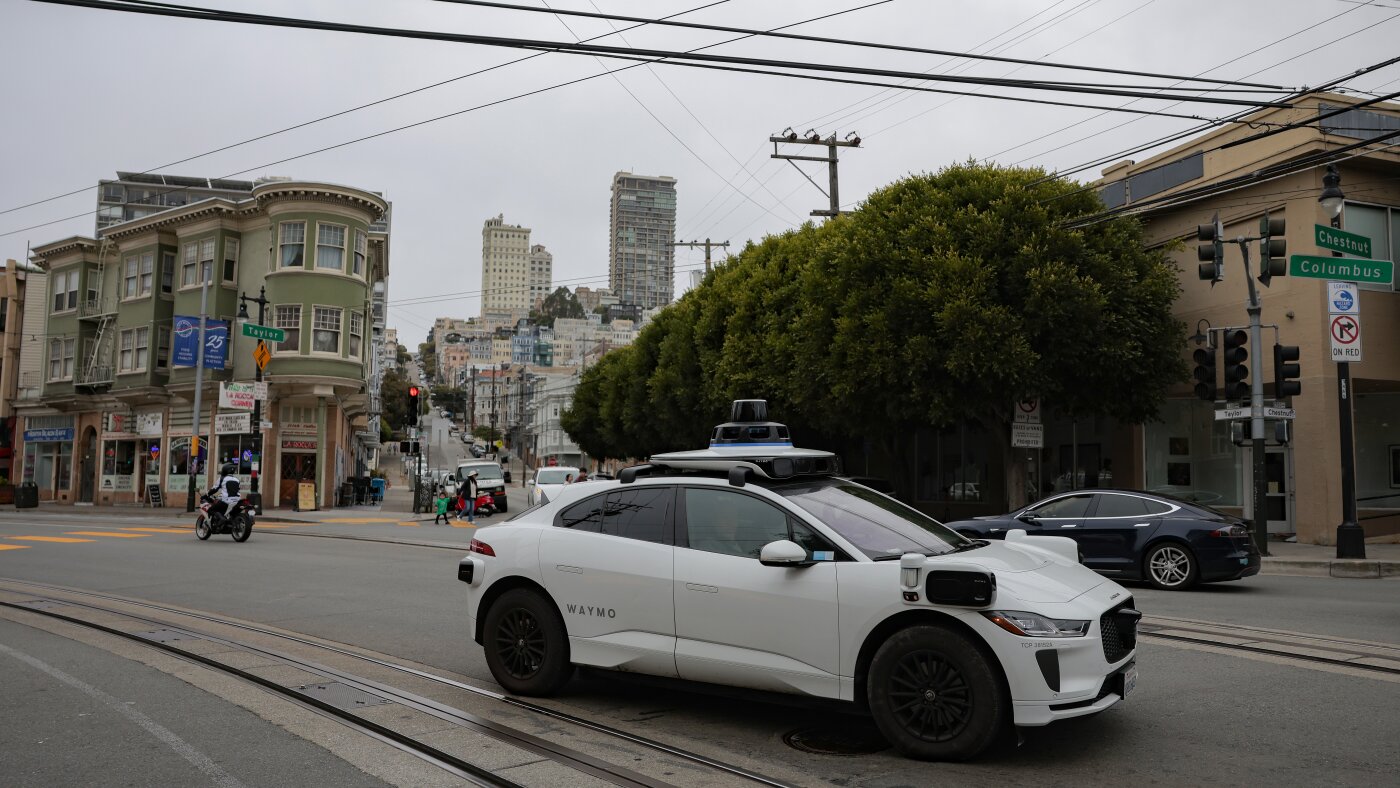
A Waymo robotaxi drives in San Francisco’s North Beach neighborhood this week.
Heather Diehl/Getty Images
hide caption
toggle caption
Heather Diehl/Getty Images
Police in San Mateo, Calif., posted Monday on social media that they had apprehended a pair of teenagers from a Waymo driverless robotaxi after the company alerted authorities to suspected criminal activity. It’s the latest incident involving video surveillance of passengers and others by autonomous vehicles — raising questions about the limits of privacy in such vehicles.

The Facebook post by the San Mateo County Police said: “Parents do you know where your teens are? @waymo does!”
The 15-year-olds were allegedly drinking alcohol and shooting toy guns from the car, according to the police. They said Waymo’s systems detected behavior that then triggered a safety response, after which the company disabled the vehicle and contacted police.
Waymo’s cars, equipped with an array of cameras, microphones and other sensors to monitor passengers and other nearby vehicles, are becoming more common in cities across the United States. Experts say the detention of the two teens in San Mateo highlights a potential — but not inevitable — trade-off between privacy and convenience. It also questions the extent to which companies similar to Waymo are required to hand over private data, including audio and video of passengers, in situations where a crime is suspected.
NPR reached out to Waymo, which is owned by Alphabet, the parent company of Google, for comment on the details of the San Mateo incident and how the company responded, but did not hear back. But on its website, the company says that as many as 29 cameras in its autonomous cars provide an all-around view and “are designed with high dynamic range and thermal stability, to see in both daylight and low-light conditions, and tackle more complex environments.”
“There already exist laws that govern duty to report or even duty to protect” for carriers such as Waymo, according to Alessandro Acquisti, a professor of information technology at the MIT Sloan School of Management. “The privacy problems arise when and if driverless carrier companies used such laws or ethical obligations as a pretext for blanket, indiscriminate accumulation of identifiable data for unspecified future purposes.”
That includes not just monitoring people inside the cars, but outside too. Take, for example, a hit-and-run investigation last year in Los Angeles. Media reported that the police inquiry was aided by video captured by a Waymo taxi that had a clear view of the crime. Critics suggested at the time that authorities were using the company’s vehicles as a mobile surveillance platform. And during 2025 protests in Los Angeles against Immigration and Customs Enforcement crackdowns, demonstrators vandalized Waymos, apparently angry that video recorded by the vehicles could be used by police, although there is no evidence that happened.
In a transparency report, Google says it received nearly 290,000 requests from governments worldwide in the first six months of 2025 for disclosure of user information across all its platforms, including Waymo. The company says that in more than 80% of the requests in those six months, some information was disclosed. “Google carefully reviews each request to make sure it satisfies applicable laws. If a request asks for too much information, we try to narrow it, and in some cases we object to producing any information at all,” the company says.
In an email to NPR, San Mateo Police Department spokesperson Jeanine Luna said that detaining the teens in the Waymo on Monday was “wholly appropriate” under the circumstances. “We received the call of a ‘firearm’ being shot from a moving vehicle,” she said. “Furthermore, the occupants were described as being possibly ‘intoxicated.’” she said.
“Being that the vehicle was disabled (the occupants had every right to exit the vehicle before police arrival, but they did not), a high-risk traffic stop was conducted to ensure the safety of all involved,” Luna added. “They were not arrested and were released to their parents, however, potential charges are still pending dependent on what the video from inside the vehicle shows.”
Autonomous taxis represent an ethical gray area
Robotaxis began to roll out across the U.S. in December 2018, when Waymo launched in Phoenix. These services have been used for less than a decade — so the norms surrounding them aren’t settled, experts agree.
The Facebook post may make Waymo passengers wonder what triggers a police intervention, says Irina Raicu, director of the Internet Ethics program at Santa Clara University. She has used Waymo’s driverless taxis and says ethically, the privacy issues surrounding them sit in a gray area. “There’s something about being in a car without another person that makes you think it’s private.”
“With all these recording devices, we don’t see them, [and] they’re not these obvious things being stuck in our faces,” Raicu adds.
That brings up a key issue: informed consent, Acquisti says.
“It is not clear the extent to which passengers … are reminded that when they step into the car, that they are being monitored, and most likely they are not told in its entirety how the data will be used,” he says.
Bruce Schneier, a cybersecurity and privacy expert and professor at the Munk School at the University of Toronto, believes that Waymo does have a compelling interest in protecting its vehicles. He compares monitoring a robotaxi via cameras to a human taxi driver keeping an eye on passengers in the rearview mirror.
“Maybe the driverless car comes back … and it has all of its cushions slashed, and it’s like, ‘Who the hell did that? Let’s go and look at the tape,’” Schneier suggests. “You can’t have sex in the back of a taxi, right? Someone would say, ‘Stop it.’”
He concludes that some supervision makes sense. In an Uber rideshare, he notes, “most of the time there’s a camera recording the back seat.” (Uber says on its website that it allows drivers to install such cameras for the purpose of “fulfilling transportation services.”)

Waymo robotaxis, while a fairly common sight in the San Francisco Bay Area, are still a novelty in much of the country. And many people are hesitant to ride in one, according to a Pew Research Center poll published this month. The survey found that only 5% of Americans had ever ridden in a driverless car. Meanwhile, 71% of those polled said they would feel uncomfortable in one, with only 7% saying they would be “extremely or very comfortable” riding in one.
For that reason, experts who spoke with NPR said they were optimistic that it’s not too late to shift gears on privacy norms and policies surrounding these vehicles.
Acquisti doesn’t see why privacy measures can’t be built into driverless vehicles.
“I would immediately challenge the notion that people have to be monitored,” he says, noting that privacy-preserving technologies exist and can be installed.
“Driverless cars are coming, but they don’t have to come in this particular incarnation,” Raicu says. “They’re still being designed and redesigned. It’s early days.”

Donald Trump has terminated the remaining members of the independent, federal commission that assists election administration officials nationwide just a few months before the midterm elections, multiple outlets reported Thursday.
The remaining three commissioners of the four-member bipartisan commission were forced out on Thursday in different ways. The one Republican appointee resigned and the other two, Democratic appointees were notified of their terminations via email from the White House presidential personnel office.
“On behalf of President Donald J Trump, I am writing to inform you that your position as Commissioner of the Election Assistance Commission is terminated, effective immediately. Thank you for your service,” the email, seen by Reuters, said.
The White House did not immediately respond to a request for comment.
The Election Assistance Commission serves as a “national clearinghouse of information on election administration”, accredits testing laboratories and certifies voting systems, and maintains the national mail-voter registration form developed by the National Voter Registration Act of 1993, according to the commission’s website. The terminations follow Trump and top administration officials’ advocacy to change vote-by-mail requirements and investigations into the 2020 election outcome, which Trump lost to Democrat Joe Biden.
“It is irresponsible and dangerous that this Administration remains dead set on causing chaos for our election officials across this country,” Arizona secretary of state Adrian Fontes said in a Thursday statement. “This move undermines the integrity of nonpartisan election administration.”
The 2002 law that established the commission, the Help America Vote Act, states the president can appoint replacements to the commission.
It is unclear how Trump will move ahead with the commission.
Reuters contributed reporting
-

 Cleveland, OH21 seconds ago
Cleveland’s First Round woes must end with the 2026 class
-

 Austin, TX3 minutes ago
Texas reports dozens of cyclosporiasis cases tied to contaminated fresh produce
-

 Alabama15 minutes ago
Small Plane Makes Emergency Landing In Peanut Field Near Florida-Alabama Line : NorthEscambia.com
-
Alaska18 minutes ago
An Alaska vacation can remind Israelis the world doesn’t revolve around them | The Jerusalem Post
-
 Arizona23 minutes ago
Arizona AG continues to investigate Glendale apartment complex after Friday deadline to fix A/C
-

 Arkansas30 minutes ago
Office of Keep Arkansas Beautiful Now Part of the ARDOT
-

 California33 minutes ago
Amber Alert issued for 3-year-old out of California City in Kern County
-

 Colorado38 minutes ago
Colorado Highway getting bicycle bypass bridge

