Northeast
New York gun control regime handed defeat in court

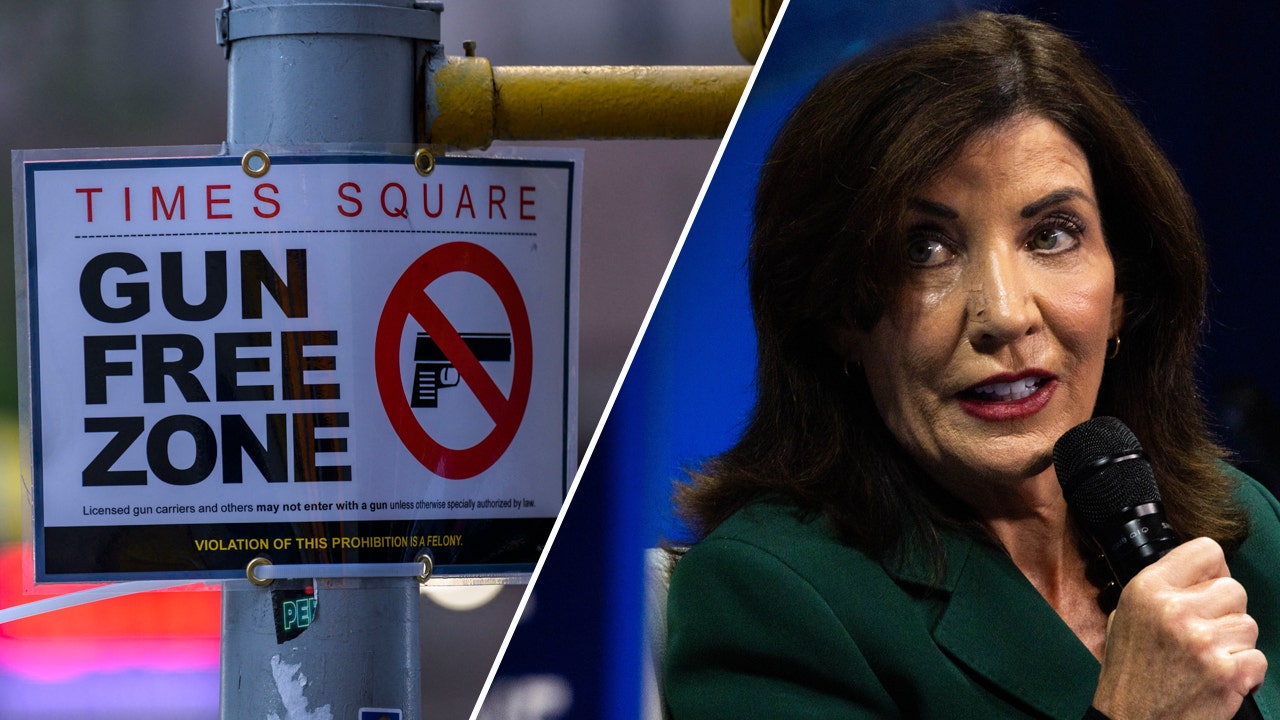
Second Amendment activists scored another win against New York State’s expansive gun control regime on Thursday.
A federal judge said a newly enacted state law that bans licensed firearms owners from carrying concealed weapons on all private property, unless the owners permit weapons with a sign or by express consent, violates the constitutional right to keep and bear arms.
“At least as to private property open to the public (the subject of this motion), New York’s restriction is unconstitutional,” wrote U.S. District Court John Sinatra, Jr., a Trump appointee.
“Regulation in this area is permissible only if the government demonstrates that the new enactment is consistent with the Nation’s historical tradition of sufficiently analogous regulations,” the judge wrote, citing recent Supreme Court precedent. “New York fails that test here.”
GOP LAWMAKER UNVEILS EFFORT TO BAN ILLEGAL IMMIGRANTS FROM USING IDS TO BUY GUNS
A man fires his pistol at an indoor shooting range during a qualification course to renew his Carry Concealed handgun permit at the Placer Sporting Club in Roseville, Calif. (AP)
The judge also denied a motion from New York for a two-week stay in the ruling while the state Attorney General’s office filed an appeal, reasoning that the state is unlikely to succeed on the merits.
Sinatra said that property owners have a right to exclude legal gun owners from carrying firearms on their property. “But the state may not unilaterally exercise that right and, thereby, interfere with the long-established Second Amendment rights of law-abiding citizens who seek to carry for self-defense on private property open to the public.”
The Concealed Carry Improvement Act, signed by Democratic Gov. Kathy Hochul in July 2022, was passed in response to a Supreme Court ruling that declared the state’s previous concealed carry permitting requirements unconstitutional. Last December, the U.S. Court of Appeals for the Second Circuit blocked several provisions of the law from taking effect, though it upheld a controversial requirement that concealed carry permit applicants demonstrate good moral character and disclose household and family members on a permit application.
The appellate court also let stand a ban on concealed carry in so-called “sensitive places,” including theaters, bars, public parks and other spaces.
TRUMP TO HEADLINE NRA EVENT IN PIVOTAL SWING STATE TWO WEEKS BEFORE ELECTION DAY
Hochul signed the Concealed Carry Improvement Act, which restricted where licensed firearms owners may carry concealed weapons. (Getty Images)
Gun rights activists praised Sinatra’s decision. “This is yet another important victory for Second Amendment rights and another major loss for New York, authoritarian governments, and radical anti-rights organizations like Everytown and Giffords,” said Brandon Combs, president of the Firearms Policy Coalition.
“We will continue to fight forward as we work to restore the full scope of the right to keep and bear arms throughout the United States. Hopefully Kathy Hochul is ready to write another check for legal fees,” he added.
The New York Attorney General’s office did not immediately respond to a request for comment.
Earlier this week, Hochul celebrated her administration’s gun control policies, announcing that gun violence in New York State has declined 47 percent since she took office in 2021.
GUN RIGHTS GROUP APPLAUDS AFTER FEDERAL APPEALS COURT DEALS BLOW TO NY CONCEALED CARRY LAW
A federal judge ruled New York’s ban on licensed firearms owners carrying concealed weapons on all private property was unconstitutional. (spxChrome)
“And you all know what happened when the Supreme Court overturned the laws against concealed carry weapons, stripping away the power of the governor of this state to make her citizens safe. When the Supreme Court did that, we didn’t throw up our hands and surrender. We fought back,” Hochul said.
“We doubled down. We came up with legislation. And we have a prohibition on concealed carry weapons in sensitive places. I personally think every place is sensitive, don’t you? Alright, well, we drew the lines, okay? We decided what was sensitive, and so far we are good.”
However, gun rights groups argue that Sinatra’s decision shows Hochul is wrong.
“As we’ve said all along, the ‘sensitive place’ carry restrictions imposed by New York post-Bruen are unconstitutional. Hard stop,” said Bill Sack, director of Legal Operations for the Second Amendment Foundation. “We are thrilled that once again, the courts have agreed, and sent this amoral and unlawful ban packing.”
Read the full article from Here


PORTSMOUTH — Serving approximately 500 LGBTQ+ youth across the state, the nonprofit New Hampshire Outright has increased its programming by 25% over the past year.
Portsmouth Pride, the organization’s largest annual event, is set for Saturday, June 20, with roughly 5,000 people expected to attend the parade and events in the city throughout the weekend.
“We are serving more young people and families than ever before. Our impact is just growing day by day, year over year in terms of folks we’re able to serve and advocate for,” said Heidi Carrington Heath, NH Outright’s executive director.
The parade will step off at Pleasant Street around 12:30 p.m. Saturday, then loop through downtown to Strawbery Banke Museum, where the mainstage will host drag performances and musical acts from 1 to 5 p.m.
Heath, LGBTQ+ advocates oppose several bills before NH Gov. Kelly Ayotte
The moment is not without its challenges for the LGBTQ+ community. Heath pointed to three bills in the New Hampshire legislature that have her and other LGBTQ+ advocates around the state concerned.
The first, Senate Bill 552, awaits possible approval from New Hampshire Gov. Kelly Ayotte. The New Hampshire House of Representatives and Senate both approved the bill, sponsored by three Senate Republicans, which proposes to separate people by their biological sex in certain places, including bathrooms, locker rooms, involuntary detention facilities and sporting events.
Critics of the latest bathroom bill initiative oppose its implications for transgender youth and adults across the state, if it were to be signed into law by Ayotte. Both Ayotte and prior New Hampshire Gov. Chris Sununu vetoed restroom-focused bills in the past.
“We really pride ourselves on individuality and individual freedom,” Heath said. “I want us to return to those Granite State values in a variety of arenas. There is a very real cost to our kids to watching the people whose job it should be to protect you to debate your personhood in public.”
Ayotte faces another Republican bill – SB 430 – opposed by LGBTQ+ leaders in the state.
The bill, amended and adopted in both the state House and Senate, would require New Hampshire teachers and school employees to “honestly and completely” answer written requests from parents and legal guardians about their children.
The language of the bill does not directly address the LGBTQ+ community, but opponents worry that teachers may be forced to disclose a student’s gender identity or sexual orientation. If it becomes law, the mandate would take effect in New Hampshire’s schools Jan. 1.
“They just want to be kids,” Heath said of LGBTQ+ youth. “That is the gift of the work we do at New Hampshire Outright. We allow them to do that. They are navigating this in every arena of their life, out in their world, at school, etc. They just want to be kids. I want that for them, too. I really do.”
In addition, Republican Senate Bill 434, a book challenging measure, sits on Ayotte’s desk.
“No later than November 1, 2027, each local school board shall adopt a procedure to be used to address complaints submitted by parents or guardians alleging that material that is harmful to minors, age-inappropriate, or otherwise offensive or inappropriate for use in the child’s school,” the House and Senate-passed bill reads.
Complaints would be filed with the superintendent of a school district or a designee, per the bill.
What events are being held before and after Portsmouth Pride?
Before the Pride parade, from 10 a.m. to noon Saturday, attendees will be welcomed at the John Paul Jones House in Portsmouth to make flags and buttons for the event.
New this year, a ticketed New Hampshire Outright Pride after party with appetizers, drinks and dancing will be hosted by The Hawthorn, a Jewell Court events center, from 7 to 10 p.m. Saturday.
The weekend’s closing event — a ticketed drag brunch at the Music Hall Lounge in collaboration with Gather and New Hampshire Outright — will be held Sunday, June 21 at 10 a.m. The drag brunch is for ages 21 and older.
Ahead of Portsmouth Pride, Heath reported New Hampshire Outright has already led or assisted in organizing nine events this year throughout the New Hampshire and Maine Seacoast region.
“We are so excited about this weekend,” Heath said. “Pride is a protest. Pride is a celebration. We are just looking forward to welcoming the community to celebrate with us at Pride and showing up big, particularly for showing young people that their identity is their superpower.”
Want to get married? Ordained minister plans to marry LGBTQ+ couples after Portsmouth Pride
Rollinsford resident Jen Walton is the daughter of a gay woman. Throughout Walton’s upbringing, she experienced taunts and isolation at school as her mother hid parts of her identity from the public eye.
Some of Walton’s earliest memories are of attending Pride parades with her mother. Now an ordained minister, Walton plans to offer 10-minute wedding ceremonies following the Portsmouth Pride parade Saturday afternoon, an idea that took shape in recent days.
“I would love to just marry as many people as I can,” Walton said.
Walton, friend and fellow ordained minister Katie Brochu and friends will station themselves at the Prescott Park fountain Saturday afternoon following the Portsmouth Pride Parade.
Couples need to bring identification, a marriage license and $20 to be approved for an impromptu Pride park wedding, according to Walton.
Three different wedding ceremony styles will be offered to couples looking to tie the knot. Walton and her friends will be on hand from 1 to 5 p.m. as the Portsmouth Pride mainstage performances occur simultaneously nearby.
“We’re really all supposed to be in this together,” Walton said. “You learn from a very young age that people are individuals and not everybody is going to think, feel and believe the same thing. For me, it’s super important that I’m an ally. I’ve said it for years and years and I’ll say it for years and years, because it’s hard.”
The event is not sanctioned by New Hampshire Outright but has Heath’s and the organization’s full backing.
“It never ceases to amaze me and bring me joy the things that people want to do around Pride month,” Heath said.
All proceeds will be split evenly between New Hampshire Outright and the Trevor Project, an LGBTQ+ suicide prevention nonprofit.

From Camden and Cherry Hill to Trenton and the Jersey Shore, what about life in New Jersey do you want WHYY News to cover? Let us know.
The borough of Lawnside in Camden County will be honored with a historical marker from the New Jersey Historical Commission as part of the state’s Black Heritage Trail.
A ceremony unveiling the marker will take place at 10 a.m. Friday at Lawnside Borough Hall on Dr. Martin Luther King Jr. Road.
Marsharee Wright, aide to Lawnside Mayor Mary Ann Wardlow and long-time resident, said everyone is thrilled about the marker unveiling.
“We’ve invited the entire community and neighboring towns to come share the celebration with us,” Wright said.
Linda Shockley, president of the Lawnside Historical Society, said it’s “an extreme honor” for the borough to be included in the state’s program, especially as Lawnside is amid a year-long celebration of its centennial.
“It really lifts our profile and hopefully more people will understand and know what Lawnside is about and what it means in the nation,” Shockley said.
Lawnside was one of six sites selected in Camden County in 2024, including “The Point,” a historic Black neighborhood in Haddonfield. Its marker was unveiled last June.
During the ceremony, the borough’s history will be showcased, along with the original documents signed by Gov. A. Harry Moore in 1926, which made way for the borough’s creation.
Though there are many Black enclaves in South Jersey, the borough is the state’s only incorporated antebellum Black community. First known as Free Haven, and later Snow Hill, it was a stop on the Underground Railroad. Peter Mott built a three-floor dwelling in 1844 that was once part of sprawling farmland where he helped slaves escape.
Mott’s house, now owned by the Lawnside Historical Society, serves as an Underground Railroad museum.

President Trump is visiting the Lehigh Valley next week.
Mr. Trump will speak at Mack Trucks in Macungie, Pennsylvania, Tuesday at 2 p.m. Macungie is roughly 10 miles from Allentown.
Mack Trucks is a 1.7 million square-foot facility in Macungie that assembles heavy-duty trucks for North American and export markets, according to its website.
“Mack Trucks are a symbol of America’s manufacturing strength,” Rep. Dan Meuser said in a Facebook post about Mr. Trump’s upcoming visit to Pennsylvania. “Their Lehigh Valley operations are a pillar of the local economy, employing Pennsylvania workers and driving the nation’s trucking industry.”
In the lead-up to the 2024 election, Mr. Trump visited Pennsylvania, a crucial swing state, multiple times. He’s also visitied during his second term.
In December 2025, Mr. Trump said in a speech in Mount Pocono, Pennsylvania, that he was “crushing” inflation and called affordability concerns a “Democratic hoax.”
One week later, Vice President JD Vance aimed to calm the affordability concerns at a Uline facility in Alburtis, about 13 miles southwest of Allentown.
Tickets are available for Mr. Trump’s visit to Macungie next week on a first-come, first-serve basis.
-

 Minnesota6 minutes ago
Minnesota contributes two items to the America250 time capsule
-

 Mississippi9 minutes ago
Kohen Wiley: Police shooting of a 1-year-old Mississippi boy ignites tension between police and Black residents | CNN
-

 Missouri14 minutes ago
What’s closed on Juneteenth in Missouri? Check trash, libraries, banks
-

 Montana21 minutes ago
Your guide to local sports events, plus what’s on TV for June 19
-

 Nebraska24 minutes ago
Nebraska’s governor doesn’t carry a state-issued phone. Critics call it an abuse of state disclosure laws. – Flatwater Free Press
-

 Nevada29 minutes ago
Conservation groups oppose potential sale of federal lands highlighted in land mapping tool
-

 New Hampshire36 minutes ago
Portsmouth Pride 2026 is a protest and a celebration
-

 New Jersey39 minutes ago
Historical marker recognizing Lawnside, New Jersey, to be unveiled Friday

