Entertainment
Who's afraid of Roy Cohn? Not Jeremy Strong


Brutal. Vicious. Crooked. Cruel.
So filmmaker Ali Abbasi’s new biopic “The Apprentice” describes its dominant figure, a New York and Washington, D.C., power broker who lies, cheats, charms and browbeats his way into the uppermost ranks of American business and government.
No, it’s not Donald Trump. It’s Roy Cohn.
As the film depicts with garish flair, the pugilistic, Bronx-born attorney — who first came to prominence prosecuting Julius and Ethel Rosenberg for espionage, then served as chief counsel to Sen. Joseph McCarthy during his anticommunist witch hunt — took Trump under his wing in the 1970s, handing the ambitious real-estate developer’s son a fiendish playbook for success. Attack, attack, attack. Deny everything. Never admit defeat. By the time of his disbarment and death from AIDS complications in 1986, however, the roles were reversed, and Cohn lost sway with his erstwhile mentee as Trump stepped out of his shadow.
Throughout “The Apprentice,” Cohn comes across not only with his renowned ferocity, but also with uncommon empathy, courtesy of actor Jeremy Strong.
“If Roy Cohn walked into this room right now, I don’t think I would want to shake his hand,” says Strong, 45, seated in a bar off the sun-dappled courtyard of the San Vicente Bungalows on an early fall afternoon. “But from the distance of a piece of work and trying to understand him — humanistically and creatively — I had to find, for lack of a better word, love. Which is a bit of a grenade to say out loud.”
Fresh off a silent meditation retreat in upstate New York, the “Succession” star folds the same circumspection into nearly all of his stacked, erudite sentences, which are peppered with literary allusions (Kafka’s “The Zürau Aphorisms”) and film-industry names (Danish director Tobias Lindholm). At times Strong pauses so long that I launch into my next question, only to be interrupted by the continuation of an apparently unfinished thought. He denies being “gun shy” about press since the publication of a viral 2021 New Yorker profile in which a number of his collaborators — some named, others anonymous — looked askance at the lengths to which he’ll go to embed himself in a character.
“I think I’m a fairly earnest person, and that’s gotten me in trouble,” Strong insists, “but I’m not interested in camouflaging or disguising myself. Life is too short.”
Strong, left, as Roy Cohn, with Sebastian Stan as Donald Trump in “The Apprentice.”
(Festival de Cannes)
The topic at hand isn’t just the life and times of Roy Cohn, of course. When “The Apprentice” premiered earlier this year at the Cannes Film Festival, the Trump campaign swiftly threatened a lawsuit, calling the film “pure malicious defamation” and suggesting it “should not see the light of day.” Then, as if the former president’s wish had come true, the project languished for months without a distributor. Despite repeated reassurances from Abbasi, Strong, writer Gabriel Sherman and actor Sebastian Stan, who plays Trump, that “The Apprentice” was not a political polemic but a character study, it seemed plausible, as recently as August, that the film would remain on the shelf until after next month’s election, if not indefinitely. (It was ultimately picked up by Briarcliff Entertainment.)
“We sort of narrowly escaped the jaws of being effectively censored in this country,” Strong says. “That’s something that happens in Russia, North Korea. Not democratic countries. I think people in Hollywood were really wary of touching this, and that was disheartening.”
In theaters Friday, “The Apprentice” arrives in the home stretch of a bruising, chaotic presidential election campaign, sure to be scrutinized as closely as any film of the fall. Supporters of the Republican nominee will likely follow the Trump camp’s lead in calling the movie — in which Trump rapes first wife Ivana (Maria Bakalova) and undergoes multiple cosmetic surgeries — a hit piece, while his most ardent opponents may see any attempt to humanize Trump or Cohn as beyond the pale.
Given the fraught political environment, Strong strains to frame his approach to the character as a historian might, decoupling understanding from endorsement. Although he uses words like empathy, kinship and love to explain how he got under Cohn’s skin, he also describes the attorney as a “cancerous conundrum” and a “demonic Peter Pan.”
“God, it’s really dangerous,” Strong says. “I feel like I could get in trouble for saying anything positive about him. When I say these things, I only really mean them in a creative arena, because creatively a character like Roy is like Iago. You don’t want to say anything nice about Iago. But as an actor, Iago is one of the great roles. This feels like one of the great roles.”
Strong is not alone in his estimation. As a key character in Tony Kushner’s Pulitzer-winning 1991 play “Angels in America,” Mike Nichols’ 2003 HBO miniseries adaptation thereof, the 1992 TV movie “Citizen Cohn,” last year’s miniseries “Fellow Travelers” and numerous documentaries, Cohn has inspired more major films and TV series than even Harvey Milk. His many portrayals have resulted in two Tonys, an Emmy and a Peabody. I ask Strong if he thinks there’s any merit to the criticism about straight actors playing gay characters, and receiving acclaim for doing so, when such opportunities and plaudits remain a rarity for out gay actors.
“Yes, it’s absolutely valid,” Strong says. “I’m sort of old fashioned, maybe, in the belief that, fundamentally, it’s [about] a person’s artistry, and that great artists, historically, have been able to, as it were, change the stamp of their nature. That’s your job as an actor. The task, in a way, is to render something that is not necessarily your native habitat. … While I don’t think that it’s necessary [for gay roles to be played by gay performers], I think that it would be good if that were given more weight.”
Then, as I begin to follow up, he interjects, “What do you think?”
I think it’s complicated, if I’m being honest. I think it might be passé of me even to ask about it. At least for cis, white gay men, who have consistently dominated LGBTQ+ representation in film and television, the flagrantly stereotypical performances — the ones that treat the character’s sexuality as if it were another layer of hair, makeup or wardrobe — are now few and far between. It’s hard to muster one’s revolutionary fervor for Cohn, the man the “Bad Gays” podcast once labeled “the polestar of human evil.”
And yet that is exactly what makes this real-life character — a closeted, self-hating homosexual who helped launch the Lavender Scare and remained silent about the AIDS crisis even as it killed him — an ideal test case. The fact remains that no out gay man has ever won an Oscar for playing a queer character in the 96-year history of the Academy Awards. Meanwhile, this season alone could conceivably add two more names — Strong and Daniel Craig for “Queer” — to the list of nine straight men who’ve previously done so. (The numbers for women, and nominations, are scarcely any better.) In light of the disproportion, one can’t help but draw the conclusion that pundits and voters still understand playing gay as one mark in the column for “outstanding performance.” Which raises the question: Might a gay actor get more credit if he opted to play our community’s most notorious supervillain, instead of another tragic hero we’re determined to uplift? Would that appear, to the film academy’s approximately 10,000 members, a little more like “acting,” and less like life?
Compared with Pacino’s outraged and outrageous Cohn, spraying a vulgarian’s spittle across Nichols’ magisterial “Angels,” Strong’s performance is a model of white-knuckle control, swaggering when Cohn exerts his power, wilting when he can’t. When Cohn learns that Trump has gifted him fake-diamond cuff links for what will turn out to be his final birthday, Strong invests the petty indignity with pathos, as a man who would step over anyone to get ahead realizes he’s subject to the same ruthless forces. Along with Will Brill’s turn in “Fellow Travelers,” painting Cohn as practically lovesick for his partner in anticommunism, G. David Schine, “The Apprentice” is the closest any screen actor has come to reflecting the description of the attorney on the AIDS Memorial Quilt: “Bully. Coward. Victim.”
“What I do feel, whoever plays any part ever, is that you have to take these things as seriously as you take your own life, and it is not a game, and that these people and their struggles and the experiences you’re trying to render are not a plaything,” Strong says. “If I didn’t believe that I could understand on some deep level his anguish and turmoil and his need, and the sort of Gordian knot that every character has but Roy has particularly — if I didn’t believe that I could understand it or connect to it in a way that is faithful or voracious, I wouldn’t have done it. I certainly don’t do these things just for my own self-aggrandizement.”
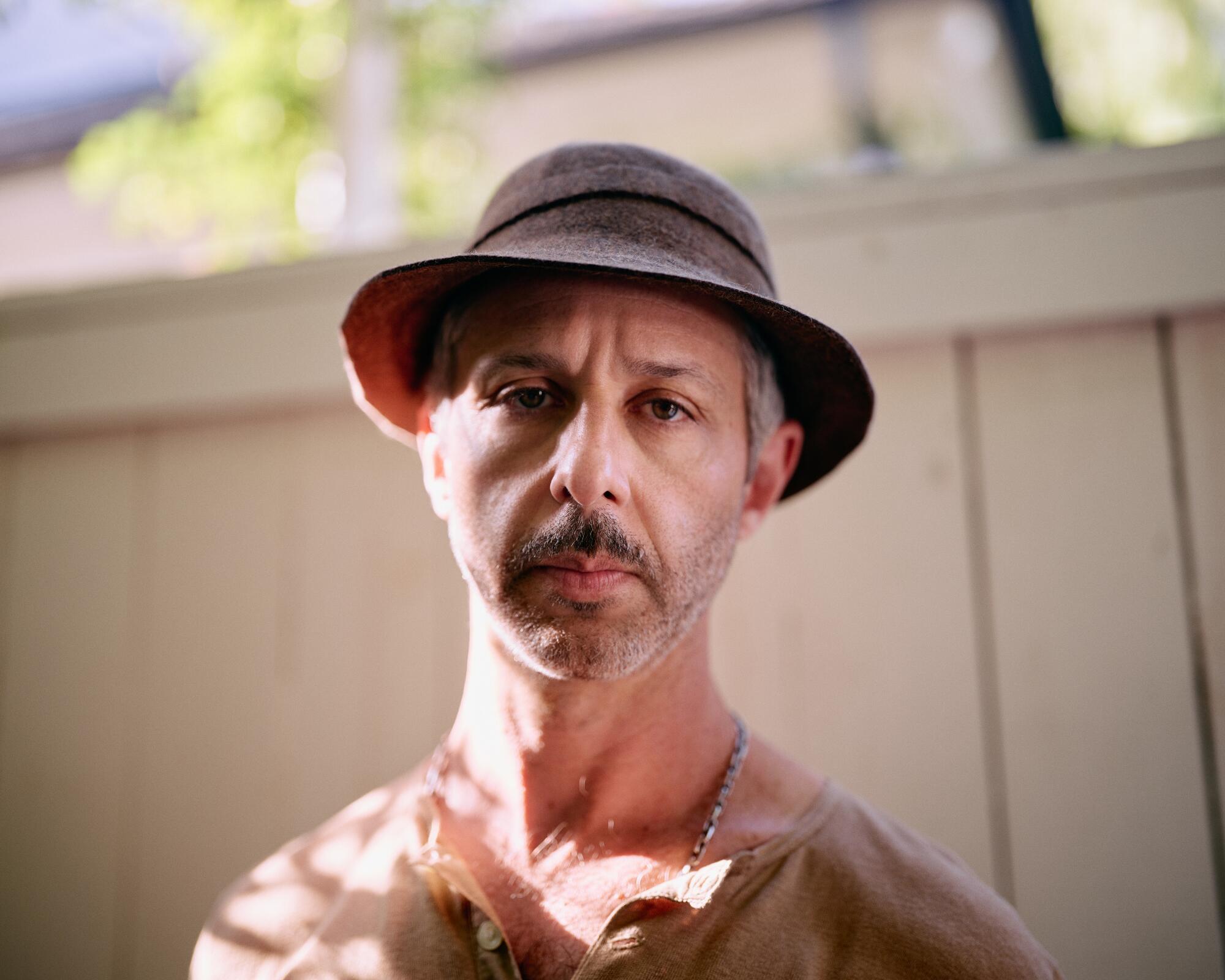
“You have to take these things as seriously as you take your own life,” says Strong of diving into the role of Roy Cohn. “And it is not a game.”
(Marcus Ubungen / Los Angeles Times)
Strong has become an almost scholarly fount of biographical information about Cohn, littering our conversation with enough details about the man’s home decor (porcelain frog figurines), taste in poetry (Joaquin Miller’s “Byron”) and dinner order at Le Cirque (Bumble Bee tuna, off-menu) to give Cohn‘s biographers a run for their money.
When Abbasi offered the role to Strong, the actor was already familiar with Cohn, not only from “Angels in America,” but also from the research he did after being approached to play Cohn in another film project about five years ago. Signing on to “The Apprentice” sent Strong’s prep work into overdrive, including studying video of Cohn to learn his “sui generis” voice — a hectoring New York sneer that’s authoritative but rarely loud — and interviewing Cohn profiler Ken Auletta. Strong says Cohn also represents his most dramatic physical transformation.
“I haven’t had to alter my body in that way,” says Strong, who underwent a doctor-supervised “starvation diet” and a regimen of tanning booth visits and biweekly spray tans to match Cohn’s notoriously leathery look. “He was obsessed with his physical appearance. He had a tremendous amount of vanity.”
With an Emmy for “Succession” and a Tony for this spring’s revival of Henrik Ibsen’s “Enemy of the People” under his belt, and Oscar buzz for his performance in “The Apprentice” already building, Strong’s own motivations are evolving. While career disappointment once spurred him, he is now just “looking for a limb to go out on.” I liken it, during the course of our conversation, to gymnast Simone Biles developing never-before-attempted vaults to challenge herself.
“I no longer feel thwarted in that way and I can pay my rent,” Strong says. “And I don’t take any of that for granted because it happened late for me. I have the luxury of choice and the luxury, more importantly, of getting to choose things that matter most to me, things that feel meaningful. I want to keep pushing myself — that Simone Biles thing of finding new ways to find the frontier and work that kind of requires a radical courage to do. Which for me is most things, because I find it all pretty fearful.”
After we’ve parted ways, Strong texts me a quote by Bruce Springsteen — “The pressures of the business are powerless in the face of what is real” — from music journalist Fred Goodman’s history “The Mansion on the Hill,” which Strong is reading to prepare to play Springsteen manager Jon Landau in the upcoming biopic starring Jeremy Allen White. I, too, am a collector of quotations, and after joking that newspaper stories should have epigraphs, I suggest one, from Wallace Stegner, that seems apropos to our conversation about Cohn: Present your subject in his own terms, judge him in yours.
“That’s a good one,” Strong texts. “For actors too.”


Comedy is a matter of taste and preference — it’s a deeply personal thing. Which makes it hard for a critic to give a blanket assessment of a specific kind of comedy, especially if it didn’t work for them, but clearly worked for others (the laughter or lack thereof is the indication). “It’s not funny,” the critic says, “well I had fun,” someone else can reply, and then we’re at an impasse.
Which is the dilemma one finds oneself in with “Gail Daughtry and the Celebrity Sex Pass,” a very strange and shaggy Hollywood satire of sorts from David Wain and The State crew, still riding the goodwill of “Wet Hot American Summer” after all these years. If only this were as funny.
“Gail Daughtry” lives in the same world as that iconic summer camp spoof, as well as Wain’s 2014 rom-com parody, “They Came Together,” in that he’s playing with genre convention and expectation, taking well-known norms to the goofiest extremes. But those films hewed more closely to their respective genres, while “Gail Daughtry” is totally scattered, combining crime and spy movie tropes with a fish-out-of-water comedy and a Hollywood send-up. It has far too many ideas for its own good, and yet no ideas that are good enough to sustain this bizarre curio of a comedy.
What’s ironic is that one of the problems driving this wacky plot forward is the characters have to come up with a movie idea to pitch to star Jon Hamm (playing himself of course), leading them to do some pretty inane and shockingly violent things. It’s almost as if Wain and co-writer and co-star Ken Marino had no idea for a movie, then baked their search for an idea into their script, and then turned it into a madcap adventure about a woman on a quest to have sex with Jon Hamm. What an ouroboros!
OK, about the sex quest. Gail Daughtry (Zoey Deutch) is a chipper hairdresser from Kansas born without the part of the brain that recognizes sarcasm or irony. She’s a cheerful, Pollyanna-ish naïf whose literal-mindedness is almost as extreme as Amelia Bedelia. Her childhood sweetheart and fiancé Tom (Michael Cassidy) is the same. She tells him about the concept of the “celebrity sex pass” as a joke, and he promptly boinks Jennifer Aniston at local book reading.
(Nitpicky aside: why didn’t they use the common nomenclature “hall pass”? Is it copyrighted? “Celebrity sex pass” is clunky and sounds like an off-brand version of the well-known slang.)
That infidelity crisis is how Gail ends up in Los Angeles determined to bang Hamm, collecting a motley crew of similarly clueless helpers along the way. There’s her best friend Otto (Miles Guttierez-Riley), her salon bestie; Caleb (Ben Wang), an overly ambitious intern at Creative Artists Agency; Vince (Marino), a screenwriter turned paparazzo with a heart of gold; and John Slattery, as John Slattery, down on his luck. An accidental briefcase swap has a pair of thugs on their tail, in a forgettable and underdeveloped B-plot.
With a parade of celebrity cameos and collaborators in bit parts, “Gail Daughtry” at times feels like an excuse for Wain and co. to make something at home with all of their friends. Fair enough, it’s great to see all these people employed, but what about what we’re watching? Behold, the Los Angeles of the middle-aged working comedian: the CAA lobby, the Chateau Marmont, Griffith Park, etc. And the plot is as half-baked as the pitch they present to Hamm.
What’s actually interesting about this comedy is the distinct streak of despair and even resentment that reveals itself at the climax, a feeling of helplessness and uselessness. Everyone’s been striving to make it in this crazy town: the intern, the actor, the paparazzo. But not even Jon Hamm can help them get a movie made; even he feels inherently powerless. There’s an unexplored anxiety vibrating there that feels the most thematically fruitful, about what it means, some 25 years after bursting onto the scene with a generation-defining comedy, about maintaining the work, the drive, a sense of purpose, after years of strikes, and in the face of a constricting industry. Do they still have it? Is the dream still alive?
Maybe that’s why Wain and Marino need to invent a dreamer stand-in with Gail, a guileless eternal optimist who knows nothing of the craven Los Angeles and accepts everything at face value (though she is filled with a scary bit of rage too). She might behave like she has a head injury, but she’s going to achieve her goal, dammit. “Gail Daughtry and the Celebrity Sex Pass” might not be as funny as “Wet Hot American Summer” (for this critic), but reframed, it serves as a fascinating status update on life in La La Land for this troupe.
‘Gail Daughtry and the Celebrity Sex Pass’
2 stars (out of 4)
MPA rating: R (for sexual content, violence/bloody images and language)
Running time: 1:33
How to watch: In theaters July 10
Entertainment
Emily Ratajkowski’s viral essay on sex life as a single mom scores her a seven-figure book deal
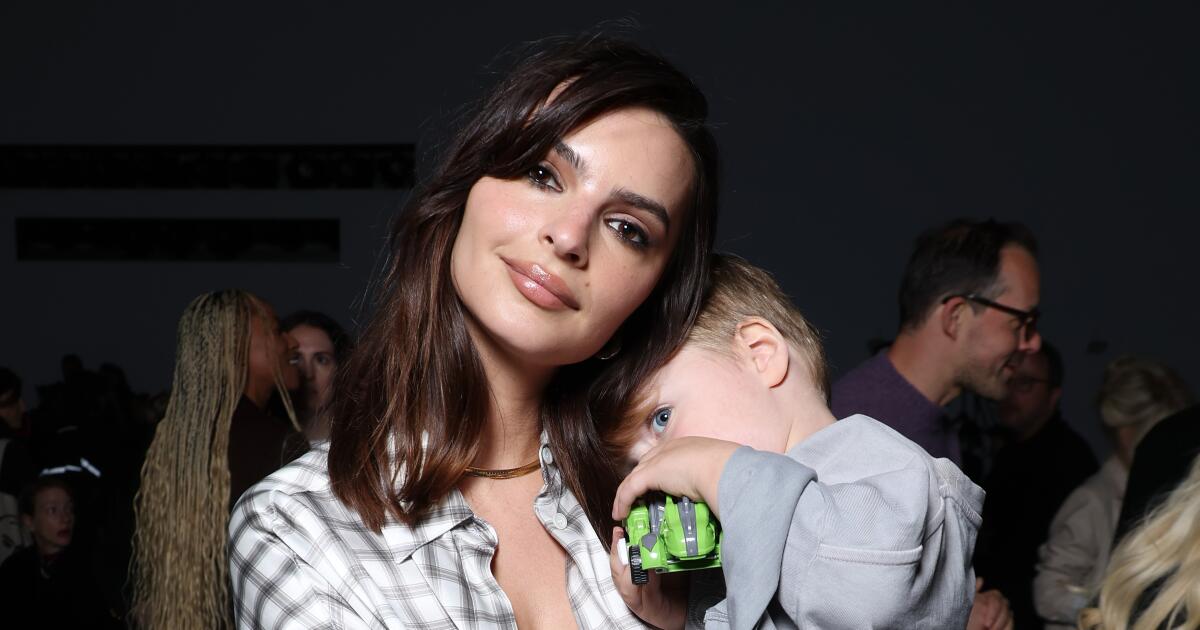
Emily Ratajkowski’s viral essay detailing her sex life as a single mom just landed her a seven-figure book deal.
According to Page Six, the model’s essay in the Cut had publishers champing at the bit in a 12-way bidding war that culminated in the hefty pay day. Editor Helen Rouner at Penguin Press — who also edited Lauren Christensen’s memoir “Firstborn” and Michael W. Clune’s novel “Pan” — reportedly landed the deal.
Penguin Press did not immediately respond to The Times’ request for comment Friday.
Publishers Marketplace announced the forthcoming memoir, describing it as “an examination of modern female identity through the story of the author’s own efforts as a newly single mother in New York City to discover what really constitutes a good life for a woman.”
The essay, which dropped a month ago and quickly broke the internet, drops the veil on EmRata’s sexual adventures (or maybe misadventures) since she and her former husband, Sebastian Bear-McClard, split in 2022.
“It was a violent transition into a new reality of screaming baby on my aching tit and ring on my swollen finger,” Ratajkowski writes of new motherhood. “And then, in a time period that felt both instant and excruciatingly slow, my marriage collapsed. Six months after my son was born, my husband and I stopped having sex. Less than a year later, we separated.”
In the missive, the model interrogates her sexuality — is she a Madonna or a whore? — while untangling bigger questions around gender, power and self-actualization. If Carrie Bradshaw wrote about “Sex and the City,” then Ratajkowski is writing about sex, the city and single motherhood. And naturally, her fleeting paramours have vague monikers: “Vegan Graffiti Artist,” “Spanish Gen-Zer” and “Son of a Billionaire.”
“And then there was the Elder Millennial: obsessed with dental hygiene, psychedelics, and dirty talk,” she writes. “He had approached the subject coyly at first, like it was something he was kind of embarrassed about — the way a kid will test you to see if you’ll talk to them about their dorky obsession of the moment. Do you like Godzilla? What about Star Wars?”
Would-be sleuths with Ratajkowski’s essay and a gossip rag handy will have their work cut out for them.
This will be Ratajkowski’s second book. The first, “My Body,” dropped in 2021 and was a bestselling collection of essays exploring gender, power dynamics, sexuality and the commodification of female beauty in the modeling and entertainment industries.
Ratajkowski’s foray into the spotlight came more than a decade ago when Robin Thicke’s controversial “Blurred Lines” music video made the model an overnight star. She was cast in David Fincher’s adaptation of “Gone Girl,” which hit theaters the following year, and catapulted to top fashion runways — Marc Jacobs, Versace, Victoria’s Secret and Dolce & Gabbana, to name a few. She she’s been romantically linked to Harry Styles, Eric Andre, Shaboozey, Brad Pitt and Pete Davidson, among others.
In 2023, she moonlighted as the host of the “High Low With EmRata” podcast, where she interviewed sex workers, investigated ethical nonmonogamy and pondered the etymology of the word “toxic.” The same year, she told The Times that she was coming into herself post-divorce, “Being able to assert what I want — that feels like it just started: My life as a creator and not as a muse.”

Wainheads will be delighted to see his alums in cameos: Kerri Kenney-Silver, Michael Ian Black, Thomas Lennon, and supporting roles for Zickel and Truglio. A large portion of the cast are his homies. But with Deutch, Gutierrez-Riley, Wang, Slattery, Impacciatore, and yes, Hamm, it’s as if they’re being inducted into a new mad family. Wain and Marino are basically catching Pokémon and hoping they can hold onto the roster (by that logic, yes, Paul Rudd is a legendary Pokémon). The film is anchored by Zoey — everything everywhere all this summer with Voicemails From Isabelle to Minions & Monsters — Deutch in the Dorothy Gale role, exuding a high level of perkiness consistent with the character’s can-do, wide-eyed, midwestern charm and heart.
A major standout, Ben Wang finally gets to show off his comedic abilities, portraying a self-assured, quick-witted agent who makes me laugh every time he reveals his sheltered upbringing in snappy whines at every inconvenience. Sabrina Impacciatore, who has proven to be a comedic juggernaut in The Paper, is having so much fun hamming it up as the mob boss-esque wicked witch counterpart, torturing her henchmen and deliciously chewing up the scenery whenever onscreen. I don’t think they use her to the height of her comedic prowess, but she’s a delight nonetheless. John Slattery is the film’s comedic MVP. The way the writers use his over-the-top character for comedy is downright hilarious every time. They use him as either a punchline or a force of nature, and he’s great. This movie is like Mad Men propaganda, and by God, it works. As someone who’s never seen it, Gail allowed me a better appreciation for Slattery and Hamm.
Man, we don’t deserve Jon Hamm. This is the second time I’ve seen him play a silly, fictionalized version of himself this year (the other being the SXSW crowd-pleasing rom-com Wishful Thinking, which Gail distributor Sony Pictures Classics acquired), and he also voice-acted in his comedic Mayor Jerry role in Hoppers. Maybe working with Wain in 2007’s The Ten was the canon event, but I consider his weird little sex scene with Kristen Wiig in Bridesmaids his awakening. Since then, I’ve only seen him as unserious, and it’s delightful. Oz-like in appearance, he’s funny and befitting the film’s overall light, joyful nature.
LAST STATEMENT
Ultimately, Gail Daughtry and the Celebrity Sex Pass is a campy, delightful romp that succeeds as both a distinctive Hollywood‑centric riff and a Wizard of Oz reimagining, retaining a loving, twisted, demented charm. It’s a weird description, but it’s so high‑spirited and light‑hearted despite being strangely ultraviolent. It might as well be a live‑action episode of Smiling Friends (RIP), yet it’s everything the theatrical market needs today. Ten years ago, this would’ve been a studio production rather than an indie Sundance acquisition, but thank God it exists for the big screen. More absurdist Gail Daughtrys for cinemas (not streaming), please, because this is the most fun to be had in a theater all summer, if not the year thus far.
-

 New York45 minutes ago
How ‘The Wire’ Star Jamie Hector Spends a Hot Day in Brooklyn
-

 Los Angeles, Ca48 minutes ago
Burglars ransack Sherman Oaks condo building during fumigation
-

 Detroit, MI1 hour ago
Metro Detroit weather forecast, July 10, 2026 — 11 p.m. Update
-

 San Francisco, CA1 hour ago
Classical music series helps reconnect downtown San Francisco community
-

 Dallas, TX1 hour ago
Dallas police officers, paramedics recall saving woman stuck in a ravine for days;
-

 Boston, MA2 hours ago
Red Sox win 7th straight game just hours after landing in New York
-
 Denver, CO2 hours ago
One tree at a time: Denver nonprofit works to close shade gap as heat dome threatens neighborhoods
-

 Seattle, WA2 hours ago
VIDEO: West Seattle Summer Fest 2026 day 1, evening report

