Sports
Why Arch Manning leaving Texas after Quinn Ewers returned never would have made sense


On Jan. 11, Texas quarterback Quinn Ewers posted a video to more than 200,000 followers on Instagram. In it, he signed a trading card with his face and added a message below.
“I’m coming back,” he wrote, holding the card up to the camera.
The top comment on the post?
“Yall gonna lose manning (sic),” it read, adding a pair of laughing emojis aimed at the Longhorns’ predicted misfortunes.
Manning, as in Arch Manning: five-star recruit, and the son of Cooper, nephew of Eli and Peyton and grandson of Archie. Ewers’ surprising decision was about chasing Texas’ first national title since 2005, but the commenter wasn’t alone in directing attention to college football’s most famous backup in an era in which there is no penalty for transferring.
Even before Ewers elected to return, Manning faced questions at the Sugar Bowl about whether he wanted to leave after barely seeing the field in his first season.
“It’s tough because you want to be out there playing with your boys,” Manning told The Athletic in July. “But just realizing there’s nowhere else I want to be, and it was my dream to play at Texas. I’m going to stick it out and play there eventually,”
GO DEEPER
Arch Manning and other QBs explain decision to transfer or stay put
He made the same decision as Ewers: He was coming back. He was always coming back. Now, Manning is likely to make his first career start against Louisiana-Monroe on Saturday, as Texas coach Steve Sarkisian said Ewers is questionable to play after straining his oblique against UTSA.
“Arch is just another guy on our team, and the reason I’m able to do that is because that’s who Arch is every day,” Sarkisian said Monday. “He’s the selfless teammate. He cares about the guys on the team. He cares about Quinn. They’ve got a great relationship. He works his tail off. He wants to play good football for them because he knows how hard everybody’s working.
“So I literally don’t address it with him. I don’t address it with the team. He’s just part of the team.”

Arch Manning threw for 223 yards and had five total TDs versus UTSA. (Tim Warner / Getty Images)
There was a time when quarterbacks seeing the field before their second or third year was an anomaly. Now, it’s an expectation, at least for five-star prospects. When Manning’s name never appeared in the transfer portal, he bucked a decade of trends among college quarterbacks.
Transfer portal decisions are unique to every player, but as Manning enters what is expected to be his first start, we’re seeing the reasons why leaving would introduce more questions than answers and present more problems than solutions.
Though Manning has thrown only 23 passes in four appearances since arriving in 2023, things have largely gone according to plan at Texas — even if winning the starting job was delayed by a year because of Ewers’ return. Manning is still one good season away from crystallizing his status as a first-round draft pick, and he has plenty of time to do it, with three years of eligibility remaining after this season. His path to the field became clearer when last year’s backup, Maalik Murphy, transferred to Duke, and another year working behind Ewers was only going to make the results better once it was time for his turn in the spotlight.
His growing pains have mostly been able to come in closed practices. They haven’t had to come in nationally televised games like young quarterbacks who are asked to be saviors like freshmen Dylan Raiola at Nebraska and DJ Lagway at Florida. But when he has been given the opportunity, he’s excelled. On Saturday, thrust into extended duty against an overmatched UTSA team, he threw a touchdown pass on his first attempt, scooted past a safety for a 67-yard touchdown run and finished with three more touchdown passes in a 56-7 blowout win.

GO DEEPER
With Quinn Ewers injured, Arch Manning tallies five TDs vs. UTSA
Now, if he starts Saturday, he’ll do it for a Texas team ranked No. 1 in the AP poll for the first time since 2008, when Colt McCoy was under center for the Longhorns. McCoy, by the way, didn’t play his first season at Texas either.
Since high school, everything the Mannings have done with Arch points to a big-picture approach, aiming for a lengthy NFL career, not the quickest path to the playing field or the best way to earn money from his fame in college. Manning’s recruitment was straight out of 1995: If you don’t have DMs, reporters and coaches can’t slide into them, and it’s easier for coaches and parents to control coaches’ access to you, too.
He’s a non-factor on social media. He barely spoke to reporters about his college decision, a family strategy borne out of a desire to allow him to live a more normal high school life. His family background affords him the ability to shrug off the obligations of chasing NIL money, as does his status as a likely NFL Draft pick after he does get on the field.
GO DEEPER
Arch Manning’s unique approach to recruiting
Now, his decision to stay patient in college is old-school, too. NIL money is the invisible hand guiding players into and out of the transfer portal, but the success that his family has enjoyed means money was never going to influence his decision. As of last December, his only NIL deal was an exclusive trading card partnership with Panini America, despite erroneous reports that he was earning millions as Texas’ third-string quarterback. After initially declining to be included, he elected to opt into his name, image and likeness being used in EA Sports’ College Football 25.
Manning has done little to nothing to “grow his brand” and yet the brand he was born with has made him one of the five biggest names in college football.
Ewers returned to Texas with national title aspirations in Texas’ first season in the SEC after reaching the College Football Playoff a season ago and narrowly losing to Washington in the semifinals. His faith in Sarkisian and the team returning to Austin has thus far been rewarded, and Manning saw the same thing.
If the program had been on shakier ground entering the SEC, it stands to reason Manning might have entertained entering the portal. But Texas is as strong as it’s been since the heyday of Mack Brown in the 2000s. Why would Manning leave and adjust to new coaches, a new play caller, a new offense and a new head coach for what would almost certainly be a worse team?
And there’s the uncomfortable reality that Ewers, who could be the first quarterback taken in the 2025 NFL Draft, has been one of the more injury-prone QBs in college football, even as he’s developed into one of the best. When he strained his oblique Saturday, he did it as the betting favorite for the Heisman Trophy. In 2022, he missed a shade under four games after injuring his shoulder in a close loss to Alabama. In 2023, he missed two Big 12 games with a sprained AC joint in his shoulder. Texas turned to Murphy to keep its Big 12 and national title hopes on track and survived an upset bid from Kansas State while Ewers healed.
Now, Ewers is injured again, and Manning looked like America’s best backup quarterback in relief against UTSA.
Regardless of Ewers’ readiness to play, handing Manning the keys for a game against ULM in which Texas is favored by 45 points is the prudent decision. The next two opponents, Louisiana-Monroe and Mississippi State, are unlikely to test the Longhorns, and Ewers seems likely to return by the time the national championship pressures increase when Texas’ date with Oklahoma in the Red River Showdown arrives on Oct. 12 before Georgia comes to town on Oct. 19.
When Ewers stayed for one more unexpected year in Austin, it was easy to expect Manning to act like every other quarterback and develop a drifting eye to find a new program. But Manning leaving Texas never made sense. His college football experience is not like every other quarterback’s.
Why wouldn’t his decision-making be different?
(Top illustration: Dan Goldfarb / The Athletic; photos: Eric Gay / Associated Press; Tim Warner / Getty Images)



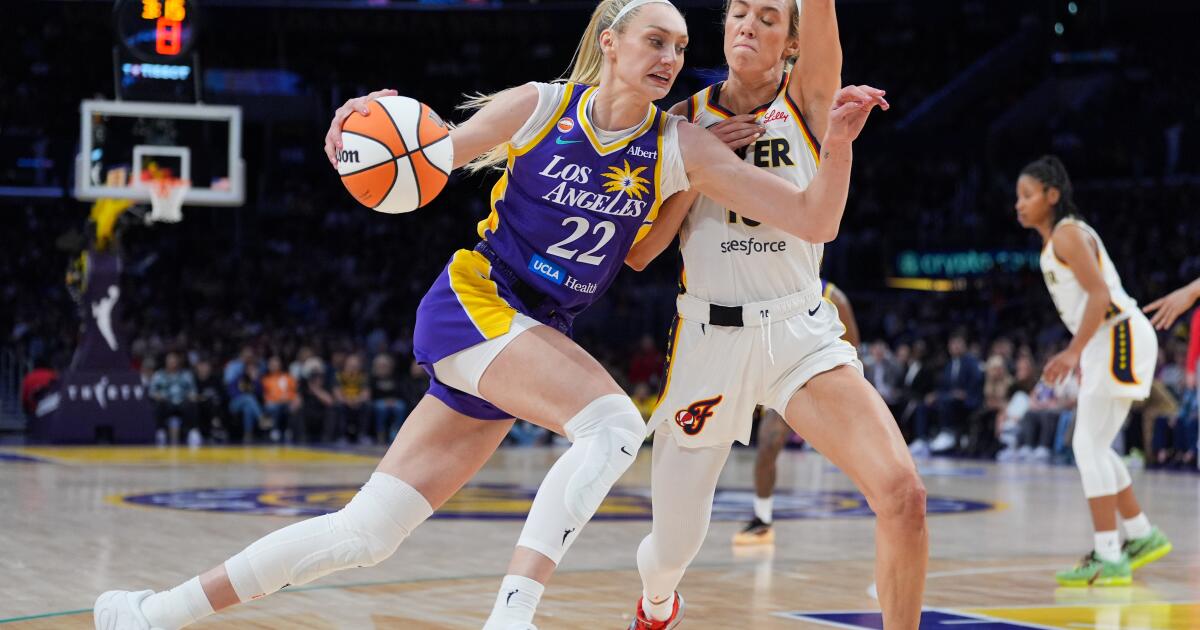
Cameron Brink said she’d appreciate some grace. She really would.
Sparks fans should give her some, because where else is she going to get it?
Certainly not from WNBA refs. Not from opponents with more to play for than ever. Certainly not from the game itself; basketball moves fast, and a bummer can become a bust in a blink.
But Brink, 24, is not on the brink of bust territory, no. Block that thought. Technically, it’s Year 3, but after a torn ACL derailed her as a rookie two summers ago, it’s practically like Year 2 for the former Stanford star. And by design, the WNBA is testing her confidence, her decision-making and her patience as she tries to reestablish herself as one of the WNBA’s best young players.
So, grace.
The recognizable 6-foot-4 forward — she’s the long-blond-haired hooper in the New Balance ads — was the No. 2 overall pick in 2024.
Now she’s her team’s No. 3 option in the post. She’s coming off the bench behind Nneka Ogwumike and Dearica Hamby for the Sparks, who are a modest 6-6 after wins this week over the expansion Portland Fire and the struggling Seattle Storm.
Against the Fire, Brink scored two points and picked up four fouls in nine minutes. Then she went to Seattle and had 15 points in 18 minutes but was pulled with more than five minutes left in the fourth quarter after getting her third, fourth and fifth fouls in 86 seconds. (WNBA players get six fouls before being disqualified.)
For the season, Brink has been called for 49 fouls in 208 minutes. A foul about every four minutes!
They’re silly fouls and they’re phantom calls. Egregious and ticky-tack. Costly and common. A real fouled-up buffet. She sets screens that get scrutinized as if by the most vigilant TSA agent. And sometimes, yes, she’s doing the accidental tripping. Other times, the officials are.
Her reputation precedes her, so everyone gets a superstar’s whistle when being defended by Brink. Opponents bake it into their game plans.
That can’t continue.
All that fouling is hindering Brink’s development because it’s robbing her of important in-game reps — which she needs, foremost, to figure out how to stop fouling.
Sparks forward Cameron Brink, left, blocks the shot of the Tempo’s Laura Juskaite during a game last month.
(Jeff Lewis / Associated Press)
“At the pro level,” said Tara VanDerveer, Brink’s coach at Stanford, “every young player always has a lot of work to do. And I saw her make a three. I see her block shots. She rebounds, she can handle the ball, she’s unselfish, she’s a terrific talent. But there’s always things players need to work on.”
We know what Brink’s thing is.
“She has to be disciplined,” VanDerveer said. “And if you want something so badly, if you want to be an All-Star someday or make the Olympic team, you’ve got to be dependable … and I think anyone can change, if it’s behavior they recognize is not in their best interests or not in their team’s best interests. It’s hard, but it’s something I think people can do.
“That’s what Cam is working on.”
And, VanDerveer added, “I’m really so excited that Nneka is there, because she will give her such great guidance and mentorship.”
And grace. Brink is getting that from Ogwumike — also a former Stanford star, the Sparks legend returned to L.A. this season after two seasons in Seattle — and her other teammates.
“I just do my best to lead by example,” Ogwumike, 35, said. “But then also let [Brink] know that she’s very capable, that she’s more than capable, which is exactly why she’s here with us and it’s exactly why we need her on this team.”

Sparks forward Cameron Brink, wearing a facemask, controls the ball while defended by Sun forward Raegan Beers.
(Joe Buglewicz / Getty Images)
But how long will Brink get grace from the Sparks in the what-have-you-done-for-me-lately business of basketball?
The foul trouble tells us why a win-now team wouldn’t trust her, why the Sparks would give meaningful minutes to two veteran post players ahead of her. Why they wouldn’t prioritize Brink’s development alongside winning as they strive to snap a previously unthinkable five-year playoff drought.
And what about fans? How patient will you all be with a player who was drafted immediately after Caitlin Clark and five spots in front of Angel Reese?
These days, that might depend on what the parlay calls for.
Or, preferably, whether you remember Brink’s first 15 WNBA games. All starts, all signs pointing to stardom. She showed up in 2024 throwing lavish block parties. Her 2.3 blocks per game were message-sending spikes, like what Lisa Leslie used to enthrall Sparks crowds with.
From the jump, she had guys coming to games at Crypto.com Arena wearing her No. 22 jersey and little girls arriving in groups with No. 22 painted on their cheeks and “I love Cam Brink” signs in hand.
And then the torn ACL cost her 25 games of her rookie season and another 25 last season, plus her spot on the United States’ Olympic 3×3 women’s basketball team in Paris in 2024.
She had to start over. Lost a lot of ground. But you see that masked woman stuck on the Sparks’ bench for all but 17 minutes per game?
You can’t miss her. She’s looking uncomfortable in protective facial gear that either hinders her breathing or her peripheral vision, her only options to protect the torn septum she suffered in a victory over the Las Vegas Aces last month.
She’s the one with the 6-8 wingspan who’s averaging 9.2 points, 4.3 rebounds and 1.5 blocks while shooting 52.1% from the field in her limited minutes.
She’s still Cameron Brink. Between fouls, she’s fluid and fast and covers more of the court than almost anyone in the WNBA, able to leap from defending guards to centers in a single bound.
“It’s just looking at every day as a new opportunity to learn and grow and not getting too bogged down when things don’t go exactly as you planned,” Brink told me. “Because more times than not, things are not going to go how you want them to. And that’s life. So I just want to be able to put my best effort out there every single night.
She knows what the Sparks need from her: “To perform, just come on the floor and compete.”
To prove she can stay on the floor to compete.

NEWYou can now listen to Fox News articles!
When will Team USA lose in the 2026 FIFA World Cup? Or, will it not lose at all?
Let’s check out the odds for the Americans’ stage of elimination at FanDuel Sportsbook, as of June 11.
Team USA — Stage of elimination odds
Last 32: +170 (bet $10 to win $27 total)
Last 16: +220 (bet $10 to win $32 total)
Group stage: +500 (bet $10 to win $60 total)
Quarterfinals: +500 (bet $10 to win $60 total)
Semifinals: +1200 (bet $10 to win $130 total)
Runner-up: +2800 (bet $10 to win $290 total)
Outright winner: +6000 (bet $10 to win $610 total)
This page may contain affiliate links to legal sports betting partners. If you sign up or place a wager, FOX Sports may be compensated. Read more about Sports Betting on FOX Sports.
The outlook appears to be … ho-hum?
If the odds ring true, the Americans are expected to make it out of the group stage but fall in the first knockout stage game.
How would that result stack up against previous results? Well, at the 2022 World Cup, Team USA made it to the Round of 16, which was viewed as a stellar accomplishment.
The U.S. men’s national team currently has 60-1 odds to lift the 2026 FIFA World Cup trophy this summer (Photo by Omar Vega/USSF/Getty Images).
In 2018, the USA did not qualify for the World Cup, and in 2014 and 2010, the Americans also made it to the Round of 16. Their best result this century occurred in 2002, when the Americans made it all the way to the quarterfinals before being eliminated.
In 1998, Team USA lost in the group stage, in 1994, it fell in the Round of 16, and in 1990, it also fell in the group stage.
With the expanded World Cup format, 32 teams will advance to the knockout stage (out of 48), giving teams a much better chance of getting out of the group stage than in previous tournaments. In past years, only 50% of the field advanced to the knockout round, but now 66.6% of teams will move on.
With that being said, anything less than a knockout round appearance on home soil would be viewed as a major failure this summer for Team USA.
The second result on the oddsboard is the “Last 16,” meaning the USA would make it out of the group stage and win one knockout stage game, before falling in the second knockout stage game. The third result is that the Americans failed to make it out of the group stage, and the fourth is that they made it to the quarterfinals, meaning they won two knockout stage games.
Making the semis, losing in the championship game and winning the championship are the three results with the longest odds.
The U.S. begins its World Cup journey on Friday as the Stars and Stripes face Paraguay at Los Angeles Stadium. Getting off to a fast start in the group is crucial for the team’s World Cup dreams of making a deep run this summer.
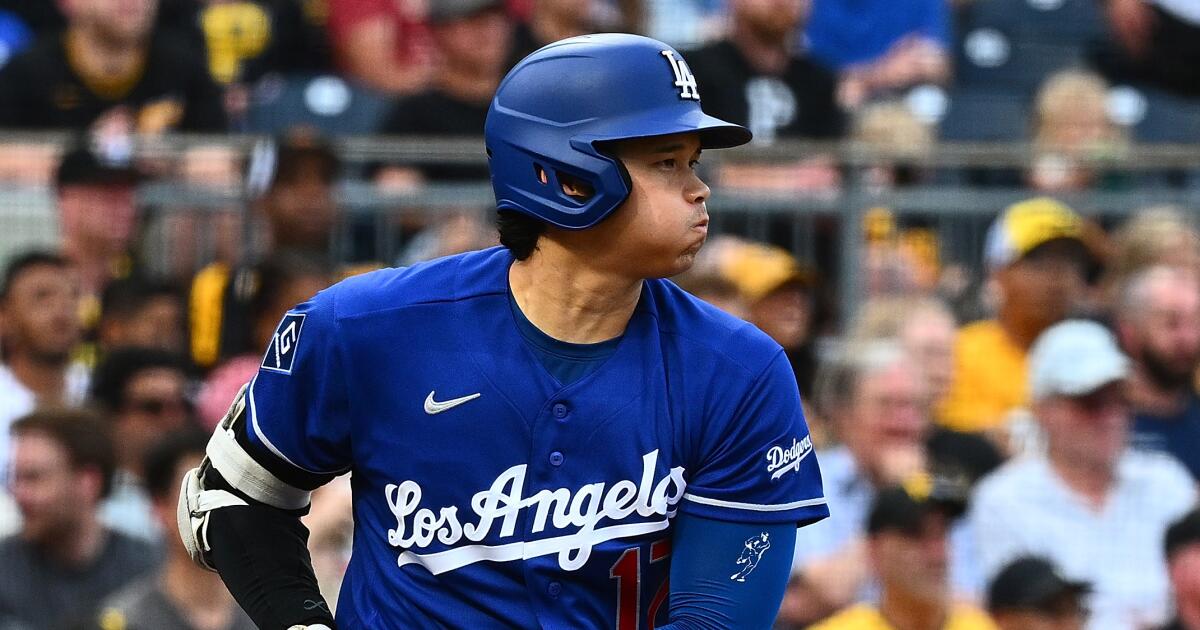
PITTSBURGH — The Dodgers couldn’t have asked for better timing, as Shohei Ohtani’s leadoff spot came back around.
They were clinging to a two-run lead in the top of the seventh inning against the Pirates on Thursday. With one out and runners on first and second, the Dodgers superstar, who had already reached base four times, was due up.
Instead, Santiago Espinal stepped up to the plate as a pinch-hitter.
Ohtani left the game with inflammation in his left knee, the Dodgers announced. They did not immediately offer an explanation for the injury.
Before leaving, Ohtani hit a solo home run — his second homer in as many games — a single and drew two walks.
It was an impressive performance, coming a day after he took on two-way duties. On the mound Wednesday, he allowed three earned runs in 6⅔ innings.
Earlier in the game Thursday, Dodgers starting pitcher Justin Wrobleski exited with a bruised right hamstring, the team said.
The fifth inning had already begun to spiral on him. After throwing four scoreless innings, he surrendered two solo home runs to Rafael Flores Jr. (the first of his major-league career) and Brandon Lowe.
Then Bryan Reynolds hit a line-drive comebacker off Wrobleski’s leg. The ball ricocheted to the edge of the infield grass, where first baseman Freddie Freeman picked it up.
Wrobleski was already racing toward first base. But after turning to catch the throw, he missed the base and stumbled backward into Reynolds, who tripped over Wrobleski’s extended left foot.
Wrobleski limped away, and an athletic trainer followed him, circling back to the mound. But as he was setting up to throw a warm-up pitch, manager Dave Roberts came out to make a pitching change.
-
Sports1 minute ago
Commentary: Cameron Brink is trying to navigate a fouled-up situation
-

 World11 minutes ago
Nigeria killed more than 13,000 ‘terrorists’ in past year, president says
-
 News38 minutes ago
Which billionaire said they learned a ‘significant lesson’ this week? The quiz knows
-

 Los Angeles, Ca2 hours ago
Fire breaks out under roller coaster at Six Flags Magic Mountain
-

 Detroit, MI2 hours ago
Mayor Sheffield absent from People Mover board during alleged wrongdoing
-

 San Francisco, CA2 hours ago
Day Around the Bay: All BART Stations In San Francisco Now Have Free Wi-Fi
-

 Dallas, TX3 hours ago
Reunion Tower debuts World Cup light show as Dallas welcomes fans
-

 Boston, MA3 hours ago
New England restaurants adding gratuity to bills during World Cup

