Sports
'American Sports Story: Aaron Hernandez': How violence, drugs and football made a monster

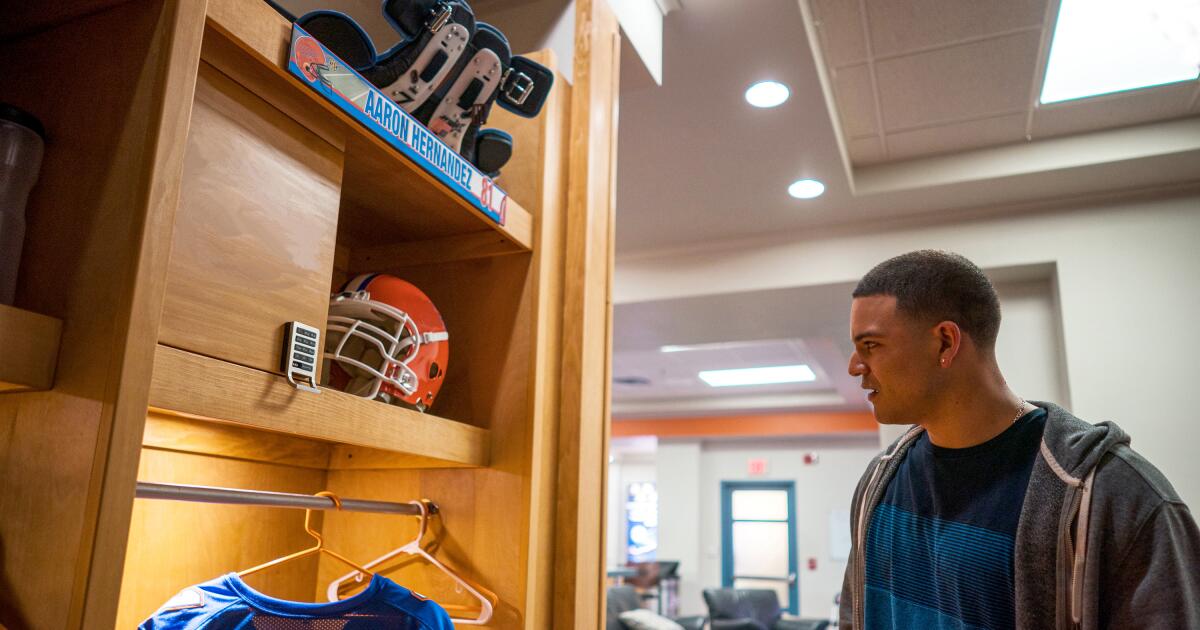
In 2009, superstar tight end Aaron Hernandez helped the Florida Gators win a national championship. In 2012, Hernandez played in a Super Bowl for the New England Patriots and signed a $40-million contract extension.
But that same year he was investigated in connection with a double homicide. A year later he shot Alexander Bradley, one of his best friends, through the eye and murdered another man, Odin Lloyd. Two years later, Hernandez was convicted of Odin’s murder, and in 2017 Hernandez killed himself while in prison.
Those are the headlines of Hernandez’s brief and violent life and death, the details that reach beyond the die-hard football fan and create a hard-to-shake image in popular culture. While Hernandez clearly had drug problems, committed violent crimes and grew increasingly paranoid, his fuller story is a complicated one: Hernandez suffered physical abuse in a violent and dysfunctional family; was sexually abused as a boy; felt compelled by society’s strictures to hide his homosexuality; was chewed up and spit out by college football’s powers-that-be; and his brain was severely damaged, resulting in chronic traumatic encephalopathy, or CTE, that likely affected his behavior.
Those nuances and much more were uncovered and laid out by the Boston Globe’s Spotlight investigative team in 2018, in a series of newspaper articles and a podcast. That was followed by a 2020 Netflix docuseries, “Killer Inside: The Mind of Aaron Hernandez.”
1
2
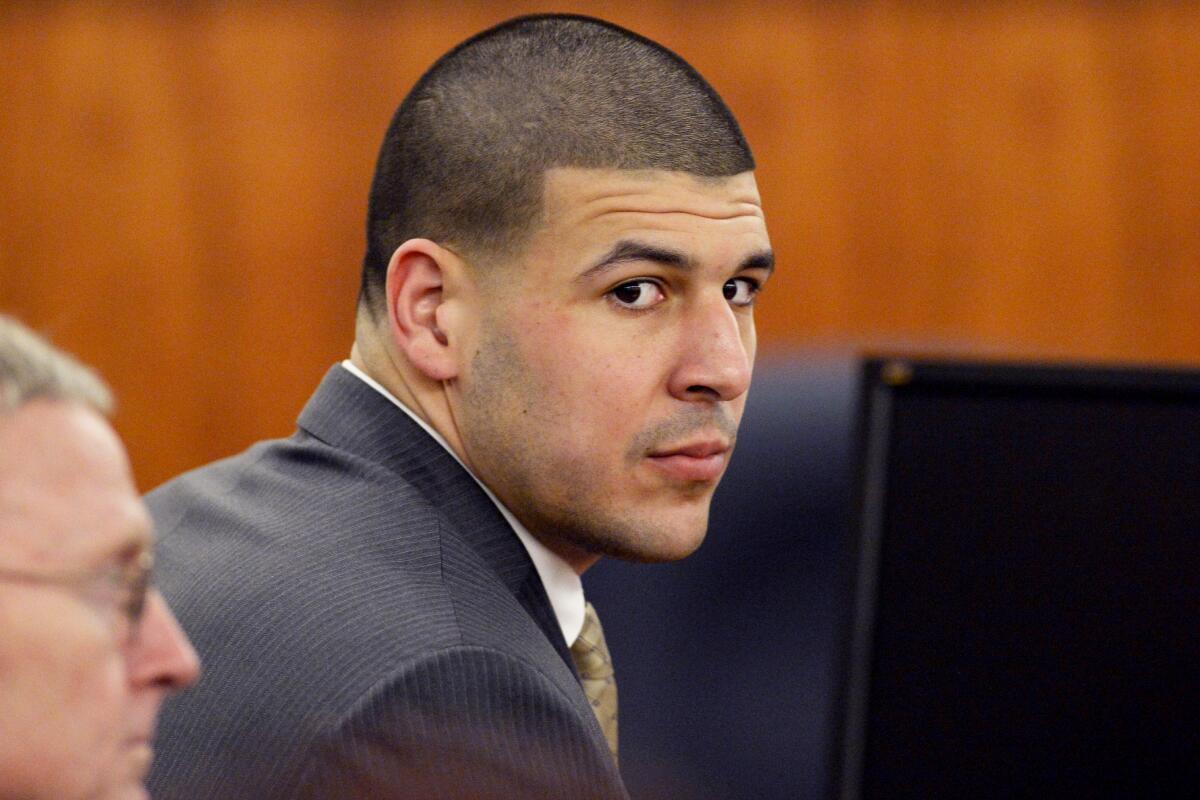
1. Aaron Hernandez in 2009 when he played for Florida. (Dave Martin / Associated Press) 2. In 2015, Hernandez during jury deliberation at his murder trial. (AP Pool)
But these days, more Americans get their facts from scripted series than from newspaper series, podcasts and documentaries, whether it’s “When They See Us,” Ava DuVernay’s Netflix limited series about the Central Park Five or the “American Crime Story” retellings of the O.J. Simpson saga and the murder of Gianni Versace. Now the “American Crime Story” producing team is branching out with “American Sports Story: Aaron Hernandez,” a 10-episode retelling of Hernandez’s life and death based on the Globe’s reporting. The limited series premieres Tuesday at 10 p.m. on FX with two episodes and streams the following day on Hulu.
Brad Simpson, one of the series’ executive producers, says they were tipped off by FX’s top executives, Nick Grad and John Landgraf, that the podcasts were about to be released, so they read the Globe’s articles.
“It had this deep reporting that we love to have in our shows, and we started developing the series with an eye toward it being part of our different franchises about the culture of America,” he says.
Simpson says fellow executive producer Ryan Murphy loved that this was a story about “a person with a fractured identity, as so many of our shows are.”
The reporting revealed a story that was “far more heartbreaking and complex than I had considered,” says Nina Jacobson, another executive producer. “When you think you know a story and then you come across something deeply reported, that really changes how you see it [and] that always makes me stand up at attention.”
She adds that since football is our national religion, Hernandez’s rise and fall “was not just the story of one person but a mirror back to us as a country.”
Numerous writers were interested in tackling the tale but the producers chose Stuart Zicherman because of his résumé — Simpson cites “The Americans” — but also because he is a passionate football fan who nonetheless has the emotional distance to see the damage the game can wreak on people. Simpson says Zicherman had a compelling pitch about the intersection of celebrity, sports, sexuality and masculinity.
“It’s character first and football second, and what made this story different from a million sports stories out there is the story about Aaron as well as his family, the people on his team and the coaches,” he says. “It becomes a Shakespearean tragedy with compelling characters at the center.”
Zicherman says he went in for his initial pitch with a huge scroll that, when unfurled, laid out all of the story’s twists and turns. “I love writing about stories people think they know but they really don’t,” he says. “We tend to label people, and Hernandez was a monster, but no one’s born a monster and I wanted to tell that story without forgiving him for what he did.”
Zicherman drew on the “American Crime Story” concept of “taking a crime or event and making it about something much bigger in the fabric of America.”
The show explores toxic masculinity at home and in locker rooms, how violence on the football field can spill into daily life, and how a dysfunctional family can be both a support and a trap.
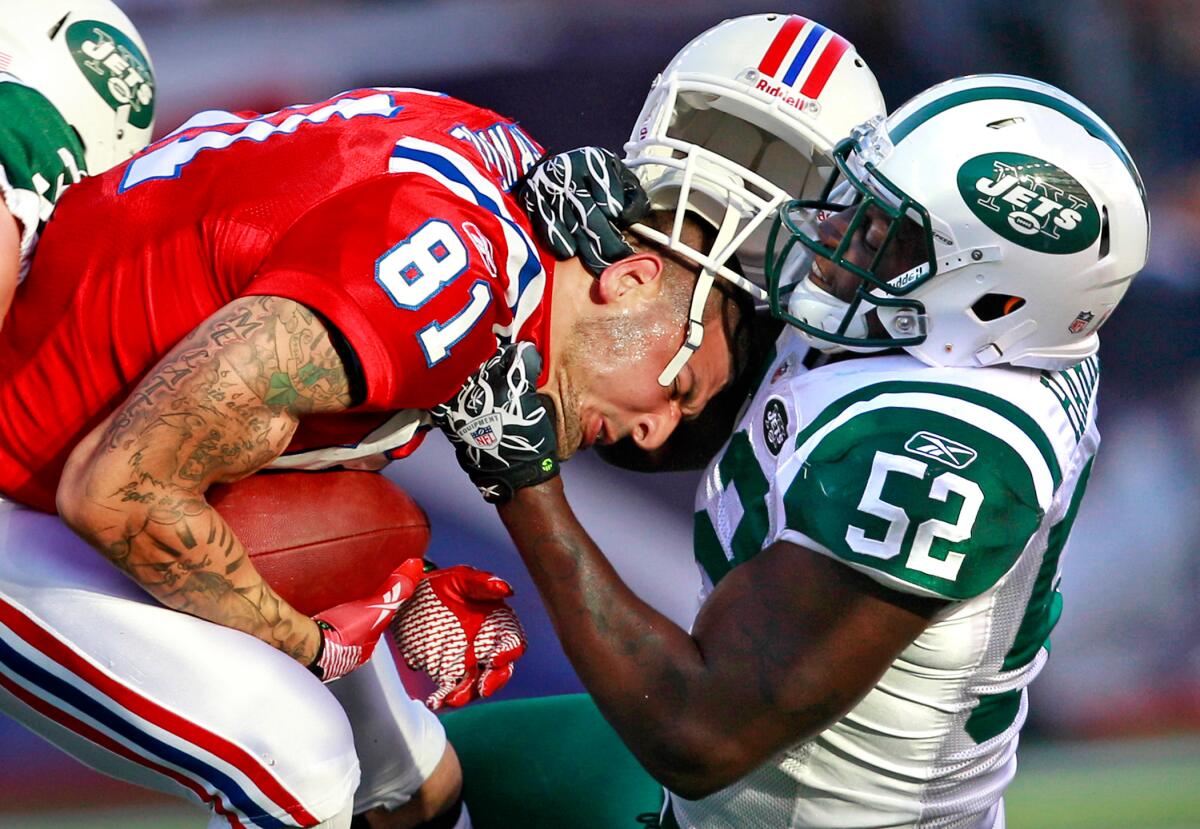
Aaron Hernandez, left, in 2011 as a New England Patriots tight end. After his death, Hernandez was found to have the degenerative brain disease chronic traumatic encephalopathy.
(Elise Amendola / Associated Press)
There’s also the issue of CTE, the brain injury caused by repeated blows to the head. “We obviously don’t want to say CTE is what turned Aaron into a murderer — he’d been exposed to violence and was prone to violence — but he did become very paranoid with an even shorter temper,” Zicherman says, noting that Hernandez’s drug use also would have exacerbated his brain injuries.
He lays out the story to show the people and institutions who directly harmed Hernandez or at least failed to “change the narrative” because of their own selfish motivations, like then-Florida coach Urban Meyer, who seduced Hernandez and his family with promises he didn’t keep and then shoved the young man out the door when he became a challenge.
“We make commodities out of our athletes and we don’t always see what’s best for them,” Zicherman says. “The Patriots were also blinded by his talent.
“But I also want the audience to see that there’s a much bigger picture here and that we’re all a bit complicit — we raise our athletes up and pay them a fortune and build them up as heroes,” he says, only to turn on them when things go awry.
Beyond the big picture, Zicherman focused on Hernandez’s story as someone “trying to find his authentic self,” giving him a throughline as Hernandez jumps from childhood to high school to Florida, the NFL and eventually the world of drugs and crime that consumed him. “By the end he’s gone mad with all the secrets he was keeping.”
Zicherman says the Globe’s Spotlight team not only provided a meticulous and thorough story, they let him come to Boston “to ask a million questions” and then they visited the writers’ room to answer even more. “They’d talked to everybody and they’d done that work, and they were a tremendous resource,” he says.
But journalists and documentary filmmakers are hemmed in by what they can demonstrably prove. Zicherman says the series resists overt fictionalization, but they felt it had to go further than the Spotlight series.
Josh Rivera as Aaron Hernandez, who was convicted of the murder of Odin Lloyd, in a scene from “American Sports Story.”
(Eric Liebowitz / FX)
“In the writers’ room we spent a lot of time connecting the dots and trying to emotionally figure out why things happen and give the answers to things,” he says.
Most important was explaining why Hernandez murdered Lloyd. “It always bothered me that in all the research no one knew,” Zicherman says. “It was a clumsy attempt that seemed unpremeditated and it didn’t make sense.”
Theories include that Hernandez wanted to keep a lid on his sexuality or his involvement in the double homicide, but Zicherman thinks it was more about how far Hernandez had descended.
“I built to the murder from the stew of all the moments throughout the season,” Zicherman says. “Hernandez is hiding so many secrets and suffusing them with drug use, and he’s paranoid as hell because he’s taken a lot of hits to the head. It’s all of those things combined; I don’t think it was a singular thing.”
Beyond the scripts, the most important factor would be casting Hernandez. Here, the team got lucky. Jacobson was producing “The Hunger Games: The Ballad of Songbirds and Snakes” and watching Josh Rivera at work. “I got to really see what he was made of,” she says of Rivera, who had previously co-starred as Chino in Steven Spielberg’s “West Side Story.” “He’s an incredibly sophisticated, grounded, natural and charismatic actor. And he was that on every take.”
But while Jacobson was sold, she also trusted Murphy’s judgment and wanted to let the audition process play out “to see if he would float to the top for Ryan as well.”
At the end of callbacks, after mixing and matching actors contending for various jobs, Murphy turned and said, “Well, it’s obviously Josh,” so they called him back in before he could leave the audition.
Zicherman says a lot of the other actors emphasized the violence and darkness, but Rivera “played the vulnerability and other emotional components and the interior emotionality. Once we had him I started stripping dialogue away to let moments play on his face — the other characters could talk and we can watch his heartbreak.”
(Rivera, he adds, is also a “goofball who likes to sing and dance and make jokes,” and that Hernandez, before things went bad, was the class clown.)
Rivera is in nearly every scene. Simpson notes that he had to work out regularly to stay big and endured multiple hours of makeup for the tattoos. “He shouldered it incredibly well and he was always game and enthusiastic,” Simpson says. “He was often exhausted, but the fact that he didn’t slip into a dark place is a testament to who Josh is as a human being. He set the tone for the set.”
Simpson recalls only one day where Rivera was, understandably, overwhelmed by the task. “We were in a muddy field at 3 a.m. reenacting the murder of Odin Lloyd, and there was just a moment where Josh had to stop. He turned to everybody and said, ‘This is just too incredibly sad,’” Simpson says. “I think we were all haunted by that moment.”



Sports
England’s Jordan Henderson officially ruled out after freak fall causes fracture, opts for surgery

A freak mishap Sunday night abruptly ended England midfielder Jordan Henderson’s 2026 World Cup.
Henderson, 36, spent the match on the bench in England’s 3-2 win, but quickly drew attention after falling over an advertising board, leaving him writhing in pain during a moment of victory for England.
England’s Jordan Henderson is stretchered off after suffering an injury during World Cup Round of 16 victory. (Photo by Bradley Collyer/PA Images via Getty Images) ((Photo by Bradley Collyer/PA Images via Getty Images))
Harry Kane celebrates with Jordan Henderson after England’s thrilling World Cup victory over Mexico Sunday. (Photo by Michael Steele/Getty Images) ((Photo by Michael Steele/Getty Images))
On Monday, Henderson opted to undergo surgery, bringing an unusual ending to the World Cup campaign of one of England’s veteran leaders.
ENGLAND PLAYER INJURES WRIST HOPPING OVER AD BOARD DURING TEAM’S WORLD CUP VICTORY CELEBRATION VS MEXICO
As the stadium speakers blasted Oasis, Henderson tried to climb over a pitch-side advertising board to celebrate with the traveling supporters. He lost his footing and landed awkwardly on his wrist.
WATCH:
England captain Harry Kane reacted to Henderson’s injury Sunday night after the match.
ENGLAND STUNS MEXICO 3-2 IN INSTANT WORLD CUP CLASSIC, HANDS TEAM FIRST WORLD CUP LOSS AT ESTADIO AZTECA
“Yeah Hendo just fell over there. I think he’s OK. Something to do with his arm,” Kane said, unaware of the severity of Henderson’s injury at the time.
Dan Burn helps injured Jordan Henderson during England’s World Cup victory celebrations over Mexico Sunday. Surgery required for English vet. (Photo by Martín Fonseca/Eurasia Sport Images/Getty Images) ((Photo by Martín Fonseca/Eurasia Sport Images/Getty Images))
The celebrations quickly turned to concern as medical staff rushed onto the field, administered oxygen, and stretchered Henderson off the pitch.
Before the accident, Estadio Azteca hosted a World Cup classic. Jude Bellingham sparked England with a first-half brace before Harry Kane added a penalty. Mexico answered through Julian Quinones and a late Raul Jimenez penalty.
ENGLAND STUNS MEXICO 3-2 IN INSTANT WORLD CUP CLASSIC, HANDS TEAM FIRST WORLD CUP LOSS AT ESTADIO AZTECA
Henderson watched the thriller from the bench, picking up a yellow card in the 98th minute for his touchline protests. The match fell into chaos when England defender Jarell Quansah was shown a straight red card, forcing the Three Lions to desperately hang on.
While manager Thomas Tuchel and the squad flew to Kansas City to prepare for a quarterfinal clash against Norway, Henderson remained hospitalized in Mexico City. England next faces Erling Haaland’s Norway on Saturday without the suspended Jarell Quansah.
CLICK HERE TO DOWNLOAD THE FOX NEWS APP
Henderson’s World Cup had its ups and downs. The last one ended it.
Send us your thoughts: alejandro.avila@outkick.com / Follow along on X: @alejandroaveela
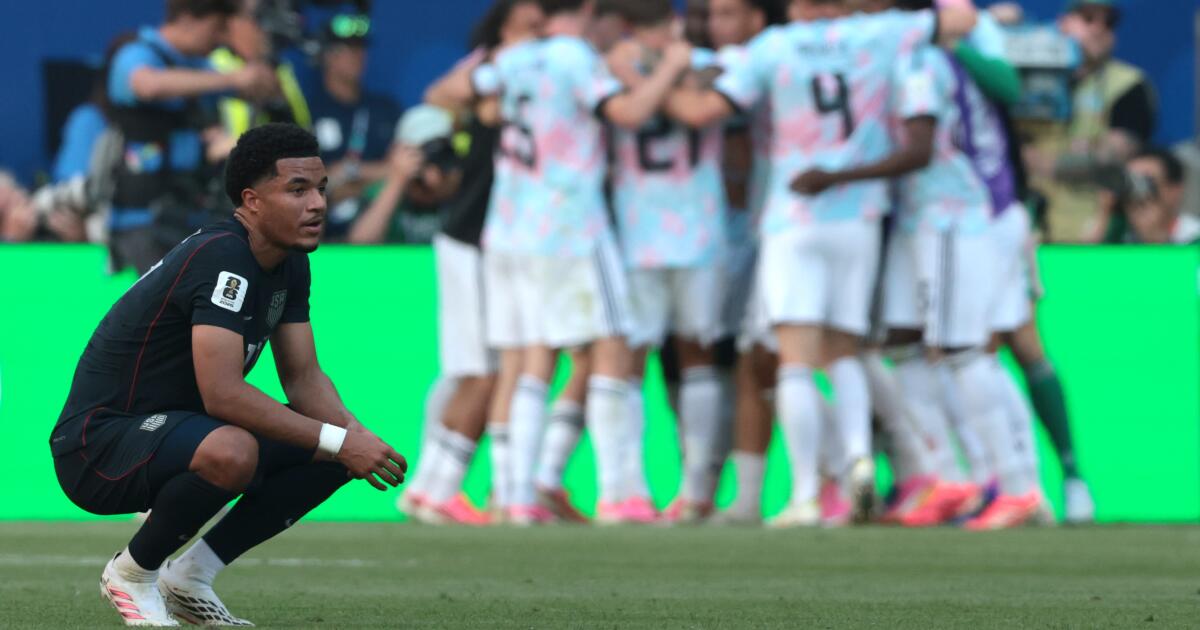
SEATTLE — For three weeks, it was the best World Cup ever for the U.S.
The Americans scored more goals, won more games and generated more interest than any U.S. team in history. But all that glory gave way to grief Monday when a 4-1 loss to Belgium brought the U.S. crashing back to Earth.
Belgium never trailed, getting two first-half goals from Charles De Ketelaere and two in the second half from Hans Vanaken and Romelu Lukaku to clinch a spot in the tournament quarterfinals, where it will face Spain on Friday at SoFi Stadium in Inglewood. For the U.S., whose lone goal came from Malik Tillman, its World Cup ended in the round of 16 for a fourth straight time.
U.S. players Tim Ream, center, Malik Tillman, left, and Folarin Balogun react after Belgium’s third goal on Monday.
(Robert Gauthier / Los Angeles Times)
The U.S. did win a knockout round game in the tournament for just the second time, but that came in a round of 32 necessitated by the World Cup’s expansion to 48 teams. All three tournament hosts, the U.S., Canada and Mexico, were eliminated in the round of 16.
The run-up to Monday’s game was clouded by the controversy surrounding U.S. striker Folarin Balogun, the Americans’ leading scorer, who wasn’t officially cleared to play until about seven hours before kickoff after FIFA rejected an appeal from the Royal Belgium Football Assn. The association was seeking to overturn an unusual ruling from the FIFA disciplinary committee, which on Sunday made Balogun eligible to play despite the fact he was shown a red card and expelled from his team’s previous game.
The red card also carried with it a ban from the team’s next game — in this case, the Belgium match — but FIFA suspended that penalty and imposed a one-year probation instead. It was just the second time in World Cup history — and the first since 1962 — that FIFA has held a red-card suspension in abeyance and allowed a player to participate in his team’s next game.
Balogun was active Monday, going the full 90 minutes, but Belgium kept him from getting on the scoreboard.
Belgium, in fact, was on the front foot from the start, taking six shots and putting two on target in the first eight minutes before going ahead on De Ketelaere’s first goal in the ninth minute. De Ketelaere, starting over the more physical Lukaku, Belgium’s all-time leading scorer, got free on the edge of the six-yard box and ran onto a centering pass from Nicolas Raskin, then made the easy tap-in for his first World Cup goal.

The sequence followed Sergiño Dest’s decision to let a headed clearance attempt from Chris Richards bounce inside the penalty area, allowing Raskin to scoop up the loose ball and send it on to De Ketelaere, whose goal marked the first time the U.S. trailed in the first half hour of a game in this tournament. It was also the earliest goal the U.S. had allowed in a World Cup game since Nani scored for Portugal in the fifth minute of the second group stage game in Brazil in 2014.
The U.S. matched that in the 31st minute when Tillman deflected a free kick in off the head of Vanaken following a foul on Balogun. It was Tillman’s second free-kick goal in as many games, making him the second player since 1966 to score twice off direct free-kick goals in the same World Cup.
But the draw was short-lived, with De Ketelaere putting Belgium in front, where they would stay, two minutes later with his second score of the first half, this one a header over the back of U.S. captain Tim Ream. Leandro Trossard got the assist, bending a perfect back-post cross from the end line to his waiting teammate.
Belgium dominated the opening half, outshooting the Americans 11-3 and putting five of those tries on goal, an edge U.S. coach Mauricio Pochettino tried to address by subbing Dest off at halftime for Gio Reyna. It didn’t work, however, with Belgium expanding its lead on a major gaffe from U.S. keeper Matt Freese in the 57th minute.
Freese, who had given up just one goal in his first three starts, came well off his line to beat De Ketelaere to a loose ball, chesting it to the turf. But De Ketelaere poked a toe out to knock the ball back to Vanaken, who skipped a shot from about 30 yards past a retreating Ream and into the vacant goal.
After the goal, U.S. star Christian Pulisic was subbed out after sustaining an apparent leg injury while attempting a shot. He was limping on the field before being replaced by Sebastian Berhalter.
Lukaku, who came on in the 67th minute, closed out the scoring with a goal in stoppage time.
The U.S., which was eliminated by Belgium in the round of 16 of the 2014 World Cup, hasn’t beaten the Red Devils since its opening match of the first World Cup in 1930.

U.S. goalkeeper Matt Freese reacts after Belgium midfielder Hans Vanaken (not shown) scored against him in the second half of Belgium’s 4-1 win at the World Cup on Monday.
(Allen J. Schaben / Los Angeles Times)

NEWYou can now listen to Fox News articles!
FIFA President Gianni Infantino released a statement on Monday addressing his interactions with President Donald Trump amid USA World Cup star Folarin Balogun’s suspended one-game ban.
Trump told reporters he asked Infantino if FIFA would review the play. Infantino said in his release that “FIFA’s judicial bodies are independent” and “operate autonomously, apply the FIFA Disciplinary Code, and decide cases based on the applicable regulations and the specific facts before them.”
ZERO BS. JUST DAKICH. TAKE THE DON’T @ ME PODCAST ON THE ROAD. DOWNLOAD NOW!
FIFA President Gianni Infantino answers questions during a 2026 soccer World Cup news conference Thursday, June 16, 2022, in New York. (AP Photo/Noah K. Murray)
“Yes, I regularly discuss matters related to the FIFA World Cup with the President of the United States, and on this matter, I did receive a call from President Donald Trump, just as I receive calls from heads of state, government officials, football stakeholders and business executives from around the world on many different issues,” he said. “During our conversation, I explained that there was an ongoing legal process involving FIFA’s independent judicial bodies and that the case would be decided in due course by the competent bodies. That is how FIFA’s system works, and it is a principle that I will always uphold.
“I read the decisions of the FIFA Disciplinary Committee when they are issued. Sometimes I am surprised by them. Sometimes I agree with them, and sometimes I disagree.
“What I always do, however, is respect those decisions and the autonomy of the bodies that make them. Whether we personally like a decision or not is irrelevant. Respect for independent institutions and the rule of law is what protects the integrity of our competitions and the credibility of FIFA at all times.”
Gianni Infantino, President of FIFA, shakes hands with U.S. President Donald Trump as he receives the FIFA Peace Prize during the FIFA World Cup 2026 Official Draw. (Hector Vivas – FIFA/FIFA via Getty Images)
Balogun was given a red card after a VAR review to look at a play in which Balogun stepped on the ankle of a Bosnia and Herzegovina defender. He would have been suspended for the team’s match against Belgium but FIFA decided to suspend the one-game ban.
Trump addressed the controversy in the Oval Office.
“All I did was, I asked for a review, because I didn’t think it was a foul,” the president said. “And again, I’m good at this stuff. I didn’t think it was a foul. I thought it was two great athletes who crashed into each other and got entangled. That was not a guy punching somebody in the face or anything that would be different.
“I think it’s a terrible … if they wouldn’t allow a top player, maybe the best, maybe among the best on the team, to play, I think it would have had a big stain. I relayed it. I didn’t tell him what to do. I don’t believe he made the decision. I think it was a committee that made the decision and they made the right decision because, No. 1, it wasn’t a foul and you want to see a game with your best players.”
Trump said the feeling would be the same if Lionel Messi, Cristiano Ronaldo or Harry Kane would have been given a red card in a similar way.
He also took issue with the call itself.
FIFA President Gianni Infantino speaks during a news conference at the stadium in Mexico City on June 10, 2026, a day before the opening FIFA World Cup match between Mexico and South Africa. (Eduardo Verdugo/AP)
“If you would have taken him out, I think it would have really stained this incredible championship,” Trump continued. “We gotta have our best players and Belgium, Belgium’s got a great team by the way. We have our best players and they have to have their best. If we win or we lose, it’s fair. Otherwise, let’s say we lost to them, then we lost the game. It would be a terrible thing. I think they made a really brilliant decision.
CLICK HERE TO DOWNLOAD THE FOX NEWS APP
“I think the referee’s call was horrible and nobody talks about that. They talk about the red card like it’s fine. The referee’s decision to red card, I didn’t know what the hell a red card was and when I found out I said, ‘You gotta be kidding.’ … I said, ‘Wow, that’s a lot of power, that’s terrible.’ And then I looked at his past and it wasn’t so great.”
Belgium’s appeal was dismissed later Monday.
-

 Los Angeles, Ca19 minutes ago
Missing 13-year-old with autism last seen at Los Angeles beach
-
Detroit, MI37 minutes ago
GET TO KNOW: Wide receiver Kendrick Law
-

 San Francisco, CA49 minutes ago
Multiple people lose eyes, hands in illegal fireworks-related injuries in San Francisco
-
 Dallas, TX52 minutes ago
Texas took this Dallas couple’s newborn baby for 3 weeks. A judge says their rights were violated
-

 Miami, FL57 minutes ago
South Florida foundation empowering thousands of young girls through education, mentorship, community support
-

 Boston, MA1 hour ago
Where to watch Boston Red Sox vs Chicago White Sox: TV channel, start time, streaming for July 7
-

 Denver, CO1 hour ago
House fire in Denver fully engulfs power pole, detached garage mostly destroyed
-

 Seattle, WA1 hour ago
WEST SEATTLE SCENE: Stranded dog’s rocky rescue

