Connect with us

West

Harris quick to call for gun control after Georgia shooting, stays mum on armed Venezuelan migrant gangs

Published

on

Harris quick to call for gun control after Georgia shooting, stays mum on armed Venezuelan migrant gangs

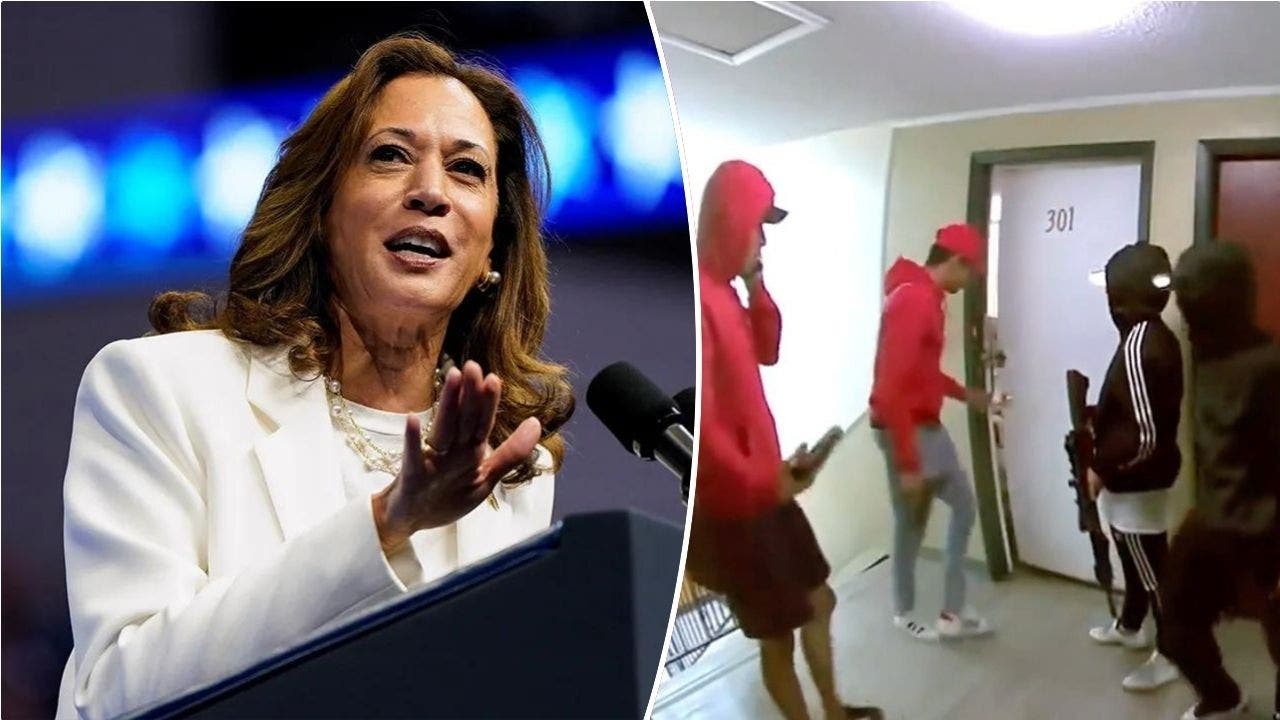
While Vice President Kamala Harris was quick to call for action against gun violence after Wednesday’s school shooting in Georgia that killed four and injured several others, she has remained silent on alarming incidents involving armed Venezuelan migrant gangs overtaking apartment buildings, critics charge.

“It’s telling that gun violence is only mentioned when it fits a particular narrative,” Beverly Hills school board candidate and gun shop owner Russell Stuart told Fox News Digital. “VP Harris is quick to politicize the actions of a mentally ill 14-year-old boy, but remains silent on the very real and dangerous violence being carried out by illegal immigrant gangs in American cities.”

“Law abiding citizens deserve safety and security, and their protection should not be sidelined by political gamemanship and deflection,” he added.

GEORGIA SCHOOL SHOOTING: LIVE UPDATES

Vice President Kamala Harris has remained silent about the alarming incidents involving armed Venezuelan migrant gangs overtaking apartment buildings, critics charge. (REUTERS/Elizabeth Frantz/Fox News)

Advertisement

Harris lamented the incident on X Thursday and said that her and her husband were “mourning the deaths of those whose lives were cut short by gun violence at Apalachee High School in Georgia.”

“Our hearts are with the students, teachers, and families impacted by this shooting, and we are grateful to the first responders and law enforcement on the scene. This is a senseless tragedy — and it does not have to be this way. We must end the epidemic of gun violence in our country once and for all,” Harris wrote.

The school shooting in battleground Georgia brought the Second Amendment back into the focal point of the neck-and-neck election race and added to the list of different policy stances between Harris and former President Donald Trump.

TREN DE ARAGUA GANG MEMBERS ARRESTED IN AURORA, COLORADO IN CONNECTION TO APARTMENT BUILDING TAKEOVER: POLICE

A screenshot from a video shows the alleged shooter’s weapon used in the mass shooting at Apalachee High School in Winder, Georgia, on Wednesday, Sept. 4, 2024. (Alexsandra Romero/Joel Romero via Storyful)

Advertisement

The familiar reaction following a school shooting echoed across social media platforms, as proponents for stricter gun control measures reignited their calls and gun rights activists attributed it to a mental health epidemic among teens.

“We need to get to the cause of what’s happening with these school shootings,” retired Immigration and Customs Enforcement agent and congressional candidate John Fabbricatore told Fox News Digital in an interview. “It’s not the guns causing the school shootings. Why are these kids thinking that they can go out and kill other human beings?”

“Why do these kids feel that it is the right thing to do to find something to kill other people? That’s the main issue. That’s the issue that we need to direct our attention to,” he said.

He added that Harris is unlikely to bring up the Venezuelan migrant gang apartment takeovers because, “she helped cause this” since she has been in office for the last four years and will avoid bringing attention to what critics have called weakened border security measures.

SANCTUARY CITY’S POLICIES PUSH VIOLENT MIGRANT GANG INTO SUBURBS: ‘IT’S A NATIONWIDE PROBLEM’

Advertisement

Alleged members of the Tren de Aragua gang have overtaken an apartment building in Aurora, Colorado, charging rent in exchange for “protection.” (Edward Romero)

Rep. Carlos Gimenez, R-Fla., a Cuban-born lawmaker, told Fox News Digital that the migrant gangs “are taking over” communities, “yet [Harris] turns a blind eye to the consequences of her disastrous policies.”

Additionally, the alleged migrant gang takeover is exacerbated by local sanctuary state laws, Venezuelan-born researcher at the Manhattan Institute, Daniel Di Martino told Fox News Digital. 

“It’s going to be a very difficult foreign policy issue too, by the way, both for Trump and Biden or Harris, no matter who wins,” Di Martino said. “Because most people don’t know this, but Venezuelans cannot be deported to Venezuela right now.”

Venezuelan President Nicolás Maduro’s regime has chosen not to cooperate with deportation requests as of February. 

Advertisement

A violent transnational gang from Venezuela allegedly first gained a “stranglehold” on an apartment complex in Aurora, Colorado, late last year, according to a local report.

Tren de Aragua gang members took over the Whispering Pines Apartments in 2023, engaging in violent assaults, murder threats, extortion, child prostitution and strongarm tactics, Denver law firm Perkins Coie wrote to city leaders in a nine-page report obtained by CBS News Colorado.

“The evidence we have reviewed indicates that gang members are engaging in flagrant trespass violations, assaults and battery, human trafficking and sexual abuse of minors, unlawful firearms possession, extortion, and other criminal activities, often targeting vulnerable Venezuelan and other immigrant populations,” T. Markus Funk, a former U.S. Attorney, wrote in the letter.

The Harris campaign did not respond to Fox News Digital’s request for comment.

Advertisement

Fox News Digital’s Stephen Sorace contributed to this report. 

Read the full article from Here

Advertisement
Continue Reading
Click to comment

Leave a Reply

Your email address will not be published. Required fields are marked *

This site uses Akismet to reduce spam. Learn how your comment data is processed.

New Mexico

Find out how New Mexico hospitals rank for patient safety

Published

on

Find out how New Mexico hospitals rank for patient safety


Leapfrog released its 2026 spring hospital safety grades.

Grades are assigned based on overall performance, including patient safety.

The Leapfrog Group’s goal is to publicly report patient safety and quality information for the benefit of consumers, purchasers, and referring physicians as they make decisions about where to seek care and where to direct patients,” the company stated on its website.

Here’s how your local hospitals performed.

Advertisement

MountainView Regional Medical Center – A

Leapfrog gave MountainView an “A.”

“Being the only hospital in Doña Ana County to earn an ‘A’ from The Leapfrog Group speaks to the high standards our team sets – and meets – every day,” said MountainView CEO Patrick Shannon. “This achievement reflects the dedication of our physicians, nurses, and employees to deliver the safest care possible for our community.”

“An ‘A’ Grade is a strong sign that MountainView is deeply committed to protecting patients from harm,” said Leah Binder, president and CEO of The Leapfrog Group. “We commend the leadership, Board, clinicians, staff and volunteers for the role each played in earning this distinction.”

The hospital performed better than average in several areas including low infection rates, addressing safety problems, and ICU care. The hospital received below average performances ratings in surgical site infections post colon surgery, communication about medicine and discharge, communication with doctors and nurses and nursing and bedside care for patients.

Memorial Medical Center – B

Memorial Medical Center received a “B” grade from Leapfrog.

Advertisement

The hospital performed well in effective leadership, reduction and prevention of infections and addressing safety problems.

The hospital received below average ratings for kidney injury after surgery, serious breathing problems, harmful events, communication about medicine and discharge, and communication with doctors and nurses.

Not rated by Leapfrog were Three Crosses Regional Hospital.

Nearby top rated hospitals

Advertisement

Leapfrog gave an A to William Beaumont Army Medical Center and Del Sol Medical Center in El Paso. Las Palmas Medical Center in El Paso received a B.

How did other New Mexico hospitals perform?

A recipients were:

  • CHRISTUS Southern New Mexico in Alamogordo

B recipients were:

  • Lovelace Women’s Hospital in Albuquerque

C recipients were:

  • Carlsbad Medical Center in Carlsbad
  • CHRISTUS St. Vincent in Santa FE
  • Eastern New Mexico Medical Center in Roswell
  • Lovelace Medical Center-Downtown in Albuquerque
  • Lovelace Regional Hospital in Roswell
  • Lovelace Westside Hospital in Albuquerque
  • University of New Mexico Hospital in Albuquerque

D recipients were:

  • San Juan Regional Medical Center in Farmington
  • UNM Sandoval Regional Medical Center in Rio Rancho

Explore the full survey results at https://www.hospitalsafetygrade.org/.

Jessica Onsurez is editor of the Las Cruces Sun-News. Reach her by email at jonsurez@usatodayco.com.


Source link

Advertisement
Continue Reading

Oregon

Oregon man shot at In-N-Out drive-thru drove family to safety with bullet lodged in head

Published

on

Oregon man shot at In-N-Out drive-thru drove family to safety with bullet lodged in head


Oregon police have arrested two suspects in connection with the shooting of a father who drove himself to a hospital after being struck in the head by a bullet after shots rang out while he was pulling out of In-N-Out drive-thru with his wife and two young sons.

Ethan Adrian Armenta-Lagunas, 20, and Gabriel “Alex” Javier, 18, both of Salem, were taken into custody Wednesday.

They face charges of first-degree assault, unlawful use of a weapon, criminal mischief, and recklessly endangering another person in connection with the Feb. 9 shooting of Marcio Garcia.

Multiple guns were allegedly found at Armenta-Lagunas’ apartment, the Keizer Police Department said. Javier was arrested later in the day.

Advertisement
Marco Garcia, left, drove himself to a hospital after being shot at an In-N-Out drive-thru in Oregon. Gofundme
A bullet lodged in Garcia’s head as he drove with his wife and two children in the car. Gofundme

Authorities are still searching for a third suspect, 22-year-old Anthony Taylor-Manriquez, who is considered armed and dangerous.

Garcia, 28, was in a car with his wife and two children, ages 2 and 7, when shots rang out near the burger chain.

The gunfire shattered the car windows and struck Garcia in the head; his wife and children were uninjured, police said.

“In the middle of chaos and fear, while he was injured and in pain, he somehow found the strength to drive us out of the scene to safety,” his wife wrote in an online fundraiser.

The gunfire shattered the Garcia family’s car windows as shots rang out near the burger chain. Gofundme
Ethan Adrian Armenta-Lagunas was arrested along with Gabriel “Alex” Javier while police hunt a third suspect. Keizer Police Department

“He protected our family before thinking of himself. That is the kind of man and father he is.”

Advertisement

Images posted online showed the bullet that was removed from Garcia’s head during surgery in February, according to his wife.

She also noted that Garcia did not suffer major brain damage and is currently recovering at home.

“The doctors told us what we already believe — this is nothing short of a miracle,” she said. “Now he faces a long road of rest, healing, and recovery.”


Source link

Advertisement
Continue Reading

Utah

A new law in Utah allows students to opt out of coursework that conflicts with their beliefs

Published

on

A new law in Utah allows students to opt out of coursework that conflicts with their beliefs


OGDEN, Utah — The syllabus in 18-year-old Madelynn Wells’ introductory film studies class assigned “Jaws” first, and then the Spanish dark comedy “Women on the Verge of a Nervous Breakdown.” She said she watched those, and did the written assignments with no problem. 

Around the third week of the term, the assignment was a film called “Pariah.” She hadn’t heard of it, so she looked it up and found that it was a coming-of-age film about a young woman who turned away from her conservative family to live as a lesbian.

Wells, a freshman at Weber State University who said she’s a devout Catholic and a political conservative, felt uneasy. She didn’t want to watch the film, and the idea of writing a paper on it made her even more uncomfortable. 

Advertisement

“I feel like whenever you put something in writing it just feels more serious,” Wells said. 

She decided to drop the class. 

In Utah, with a large and devout religious population, Wells is not alone in trying to uphold her religious beliefs while getting a college education. 

A new state law offers these students a unique protection: If something in a class conflicts with their strongly held religious or personal beliefs, students can ask their professor for an alternative assignment or exam. And as long as their request doesn’t change the fundamental nature of the course, the professor is now required by law to allow the student to opt out. 

Advertisement

The law has some guardrails that protect against accommodation requests that are universally considered absurd. For example, a student won’t be able to claim a moral objection to math in a college algebra course. And the law requires faculty to make these accommodations only in courses that are part of a college’s general education requirement or are required for the student’s major.

Despite those protections, the law is polarizing. Proponents say that students shouldn’t be required to do assignments or take exams on topics that compromise their morals unless it’s absolutely necessary to advance in their field of study. Opponents argue that engaging with beliefs they don’t hold helps students understand their own views better. 

This Utah law is the first of its kind targeting higher education, but it’s an extension of concerns being expressed at the K-12 level. There have been efforts to emphasize conservative and religious values in public schools, and limit what can be taught about subjects including racial history, gender and sexuality. The Utah law is also reminiscent of a case the Supreme Court took up last year, in which the justices sided with parents of public school students who wanted to take their children out of class during lessons that violate their religious beliefs — such as using books about LGBTQ+ identities. President Donald Trump has said that colleges are “corrupting our youth and society with woke, socialist, and anti-American ideology.” 

And over the past few years, there have been dozens of state-level bills — including one in Utah — banning initiatives or programs that promote diversity, equity and inclusion, or DEI. Lawmakers in other states have gone after what’s taught in the classroom and how certain issues, like race and gender identity, are discussed. The legislative approach here is different. Instead of dictating what can or cannot be taught, the new Utah law shifts the power to students who now have the agency to decide when curriculum crosses a line for them. 

Amy Reid, who directs the Freedom to Learn initiative at the free speech advocacy organization PEN America, said it’s the responsibility of faculty to help all students get the most out of what’s being taught. Some accommodations — like those for students with disabilities or religious students who need to reschedule exams for religious holidays — help faculty meet that goal, she said. This one, she said, does not. 

Advertisement

Rather than “encourage students to shut their eyes or plug their ears or throw a book out the window,” she said, “You encourage students to engage with ideas, and you provide them with the support that they need — which can be different for individual students — so that they are able to complete the work.”

“Being exposed to ideas that you disagree with doesn’t mean you’re going to change your mind, but it should make you clearer about what it is that you believe and why,” Reid added.

Interested in more news about colleges and universities? Subscribe to our free biweekly higher education newsletter.

Wells, a zoology major, was taking the film course to fulfill a general education arts credit. After dropping it, she had more than two dozen other classes to choose from to earn that credit. She picked photography. 

Advertisement

But if she had needed the course to graduate, she said she would have had to swallow her discomfort or work up the courage to talk to her professor about an alternative assignment. In the case of the film studies course, perhaps she could have watched a different coming-of-age film, or another film by a Black screenwriter — depending on the goal of that assignment. (Her professor declined to comment.) 

Seth Mulkey, a junior at Utah State University in Logan, said he felt uncomfortable in his general education biology class when the course topic turned to evolution. Mulkey, an evangelical Christian, said he believes that God created the Earth in seven days.

“It can be a bit disheartening to have to learn about something and have something proposed as fact when it’s not something that you’re in agreement with,” Mulkey said. He tries to keep his beliefs to himself and instead, he said, “I’ll do my best to engage from an intellectual standpoint with this idea. So, if this is the assumption we’re making about how this works, we’ll talk about it, we’ll see what conclusions are there.” 

Even if the law had been in effect when he took that biology class, Mulkey said he wouldn’t have asked for an accommodation to get out of uncomfortable group discussions. But writing assignments might have been a different story. 

“If the assignment were to write an essay supporting this view, write an essay about why evolution is correct and why it is the right view of the creation of the world — I think at that point, I would want to step back,” Mulkey said. 

Advertisement

Politicians say left-wing professors push their views. New poll shows students don’t see it that way

Utah appears to be the most religious state in the country. About 76 percent of Utah residents are religious, compared to only about 49 percent nationwide, according to a 2024 report from the Gardner Policy Institute at the University of Utah. Data from the Pew Research Center shows that about 50 percent of all residents are members of the Church of Jesus Christ of Latter-day Saints, and another 13 percent identify as members of other Christian denominations. 

Michael J. Petersen, a Republican state representative from Logan, said the idea for the bill came after his daughter was assigned to write a letter to a legislator in support of LGBTQ+ rights as part of a master’s degree program at an out-of-state college. The assignment was in conflict with her beliefs, so she called her dad for help. 

He helped her write “something that was very, very bland.” She moved on — and he began drafting the legislation. 

Had Petersen’s daughter been an undergraduate student at a public college in Utah, the law would have helped her in two ways. It would have prohibited her instructor from requiring that she take a specific public stance (such as sending a letter) on anything that is a “political, social, religious, moral, or community matter.” And it would have allowed her to ask her professor for an alternative assignment.

Advertisement

Petersen said he believes that his daughter’s assignment was to write the letter and also send it. (The Hechinger Report was not able to independently confirm this.)

Most faculty and education advocates, whatever their politics, agree that requiring her to send the letter would be inappropriate.

Mike Gavin, the president and CEO of the Alliance for Higher Education, said it is reasonable for a professor to ask a student to take on other perspectives during an in-class debate or in a written assignment. But it shouldn’t be taken outside the classroom. 

“In no way, shape or form should they be required to publicly sign their names to something. That would be very problematic,” Gavin said. “That, I think, would be a personnel issue that an institution should handle. That is not an academic freedom issue. That is actually using students for things that are political.” 

And, he said, in 30 years in higher education he’s never heard of it happening. 

Advertisement

Gavin said he thinks it’s unnecessary to give students such broad permission to opt out of coursework that conflicts with their beliefs. There are cases in which it’s appropriate, but those already come up and are handled on a case-by-case basis between professors and students, he said. 

“It’s entirely probable — I say this facetiously and also seriously — that a freshman in college doesn’t know everything yet,” Gavin said. “They need to engage with ideas they have not come across. Even if they end up being uncomfortable for a minute, that doesn’t mean that they’re traumatized.” 

Conservative-leaning civic centers now teach courses at public colleges 

Outside of Utah, many people might gawk at the idea of students opting out of coursework that makes them feel uncomfortable, and worry about the broader implications of such a policy. But among Utahns, there seem to be wider-ranging and more nuanced perspectives.

It’s partly because they’ve been down this road before. In 1998, a Mormon theater student at the University of Utah objected to reading a script with profanity. The student sued the university, accusing faculty of essentially pushing her out after she was given the choice to recite the lines as written or leave the program. 

Advertisement

A settlement agreement required the university to write a policy to deal with coursework objections related to sincerely held beliefs. But the policy still requires that students be able to understand and articulate ideas and theories that are important to the course, regardless of whether they agree with or believe them. The new law does away with that requirement. 

High school speech and debate allows students to find common ground 

Sarah Projansky, the vice provost for faculty and academic affairs at the University of Utah and a professor of film and gender studies who has examined the representation of sexual violence in film and media, said she’s had students walk out of class film screenings during intense moments. If a student says they can’t watch a certain film, she says she works with them to find an alternative. 

“It’s not my business why a student can’t be there. Religion, sincerely held belief of conscience, memory, family memory. It doesn’t matter, they can’t be there,” Projansky said. “Anything that’s not pedagogically necessary is very easy to accommodate.”

Nicole Allen, a communications professor at Utah State, said she thought the law was “a solution in search of a problem,” given existing policies at public institutions and the fact that most professors are able to handle these issues on a case-by-case basis. 

Advertisement

Still, she thinks there’s no need for students to experience “gratuitous discomfort” in the name of academia, she said, as long as accommodations wouldn’t take away from the big-picture goals of the course. 

Although the law doesn’t concern what professors are allowed to teach, some worry that it could still influence academic freedom.

Reid, of PEN America, worries that faculty may overcorrect. They might leave controversial reading materials off their syllabuses or dodge subjects that tend to make students feel uncomfortable, in order to avoid consequences. Those range from the extra work of writing new assignments and test questions to the bureaucratic headache that comes with denying a request to, in the worst and least likely scenario, becoming caught up in a public controversy if a student takes issue with something they’re being taught. 

She said it makes sense that professors would not want to end up like Melissa McCoul, who was fired from Texas A&M University after a student recorded her teaching about gender identity, or Mel Curth, the graduate teaching assistant who lost her job at the University of Oklahoma after she failed a student who had turned in a poorly written psychology paper using only the Bible as a source. 

Behind the turmoil of federal attacks on colleges, some states are coming after tenure 

Advertisement

Though students can now choose to opt out of coursework on difficult topics, many Utah public colleges go to great lengths to encourage them to do the opposite outside the classroom. Many institutions host regular forums where students can come together for facilitated conversations on controversial topics and engage with classmates who hold differing opinions. Often, the colleges offer free lunch to incentivize students to dig into tough topics. 

At Weber State, the dialogue programming is run by the Walker Institute of Politics and Public Service. On a recent Wednesday, a group of students, staff, and current and retired professors came together at a long, conference room table to discuss the war in Iran over sub sandwiches and chips. 

Strict rules protect the integrity of conversations: Everyone has to read the same article, there’s to be no use of tech devices and no note-taking, and nothing that is said should be shared outside that space. 

Leah A. Murray, the institute’s director and a professor of political science and philosophy, said the rules exist so that everyone feels comfortable speaking freely. (The group made an exception to the no note-taking rule for the reporter in the room.) 

Advertisement

Sometimes Murray selects the topic, but sometimes the topic comes from a student.

Adam Nichols, a 43-year-old junior who is studying to become a high school teacher, said he proposed the idea to Murray because he wanted to be able to talk about the Iran conflict with people in his life, but he felt he didn’t quite have the language to feel comfortable doing so.

When he’s been forced to reckon with his strongly held beliefs, both in class and in various Walker Institute Talks, he said, “It forces me to reassess other areas where I may have been wrong. And I would much rather be wrong and be corrected than to continue under those false pretenses.” 

Despite her appreciation for difficult conversations with people she doesn’t necessarily agree with, Murray sees value in making the types of accommodations in the law. Her views are informed by her own experience as a vegan, animal-loving undergraduate who opted to fulfill her science requirement with geology instead of biology to avoid having to dissect a pig.

“I was unwilling to do that,” Murray said. “It was a violation of my conscience at that time.”

Advertisement

She said that experience has also informed the way she handles difficult issues with her students. At the beginning of each term, she says, “If you’re going to go to hell for learning this, please drop this class.”

She delivers it just like that, she said, and her students always laugh. But she’s serious. 

“I don’t want to be responsible for your salvation being denied because you learn something in this class.”

Contact staff writer Olivia Sanchez at 212-678-8402 or osanchez@hechingerreport.org

This story about religious beliefs and college students was produced by The Hechinger Report, a nonprofit, independent news organization focused on inequality and innovation in education. Sign up for the Hechinger newsletter.

Advertisement

This <a target=”_blank” href=”https://hechingerreport.org/new-law-utah-student-coursework-religious-beliefs/”>article</a> first appeared on <a target=”_blank” href=”https://hechingerreport.org”>The Hechinger Report</a> and is republished here under a <a target=”_blank” href=”https://creativecommons.org/licenses/by-nc-nd/4.0/”>Creative Commons Attribution-NonCommercial-NoDerivatives 4.0 International License</a>.<img src=”https://i0.wp.com/hechingerreport.org/wp-content/uploads/2018/06/cropped-favicon.jpg?fit=150%2C150&amp;ssl=1″ style=”width:1em;height:1em;margin-left:10px;”>

<img id=”republication-tracker-tool-source” src=”https://hechingerreport.org/?republication-pixel=true&post=116311&amp;ga4=G-03KPHXDF3H” style=”width:1px;height:1px;”><script> PARSELY = { autotrack: false, onload: function() { PARSELY.beacon.trackPageView({ url: “https://hechingerreport.org/new-law-utah-student-coursework-religious-beliefs/”, urlref: window.location.href }); } } </script> <script id=”parsely-cfg” src=”//cdn.parsely.com/keys/hechingerreport.org/p.js”></script>


Source link

Continue Reading
Advertisement

Trending