Lifestyle
The internet loves this L.A. Chinese herb shop. Can its ancient prescriptions really improve your health?

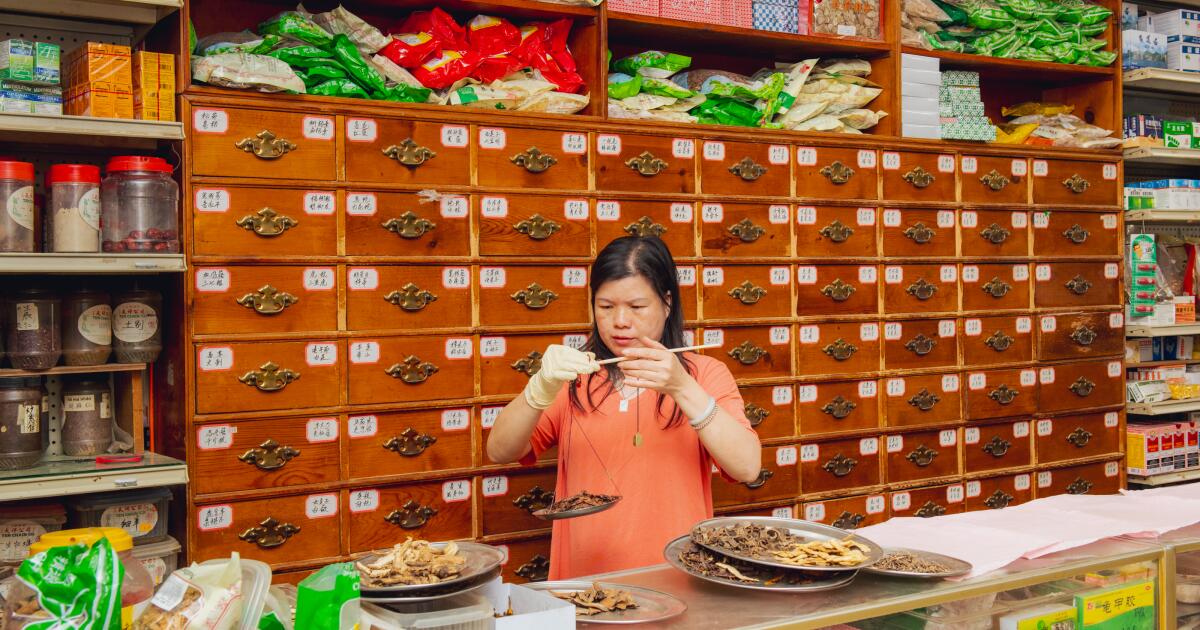
Based on the number of local L.A. content creators that have visited Tian Xiang — a small, nondescript herbal medicine shop in Los Angeles’ Chinatown — you might think it’s the single best Chinese pharmacy in Los Angeles. Its TikTok star, in particular, is rising. You can find more than two dozen videos on the platform of customers touring the business and documenting their alternative healthcare journeys.
One TikTok user, who goes by mooneyegoddess, traveled 2½ hours by train to L.A.’s Union Station in May, then walked several blocks to Chinatown to see the herbal doctor at Tian Xiang. Why?
“After being frustrated with modern doctors not listening to me when I go in, I decided to go to what my spirit connected best with, an herbal doctor,” the caption for her video read.
“And I’m telling you guys, I feel amazing!” she raved in the video.
Another customer gushed over the customization of the herbal prescriptions.
“Oh, you can’t find this in the store, uh-uh, not this, baby!” the user actressamira voiced over a TikTok video of raw herbs being sorted.
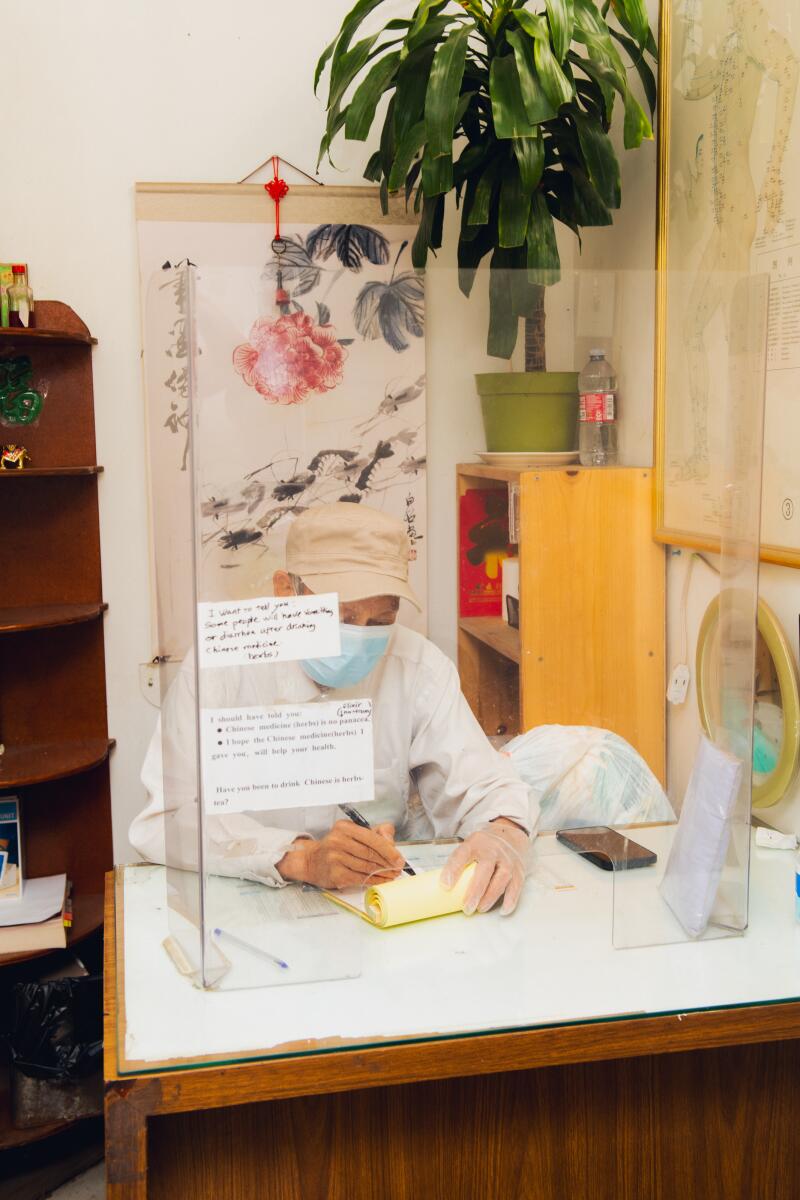
Huang at his desk inside the clinic.
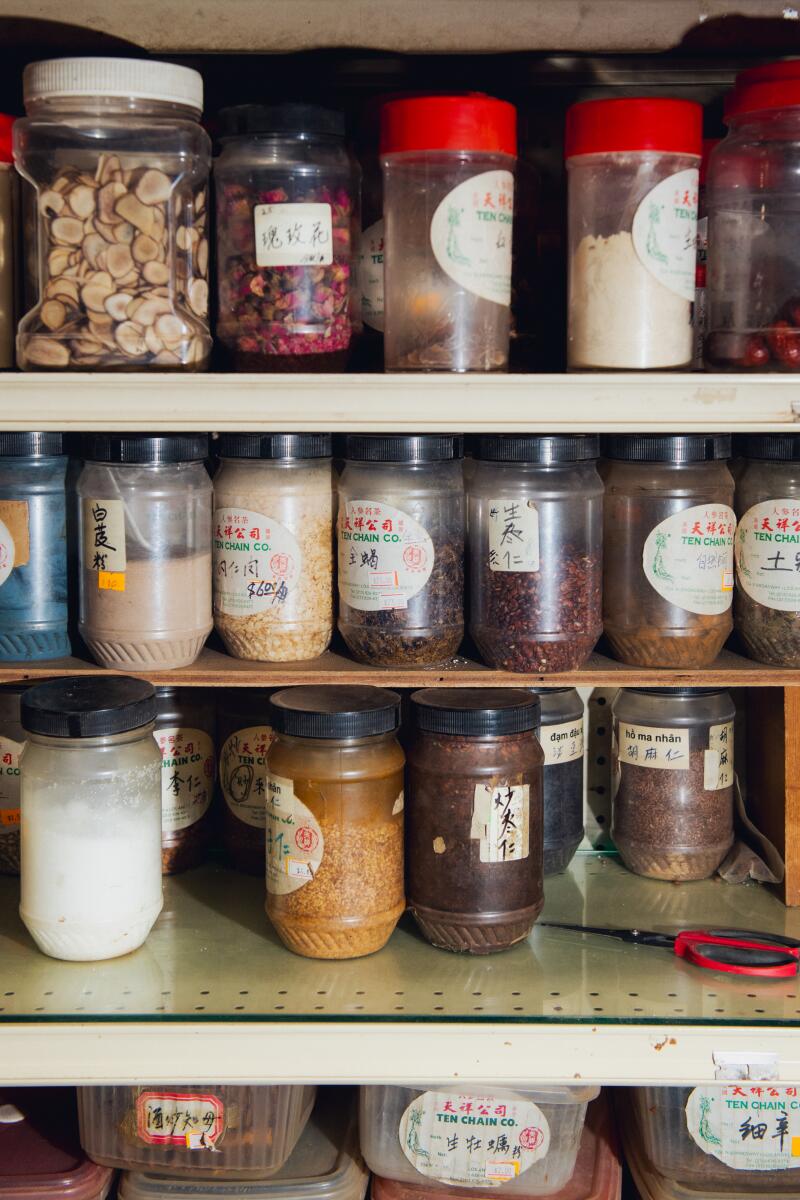
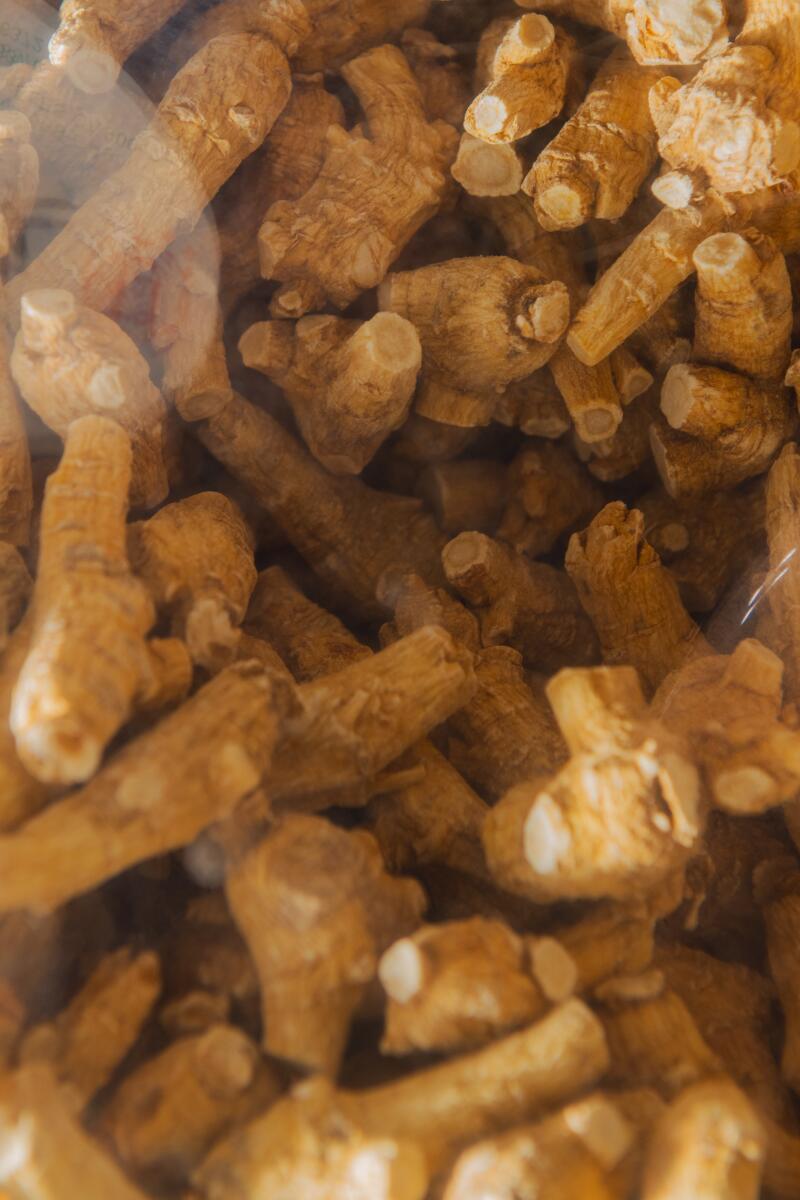
From top, left: Dry herbs, roots, and spices inside Tian Xiang.
The appeal is clear. Tian Xiang’s shelves are packed with dried herbs, roots and flowers that make a prism of colors and textures. A wall of wooden drawers stores loose herbs; bulk bins contain varieties of ginseng, goji berries and medicinal spices such as cinnamon and dried turmeric; a display behind the checkout counter showcases bottles of pre-made herbal supplements for nearly every imaginable condition: digestive issues, allergies, immune support, menopause, liver, heart and lung function among them.
What sets the store apart from other retail outlets, though, is the tiny clinic, jammed in a back corner beside a stack of unpacked boxes, barely larger than a walk-in closet. There, a man who goes by Dr. Huang — wearing a plastic surgical glove and medical mask — sits at a small desk behind a protective divider. (He did not go to medical school but has practiced traditional Chinese medicine, he says, for more than 50 years.)
There’s no weeks-long wait to see him, as is so often the case with, say, the U.S. healthcare system. Customers simply drop by, sans appointment, and pay $15 for a few minutes for Huang to assess their condition and prescribe them a customized, herbal remedy. It runs, on average, about $80-$95 for 10 days of daily use. The pharmacy will mix the herbs right there and send customers home with directions for how to prepare the loose tea.
There are more than 50 Chinese herbal apothecaries in the Los Angeles area, according to Willie So, sales director of Chinatown-based Solstice Medicine, a leading distributor of traditional Chinese medicine products since 1979. (He said Solstice Medicine has been providing inventory to Tian Xiang since the store opened.) And while Tian Xiang is a well-stocked and conveniently located one, its social media success is a mystery — even to the people who work there.
David He, the store’s manager, says Tian Xiang began seeing an uptick in business in 2020, at the start of the COVID pandemic, that has become amplified on social media over the last two years.
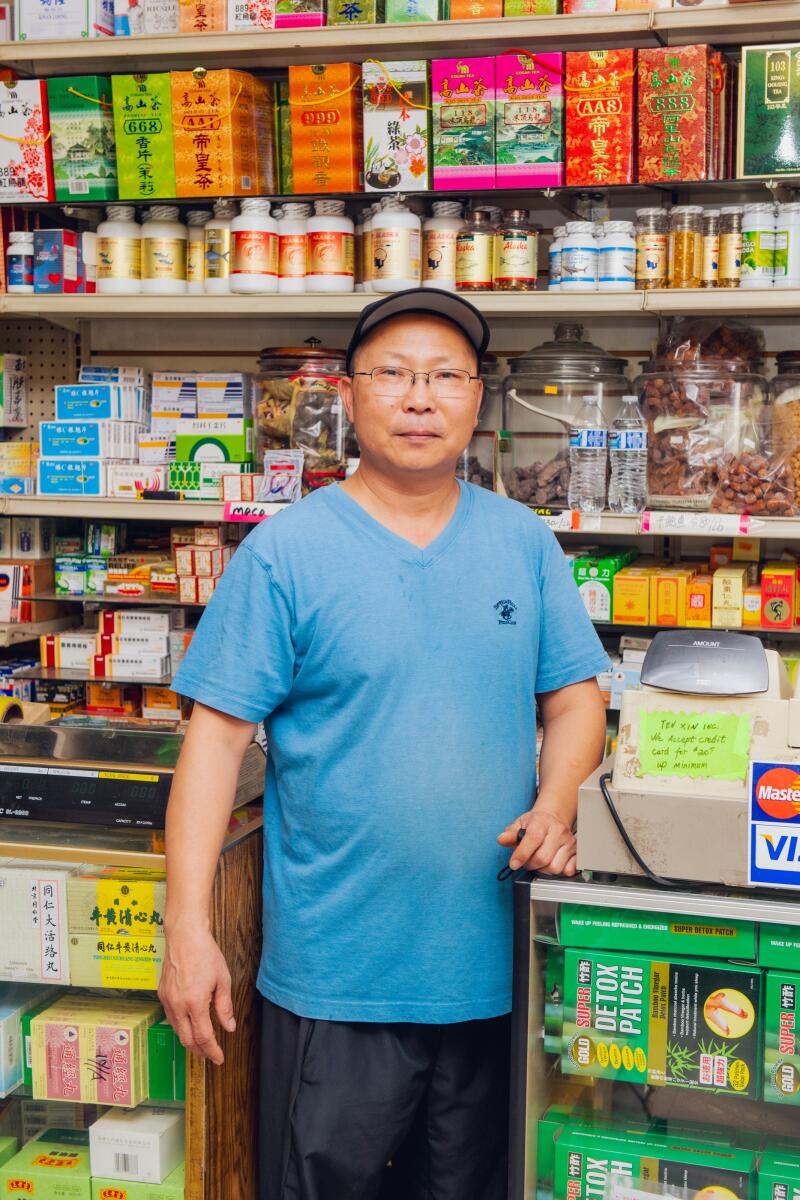
Store Manager, David He.
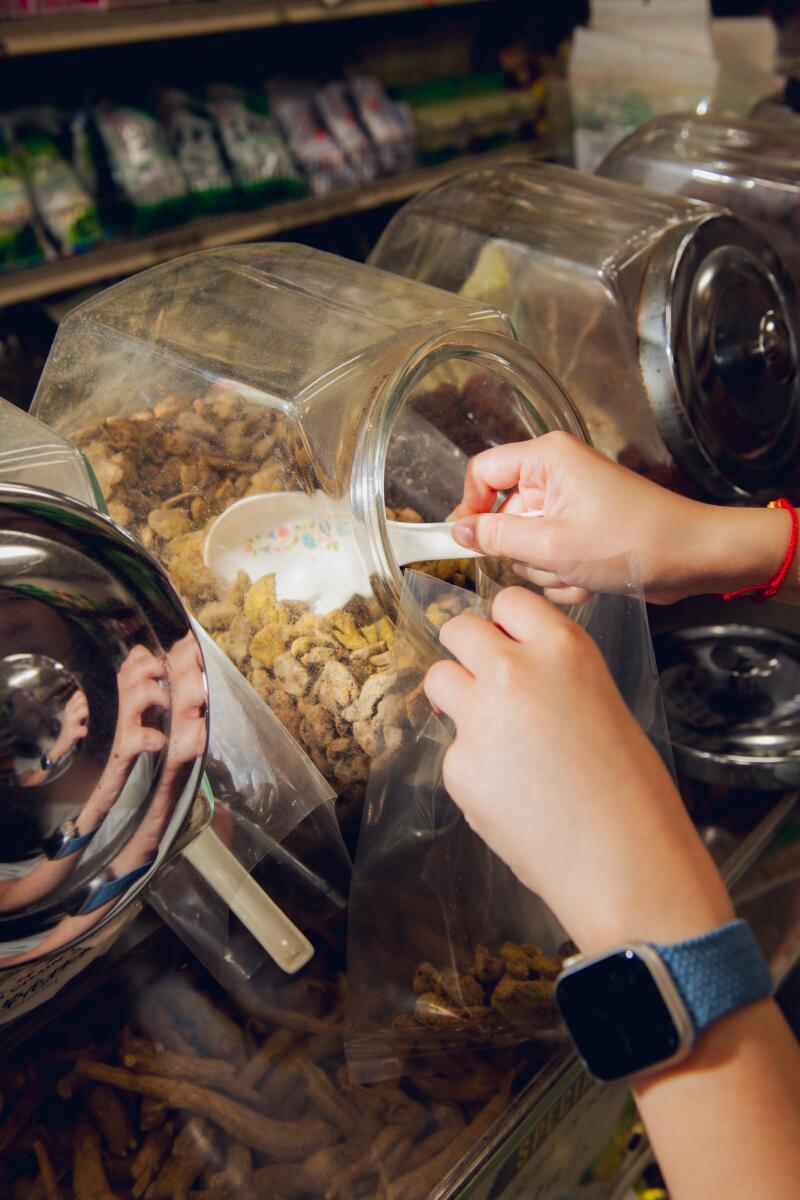
A container of dried fruit at Tian Xiang.
“Many Asian people from China and Cambodia and Vietnam came to get medicine for COVID because they believe more in traditional herbs to boost the immune system,” he said through a translator. “And at that time there was no vaccine. The customers felt good, and they posted about it, and then more people started coming. So it’s word of mouth.”
The type of wellness that Tian Xiang was peddling at the time was ripe for TikTok, says Freddy Tran Nager, a digital media professor at USC.
“A lot of alternative wellness trends do exceptionally well on social media, especially since the pandemic, as people look for new ways to be healthy,” he says. “And Asian culture, in particular, has been gaining more popularity online, whether that’s boba drinks or K-pop music — and Asian wellness goes along with it.”
That Tian Xiang is situated on Broadway, a main thoroughfare in Chinatown, didn’t hurt, he adds.
I was intrigued and decided to check out Tian Xiang for myself. I’m currently nursing a gym injury and open to anything that might help ease the pain in my neck and shoulder.
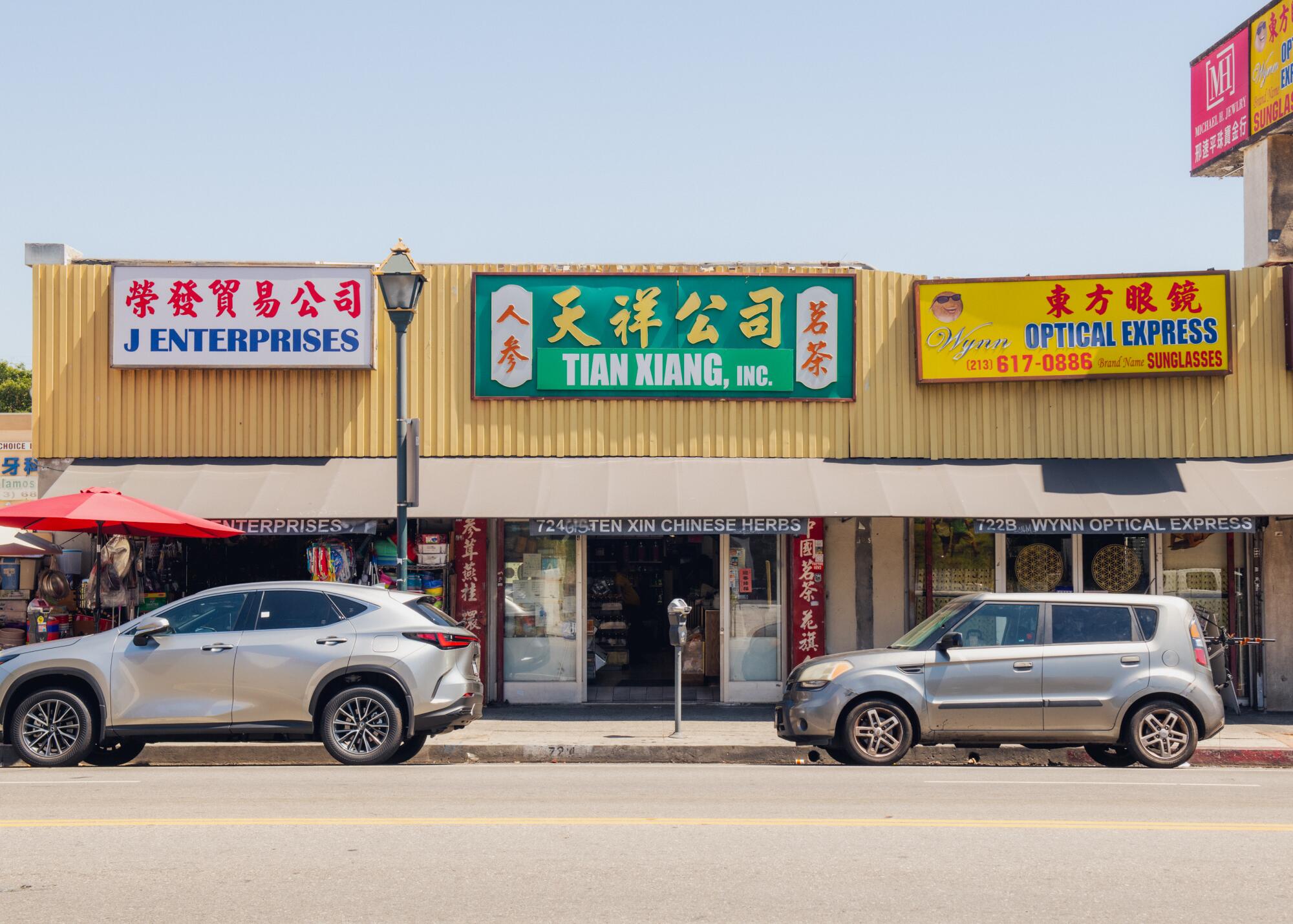
Tian Xiang’s location on Broadway, a main thoroughfare in Chinatown, provides it visibility to the curious wellness seeker.
Tian Xiang has been in the neighborhood for more than 40 years, though it has changed ownership multiple times. It’s a lively place, with a steady stream of customers — “mostly older, mostly repeat visitors and mostly Asian and Hispanic,” He says. They come regularly to treat everything from colds and the flu to infertility and back pain. The late-August afternoon I visited, I saw customers perusing the aisles and consulting with He, who frequently steps out from behind the counter, rubbing his belly or tapping his chest to demonstrate how the herbs might aid their ailments.
Nearby, two employees prepared a prescription for a customer, moving with assembly line-like efficiency in a precise but fluid dance: one ground herbs with a mortar and pestle while the other measured slabs of marbled ginseng on a traditional handheld gram scale. They alternately layered scoops of one ingredient or a sprinkle of another onto pieces of pink paper laid out on the counter top. Side by side, the piles of mixed herbs were like still-life paintings, each sparking with texture. Finally, a third employee packaged the herbs, sealing them in plastic bags.
“The doctor’s ready for you,” He told me, interrupting the mesmerizing show.
Our consultation was quick and to-the-point. Huang had me fill out my name and age on a small sheet of paper. Then he took my pulse. As he cradled my wrist, his forehead wrinkled in concentration. Then he tapped the keyboard on his phone for several minutes, writing into the Google Translate app, before pushing the phone toward me: “Poor blood circulation, weak spleen and stomach, disordered hormones, and a bit,” read the screen.
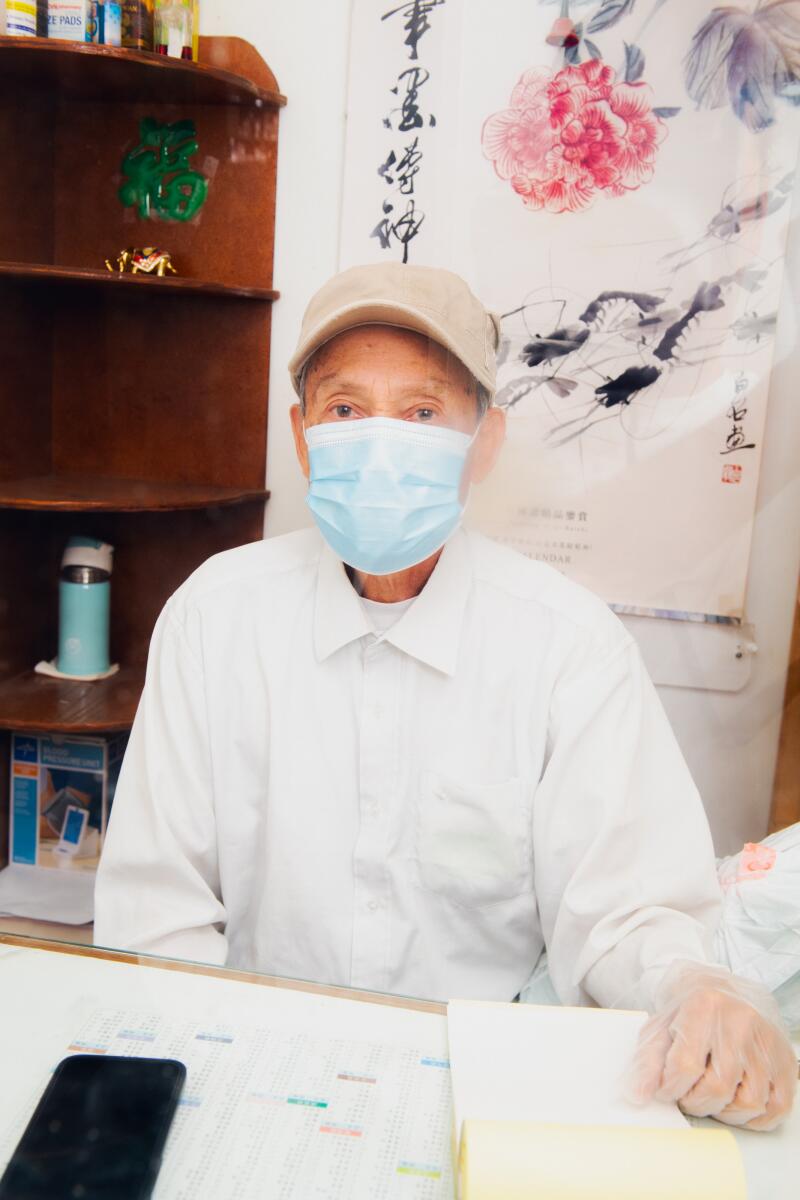
Huang inside the clinic.
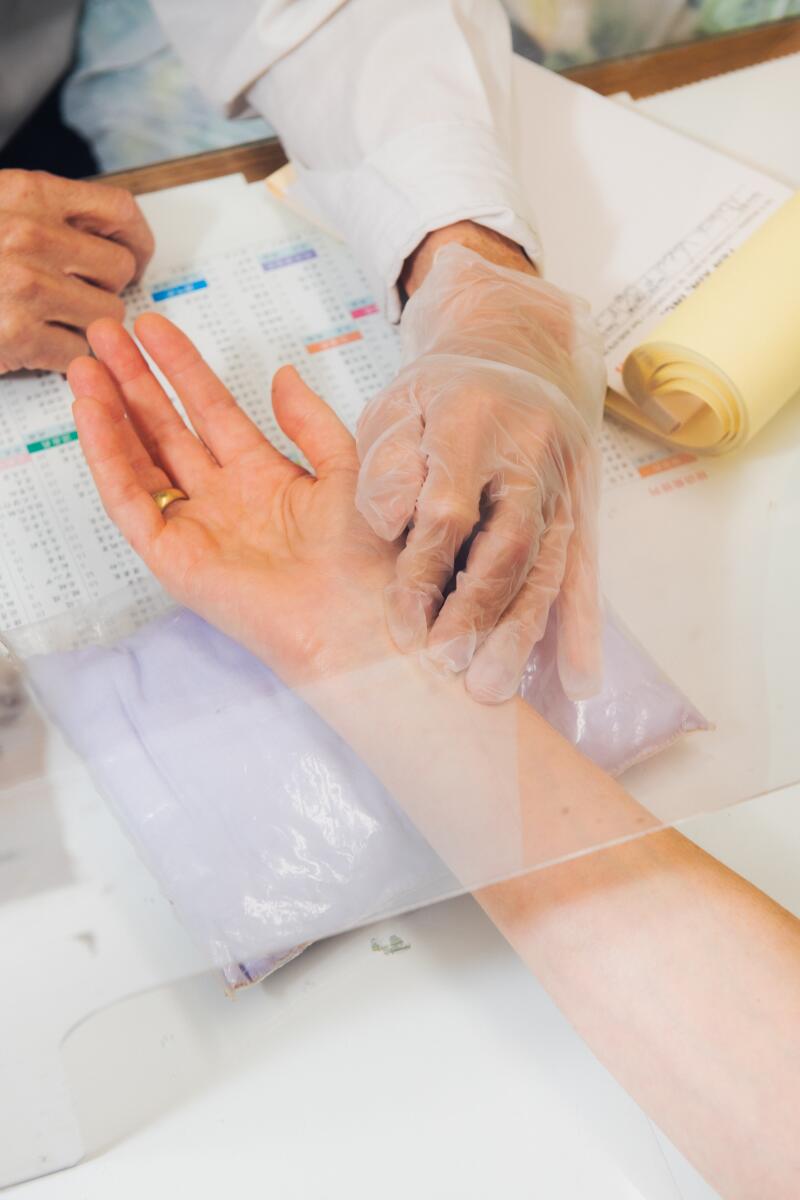
Huang takes reporter Deborah Vankin’s pulse.
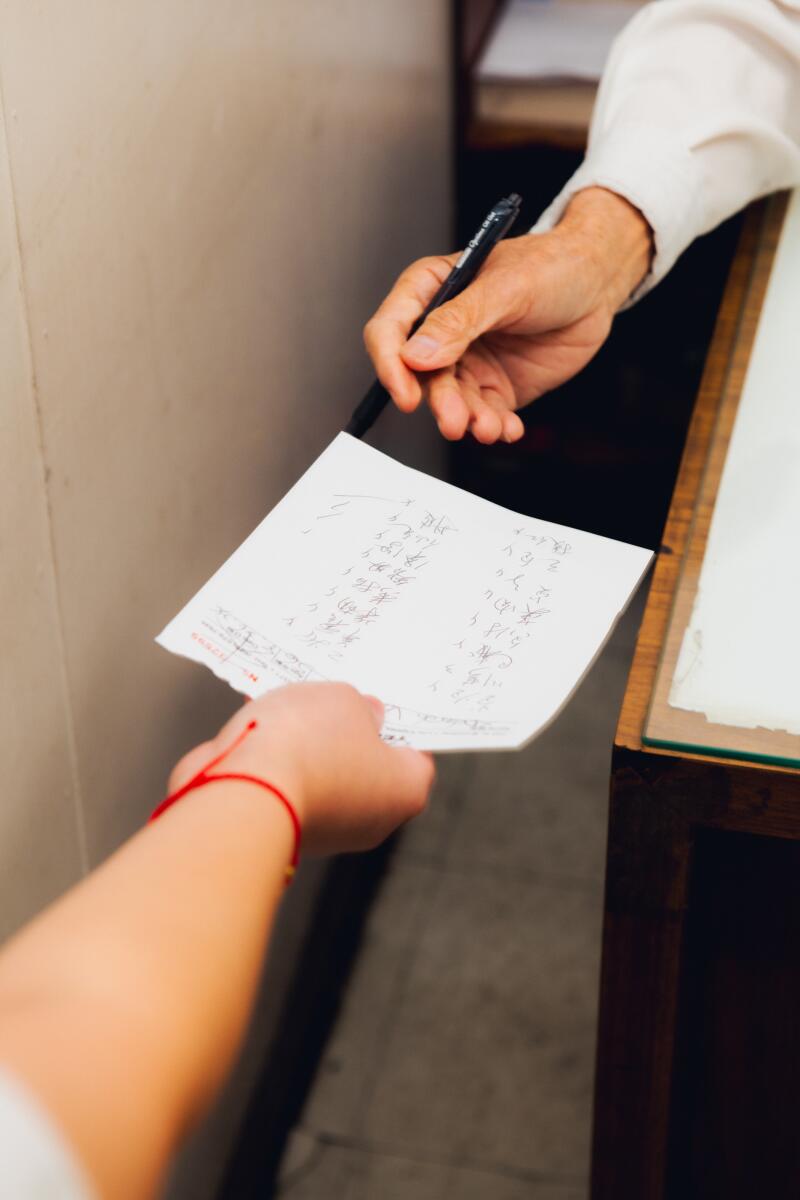
Huang hands over his prescription.
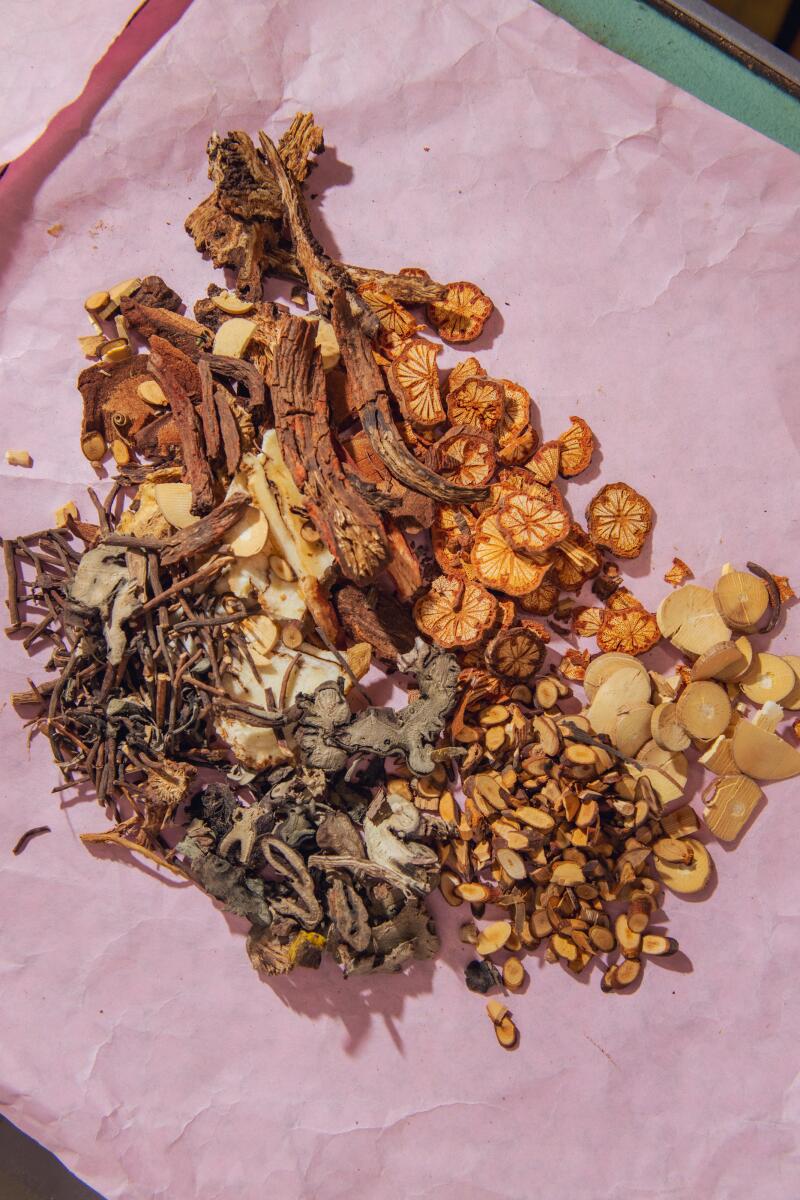
Dry herbs, roots, and spices for Deborah Vankin’s customized medicinal tea.
How did he know all this without examining me? He didn’t even look at my tongue, which is typical of a traditional Chinese medicine, or TCM, “tongue and pulse consultation,” I learned from a doctor at UCLA’s Center for East-West Medicine, while researching this piece.
“Experience,” he says through a translator. Huang has been working at Tian Xiang for more than 20 years. Before that, he practiced traditional Chinese medicine for 30 years in the city of Taishan in the Guangdong province of China. He’s a third-generation TCM doctor.
My neck stiffness, he says, is from poor blood circulation — he can tell that by listening to the rhythm and patterns of my pulse on each wrist, not just the number of beats per minute.
Herbal remedies in traditional Chinese medicine have been around for thousands of years, though their efficacy is debatable. Some, such as Dr. KaKit Hui, director of UCLA’s Center for East-West Medicine, say the right combination of herbs for the appropriate ailment can “save lives,” though he stresses the importance of practitioners being properly educated.
“Many conditions — coughing and upper respiratory infections or GI problems — can be helped,” Hui says. “They use herbs for lupus and cancer in China. But you don’t want to use herbs to replace necessary medications or [receive treatment] from someone who doesn’t know what can be mixed with what — herbs can interact with medications — you need someone who knows how to monitor it.”
Others, such as Dr. Craig Hopp of the National Institutes of Health’s National Center for Complementary and Integrative Health, which researches medical approaches outside the Western mainstream, note that Chinese herbs, like supplements, are not FDA regulated and there can be concerns about the purity of the plants and their provenance.
“It can sometimes get a little murky as to where [the herbs] come from,” Hopp says. “Lots of plants look alike and are called similar things, so the taxonomy and the nomenclature can be confusing. Unless you have a very well-trained botanist who knows what they’re looking for, you could be getting something else by the time it gets to an apothecary.”
My prescription — which came in three large plastic bags for six days worth of tea — was $63. It included 16 ingredients, Indian mulberry, golden eye-grass, the deciduous perennial Asian lizard’s tail and the carrot-like plant Szechuan Lovage among them.
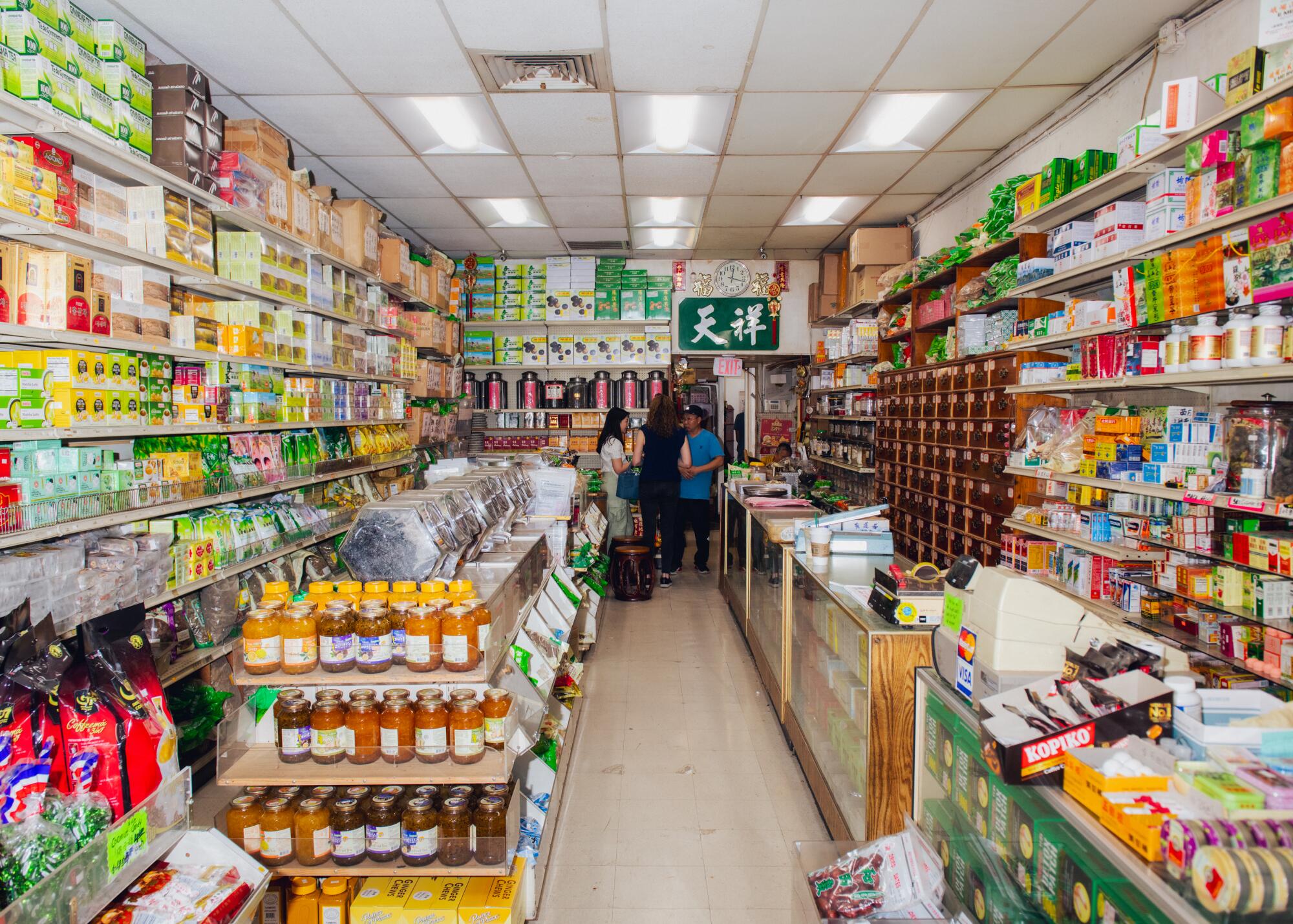
The interior of Tian Xiang, a Chinese herbal remedy shop.
He wouldn’t say where, exactly, the herbs come from, just that the store gets them from distributors in Monterey Park and Alhambra, who source them mostly from China, with some coming from Korea, Vietnam and Japan. He did say the herbs are “high quality.”
“My father, he’s 80 and he just had gallbladder surgery and the herbs seem to help,” one customer, Dericia Witalina, said while awaiting herbs her dad was prescribed. Her family lives in the San Fernando Valley and despite the drive, “if we need something, we come here,” she said.
Most, however, visit because it makes them feel healthier, He says.
“Many customers come here not to kill this germ or kill this virus, but it’s more about boosting the general body function.”
No matter how much better TikTok users claim to sleep or feel after drinking their prescribed herbal tea, the consensus on its taste seems to be less enthusiastic. One patron, who goes by 123aram5 on TikTok, summed up their review in two words: “Uh-uh — nope!” Others complained about the woodsy, pungent flavor.
I proceeded with caution, simmering the herbs for about an hour, per the store’s instructions, until they were mushy and the tea was a deep, murky brown. My home smelled like a forest after the rain, which was actually kind of pleasant and soothing.
The taste, however, was rank, nearly impossible to get down. I made a note to next time use a dollop of the honey and yuzu mixture, sold at the store. If there would be a next time.
That night I slept especially deeply. Was it the herbs? A placebo effect? The hot yoga I’d done earlier? Who’s to say. But I’ll take whatever I can get.
Grace Xue contributed reporting for this article, including translating interviews.


People visit the Liberty Bell on the eve of Independence Day in Philadelphia on July 3, 2025. The crack in this symbol of U.S. freedom echoes the paradox between national pride and civic ignorance revealed in a new national poll.
Juan Mabromata/AFP/Getty Images
hide caption
toggle caption
Juan Mabromata/AFP/Getty Images
A new national poll reveals a striking paradox in public sentiment ahead of America’s 250th anniversary: a disconnect between Americans’ strong patriotic pride and their lack of civic knowledge.
According to a survey from the libertarian Cato Institute think tank of more than 2,000 U.S. adults conducted in late June, 86% of respondents said they are grateful to be American and 70% believe the nation’s founding principles remain relevant.
However, nearly half of Americans (46%) don’t know that America’s 250th anniversary commemorates the adoption of the Declaration of Independence.
This civic ignorance extends to basic governance: Nearly 60% do not know the main purpose of the U.S. Constitution is to limit government power, and do not know why the colonies declared independence from Great Britain.
Furthermore, the report highlights deep anxieties about the future of American liberty.
The majority of those surveyed believe the country has strayed from its founding principles, and more than half fear the U.S. could cease to be a free country within the next 50 years, citing corruption and the abuse of power as primary threats. The majority of both Republicans and Democrats share these fears.
The concerns are especially pronounced among Gen Z respondents, who exhibited both the lowest levels of civic knowledge and the least favorable views of the nation’s founders. The majority of Gen Z failed to cite the adoption of the Declaration of Independence as the source of the 250th anniversary.
“The lack of civic knowledge is a great disaster,” said Coe Professor of History and American Studies and Professor of Political Science Emeritus at Stanford University Jack Rakove. “Any democratic system of government to succeed requires having an informed electorate.”
The Pulitzer Prize-winning authority on the drafting of the Constitution and the Declaration of Independence blamed the problem on the fragmented media landscape and schools prioritizing STEM subjects over civics and history.
“Our educational system is highly decentralized. So the idea that you could have one clean, neat, sweeping educational reform that will cope with the problem is hard,” Rakove said. “And of course, and we do live in this disaggregated information environment where people pick the sources they like. If you assume that a Democratic society depends upon well-rounded deliberation of being exposed to the views of other people, the information environment itself is not conducive to the underlying foundation of Democratic debate.”

Unpacking my third suitcase in our new West Hollywood home, a sharp pain shot through my chest. I felt dizzy and short of breath before sprawling out on our mattress, which was still covered in plastic.
“What’s wrong?” David asked.
An hour later, on a gurney in the emergency room at Cedars-Sinai, I waited to be admitted overnight. What a great start to our new life — back in L.A. after seven years in New York City — David sleeping alone at our apartment while I was to keep close to the paddles and operating room in case what had just happened was a heart attack.
I was 33, practicing yoga and exercising almost daily. A few months earlier, my New York doctor noticed I had high blood pressure, and I was feeling terrible, so something clearly was going on. Was an artery blocked? Nope, the tests revealed; physically, I was fine. What had happened was a panic attack.
“Your health will be better in L.A.,” David had promised before returning to L.A.
Now I took no pleasure in his being wrong.
After growing up in Temple City (hardly L.A.), I went on a high school trip to the Big Apple and knew it was where I needed to be.
Exactly five years later, the time to escape California arrived after a miserable breakup from a three-year relationship with a guy that I hid entirely from my family. I was desperate and depressed, down 15 pounds from not eating much, my diet consisting largely of cigarettes and red wine. At the Archstone, my Studio City apartment, I did ecstasy alone on a Wednesday. One has to take a good look at himself when he’s in his bedroom, by himself, rolling, and so I decided it was time to start over in New York.
On the other side of the country, I thought it was normal to hook up with a new guy every third night. Which I suppose, for a gay man who’d spent the first 27 years of his life denying his sexuality to a family he feared wouldn’t understand, it was. My self-esteem was in the gutter, though you wouldn’t have known it from the outside.
After a three-digit number of hookups on Grindr, I met David, a guy who lived on the same Manhattan corner as I did. We did what people do on Grindr and hooked up a couple of times.
But one morning, we bumped into each other on 9th Avenue. I left our short chat feeling uplifted by how smiley and polite he was in daylight and while we were sober. That night, we went on our first date, and the rest is history. But I hid what I assumed wouldn’t be well-received.
“Let’s move back to L.A.,” he said after four years of life together in New York.
“I’m really not ready,” I said. I loved living in New York and never, ever expected to leave. He understood, but he wanted to return to “the coast.” I knew that in a healthy relationship, it couldn’t be just what I wanted. So eventually, we packed up and moved to an apartment on North Flores Street in West Hollywood.
And now, I was in the hospital.
After having to cancel the welcome home party our L.A. friends had planned for us, and being released from Cedars, my life fell apart. But being the one who kept everything together, I kept it together better than most would, at least in the presence of others.
I’m fine, I told myself, but I worried my heart was broken, and there was something medically wrong with it. To heal it, I’d need to accept truths that I didn’t want to.
Growing up was devastatingly hard for me. Being gay and misunderstood, with the unacknowledged pain of it kept inside, was quite literally eating me alive. Being back in L.A. meant being near my past. I told my mom I was gay before leaving for New York. She said she still loved and accepted me, but to this day, the struggle has never been discussed or acknowledged. I knew I was a disappointment to my family.
I went to Westwood what felt like 70 times, and after visiting a bunch of UCLA’s specialists, I found myself in the office of a neurosurgeon who took one look at me and said, “You don’t belong here. What you’re suffering from is plain old anxiety, and you’re going to have to work with your therapist on this.”
“I have been,” I said, “and it’s not helping.” But before I finished, he had walked out the door.
Before long, the panic attacks got so bad, I could hardly drive. David chauffeured me, under the palm trees and bright sun, around as much as his schedule allowed, and when he couldn’t, I made the best of it, lugging my laptop with me for the hour-long trek to yoga-teacher training at Equinox in the South Bay, using that extra time in the back of an Uber to write.
For almost my entire adult life, I’d been in therapy, but it was couples therapy with David where I felt supported enough to admit, first to myself, that I’d been terrified of being fully myself. I was afraid he’d leave me if he saw the real me. Secretly I had been keeping a lifetime of pain bottled up inside because of fear — I didn’t want to risk losing him by being too emotional or having too many feelings.
Three months after that therapy session, the pandemic arrived, and being together 100% of the time for the next year, I let him in fully. He didn’t run — instead, he proposed.
It’s been eight years since that neurologist, and six since I’ve been able to fully drive again. And here in L.A., in a city characterized by its distance, I have, with David, built a close chosen family that supports and fully understands me.
Now, I feel “at home” at our Spanish-style Hancock Park house, the one we bought because we wanted to start a family of our own, only after L.A. allowed me to heal and live peacefully, and now, anxiety free.
Had David not dragged me back, I wouldn’t have learned what I did about myself, my story of origin and living a life that’s so beautiful and that’s so true to me.
And certainly, we wouldn’t be bringing our baby daughter, Lucy, named after Lucille Ball (who’s more Hollywood?), home in mid-July by way of surrogacy.
The author is a writer and coach who helps established business owners build lives that feel as good as they look. He lives in Hancock Park. He’s on Instagram: @iammattgerlach.
L.A. Affairs chronicles the search for romantic love in all its glorious expressions in the L.A. area, and we want to hear your true story. We pay $400 for a published essay. Email LAAffairs@latimes.com. You can find submission guidelines here. You can find past columns here.

Could you see your life just as easily with children as without?
What if you’re not cut out for parenthood? What if you grow lonely in your old age? Or what if you have a loving partner, but you disagree on this choice? Deciding between parenthood and a child-free life requires clarity about your fears and deepest desires — no easy task. This episode, psychotherapist and author of the book, The Baby Decision, Merle Bombardieri, helps us get clear. She discusses minimizing regret, normalizing feeling ‘stuck’ and why waiting to have a baby at 38 may be best.
Want more about the decision to have kids?
Many women don’t want kids. And for good reason.
Why are people freaking out about the birth rate?
Support Public Media. Join NPR Plus.
Follow Brittany on Instagram: @bmluse
For handpicked podcast recommendations every week, subscribe to NPR’s Pod Club newsletter at npr.org/podclub.
Additional support for this episode came from Alexis Williams. It was edited by Neena Pathak. Our Supervising Producer is Cher Vincent. Our Executive Producer is Barton Girdwood. Our VP of Programming is Yolanda Sangweni.
-

 Missouri3 minutes ago
Missouri Highway Patrol investigates death of staffer at youth ranch in Reynolds County; 1 juvenile arrested
-

 Montana10 minutes ago
Montana DEQ warns of algal blooms ahead of holiday weekend
-

 Nebraska13 minutes ago
Some Nebraska communities ban fireworks in year marked by drought, wildfires
-

 Nevada18 minutes ago
How Chinese-Americans contributed to mining in Nevada
-

 New Hampshire25 minutes ago
Man From Concord Arrested On Drug Sale, Subsequent Possession Charges: Concord Police Log
-

 New Jersey28 minutes ago
Mikie Sherrill welcomes July 4 tall ships to NJ at Sandy Hook
-

 New Mexico33 minutes ago
Wildfire smoke moves through Taos Valley, Northern New Mexico
-
North Carolina40 minutes ago
More than 60 North Carolina cases tied to parasite behind ‘explosive diarrhea’


