Sports
How a 'chiropractic adjustment' finally helped Max Muncy return to the Dodgers

A few days before Max Muncy strained his oblique in May, the Dodgers infielder noticed a bruise on his chest.
At first, he didn’t pay it much mind.
“You look in the mirror and you’re like, ‘Oh I’ve got some weird bruises there. Maybe I took a weird hop on a ground ball in practice or something,’” Muncy recalled recently. “You really don’t even think about it.”
As it turned out, the contusion actually was an early clue in what became a three-month odyssey for Muncy, who languished on the injured list for most of the summer with perhaps the most confounding ailment of any Dodger this season.
When Muncy went on the IL on May 17, the Dodgers expected him to return in a matter of days.
“I remember when it first happened,” manager Dave Roberts said, “we were even contemplating not even making it an IL.”
But as days turned into weeks, and weeks into months, Muncy’s discomfort never improved. His swing never felt right. And as his absence dragged on, he and the Dodgers medical staff started looking for other reasons the 33-year-old’s recovery was taking so long.
“I’d have a good day, and then I’d wake up and it’d feel like Day 1 of the injury,” Muncy said. “It was a whole process to get back to where I felt [OK] to even start to swing.”
Eventually, doctors discovered the root of Muncy’s issue: One of his bottom ribs was “out of place,” he said. And up until last month, it was starting to seem like it might cost the slugger the rest of his season.
“It was pretty severe,” Muncy said. “It didn’t feel like we were ever going to clear that hurdle.”
Now, however, all that is in the past. After a “chiropractic adjustment,” as Roberts termed it, late last month, Muncy’s rib finally was back into the correct spot. His lingering pain rapidly began to dissipate.
It culminated with his long-awaited activation this week, when he gave the Dodgers the kind of jolt they feared they’d be without for the stretch run: two home runs, two doubles and six RBIs in a three-game sweep of the Seattle Mariners.
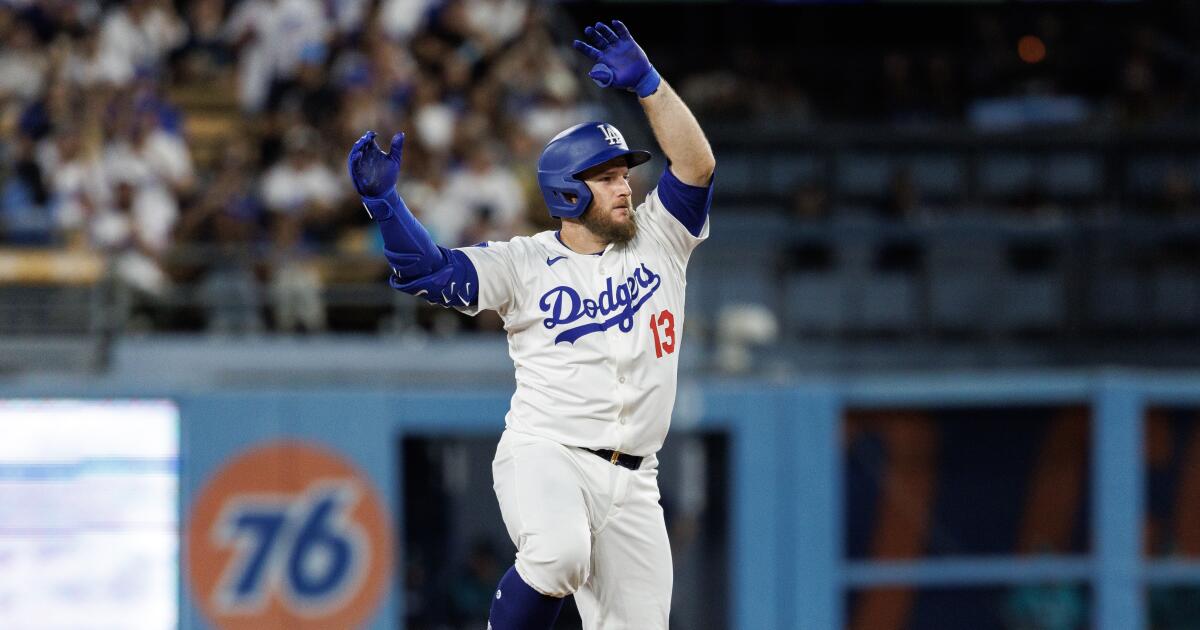
Dodgers third baseman Max Muncy celebrates after hitting a home run against the Seattle Mariners on Tuesday.
(Gina Ferazzi / Los Angeles Times)
Three months of uncertainty and despair, suddenly replaced by three electric days at the plate.
“I’d definitely say it’s unexpected,” Muncy said with a chuckle. “But it felt good. Just trying to keep things simple, and got some good results out there.”
The Dodgers’ new hope: that the saga proves to be a serendipitous turning point in their season, one of the rare injury subplots that might lead to a happy ending for both him and the team.
“To get back, hit the ground running, understand every play, every at-bat is important, and for him to pick us up … we’ve needed every bit of it,” Roberts said. “It’s just really good to have him.”
It didn’t take long for Muncy and the team to realize something was amiss when he was on the IL.
While scans showed he had an unusually bothersome oblique injury — he said in June it was affecting his entire core, rather one specific area — the stop-and-start nature of his recovery raised suspicions that something else was afflicting him.
While Muncy could take ground balls and complete other basic infield drills, any attempt to resume swinging resulted in one setback after another.
“I’d have two, three really good days of swinging, ball would be coming off hot, no pain in the swing at all, bat speed would be great, and then I’d wake up on the third or fourth day and it’d feel like Day 1 of the injury,” Muncy said. “We’d start back over and go back to the drawing board, see what was going on, go get more scans. That process obviously happened three or four times.”
Early in that process, Muncy thought back to that bruise he had before he got hurt. And as his absence dragged on, the medical staff turned its attention to his rib cage, realizing that might be causing the delays in his recovery.
“My best guess is maybe the week leading up to when I got hurt, I dove for a ball or something and landed on it wrong, and we just didn’t know it at the time,” Muncy said. “We thought that maybe it was hurt before that day even happened.”
That led Muncy to begin making routine trips to a chiropractor, who made several attempts to get Muncy’s displaced rib back in the right position.
“It just wasn’t ever getting set properly,” Muncy said. “Each time I tried to come back, I felt like I was locked and couldn’t move properly.”
But then another trip to the chiropractor in late July resulted in a long-awaited breakthrough, with Muncy immediately feeling relief in the area that had bothered him for so long. When asked how his chiropractor did it, Muncy laughed.
“I’d re-show you, but I can’t actually physically get my body in that position,” he said. “It kind of felt like they almost broke my rib, but they didn’t. But it almost felt like that’s what happened.”
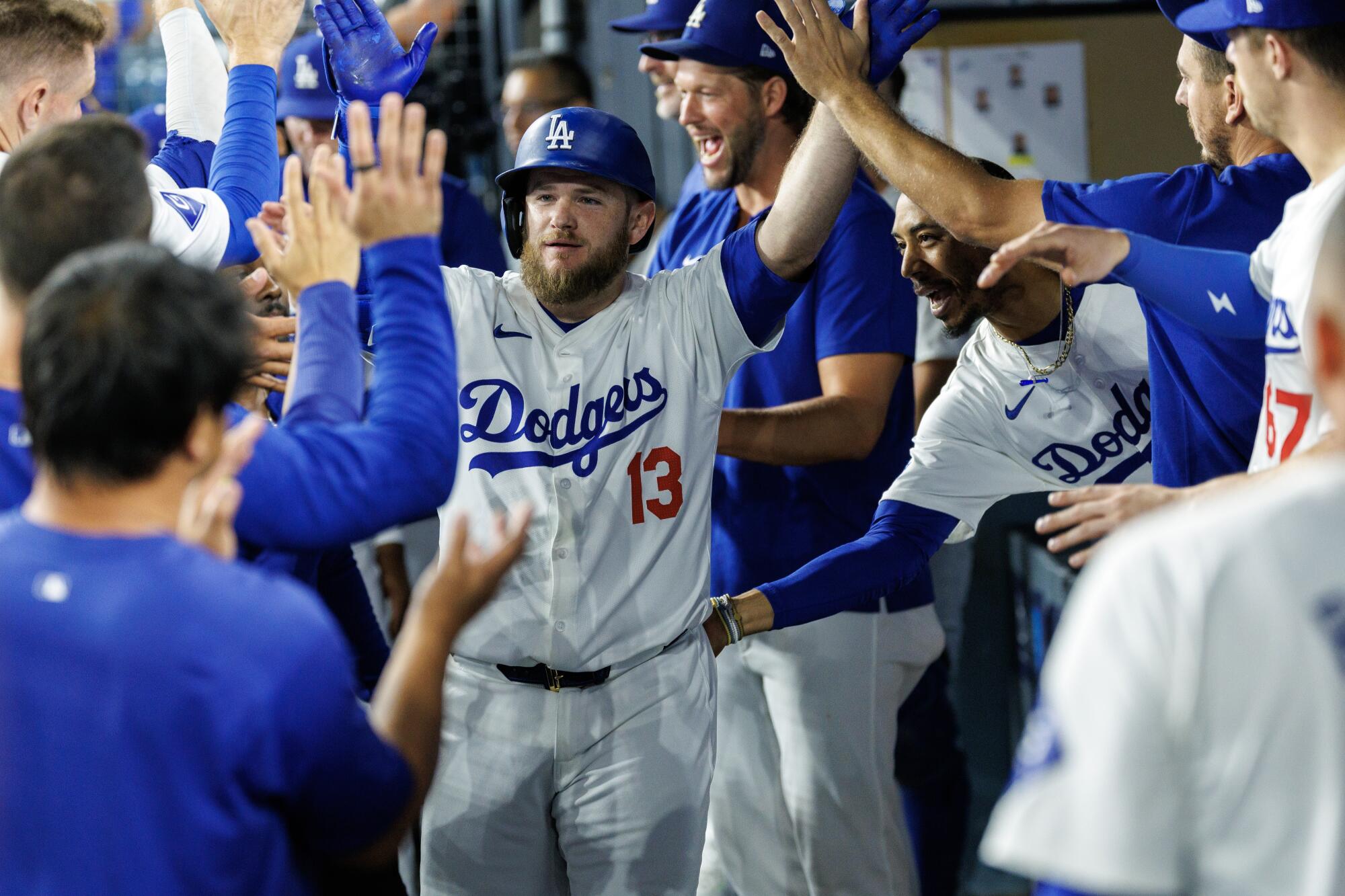
Max Muncy celebrates in the dugout after hitting a solo home run against the Mariners on Tuesday.
(Gina Ferazzi / Los Angeles Times)
The adjustment, coupled with a pain-relieving injection the following day, allowed Muncy to finally turn a corner. This time there were no setbacks or aggravations. He quickly progressed from swings in the cage, to live at-bats, to a weeklong rehab assignment with triple-A Oklahoma City. Then his monster week against a talented Mariners pitching staff.
“It felt like I was never even hurt,” Muncy said. “That’s why this whole process has been pretty fast once we got that going.”
The challenge will be carrying it on over the final five weeks of the season, with Muncy resuming his role as the Dodgers’ everyday third baseman while batting seventh in a suddenly deep batting order.
During his time on the IL, Muncy said he tried to maintain certain “cues” in his swing mechanics, mimicking his hand placement and foot position while at home watching the Dodgers. But his swing isn’t exactly the same as it was early in the season, when the ninth-year veteran flashed early improvements following disappointing 2022 and 2023 seasons.
“When I come back, it’s just second-nature to be thinking about that stuff,” Muncy said. “But at the same time you have to get your swing back. So it’s a little bit of both.”
If this week was any indication, he’s close to finding that balance. He homered Monday night on a hanging changeup over the plate, then went deep again Tuesday on a 95-mph fastball well above the strike zone.
In Roberts’ eyes, however, Muncy’s biggest contribution might have been a bases-loaded, three-run double Wednesday — on a first-pitch slider up in the zone — that put the Dodgers’ 8-4 win out of reach.
As the manager noted, the knock allowed the team to stay away from key relievers like Michael Kopech in the later innings.
“That,” Roberts said, “has an exponential effect on our ballclub.”
Of course, the Dodgers would have preferred to get such contributions from Muncy all season. His extended absence contributed to a revolving door of replacements at third base, and the team’s seasonlong struggles to balance the lineup.
Getting him back, however, already is serving as a nice consolation.
“It was always in the back of my head … that, ‘Oh, what if this happens again?’” Muncy said. “But we’re definitely in the clear on that now. It’s a blessing to be back out here.”


Rui Hachimura became the latest Lakers player to move on, agreeing to a two-year, $28-million deal with the Clippers on Monday, people familiar with the deal but not authorized to speak publicly on the matter confirmed to The Times.
Hachimura played at a high level for the Lakers in the playoffs, averaging 17.5 points per game in 10 postseason games, the third-highest average on the team.
He was a lights-out shooter, making 54.9 percent of his field goals and a sizzling 56.9 percent of his three-pointers, which ranked him fifth in three-point shooting during the NBA playoffs.
According to people familiar with the team but not authorized to speak publicly, some members of the Clippers coaching staff liked how Hachimura played and thought he would be a good pickup because of his shooting and athleticism.
The Lakers acquired Hachimura, 28, from the Washington Wizards in Jan. 2023. He spent three-plus seasons with the Lakers and was a favorite of his teammates.
His ability to knock down three-pointers from the corner opened up things for Luka Doncic and Austin Reaves, both of whom could rely on Hachimura to be ready to catch and shot even when he didn’t get many touches.
Over 68 games last season with the Lakers, 41 as a starter, Hachimura averaged 11.5 points and shot 51.4 percent from the field and 44.3 percent from three-point range.
He started all 10 playoff games for the Lakers, scoring a playoff-high 25 points against the Thunder in 43 minutes, going nine-for-15 from the field, four-for-eight from three-point range.
Sports
England stuns Mexico 3-2 in instant World Cup classic, hands team first World Cup loss at Estadio Azteca

NEWYou can now listen to Fox News articles!
One of the tournament’s instant classics unfolded Sunday at the historic Estadio Azteca, where 87,500 screaming fans created a deafening atmosphere.
England weathered the storm, silencing the sea of green with a ruthless finishing display to escape with a dramatic 3-2 victory.
Jude Bellingham and Harry Kane combined to crush El Tri’s World Cup dreams. El Tri is a popular nickname for the Mexican men’s national team.
WORLD CUP ROUND OF 32 SOCCER PREVIEW AS ENGLAND, BELGIUM AND USA ALL SEEK REGULATION WINS ON A PACKED DAY
England’s Harry Kane buries a penalty kick to score his second goal against Mexico. (Photo by Nick Potts/PA Images via Getty Images) ((Photo by Nick Potts/PA Images via Getty Images))
In a stunning two-minute span in the first half, Bellingham struck twice, leaving Mexico’s defense completely shell-shocked.
But before halftime, Julian Quinones gave El Tri a lifeline. He buried a clutch goal, trimming the deficit to 2-1.
The second half was as electric as the first.
USA WORLD CUP STAR CALLS LACK OF APPEAL PROCESS FOR TEAMMATE’S RED CARD ‘BOGUS’
In the 53rd minute, England went down to 10 men after Jarell Quansah was shown a straight red card. Suddenly, the momentum appeared to swing in Mexico’s favor.
England’s Jude Bellingham clears the danger as goalkeeper Jordan Pickford celebrates the crucial defensive stop. (Photo by Nick Potts/PA Images via Getty Images) ((Photo by Nick Potts/PA Images via Getty Images))
Instead of capitalizing on the numerical advantage, however, Mexico gifted England a golden opportunity.
Goalkeeper Raul Rangel recklessly brought down Anthony Gordon inside the penalty area, conceding a spot kick. Captain Harry Kane calmly stepped up and buried the penalty, restoring England’s two-goal cushion at 3-1.
Still, Mexico refused to fold.
In the 69th minute, the referee pointed to the spot once again, awarding Mexico a penalty after another frantic sequence inside England’s box.
Raul Jimenez confidently converted, cutting the deficit to 3-2 and setting up an edgy finish.
England’s Jude Bellingham (left) reacts after Mexico’s Julian Quinones scores their side’s first goal of the game during the FIFA World Cup Round of 16 match at Mexico City Stadium, Mexico. Picture date: Sunday July 5, 2026. (Photo by Nick Potts/PA Images via Getty Images) ((Photo by Nick Potts/PA Images via Getty Images))
From there, England dug in, despite being down to 10 men. England absorbed wave after wave of Mexican pressure before hanging on for a gritty 3-2 victory, advancing to the quarterfinals against Norway.
England booked its place in the quarterfinals and handed Mexico its first-ever World Cup defeat at the Estadio.
CLICK HERE TO DOWNLOAD THE FOX NEWS APP
Traveling England supporters celebrated by belting out “Wonderwall” one more time.
Send us your thoughts: alejandro.avila@outkick.com / Follow along on X: @alejandroaveela

As the announcer called out his name in the lineup, Eliezer Alfonzo hugged fellow Venezuelan Miguel Rojas before the catcher walked down the dugout to greet his teammates and coaches. The two had written messages on their caps in silver ink: On Alfonzo’s, “EyP, RIP,” the initials of his stepmother Patricia and his younger sister Eliana. On Rojas’, a cross was drawn next to “Alfonzo” and below “Fuerza Matatan.” In other words, stay strong, Matatan, the nickname given to Alfonzo’s father, the former major league catcher Eliezer “El Matatán” Alfonzo.
An unimaginable weight rested on his shoulders when Alfonzo stepped into the batter’s box to a standing ovation. Alfonzo’s stepmother and sister were reportedly found dead after the earthquakes in Venezuela last month.
Alfonzo went 0-for-2 in an otherwise quiet Dodgers 5-2 loss to the Padres, though even in that performance, he found moments to reflect. His sister, he said after the game, had a dream that she refused to tell him until it came true.
“I’m pretty sure the dream was something about this. I wish she was alive to watch me play in the big leagues,” Alfonzo said. “But I know she’s in God’s side now, and she’s gonna protect me, and she’s gonna enjoy every moment that I’m gonna have.”
He honored his family’s loss by playing as if his sister were sitting in the stands. Because if she were here, he said, she would be yelling from the stands, “Hit the ball hard!”
The Dodgers catcher had previously clung to hope that the two, who had been reported missing, would be found. His father had searched tirelessly for them, his hope bolstered when he found the family’s dog alive. Alfonzo’s father stayed in the country, searching, when the Dodgers called his son to let him know he’d join the team.
The series finale with the Padres should’ve been a happy day. Most players who have toiled in the minor league system debut in front of applauding friends and family. Instead, Alfonzo’s first appearance, the culmination of nine tireless years, was somber , stricken by the grief overshadowing what should’ve been a joyous moment in the Dodgers’ to the Padres.
Even manager Dave Roberts was lost for words.
“After today, it’s going to really hit him,” Roberts said. “All of us feel for him and his father, who I know, their family. It’s devastating.”
Alfonzo never considered not playing today, despite the personal tragedy. He’s spoken with his brother and his father in Venezuela, who asked him to play in the series finale for his sister. His agent, girlfriend and teammates, like Rojas, also helped Alfonzo approach the game calmly.
“What happened, unfortunately, is out of my hands and part of life,” he said in Spanish. “Only God knows why they happen. I went out there to honor my sister and my stepmother, and give my best in a difficult moment. Unfortunately, we couldn’t get the win, but you have to keep moving forward.”
Rojas, who spoke through reddened, teary eyes after the game, knows the family well. He learned from and played against Alfonzo’s father in Venezuelan winter ball. And, in a country struck by tragedy, this loss felt close to home.
“Everybody in Venezuela loves his dad,” Rojas said. “It’s really tough right now to put into context and to put into words. Just for him to be here today and making the decision that he was going to fulfill his childhood dream of playing in the big leagues, thinking about that and thinking about them and what happened over there and what his dad has to be going through right now by himself in Venezuela, it’s really tough.
“For me, I’m just going to support the whole family and especially Eliezer, because I know how hard it is to play like that. It’s been hard for me. Nothing happened to one of my family members, but as soon as I heard the news about them, it hit me as hard as if it were my family. I consider Eliezer Alfonso Sr. one of my close friends in baseball.”
In a way, playing baseball helps bring happiness to those going through tragedy, Rojas said. He knows because he’s lost both his parents, but his family still asks him to play.
“This is how I make a lot of people happy in my family and people who know me,” he said. “This is not just my job. This is who I am.”
Against the Padres, Rojas helped break a five-inning hitless streak for the Dodgers (59-32), who lead MLB in batting average (.265), with a single in the fifth. However, by then, the team had already found itself in a hole.
Emmet Sheehan gave up an RBI single to Padres’ center fielder Jackson Merrill in the fourth inning. In the fifth, he pitched himself into a jam, giving up a successive walk and double that put two runners in scoring position. With no room for error, Sheehan was quickly replaced by Jack Dreyer, who escaped the inning scoreless.
Sheehan (4-6) has now had five straight starts that lasted no more than five innings. But, having given up only one earned run in the series closer to the Padres (44-45), Sheehan’s start could be viewed as a step in the right direction: only three hits and five strikeouts.
“I thought the first three innings were great,” Roberts said. “They really were. I thought the stuff was up, he was on the attack, you’re getting the swing-and-miss, getting the soft contact, he was great.”
However, emotions remained high on both sides. San Diego’s manager Craig Stammen and coach Ryan Goins were ejected three pitches into the game after arguing a check-swing call. The ejection seemed to spark the Padres back from a season-high eight-game losing streak, though the Dodgers didn’t make the win easy at times.
The pressure ratcheted up in the sixth when Shohei Ohtani and Andy Pages worked walks off Yuki Matsui, who replaced JP Sears. The Padres switched pitchers again before Mookie Betts’ two-out at-bat, and the move paid off. Betts hit a routine flyball, and the inning — and the Dodgers’ momentum — ended.
After scoring in the fourth, San Diego extended its lead in the seventh courtesy of Fernando Tatis Jr. and Manny Machado. Tatis Jr. beat out a throw from Rojas to Freddie Freeman, driving in one run. And though the Dodgers challenged, the call was upheld. Then, two batters later, reliever Kyle Hurt threw a four-seam fastball down the middle of the plate, and Machado rocketed the pitch to the center field wall beyond the grasp of a leaping Pages.
The Dodgers clawed back two runs in the seventh. Alex Freeland drove in one on a line-drive RBI-single. Ohtani added another one. Neither was enough to win, though it ensured the Dodgers weren’t blanked.

Shohei Ohtani loses his bat during the third inning Sunday.
(Eric Thayer / Los Angeles Times)
Still, the game’s result seemed minuscule when stacked against Alfonso’s personal tragedy and the earthquake’s destruction in Venezuela. And, as the country and its people begin to piece together the full toll of the destruction amid the rubble, the notion of playing baseball seems absurd in the wake of such tragedy.
“It’s not always easy, but sometimes getting on the field, competing, life goes to the wayside,” Roberts said. “And you can just compete and do your job, and that’s sort of a blessing. But yeah, to play every day, and to have to perform, it’s pressure in itself.”
But for the men who have only known how to play baseball since they were young, there’s little else to do.
“That’s the worst feeling, feeling selfish of being here and playing, and we look out there like we’re having fun and we’re laughing,” Rojas said. “At the end, when I put my head to bed after everything is over, after the show is over, it’s really hard to go to sleep. I’m pretty sure a lot of Venezuelans are going through the same thing.”
-

 Technology5 minutes ago
Fake Booking.com travel credit scam targets travelers
-
 Business12 minutes ago
Many indie festival films struggle to get distribution. Alamo Drafthouse is trying to change that
-
 Entertainment15 minutes ago
AI actor Tilly Norwood to star in first movie
-
 Politics27 minutes ago
Trump says he disputed U.S. star player’s suspension, calling it ‘stain’ on World Cup
-
 Science30 minutes ago
14 propositions that could remake California taxes, housing, healthcare and elections
-
Sports35 minutes ago
Lakers lose Rui Hachimura, who signs two-year deal with the Clippers
-

 World45 minutes ago
Hungary could vote to oust president as early as next week
-

 New York2 hours ago
How a Museum Security Guard and Artist Lives on $51,000 in Parkchester

