California
See COVID’s toll on California’s life expectancy in new CDC longevity report

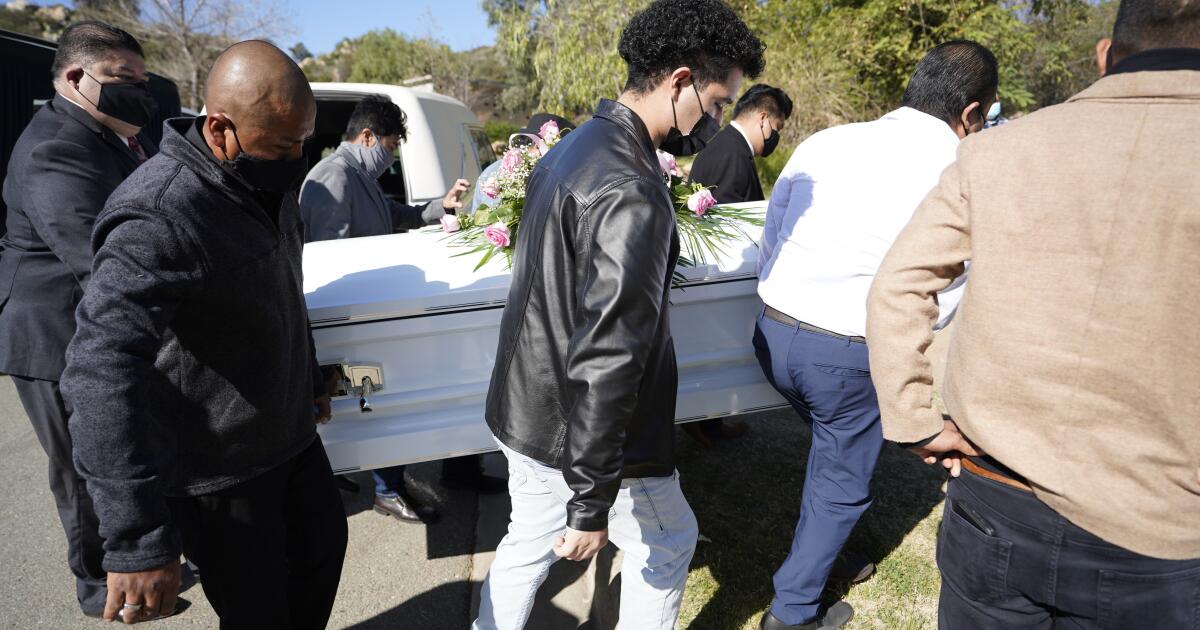
It was the year COVID-19 vaccines became widely available, and the pandemic’s startling death toll in California and elsewhere appeared close to being reined in.
Instead, life expectancy in California fell by more than 8 months in 2021, dropping the Golden State to 10th place in the nation, according to a new report from the Centers for Disease Control and Prevention.
An analysis of all 50 states and the District of Columbia found that babies born in California in 2021 could expect to live 78.3 years — down from 79 years in 2020, when California ranked fourth in the nation.
The decrease, which was reported Wednesday by the CDC’s National Vital Satistics System, revealed that the promise of COVID-19 vaccines — along with other public health measures — was not enjoyed uniformly across the nation.
While life expectancy dropped in California and 38 other states, it increased in 11 others and held steady in the District of Columbia. (New Jersey logged a gain of 1.5 years between 2020 and 2021, the best performance among the states.)
In 2019, before the coronavirus reached U.S. shores, the state’s overall life expectancy at birth was 80.9 years, with an expected life span of 78.4 years for men and 83.3 years for women. That put California in the No. 2 spot, just slightly behind Hawaii. (The states were so close that Hawaii’s overall life expectancy that year was also reported as 80.9 years.)
Then deaths during the first year of the pandemic shaved 1.9 years off California’s life expectancy at birth. Only 15 states weathered larger declines. (New York saw the biggest drop, losing 3 full years of life expectancy between 2019 and 2020.)
Expected life spans in the Golden State shrank by another 0.7 years in 2021, according to the new report. That was the 27th-largest decline, putting it in the middle of the pack. (The biggest drop was in Alaska, where it plunged from 76.6 to 74.5 years.)
This map divides states into quartiles based on their life expectancy at birth for 2021. The darker the state,the longer the life expectancy.
(National Center for Health Statistics, National Vital Statistics System)
The life expectancy of Americans as whole fell by 0.6 years to 76.4 years, according to the new report. CDC researchers attributed that decrease primarily to high numbers of COVID-19 deaths and fatalities from accidental drug overdoses.
Hawaii retained the longevity crown in 2021, with a life expectancy of 79.9 years.
That was a full 9 years longer than in Mississippi, which ranked 51st among all states and the District of Columbia. A baby born in the Magnolia state could expect to live 70.9 years, according to the new report.
The states that rounded out the top five overall in 2021 were Massachusetts (79.6 years), Connecticut (79.2 years), New York (79.0) and New Jersey (also 79.0).
Joining Mississippi at the bottom of the list were West Virginia (71.0 years), Alabama (72.0 years), Louisiana (72.2 years) and Kentucky (72.3 years).
More broadly, “states with the lowest life expectancy at birth were mostly Southern states,” the report said. “States with the highest life expectancy at birth were predominantly Western … and Northeastern states.”
Women were expected to outlive men in every state in 2021. The life expectancy gap ranged from a high of 7.6 years in New Mexico to a low of 3.9 years in Utah. The average gender gap for the country as a whole was 5.8 years, according to the report.
In California, the expected lifespan was 81.4 years for a baby girl born in 2021 and 75.3 years for a baby boy — a difference of 6.1 years.
For the most part, the states with the largest differential between the sexes had lower life expectancies overall. Meanwhile, states with the smallest discrepancies between males and females tended to have higher overall life expectancies, the CDC noted.
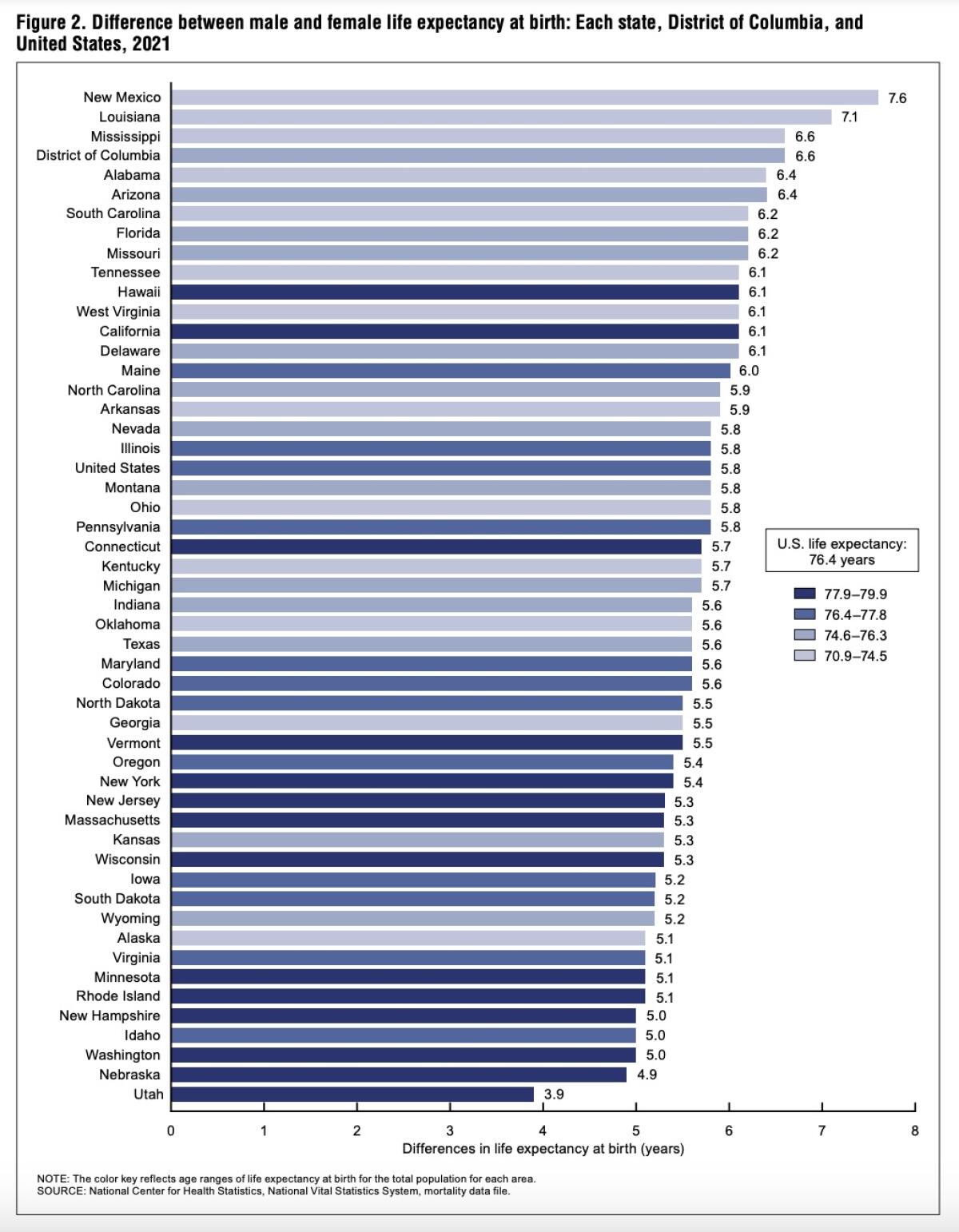
This chart ranks states according to the size of their gender gap for life expectancy at birth in 2021. New Mexico had the biggest discrepancy, while Utah had the smallest.
(National Center for Health Statistics, National Vital Statistics System)
CDC researchers also calculated the remaining lifespan for Americans who were 65 years old in 2021. The nationwide average was 18.4 years — 17.0 years for men and 19.7 years for women.
Life expectancy at 65 is always greater than life expectancy at birth because the pool of people who survive to their 65th birthday excludes those who weren’t able to reach that milestone.
The risk of death in the first year of life is particularly high — the U.S. infant mortality rate in 2021 was 5.44 deaths per 1,000 live births — and actuarial life tables from the Social Security Administration show that it takes until age 49 for the mortality rate to reach the same level.
In 2021, 65-year-olds in Hawaii had the most years to look forward to, with an average remaining life expectancy of 20.6 years. That was followed by Connecticut at 19.9 years, Massachusetts at 19.6 years, and Minnesota, New York, Vermont and New Jersey at 19.4 years.
Mississippi ranked 51st on this longevity list as well, offering 65-year-olds an expectation of 16.1 more years to live. West Virginia also had a remaining life expectancy of 16.1 years, followed by Alabama, Oklahoma and Kentucky at 16.4 years.
California beat the nationwide averages for 65-year-olds with a remaining overall life expectancy of 19.3 years. That included 17.8 additional years for 65-year-old men and 20.7 years for 65-year-old women.

California
JD Vance accuses California of letting Medicaid fraudsters cash in at taxpayer expense | Fox Business Video

Rep. Buddy Carter, R-Ga., joins ‘Mornings with Maria’ to discuss the Trump administration’s crackdown on Medicaid fraud, Republicans’ push for new immigration enforcement funding and President Donald Trump’s latest trade negotiations with China.
California
Live Updates: Candidates face off in the CBS News California and San Francisco Examiner Governor’s Debate

Learn more about candidates’ stances on the issues in the California Governor’s Race interactive guide
CBS News California launched an interactive tool to help voters navigate this year’s gubernatorial race. The California Governor’s Race Candidate Guide features 20 hours of interviews with top-polling candidates to provide voters the opportunity to compare each candidate’s responses side-by-side on the issues that matter most to them.
Those running to succeed Gov. Gavin Newsom as California’s next chief executive offered their thoughts on more than a dozen issues, including homelessness, housing affordability, gas prices and environmental policy, immigration, healthcare, crime and public safety funding, and the state’s ongoing insurance crisis.
Here’s what to know about the CBS News California/San Francisco Examiner Governor’s Debate format
The format of the CBS News California and San Francisco Examiner Governor’s Debate on Thursday will allow candidates to question each other directly.
Candidates will also participate in segments in which they address real-world issues California voters may face in their daily lives. The Californians who will be featured include a working single mother pursuing education; a couple struggling to achieve homeownership; and a scientist warning of the long-term consequences of inaction on climate change.
This structure for Thursday’s debate differs from the previous face-off hosted by CBS News California stations, which comprised three segments focused on affordability, accountability and social issues that lasted roughly half an hour each.
Becerra, Hilton, Steyer lead field in latest polling on California governor’s race
An Emerson College poll released the day before the CBS News California and San Francisco Examiner Governor’s Debate showed Xavier Becerra leading the field with likely voters surveyed at 19%, followed by Steve Hilton and Tom Steyer both receiving 17%. Chad Bianco came in at 11%, followed by Katie Porter at 10%, Matt Mahan at 8%, Antonio Villaraigosa at 4% and Tony Thurmond at 1%. Twelve percent said they remained undecided.
In a CBS News/YouGov poll last month conducted before the April 28 CBS California Governor’s Debate, Hilton received support from 16% of likely voters polled, with Steyer and Becerra following at 15% and 13% respectively. Bianco came in at 10%, Porter received 9%, Matt Mahan and Antonio Villaraigosa both received 4%, and Tony Thurmond received 1%. The survey also found that a significant 26% of those polled were undecided.
California’s June 2 primary is an open primary where the top two vote-getters, regardless of party affiliation, advance to face off in the November general election.

By Dan Walters, CalMatters
This commentary was originally published by CalMatters. Sign up for their newsletters.
Two decades ago, when California got serious about reducing or even eliminating carbon dioxide and other greenhouse gases, its political leaders weighed two potential tactics about industrial emissions.
The state could impose direct facility-by-facility limits, generally favored by climate change advocates. Or it could set overall emission reduction goals that would gradually decrease and auction off emission allowances, assuming their costs would encourage reductions.
The latter, known as cap-and-trade, was favored by corporate interests as being less onerous and was adopted, finally taking effect in 2012.
Since then, the California Air Resources Board has conducted quarterly auctions of emission allowances, collecting a total of $35 billion dollars so far, which, in theory, is being spent on projects that would reduce emissions.
The revenues have varied from year to year, but they have generally increased as the emission caps have declined. Since reaching a peak of $8.1 billion in the 2023-24 fiscal year, however, auction proceeds have been declining.
Roughly half of the money has been given to utilities to minimize cap-and-trade’s impact on consumer costs. However, the program has been widely criticized as a de facto tax on gasoline and other fuels, which were already among the most expensive of any state.
The remaining revenues have been deposited into a Greenhouse Gas Reduction Fund that governors and legislators have tapped for various purposes, not all of them connected to emission reductions. In a sense, it’s been a slush fund.
Last year Gov. Gavin Newsom and the Legislature overhauled the program in two bills, Senate Bill 840 and Assembly Bill 1207. The program was extended, it was renamed as cap-and-invest and new priorities for spending auction proceeds were set.
Notably, the state’s cash-strapped and long-stalled bullet train project would get a flat $1 billion a year, rather than the 25% share it had been getting. Project managers hope that lenders will advance enough money to complete its first leg in the San Joacim Valley; the plan is to repay the loans from the $1 billion annual cap-and-invest allocation.
Early this year, the Air Resources Board released new regulations to implement the legislative changes but faced criticism that they would increase consumer costs. That led to a revision in April that softens the rules’ impact — most obviously on refiners who have been threatening to leave California — but environmental groups are very critical.
The April version would also sharply reduce net revenues from emission auctions, according to the Legislative Analyst’s Office, providing barely enough for the $1 billion allocation to the bullet train and another $1 billion for the governor and Legislature to spend. Other programs that have been receiving cap-and-invest support, such as wildfire protection and housing, would probably get nothing.
The program has been tapped in recent years to backfill programs that a deficit-ridden state budget could not cover, so the projected revenue drop would exacerbate efforts by Newsom and legislators to close the state budget’s yawning gap.
“The (Greenhouse Gas Reduction Fund) is a relatively small portion of the overall state budget, but it has been a noteworthy source of funding for environmental and other programs in recent years,” the state Assembly’s budget advisor, Jason Sisney, says in an email. “Collapse of its revenues would change the state budget process noticeably. The state’s cost-pressured general fund seemingly would be unable to make up much, if any, of a significant (Greenhouse Gas Reduction Fund) revenue decline at this time.”
When Newsom presents his revised budget this week, he may reveal how he intends to cover the cap-and-invest program’s shortfall, particularly whether he will maintain the $1 billion bullet train commitment that project leaders say is vital to continuing construction of its Merced-to-Bakersfield segment.
It could boil down to bullet train vs. wildfire protection.
This article was originally published on CalMatters and was republished under the Creative Commons Attribution-NonCommercial-NoDerivatives license.
-

 San Francisco, CA3 minutes ago
Where to Find Free Street Parking for Shows in San Francisco | KQED
-

 Dallas, TX9 minutes ago
Dallas Stars Forward Would Be Perfect Trade Target for NY Rangers
-

 Boston, MA21 minutes ago
JetBlue to pull out of N.H.’s largest airport amid capacity crisis, officials announce – The Boston Globe
-

 Denver, CO27 minutes ago
Denver area events for May 15
-

 Seattle, WA33 minutes ago
Friday Roundtable: Free Summer Shuttles
-

 San Diego, CA39 minutes ago
Six concerts to fill your musical soul this week in San Diego County
-
 Milwaukee, WI45 minutes ago
Five teenagers arrested following police pursuit in Milwaukee
-

 Atlanta, GA51 minutes ago
2 Giant Pandas Are Headed to This US Zoo. Meet Ping Ping and Fu Shuang