California
See COVID’s toll on California’s life expectancy in new CDC longevity report

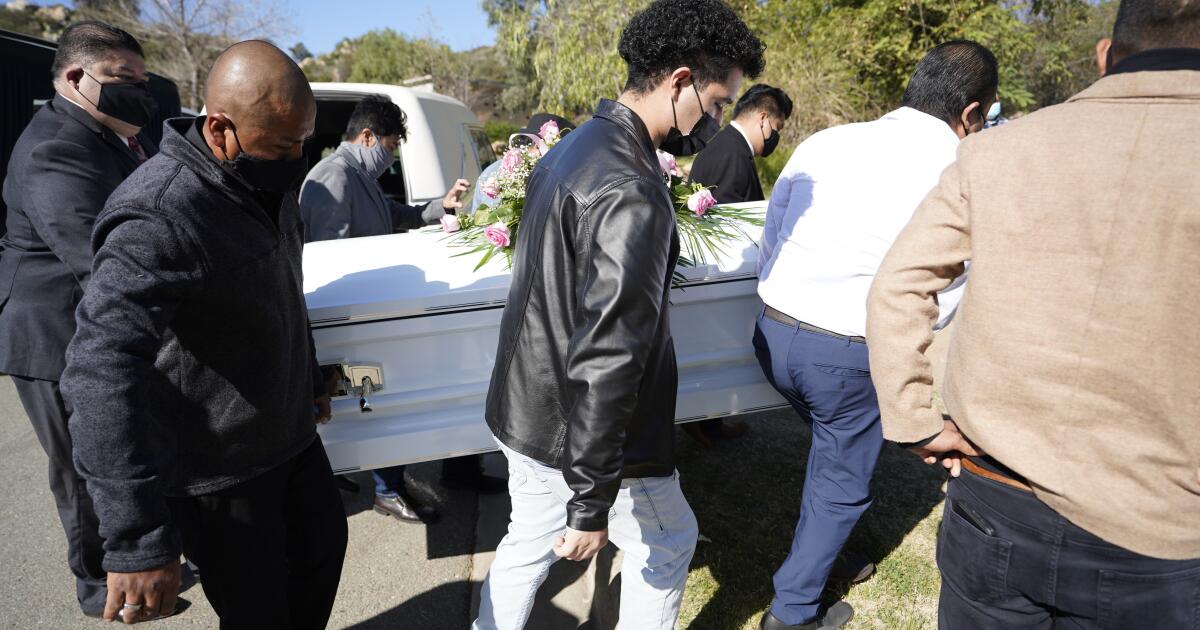
It was the year COVID-19 vaccines became widely available, and the pandemic’s startling death toll in California and elsewhere appeared close to being reined in.
Instead, life expectancy in California fell by more than 8 months in 2021, dropping the Golden State to 10th place in the nation, according to a new report from the Centers for Disease Control and Prevention.
An analysis of all 50 states and the District of Columbia found that babies born in California in 2021 could expect to live 78.3 years — down from 79 years in 2020, when California ranked fourth in the nation.
The decrease, which was reported Wednesday by the CDC’s National Vital Satistics System, revealed that the promise of COVID-19 vaccines — along with other public health measures — was not enjoyed uniformly across the nation.
While life expectancy dropped in California and 38 other states, it increased in 11 others and held steady in the District of Columbia. (New Jersey logged a gain of 1.5 years between 2020 and 2021, the best performance among the states.)
In 2019, before the coronavirus reached U.S. shores, the state’s overall life expectancy at birth was 80.9 years, with an expected life span of 78.4 years for men and 83.3 years for women. That put California in the No. 2 spot, just slightly behind Hawaii. (The states were so close that Hawaii’s overall life expectancy that year was also reported as 80.9 years.)
Then deaths during the first year of the pandemic shaved 1.9 years off California’s life expectancy at birth. Only 15 states weathered larger declines. (New York saw the biggest drop, losing 3 full years of life expectancy between 2019 and 2020.)
Expected life spans in the Golden State shrank by another 0.7 years in 2021, according to the new report. That was the 27th-largest decline, putting it in the middle of the pack. (The biggest drop was in Alaska, where it plunged from 76.6 to 74.5 years.)
This map divides states into quartiles based on their life expectancy at birth for 2021. The darker the state,the longer the life expectancy.
(National Center for Health Statistics, National Vital Statistics System)
The life expectancy of Americans as whole fell by 0.6 years to 76.4 years, according to the new report. CDC researchers attributed that decrease primarily to high numbers of COVID-19 deaths and fatalities from accidental drug overdoses.
Hawaii retained the longevity crown in 2021, with a life expectancy of 79.9 years.
That was a full 9 years longer than in Mississippi, which ranked 51st among all states and the District of Columbia. A baby born in the Magnolia state could expect to live 70.9 years, according to the new report.
The states that rounded out the top five overall in 2021 were Massachusetts (79.6 years), Connecticut (79.2 years), New York (79.0) and New Jersey (also 79.0).
Joining Mississippi at the bottom of the list were West Virginia (71.0 years), Alabama (72.0 years), Louisiana (72.2 years) and Kentucky (72.3 years).
More broadly, “states with the lowest life expectancy at birth were mostly Southern states,” the report said. “States with the highest life expectancy at birth were predominantly Western … and Northeastern states.”
Women were expected to outlive men in every state in 2021. The life expectancy gap ranged from a high of 7.6 years in New Mexico to a low of 3.9 years in Utah. The average gender gap for the country as a whole was 5.8 years, according to the report.
In California, the expected lifespan was 81.4 years for a baby girl born in 2021 and 75.3 years for a baby boy — a difference of 6.1 years.
For the most part, the states with the largest differential between the sexes had lower life expectancies overall. Meanwhile, states with the smallest discrepancies between males and females tended to have higher overall life expectancies, the CDC noted.
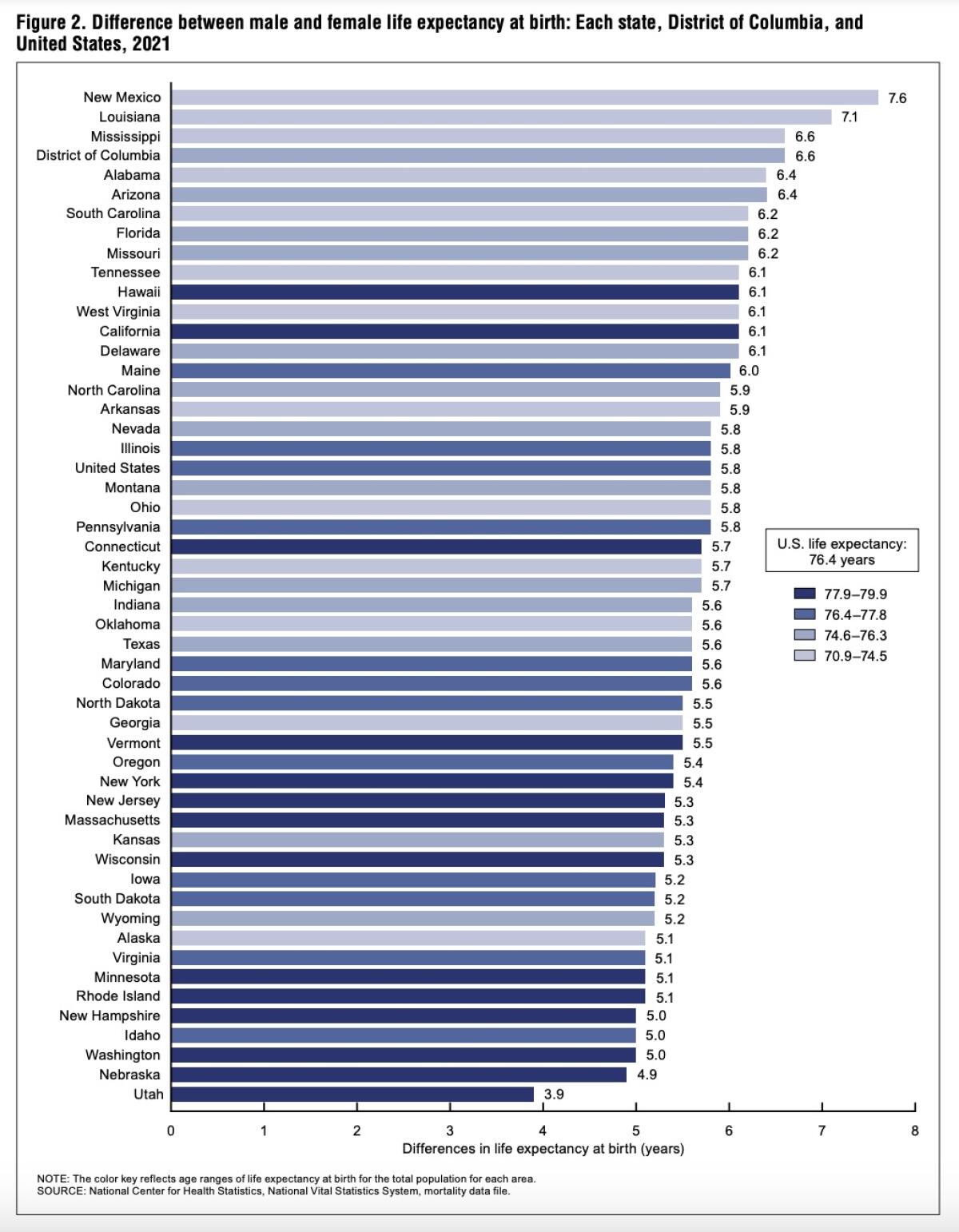
This chart ranks states according to the size of their gender gap for life expectancy at birth in 2021. New Mexico had the biggest discrepancy, while Utah had the smallest.
(National Center for Health Statistics, National Vital Statistics System)
CDC researchers also calculated the remaining lifespan for Americans who were 65 years old in 2021. The nationwide average was 18.4 years — 17.0 years for men and 19.7 years for women.
Life expectancy at 65 is always greater than life expectancy at birth because the pool of people who survive to their 65th birthday excludes those who weren’t able to reach that milestone.
The risk of death in the first year of life is particularly high — the U.S. infant mortality rate in 2021 was 5.44 deaths per 1,000 live births — and actuarial life tables from the Social Security Administration show that it takes until age 49 for the mortality rate to reach the same level.
In 2021, 65-year-olds in Hawaii had the most years to look forward to, with an average remaining life expectancy of 20.6 years. That was followed by Connecticut at 19.9 years, Massachusetts at 19.6 years, and Minnesota, New York, Vermont and New Jersey at 19.4 years.
Mississippi ranked 51st on this longevity list as well, offering 65-year-olds an expectation of 16.1 more years to live. West Virginia also had a remaining life expectancy of 16.1 years, followed by Alabama, Oklahoma and Kentucky at 16.4 years.
California beat the nationwide averages for 65-year-olds with a remaining overall life expectancy of 19.3 years. That included 17.8 additional years for 65-year-old men and 20.7 years for 65-year-old women.



California
CA state senator physically, verbally harassed at pride parade for Israel stance | The Jerusalem Post

California State Senator Scott Wiener was harassed for his stance on Gaza during the San Francisco Trans March on Friday, to the point where it was no longer safe for him to remain, Wiener said.
A group of people were so “physically and verbally aggressive that it was impossible for me to safely remain in the park,” Wiener stated, adding that this was the first time he did not participate in the march.
Wiener was surrounded by people who made statements about his “Israeli handlers, among many other inaccurate, extreme, and vile statements,” Wiener said.
“We f***ing hate you. You stopped being queer the moment you started supporting Israel,” one person yelled in a video later shared on social media.
Wiener stated that while he has no objection to anyone disagreeing, opposing, or protesting him, the “harassment, including cornering me, touching me, or trying to physically bully me out of a public event, that crosses a line.”
“In San Francisco, we’re better than that,” he added.
Mayor Daniel Lurie made a statement on X/Twitter condemning the harassment, calling the language used “targeted, hateful, and antisemitic.”
In San Francisco, we welcome disagreement and respectful dialogue around issues many of us feel passionately about – but we cannot allow harassment and threats of violence,” Lurie wrote.
The California State Senate Democratic Caucus also released a statement on X, condemning the hate Wiener received.
“The harassment and violence shown from yesterday’s march in San Francisco towards Senator Scott Wiener is unacceptable and must be called out,” the statement read.
The caucus also pointed to Wiener’s work on legislation “advancing the rights and protections for Transgender, Gender Expansive and Intersex people.”
“The CA Senate Democratic Caucus and CA LGBTQ Caucus jointly denounce the verbal harassment and attacks he experienced,” the statement said.
California
At least 117 dead dogs found in search at California animal rescue accused of abuse, officials said

California authorities unearthed at least 117 dogs in “various states of decomposition” on Friday, many of which appeared to have been killed by gunshot, as part of an ongoing investigation into an animal rescue organization.
The bodies were discovered during a search of Miranda’s Rescue in Fortuna, California, according to the Humboldt County Sheriff’s Office. Officials had been granted a warrant that included excavation of the property for evidence that dogs had been buried in “mass graves.”
The 117 canine remains were those found mostly intact at two sites, the sheriff’s office said. Nearly two dozen skulls, “hundreds” of bones, and 600 dog collars were also recovered on the property.
Humboldt County Sheriff William Honsal thanked the law enforcement teams and forensic veterinarians who assisted in the recovery. In a statement, he noted that the investigation is “just getting started.”
“The determination all of these professionals showed while working through this horrific scene is something we will not forget,” Honsal said.
NBC News was not able to reach Shannon Miranda, the founder of Miranda’s Rescue, by phone on Sunday. She did not immediately respond to an email requesting comment.
The sheriff’s office said in a news release last week that it had been contacted in April regarding allegations of fraud, animal abuse and animal cruelty at the rescue, and that the case had been assigned to the Major Crimes Division.
An initial search warrant was executed on May 1, at which time officials seized evidence related to the investigation. Investigators also determined that a “significant number” of animals surrendered to the rescue had not been accounted for.

A second search warrant, executed Thursday, led to the recovery of the canine remains.
Forensic veterinarians were able to examine 71 of the bodies on-site Thursday but did not have time to reach the remaining 46. A preliminary examination — including X-rays of the remains — found that “many of those animals showed evidence of bullet fragments.”
Investigators are working to identify dogs that were microchipped.
Other remains were found “in advanced stages of decomposition” and were deemed too severely deteriorated to be removed from their burial site, the sheriff’s office said.
This investigation is expected to be lengthy, the sheriff’s office cautioned in a statement to the public.
“The Humboldt County Sheriff’s Office understands the public’s desire for accountability and justice,” it said. “However, it is our responsibility to conduct a complete, impartial, and legally sound investigation while ensuring that the constitutional and legal rights of everyone involved are protected throughout the process.”
No charges were announced.
Miranda was not available for comment, but posted a statement on June 18 addressing “recent media coverage and online commentary,” on the rescue’s website. The statement described two incidents that had “drawn particular attention” both involving animals that were killed at the facility.
The first involved a dog that killed another animal and attacked a third; the second involved a dog that lunged at a stroller carrying a baby, according to the statement.
“These were not decisions made lightly and were based on my responsibility to protect both the public and the animals in our care,” Miranda wrote.
The statement also described Miranda’s Rescue is a no-kill shelter, meaning animals are not euthanized simply to free up space, but acknowledged euthanasia is sometimes necessary.
“Whenever euthanasia has been necessary, I have notified local authorities in advance, even when told that reporting is not required,” Miranda wrote. “I believe it is important to maintain a clear record of these difficult decisions.”

Long Beach city officials have confirmed California’s first human case of West Nile virus in 2026.
In a news release shared Friday, the Long Beach Department of Health and Human Services said that the person was hospitalized with “neuroinvasive illness” and has since been recovering at home.
“While there have been WNV positive mosquito detections in California, including in Long Beach, this is the first symptomatic case reported in California for the 2026 season,” the release said.
Health officials said that West Nile virus typically spreads through the bite of an infected Culex mosquito. While most people who get infected with WNV have no symptoms, one in 150 may develop more serious illnesses like brain inflammation, paralysis or death. Typical symptoms include fever, rash, body aches, headache, nausea and vomiting.
They advised anyone exhibiting such symptoms to seek immediate medical care.
“The risk of WNV and other mosquito-borne diseases increases during hot weather, typically from June to October,” officials said. “People who are over 55 years old or have chronic health conditions are at higher risk for severe illness.”
Acting Long Beach City Health Officer Dr. Cliff Okada urged residents to take several precautions to prevent infection, including:
- using insect repellent to prevent mosquito bites
- wear long-sleeved shirts and long pants if spending time outdoors during dawn or dusk
- install or repair window screens
- remove standing water around their homes
- report increased mosquito activity so health officials can take action
People seeking further information or who wish to know more about how to protect themselves from mosquito bites was asked to contact the city’s mosquito hotline at 562-570-4132.
Health officials said the risk of West Nile virus and other mosquito-
borne diseases increases during hot weather, typically from June to October.
WNV spreads through the bite of an infected Culex mosquito.
Symptoms of may include fever, body aches, rash, nausea, vomiting and
headaches. Most people infected have no symptoms; approximately one in 150 may
develop more serious disease, such as brain inflammation, paralysis or death.
Those who are over 55 years old or have chronic health conditions are
at higher risk for severe illness. People with these symptoms should seek
immediate medical care.
There is no vaccine or treatment for West Nile virus.
Acting City Health Officer Dr. Cliff Okada urged residents to take the
following precautions:
— Dump and drain standing water around your home.
— Prevent mosquito bites by applying insect repellent with EPA-
registered active ingredients such as DEET, picaridin, IR3535 or lemon
eucalyptus before going outside.
— Wear long-sleeved shirts and long pants if spending time outside
during dawn and dusk.
— Install or repair door and window screens.
Additional information about mosquito prevention and West Nile virus
is available at longbeach.gov/mosquitoes.
-

 Detroit, MI15 minutes ago
On the front lines of chronic absenteeism: What Detroit’s Health Hubs do to get kids to school
-

 San Francisco, CA25 minutes ago
S.F. police arrest 20 at 300-person SoMa block party during Pride
-
Dallas, TX30 minutes ago
CJ Goodwin announces retirement after 8 seasons with Cowboys
-

 Miami, FL32 minutes ago
Several people reportedly hurt in ‘mass casualty’ crash near Miami Gardens – WSVN 7News | Miami News, Weather, Sports | Fort Lauderdale
-

 Boston, MA37 minutes ago
Inside Britten’s Record-Breaking Boston Waterfront Activation
-

 Denver, CO40 minutes ago
Denver area events for June 29
-

 Seattle, WA45 minutes ago
Seattle Mariners acquire INF Buddy Kennedy from San Francisco
-

 San Diego, CA52 minutes ago
Feds Will Finally Help Oceanside 73 Years After Admitting Fault for Its Disappearing Beaches

