Lifestyle
For $5, Radical Sewing Club teaches you to mend clothes like an anticapitalist

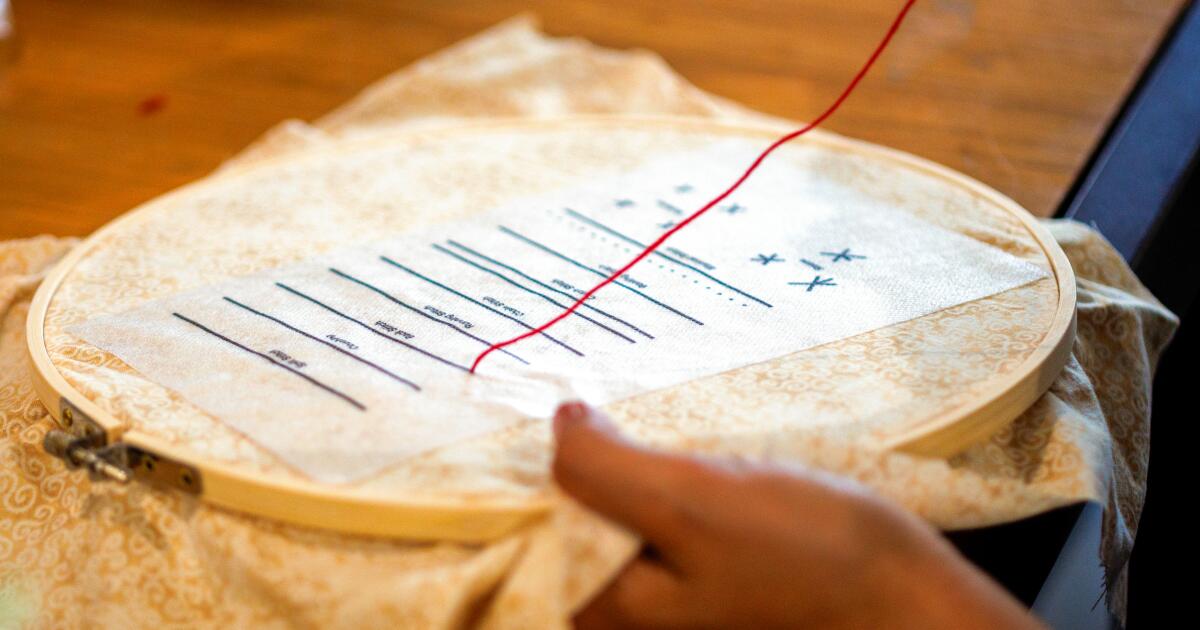
On a balmy summer evening, Sary Gil of Norwalk tediously repairs one of his T-shirts with red thread using decorative stitches that look like rosebuds. You wouldn’t know it, but just three weeks ago, he sewed for the first time. Ever since, on Wednesdays after work, he’s attended Radical Sewing Club in Huntington Park.
His motivation was simple: He wanted to learn to sew so he could fix damaged clothing like this T-shirt. “My first day here I learned using the practice stitching guide. They started me with the back stitch, into the split stitch, into the blanket stitch, and the flowers. … I wasn’t sure how the class was structured, so I came in blind,” he said. But once founder Scout Quiquivix explained that the club was started to fight against fast fashion and, by extension, capitalism, his interest deepened. The new skill was more in line with his morals than he realized.
Founded in 2023, Radical Sewing Club teaches practical hand sewing and mending skills every Wednesday night. For $5 (though no one is turned away for lack of funds), predominantly Southeast Los Angeles residents gather at Art Space HP, a multiuse spot with a leftist bookstore, coffee shop, art gallery and community programming area.
At the Radical Sewing Club class, Scout Quiquivix, left, shows beginners the length thread should be before putting it through a needle.
For the record:
12:07 p.m. Aug. 9, 2024An earlier photo caption stated Natasha Dominguez used a pattern to learn new stitches. It was Rosario Calatayud-Serna. The story also previously misspelled Art Space HP.

Various colors and sizes of threads on spools during the Radical Sewing Club class.
Fast fashion — when clothes are made quickly and cheaply to meet rapidly shifting trends — has been on the rise for years. But recently, so has resistance to it. Shein, a brand synonymous with fast fashion and beloved by Gen Z, updates its website with 10,000 new pieces per month, according to NPR, testing what shoppers want and then deciding what to produce in mass quantities. Shein describes this strategy as being “on demand,” but some discerning shoppers call it “ultrafast fashion.”
The Radical Sewing Club is among a growing number of Los Angeles communities preaching sustainability in fashion. Others are Suay L.A., which used to offer mending services in the past and currently offers community dyeing services (between $5 and $50 per dyed item), and Other Lives Studios, which offers classes in upcycling practices like fabric painting and decorative mending ($50-plus per class).
Back at the Radical Sewing Club meeting, a dozen sewers and hopefuls gathered around a square of shared tables. Some are here for the first time, while others, like Gil, have become regulars. Due to the fluctuating flow of attendees, there is no single lesson for each meetup. The $5 suggested fee covers materials like needles, thread, fabric for patching and more — some of which Quiquivix purchases, some of which has been donated.
First-timers can use provided embroidery hoops to practice a variety of stitching techniques. Once they’re comfortable, they can practice those stitches on clothing they bring in to mend. At this gathering, Quiquivix paces among attendees, teaching how to thread a needle (“Make sure the string is as long as your hand to your shoulder”) and answering questions, all with rescue dog Cinnamon in a pet carrier backpack.

Scout Quiquivix, with their small dog Cinnamon, runs the Radical Sewing Club.
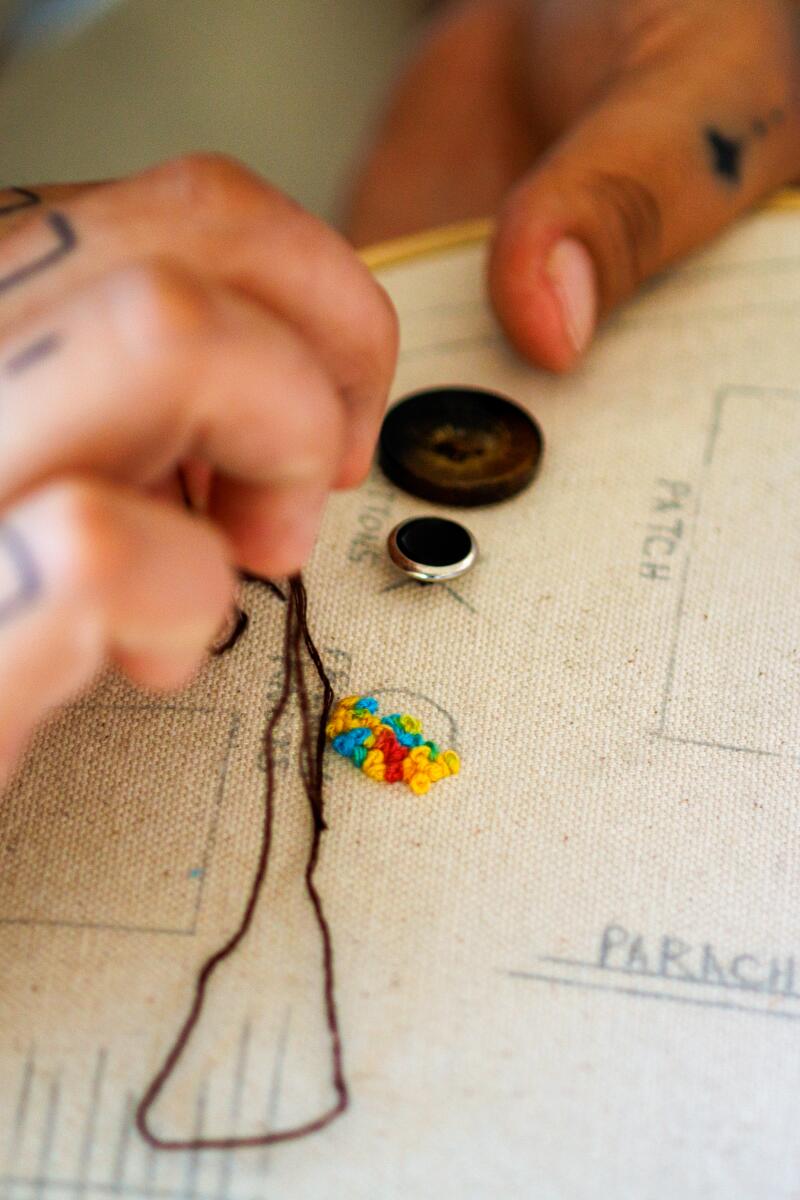
Scout Quiquivix uses a template to show beginners different stitch techniques.

Veronica Tadeo of Los Angeles works on a sewing design at the Radical Sewing Club.
Brenda Ceja of Whittier brought in a ripped pair of pants for her second visit to Radical Sewing Club. Before attending, she had no sewing experience. “I think this is very important because it’s a life skill that’s not being taught to people anymore. I can teach others the skills I learn here. It has a ripple effect, ” she said.
This rings true for Quiquivix, who works as a manager of a thrift store by day and grew up in a suburb of Pomona. They learned to mend, sew and buy secondhand from their mother. During the pandemic, they discovered social media videos of creative embroidery used for not just design but repair. Quiquivix initially sought commission work mending others’ clothing but then decided to channel their experience and learned patience from working at youth summer camps to teach a class.
The radical element of the club is rooted in anticapitalist values. “The fact that we’re repairing our clothes in a highly capitalist society is radical. It’s radical to fix something versus throwing it away and buying something new,” said Quiquivix. This mission is more apparent to some attendees than others, but Quiquivix doesn’t mind. “If I can just get somebody to come in and learn how to sew and learn how to repair their clothes, and that’s all that they got from it, they’re still going to go home and repair their clothes and they’re still doing something anticapitalist,” they said.
Matthew Gardea and Sofia Guevara of Downey joined Genevieve Quiquivix, Scout’s wife, at a table. Gardea and Guevara, who found the club on Instagram and have attended once before, are working on embroidering a decorative patch with the Radical Sewing Club logo. Genevieve Quiquivix is using red, green and yellow thread to create a design to repair holes in the heel of a sock.
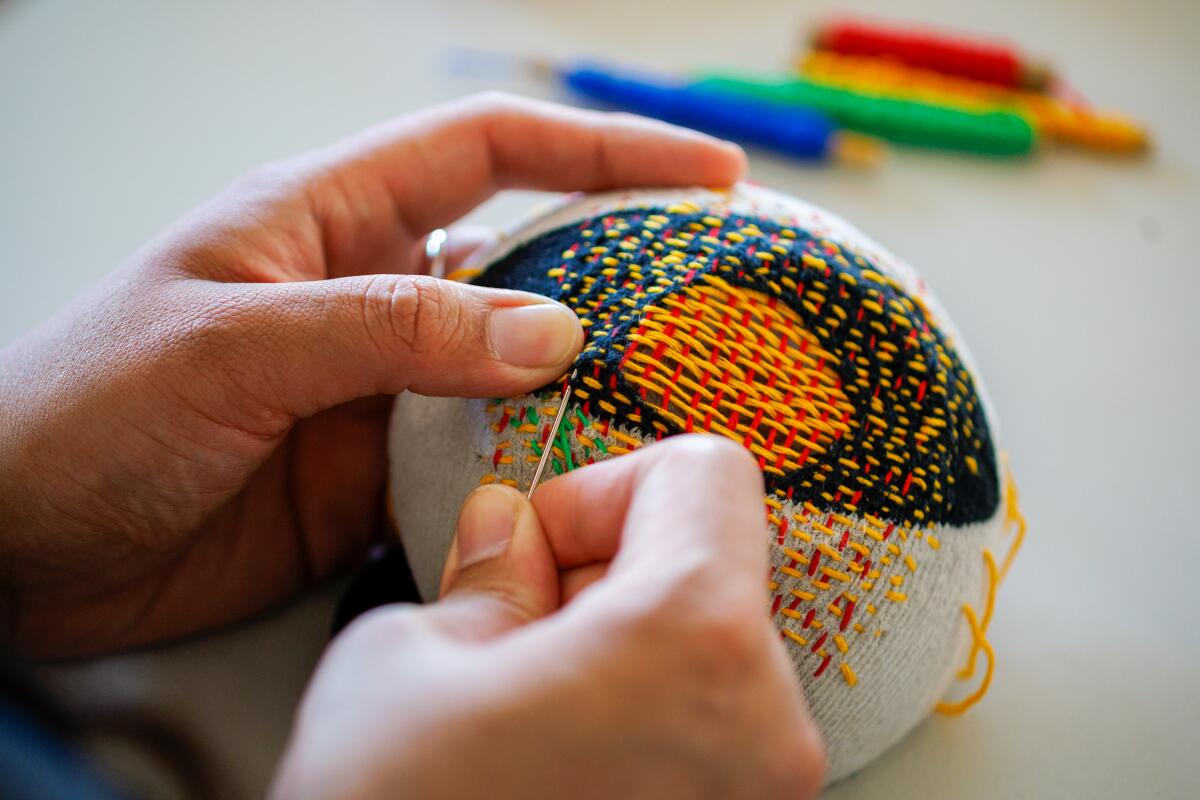
Genevieve Quiquivix darns a sock using a weave pattern.
“There’s been a stigma in the past that if you do this [mending] you’re poor. This breaks down those walls,” said Genevieve Quiquivix. Guevara agrees: “In school, when I’d wear secondhand pants that I altered so they’d fit me, kids would make fun of me. I’m glad this is normalized. It’s fun to fix your clothes.”
Amanda Tapia, a worker-owner of FTP Cafe, also inside Arts Space HP, believes Radical Sewing Club is critical for the Latino community in Southeast L.A.. “A lot of us grew up with abuelas where this skill was so natural to them. As children of immigrants being forced into assimilation, we’re claiming these skills again. … We’re learning ways to fight capitalism, stay in alignment with our values and maintain our culture in a more radicalized way, which I think is beautiful.”
As attendance grows, Scout Quiquivix hopes to enlist a second teacher. In the meantime, regular attendees are teaching their newfound skills to first-timers. “It’s the most beautiful thing in the whole world,” Quiquivix said.
Follow @radicalsewingclub on Instagram for more information or join every Wednesday at 6:30 p.m. at Art Space HP: 3382 E. Florence Ave., Huntington Park.


If you’re struggling to use up leftovers like a half-eaten rotisserie chicken, turn the assignment into a creative exercise, says chef Margaret Li. It’ll make the cooking process more fun and less guilt-driven.
Pulse/Getty Images/Corbis RF Stills
hide caption
toggle caption
Pulse/Getty Images/Corbis RF Stills
On a recent weeknight, I opened up my fridge and found an assortment of half-eaten or ignored food.
That included takeout that I didn’t find appetizing enough to eat for lunch. A rotisserie chicken with most of the meat picked off. A couple of raw vegetables from the farmers market that were starting to wilt.
“There’s nothing to eat,” I told myself. Yet even I knew that was ridiculous. There was plenty of food in my fridge. I just didn’t feel inspired to cook with it.
So I asked some chefs for guidance. How could I more consistently use leftovers and the other ingredients I tend to overlook?
Start with a mindset shift, says Margaret Li, chef and co-author of the cookbook Perfectly Good Food: A Totally Achievable Zero Waste Approach to Home Cooking. Think about cooking with leftovers as a creative, experimental exercise, not a guilt-driven one.
“It ends up being this fun game where you are creating something from what seems like nothing and solving this puzzle, and then you get to eat it,” she says.
There are other good reasons to use up your food scraps. Nationally, about a quarter of food products go to waste, according to the nonprofit ReFED. In my own household, where we spend about $200 a week on groceries, that means I might be throwing out the equivalent of $50 of food — an unnecessary burden on my wallet, not to mention the environment.
The chefs I spoke to had some practical tips about using up more of the food we buy. Here are a few that I put to the test.
Find your “hero recipes”
Build up an arsenal of go-to recipes that are flexible enough to use up just about any ingredient. Li calls them “hero recipes.”
I tried one of these from her cookbook, called “Make-It-Your-Own Stir-Fry.” (Scroll down for the recipe.) It includes loose ingredients like “1 pound crisp-crunchy vegetables” or “4 cups leafy greens.”
In the spirit of the recipe, I pulled vegetables out of my fridge at random and did not measure them out. The sauce was a simple mixture of soy sauce, vinegar, sugar and water. By the time I topped my bowl with chopped scallions, the dish looked like a gourmet meal, not an afterthought.

Other ideas: “You could put anything in a frittata, and it’ll be great,” says Tamar Adler, chef and author of The Everlasting Meal Cookbook: Leftovers A-Z.
Or, if you have day-old rice on hand, cook it alongside other ingredients to make fried rice. “Saute some aromatics — ginger, garlic, onion — in oil,” Adler says. Then add your rice and whatever leftover bits you have, like the rotisserie chicken and older produce I had in my fridge.
“Just take the approach of making it more flavorful and crispy and then spicy, and then usually adding a squeeze of lemon,” Adler says.
Label your leftovers
Keep a permanent marker and painter’s tape in your kitchen to label and date your leftovers, Li says. “That is a classic chef’s method for knowing what something is and when it was made. That saves you the guessing game.”
Adler takes the concept a step further and labels her leftovers with their intended use. Leftover blueberries are labeled “muffins-to-be on Tuesday,” she says. “I really like doing that — assigning the destiny of the food.”

So after a night of Ethiopian takeout, when we ended up with an entire container of leftover injera, I followed Adler’s advice and thought about what it might become in the future.
I imagined scrambling the spongy, tangy bread with eggs, akin to scrambling matzo into matzo brei. “Injera for eggs,” I wrote on the container. Sure enough, their destiny was fulfilled the following morning.

Li keeps a dedicated bag in her freezer just for scraps from which to make chicken or vegetable stock. That bag houses carrot peels, the ends of onions, extra garlic cloves and chicken bones.
Flavia Morlachetti/Getty Images/Moment RF
hide caption
toggle caption
Flavia Morlachetti/Getty Images/Moment RF
Don’t forget your odds and ends
Adler encouraged me to never, ever throw away the stems of herbs. Stems don’t get as much glory as tender, pretty leaves, but they still have the same herby taste.
“I’m going to chop these herbs up or stick them in a blender with a clove of garlic,” she says. Then add olive oil. “And then it’s just gonna be my base sauce for everything.”
So I foraged a few varieties of half-cut herbs from my refrigerator drawers, most of them sad looking and unidentifiable.
I threw out the stems that had turned brown and gooey and put the rest in a blender. I added garlic on Adler’s instructions, nuts and kale for bulk, and plenty of olive oil and salt. Then, on a whim, I added a splash of olive juice for brightness.
The result was somewhere between a pesto and a chimichurri, and it elevated that night’s otherwise routine dinner. And Adler was right: Once the stems were blended, it tasted exactly the same as the leaves. (The same idea applies for broccoli stems in a cheesy broccoli soup, Li says.)
Li likes to keep her odds and ends organized with an “Eat Me First” box in her fridge. That’s where she keeps half-used lemons, leftover coconut milk or produce that’s starting to get wrinkly. “You kind of have an idea for, OK, here’s where you look first,” she says.
Don’t strive for perfection
Cooking these meals did feel like a game, as Li had suggested. It brought me unexpected joy to use up as many existing ingredients as possible — to the point where I often spent much longer in the kitchen because I kept thinking of new ideas: If I turn these wrinkly sweet potatoes into a soup, then I can caramelize this half-cut onion for a topping, and then I can use the leftover soup as a sauce tomorrow …
Did I cook more often, though? Probably not. My cooking energy burned brighter but fizzled out after a few nights, at which point I ordered takeout.
So I was glad to hear Li’s take: If you’re too hard on yourself, you’re not going to enjoy it at all. “ I try not to be too obsessive about eating absolutely everything,” she says. If my takeout was truly terrible, I’m allowed to toss it or, better yet, compost it.
If you really want to use up everything, you can always chuck ingredients into the freezer. Li has dedicated freezer bags for different dishes, like vegetable scraps for soups or fruit discards for smoothies. (She labels them, of course.)
And how does that smoothie taste? It’s “delicious,” she says, “even if it’s made up of all the things that have been rejected in the past,” she says.
Recipe: Make-It-Your-Own Stir-Fry
Excerpted from Perfectly Good Food: A Totally Achievable Zero Waste Approach to Home Cooking. Copyright ©2023 by Irene Li and Margaret Li. Used with permission of the publisher, W. W. Norton & Company, Inc. All rights reserved.
Sauce
- 1 tablespoon soy sauce
- 1 tablespoon water
- 1 teaspoon sugar
- 1 teaspoon black vinegar, rice vinegar, lime juice, or other acid
- 1 tablespoon neutral oil, or enough to lightly coat the bottom of your wok or skillet
- 1 garlic clove, thinly sliced or minced, or more as desired
- ½-inch piece fresh ginger, minced or grated (optional)
- Pinch chili flakes or 1 small chile pepper, diced (optional)
- 4 cups leafy greens, torn into bite-size pieces, or 1 pound crisp-crunchy vegetables, cut into chunks
- Kosher salt
Stir the sauce ingredients together in a small bowl and set by the stove.
Heat a wok or large skillet over high heat until just smoking, then add the neutral oil and tilt to coat the bottom of the pan.
Add the garlic, ginger (if using), and chili flakes (if using) and stir-fry for 10 seconds. Add the greens and/or vegetables, in stages as necessary, and toss in the garlicky oil, then add the sauce and cook to your liking, stirring frequently.
Vegetable chunks may need 4 to 7 minutes — if you want to speed up the process, cover the pot so the vegetables steam for a minute or two, then uncover and toss again. Sturdy greens may need 3 to 5 minutes to get tender (we like to let them sit for a bit and char for extra texture).
Lighter leaves will need less than a minute to wilt down. Stir in a spoonful of any additional sauce you like, season with salt to taste, then sprinkle with your favorite garnishes and a generous drizzle of sesame oil.
A sprinkle of crunch is a great way to finish a stir-fry. Our favorites include crushed cashews or peanuts, toasted sesame seeds, thinly sliced scallions, and fried onions or shallots.
Your turn: What are your favorite go-to leftover recipes?
We’d love to hear from you! Share your recipe with us at lifekit@npr.org with your full name. We may publish it on NPR.org.
The story was edited by Malaka Gharib. The visual editor is CJ Riculan. We’d love to hear from you. Leave us a voicemail at 202-216-9823, or email us at LifeKit@npr.org.
Listen to Life Kit on Apple Podcasts and Spotify, and sign up for our newsletter. Follow us on Instagram: @nprlifekit.

Stephen Malkmus & the Jicks perform onstage during day two of the Boston Calling Music Festival at Boston City Hall Plaza on September 26, 2015 in Boston, Massachusetts. (Photo by Mike Lawrie/Getty Images)
Mike Lawrie/Getty Images
hide caption
toggle caption
Mike Lawrie/Getty Images
This week’s show was recorded in Chicago with host Peter Sagal, judge and scorekeeper Alzo Slade, Not My Job guest Stephen Malkmus and panelists Emmy Blotnick, Joyelle Nicole Johnson, and Gianmarco Soresi. Click the audio link above to hear the whole show.
Who’s Alzo This Time
Pool Problems; Don’t Forget to Hydrate; The Rise of Hot Podium Guy
Panel Questions
TSA Gets A Dressing Down
Bluff The Listener
Our panelists tell three stories about game shows in the news, only one of which is true.
Not My Job: Stephen Malmus, lead singer and guitarist for Pavement, answers our questions about road construction
Indie rock legend and founder of Pavement, Stephen Malkmus, joins us to play a game called, “Pavement repairs are underway!” Three questions about road construction.
Panel Questions
The Battle Over A Home Sale; The Best Three Words To Get Over A Loss and Out of a Meeting?; A New Job in the Dating World
Limericks
Alzo Slade reads three news-related limericks: Good News For Gym Slobs; Cruisin’ For A Tattooin’; Fringe Food Benefits
Lightning Fill In The Blank
All the news we couldn’t fit anywhere else
Predictions
Our panelists predict what will find after the reflecting pool is emptied

When Julio Miranda-Martin began his apartment search, he had one nonnegotiable: He wanted a dedicated dining room to entertain his friends. He was scouring Zillow in 2025 when a listing for a railroad-style, one-bedroom on the edge of West Hollywood came up that included the requisite dining room. It was also walking distance to his part-time job as a marketing coordinator at furniture store Lawson-Fenning. More importantly, at $2,500 a month it was within his budget.
-
Share via
Miranda-Martin met with his landlord the same day he found the listing, who told him he looks like his son. Feeling like finding this 950-square-foot apartment was kismet, Miranda-Martin signed the lease and set about creating a sophisticated and color-saturated sanctuary. Miranda-Martin decided he needed to make two major investments before moving in: painting the walls and changing the lighting. “I was finally able to move into a place that I actually like, not just out of necessity. I was like, let’s make it feel like my own,” says Miranda-Martin, who refers to the space as his “living canvas.”

In this series, we spotlight L.A. rentals with style. From perfect gallery walls to temporary decor hacks, these renters get creative, even in small spaces. And Angelenos need the inspiration: Most are renters.
The apartment is on the second floor of a fourplex, up a windowless staircase. Miranda-Martin embraced the lack of light and painted it a high-gloss crimson. Without natural light, he hard-wired sconces found on Facebook Marketplace that recall ornamental 18th century candlesticks. They cast a dim but moody light throughout the staircase, ending with an ornate mirror at the top. The mirror shows a glimpse of the apartment’s interior in its reflection when Miranda-Martin opens the door. “Every time people walk in, especially at night, it’s such a dramatic entry,” he explains. “It’s very cinematic,” agrees friend and co-worker Kristin Reeder, who is often a guest at his soirees, “like something from ‘Eyes Wide Shut.’ ”
1

2

3

1. Julio Miranda-Martin’s apartment decor starts in the bold staircase that leads to his door. 2. A mirror at the top of the staircase offers extra depth. 3. Julio Miranda-Martin fills the bookshelf in his dining room with books and treasures.
In contrast, the living room offers a calmer palette of sky blues and earthy browns. Miranda-Martin tends to choose paint colors based on the light. The living room, with abundant west-facing windows brings in soft, bright light. Miranda-Martin painted it with Benjamin Moore’s Navajo, a flat white, as a backdrop to the softer hues of the furniture he designed at his furniture and lighting company, Studio MM. “It adds a stillness,” he says.
The room is anchored by a large velvet couch in a rich brown. The modular couch is anchored on each side with Art-Deco influenced side tables, lamps and light blue slipper chairs he designed, setting up a cozy tableau for hosting his friends. Pale pink cushioned ottomans provide additional seating that can easily be moved around the room to accommodate additional guests.

A velvet couch acts as a statement piece in the apartment living room.
(Etienne Laurent/For the Times)
French doors separate the living room from the dining room. The chartreuse-infused dining room returns to a more dramatic colorway. With less natural light, Miranda-Martin wanted to play up the idea of dining-room-as-treehouse, reflecting the second-floor foliage visible from the small windows. Rather than trying to brighten the room, he leaned into the moodiness by buying inexpensive, USB battery-powered spotlights that are mounted on the ceiling with magnets. Taking an alcohol marker, he tinted the lights a soft amber, allowing him to highlight the art in the room without adding harsh overhead lighting.

The dining room is meant to reflect the foliage just outside the window.
(Etienne Laurent/For the Times)
A shell-adorned mirror anchors the wall facing the windows and built-in shelving, making the room feel larger. Miranda-Martin sourced two shell-shaped sconces that flank the mirror at an estate sale in San Francisco. Most of the art and home decor comes from Facebook Marketplace and Craigslist, or is thrifted from local stores. Estate sales are also a source, though Miranda-Martin feels the rising popularity of these sales in Los Angeles has led to an increase in pricing. “They’ve gotten so over the top now in L.A. [They’re] super expensive. You’re not really gonna find a deal,” he laments, citing the armed security checking bags recently at some of the hottest estate sales.
In addition to changing the lighting and painting the walls, Miranda-Martin prioritized the window treatments, with pinch pleat curtains from Ikea. “Drapery can just make a space feel super elevated,” he advises. He prefers a mix of new and vintage decor, balancing both for an eclectic but deeply personal look to his home. He tries not to overthink his aesthetic choices. “I think it’s very instinctual. I’m not really thinking, ‘Is this in good taste or is this going to be weird?,’ ” he says.
Down the hall, the bedroom’s mostly white design theme returns to a more serene composition, providing a quiet sanctuary. Miranda-Martin removed the headboard from his bed, making it seem like it’s floating between the night tables he designed. “Everything feels sort of streamlined and smooth,” says Miranda-Martin. Like the living room, the bedroom is painted the same flat white but the quality of the eastern light filtering into the bedroom casts a buttery glow.
1

2

3

1. Ceramics fill inset shelves in the kitchen. 2. A glass case in the apartment corridor between the dining room and the bedroom. 3. With its lighter decor, the bedroom was meant to be a sanctuary.
The small kitchen retains its midcentury charm, but open shelving above the counter provides an airier, more contemporary cupboard to show off Miranda-Martin’s dish and glassware collection. The easier access comes in handy when he’s entertaining. His apartment is the perfect pre-game space for him and his friends before a night on the town. He tries to make sure he pre-batches cocktails before his guests arrive.
He also likes to host more elaborate dinner parties and game nights. He attributes his love of entertaining to his upbringing as an only child in Downey. “I like hosting because I enjoy being around more people than when I was growing up,” explains Miranda-Martin. His goal, ultimately, is to bring together disparate groups of people from different spheres in a space everyone will feel comfortable in. Dinner parties at Miranda-Martin’s “feel like an event,” says Reeder. “It’s something you’re excited for and you want to get dressed up for.”
“I’m kind of going through a phase right now where I need to be around people,” admits Miranda-Martin. “I think I just hate being alone.”
-
 News18 minutes ago
Three firefighters killed on Colorado-Utah border as wildfires intensify
-

 Los Angeles, Ca2 hours ago
6 members of suspected South American burglary crew arrested by Irvine police
-

 Detroit, MI2 hours ago
Detroit Tigers seek split in home series vs Houston Astros on Sunday
-

 San Francisco, CA2 hours ago
People’s Budget Coalition Claims Victory After San Francisco Budget Restores Most Proposed Service Cuts – Davis Vanguard
-

 Dallas, TX2 hours ago
Dallas weather: June 28 morning forecast
-

 Miami, FL2 hours ago
Where to watch Miami Marlins vs St. Louis Cardinals: TV channel, start time, streaming for June 28
-

 Boston, MA2 hours ago
Police: Man killed in crash caused by wrong-way driver on I-93 in Boston – Boston News, Weather, Sports | WHDH 7News
-
Denver, CO2 hours ago
Even without extension talks, Nikola Jokic has reiterated his desire to stay long-term in Denver

