West
Kamala Harris’ record as prosecutor in California spells ‘trouble’ for presidential campaign: lawyer

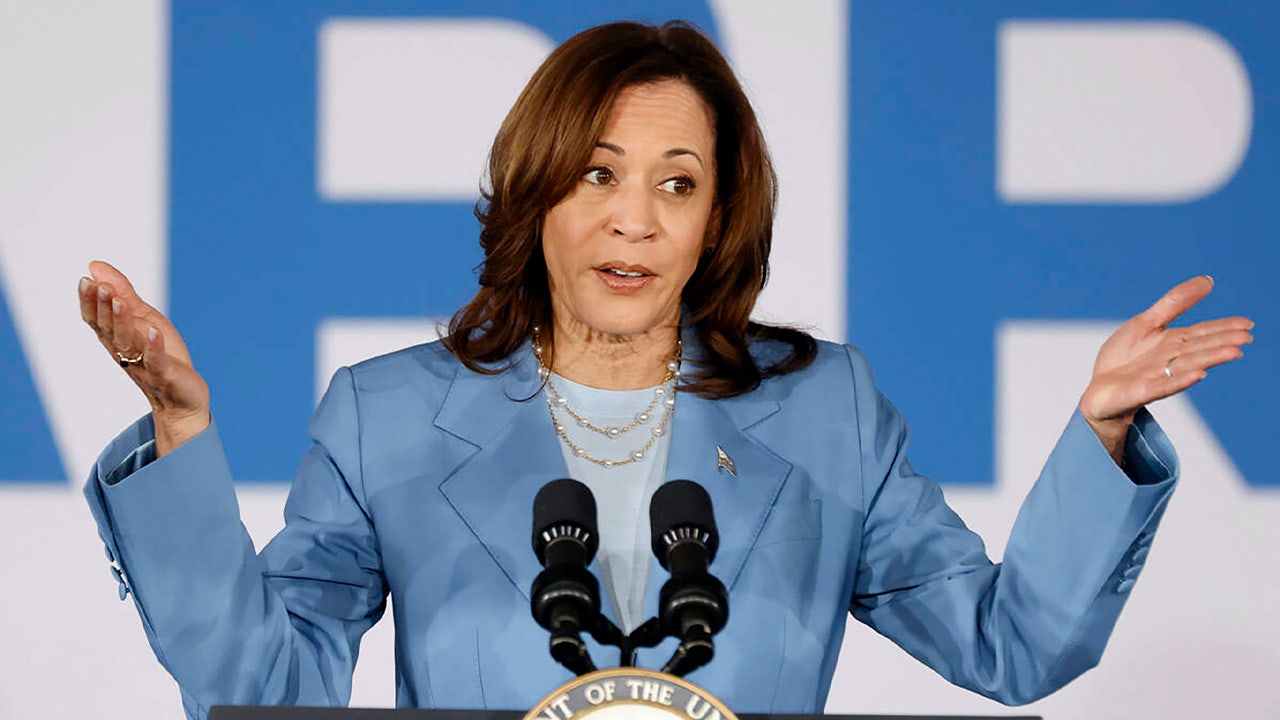
Kamala Harris’ policies as San Francisco District Attorney and California Attorney General could come back to haunt her as the Democratic Party’s presumptive nominee for president, experts say.
“She’s one of these people who’ve talked out of both sides of her mouth, and she’s going to have trouble with both the left and the right with the stances she’s taken over the years,” Los Angeles-based criminal defense lawyer Nicole Castronovo told Fox News Digital.
Critics of potential presidential nominee Harris are calling attention to her backing of a controversial 2014 California law that some blame for unleashing rampant crime across the state.
As California’s then attorney general, Harris and her office were responsible for writing up a summary of Proposition 47 to inform voters of its contents and intent.
10 DEMOCRATS VICE PRESIDENT KAMALA HARRIS COULD NAME AS HER 2024 RUNNING MATE
Vice President Kamala Harris speaks at a campaign rally on June 28, 2024, in Las Vegas. (Bizuayehu Tesfaye/Las Vegas Review-Journal/Tribune News Service via Getty Images)
Dubbed the “Safe Neighborhoods and Schools Act,” the legislation lessened penalties for a variety of crimes – including making the theft of items with a total value of less than $950 a misdemeanor.
That provision, critics assert, handed thieves a de facto carte blanche to plunder beleaguered retail outlets with near impunity.
“Now she’s running in a general election against someone who is tough on crime, I would expect her to shift back to her less progressive, more conservative prosecution roots,”
“They changed sentencing to free criminals who should have been incarcerated and titled it with a misleading name,” Castronovo noted. “But it actually made communities less safe.”
Other crimes that were once felonies – including forgery, fraud, drug use, and the receiving of stolen goods valued under $950 – were also reclassified as misdemeanors.
DEMOCRATS TO MEET WEDNESDAY TO HAMMER OUT TIMING OF HARRIS PRESIDENTIAL NOMINATION
Castronovo said the law has even angered some of Harris’ liberal backers.
“People are over the crime,” she said. “It really does affect your daily life. We’re paying so much money to live in LA where crime is just out of control.”
Then Alameda County District Attorney Nancy O’Malley called Proposition 47 a political “Trojan Horse” that would eventually foment illegality in an op-ed for the San Francisco Chronicle.
Castronovo also highlighted Harris’ full-throated endorsement of polarizing Los Angeles County District Attorney George Gascón.
“As D.A. of L.A. County, I know George Gascón will work every day to keep our communities safe and demand real accountability from our justice system and real justice for every Angeleno,” Harris told the Los Angeles Times in February 2020.
TRUMP CALLS FOR NEXT PRESIDENTIAL DEBATE TO BE HELD ON FOX NEWS
Los Angeles County District Attorney George Gascon arrives at a news conference to address the allegation that hotels are using staffing agencies to hire homeless migrants as replacement workers for strikers at Le Meridien Defina hotel in Santa Monica on Oct. 23, 2023. (Genaro Molina / Los Angeles Times via Getty Images)
But Gasccón’s reign has since been turbulent, with critics arguing that his office has ushered in spiraling disorder.
His tenure has produced several recall campaigns that fizzled out.
Prior to becoming California Attorney General in 2011, Harris served as San Francisco’s District Attorney from 2004 to 2011.
Some observers said she had a more tough-on-crime approach to prosecutions during that period.
In a vastly different political climate predating the George Floyd killing and the rise of the Black Lives Matter movement, Harris was considered a moderate, according to former federal prosecutor turned defense attorney Neama Rahmani.
“I thought she was tough and fair,” he said. “This was well before any of these progressive initiatives. She’s now tried to distance herself from that a bit.”
WHAT COMES NEXT FOR DEMOCRATS AFTER BIDEN’S CAMPAIGN SUSPENSION?
Vice President Kamala Harris speaks at an event as part of the Essence Festival of Culture in New Orleans, Saturday, July 2, 2022. (AP Photo/Gerald Herbert) (AP Photo/Gerald Herbert)
Harris drew scrutiny during her time as San Francisco DA for seeking to charge parents of chronically truant students. She also sought higher bail for defendants charged with gun offenses.
Some progressives criticized Harris prosecuting more than 1,900 marijuana cases during her reign as DA.
“She was attacked for being too extreme, putting people in prison for longer periods of time, disproportionately affecting men and people of color,” Rahmani said.
But despite her reputation as a prosecutorial hawk in those days, Harris remained opposed to the death penalty.
That position drew attention after she refused to seek a capital murder case against a man who shot and killed a San Francisco police officer.
WHITE HOUSE, FAMILY OFFER CONFLICTING ACCOUNTS IF BIDEN’S HEALTH INFLUENCED DECISION TO DROP OUT
President Biden and Vice President Kamala Harris arrive for a wreath laying ceremony at the Tomb of the Unknown Soldier at Arlington National Cemetery in Arlington, Virginia, May 27, 2024. (MANDEL NGAN/AFP via Getty Images)
The decision even drew a rare public rebuke from then Sen. Dianne Feinstein. But then, when she became AG, she defended the death penalty, Castronovo noted.
“She’s going to have a lot of issues with her death penalty positions,” the attorney said.
Rahmani said he expects Harris to now modify her tone once again given her potential face-off with former President Donald Trump.
“Now she’s running in a general election against someone who is tough on crime, I would expect her to shift back to her less progressive, more conservative prosecution roots,” he said.
Read the full article from Here


ANCHORAGE, Alaska (KTUU) – The National Science Foundation has selected the University of Alaska Fairbanks to be the site of a new critical minerals research program, making it one of 12 new technology innovation centers across the nation that received federal funding, according to Yereth Rosen with the Alaska Beacon.
The new Critical Minerals Accelerator Engine in Alaska will receive $15 million in funding for two years and up to $160 million over 10 years, the university said on Tuesday.
The organization will be located at and led by UAF’s Geophysical Institute and will work with more than 40 partners, said Steve Masterman, the university faculty member who helped lead the application for the award. Partners include private companies, Native corporations, nonprofits, other universities and other entities, said Masterman, who formerly served as Alaska’s state geologist.
UAF already conducts scientific research into minerals considered critical to the nation’s economy through its Critical Minerals Collaborative. That program is more scientific and academic-focused, said Masterman, who is its deputy director.
In contrast, the Critical Minerals Accelerator Engine will be focused on putting research to use, determining ways to commercialize resources, addressing supply needs, workforce development and other issues important to the critical minerals industry.
Though the scientific research already conducted at UAF will be helpful, the accelerator idea is industry-focused, Masterman said.
“This is quite different because it’s an economic development project,” he said.
Alaska is rich in resources considered critical minerals. The state has 56 of the 60 minerals classified by the U.S. Geological Survey as critical to the nation’s economy, UAF said in its statement.
In addition to the Alaska award, the NSF on Tuesday announced its awards for other innovation engines in different parts of the nation. The sites have different primary purposes, such as disaster prevention and mitigation, robotics development and development of advanced information technologies.
The Alaska innovation engine will be led by Lee Ann Munk, a faculty member at the Geophysical Institute and a geosciences professor at UAF’s College of Natural Science and Mathematics. Munk is currently director of the Critical Minerals Collaborative at UAF.
“Our NSF Engine is built on the simple but ambitious idea that Alaska can lead the nation not only with the abundance of its critical mineral resources, but also in how we innovate, develop and deploy the technologies needed to produce them responsibly,” Munk said in a statement released by the university.
“By bringing together researchers, Alaska Native organizations, industry, workforce partners, state and federal agencies, national laboratories and communities, we are creating an engine that accelerates discovery into action,” she said.
Editor’s note: This story was republished with permission from the Alaska Beacon.
See a spelling or grammar error? Report it to web@ktuu.com
Copyright 2026 KTUU. All rights reserved.

GLENDALE, AZ — A Glendale Police Department traffic enforcement operation is targeting red-light runners, putting a spotlight on the split-second decisions that can lead to life-altering crashes.
Arizona continues to be one of the worst states in the country for red-light running.
According to the Arizona Department of Transportation, nearly 6,000 drivers were involved in red light crashes at intersections, resulting in more than 60 deaths.
Officer Schlingman from the Glendale Police Department said the two most common excuses he hears from drivers cited for the violation are that they thought the light was still yellow, or that they were running late.
Watch in the player above as ABC15 gets a front-row seat inside the traffic enforcement operation as part of Operation Safe Roads.
Want more news in your community? Add ABC15 as a preferred source on Google below:


LOS ANGELES – A routine internal monitoring sweep by the California Department of Motor Vehicles has flagged thousands of suspicious test results, prompting a massive recall of licensed drivers to testing centers.
The state agency has warned that anyone who fails to comply with the retesting directive will face immediate cancellation of their driving privileges.
What we know:
The California DMV sent letters to about 11,000 licensed drivers last month after identifying suspicious patterns in their written test results.
According to the agency, these irregularities were detected through routine internal monitoring and point to various methods used to circumvent the testing process.
PREVIOUS COVERAGE: 11,000 CA drivers told to retake written test or lose licenses
The DMV has stated that the issue is entirely “test-taker related” and not the result of an internal technical glitch or the involvement of artificial intelligence.
To address the suspected fraud, several cases have already been referred to county district attorneys for criminal prosecution.
What we don’t know:
The DMV has not revealed the specific cheating methods used by the test-takers, nor have they disclosed the exact locations or dates of the flagged tests.
It’s unclear exactly how many of the 11,000 affected drivers have already completed their retests or how many licenses have been canceled so far.
What they’re saying:
A DMV spokesperson emphasized the importance of exam security in an email to City News Service: “The California DMV has identified irregularities in certain driver knowledge test results that may indicate instances of cheating.”
The spokesperson further explained, “Some individuals may have attempted to circumvent the testing process using various cheating methods.”
Addressing the root cause, the spokesperson added, “Nonetheless, these irregularities are test-taker-related and not the result of an internal DMV technical issue, or the involvement of artificial intelligence. Ensuring the integrity of the knowledge testing process is essential to public safety and to confirm that drivers understand California’s rules of the road.”
Regarding the lack of specific details on how the cheating occurred, the department stated, “DMV is not sharing additional information at this time, so as not to reveal investigative methods and protect the integrity of the investigative process.”
Sen. Tony Strickland (R-Huntington Beach), vice chair of the Senate Transportation Committee, recently sent a letter to DMV administrators expressing concerns about the situation.
On Tuesday, Strickland released a statement saying the DMV’s own letter to drivers created “confusion and unnecessary anxiety” among new license holders.
“The DMV is a state agency that serves millions of Californians, and they deserve clear communication along with timely information when something like this happens,” Strickland said. “I have heard from Californians who believe this language suggests the DMV is accusing them of cheating or engaging in misconduct during the examination process. Whether that is the Department’s intent or not, the wording of the notice has created confusion and unnecessary anxiety. In my letter, I requested additional information about what happened and the steps the department is taking to address the issue.”
What’s next:
The DMV will continue to monitor test results internally while working alongside county district attorneys on the active criminal referrals.
Drivers who received the letters must schedule and pass their exams before their individual 30-day deadlines expire to avoid losing their driving privileges.
What you can do:
If you received a letter from the DMV regarding testing irregularities, you must visit a local DMV office as soon as possible to retake your knowledge test.
Be sure to complete and pass the exam within the mandated 30-day window to prevent your driver’s license from being canceled.
The Source: This report is based on official statements and email correspondence provided by the California Department of Motor Vehicles to City News Service.
-

 Indianapolis, IN5 minutes ago
NFL Trade Rumor: Indianapolis Colts and Tampa Bay Buccaneers emerge as top landing spots for $4M Cleveland Browns’ QB
-

 Pittsburg, PA11 minutes ago
Postponed: Waiting on Parkway East bridge to be demolished in explosion
-

 Augusta, GA17 minutes ago
Augusta youth program feels state budget cut heading into new school year
-

 Washington, D.C23 minutes ago
National Guard continuing DC deployment through Inauguration ’29
-

 Cleveland, OH29 minutes ago
Cleveland Advances Housing Manufacturing Strategy with MMY US Selection and Historic Tax Credit Award for Wellman-Seaver-Morgan Building
-

 Austin, TX35 minutes ago
Austin Pets Alive! activates emergency response to assist shelters affected by flooding
-

 Alabama41 minutes ago
Governor Ivey Taps Glenda Allred as New Tourism Director, Announces Lee Sentell’s Retirement –
-

 Alaska47 minutes ago
Alaska university gets funding for critical minerals center

