West
Hiker dies after running out of water near Utah state park in extreme heat

- A 56-year-old woman died while hiking near Quail Creek State Park in southwestern Utah over the weekend after running out of water on a 106-degree Fahrenheit day, officials said.
- The woman was unresponsive by the time rescuers reached her, and life-saving measures were unsuccessful.
- This incident follows a string of deaths believed to be caused by the heat in the western United States over the past several weeks.
A 56-year-old woman died while hiking near a state park in southwestern Utah over the weekend after running out of water on a sweltering day, officials said.
Emergency crews responded near Quail Creek State Park on Sunday to a report of a hiker “in distress due to not having enough water and the temperature being 106 degrees Fahrenheit,” the Hurricane City Police Department said in a statement.
She was unresponsive when rescuers found her. Life-saving measures were not successful, police said. Her name and hometown have not been released.
FOLLOW THESE 9 SAFE HIKING TIPS TO PREVENT TRAGEDY ON THE TRAIL
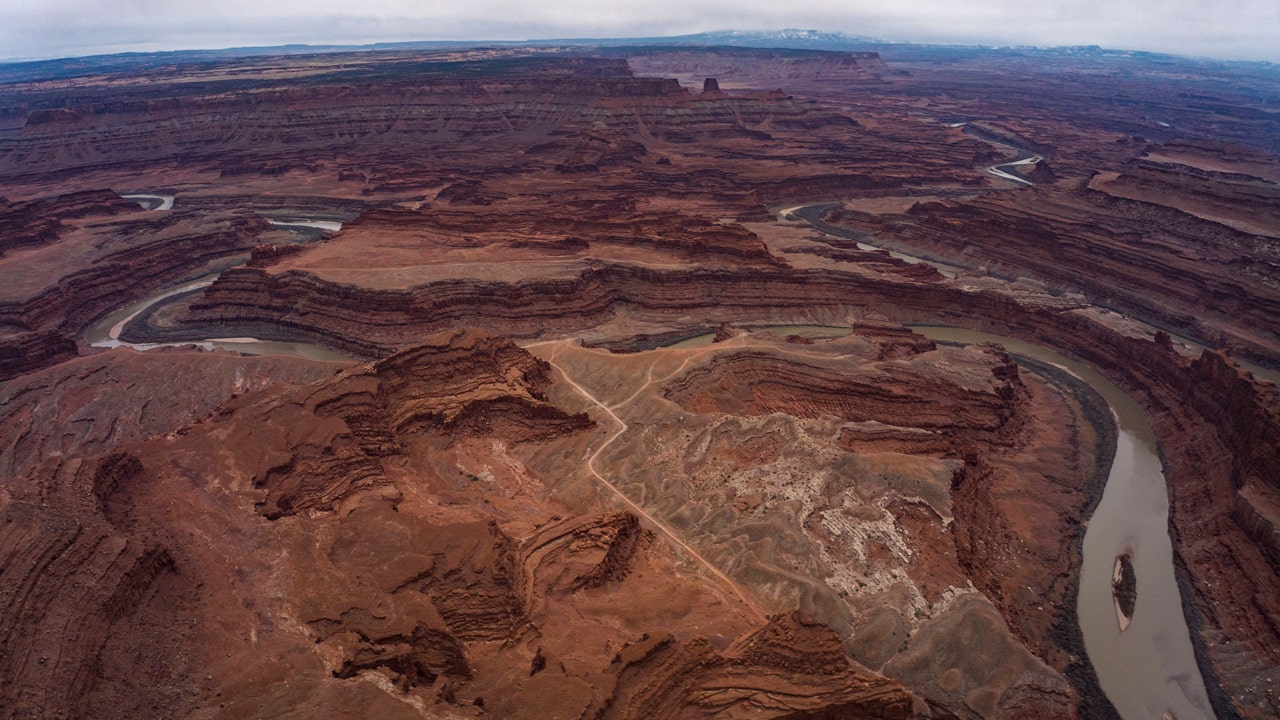
Canyonlands National Park is ssen from above. Several hikers are believed to have died because of extreme heat in the Western U.S. in recent weeks, including a father and daughter who got lost in Canyonlands National Park in triple-digit temperatures. (Joe Sohm/Visions of America/Universal Images Group via Getty Images)
The woman’s death is one of several believed to be caused by the heat in the western United States over the past several weeks.
Three hikers died in state and national parks in Utah over the previous weekend, including a father and daughter from Wisconsin who got lost on a strenuous hike in Canyonlands National Park in triple-digit temperatures. A 30-year-old woman died in Snow Canyon State Park while two others were suffering from heat exhaustion.
Three hikers died in recent weeks at Grand Canyon National Park in Arizona, where summer temperatures on exposed parts of the trails can exceed 120 degrees Fahrenheit.
Read the full article from Here

Wyoming
At 6,000-year-old crossing, Gov. Gordon OKs Wyoming’s first-ever designated pronghorn migration route – WyoFile

SUBLETTE COUNTY—Gov. Mark Gordon heralded Wyoming’s first-ever designation to protect a pronghorn migration corridor — a more than 2 million-acre web of habitat — at Trapper’s Point, which he called a “wonderful passageway.”
“How incredibly valuable it is that you are standing here today,” Gordon told the crowd, “to witness this remarkable moment.”
Gordon commemorated the moment with his feet planted on the narrow bulge of high country that splits the Green and New Fork rivers. Thousands of years ago, the site was a well-used hunting ground for Native Americans — it’s the earliest known killing and processing site for pronghorn in North America. Now it boasts a wildlife overpass.
No pronghorn were to be seen during the especially windy Friday afternoon gathering, which attracted 75 attendees from nearby Pinedale and other western Wyoming communities.
Now Trapper’s Point is officially classified as a “bottleneck” for the Sublette Pronghorn Herd — one of 13 such bottlenecks. That classification is supposed to prevent any surface-disturbing activity, with the intent that pronghorn can keep passing through Trapper’s Point for generations to come.

Protecting the ability of the fleet-footed, tawny-and-white ungulates to migrate is a “key factor” in sustaining their population, Wyoming Game and Fish Director Angi Bruce said.
“This becomes even more important in severe winters or extreme droughts,” Bruce said. “Pronghorn are long overdue for recognition.”
Pronghorn in Sublette, Teton, Sweetwater and Lincoln counties travel a long road — some migrate more than 200 miles to escape harsh winters, trekking south into the lower Green River Basin, a semi-arid sweep of sagebrush steppe between Pinedale and Rock Springs. Then in the spring, they retrace those paths, returning to summer ranges, lush with verdant vegetation, even going as far as Grand Teton National Park.
There was also a long road of bureaucracy to get to this point.
Nearly three decades of effort preceded the formal designation of the migration routes used by the Sublette Pronghorn Herd, which is the farthest-traveling and among the largest pronghorn herds in the West.
Jackson Hole biologists long knew that the valley’s pronghorn left in the winter. But details were hazy on where they went and how they got there until around the turn of the century. Using data from tracking collars, biologists like Joel Berger, Steve Cain, Hall Sawyer and Doug Brimeyer helped delineate the route.

In 2008, a Bridger-Teton National Forest plan amendment established a portion of the path as the nation’s first designated wildlife migration corridor.
Popularized by its branding as the “Path of the Pronghorn,” the route has received press in national publications like High Country News and the New York Times.
But the southern reaches of the migration through the energy-rich Green River Basin have faced major political opposition since the early 2000s. Wyoming first attempted to protect those travel corridors in 2019, under a policy administered by the Wyoming Game and Fish Department. That effort was halted after a coalition of industry trade groups and counties protested.
Then, in early 2020, Gordon revamped the migration policy with an executive order. Still, the Sublette Pronghorn Herd proposal gathered dust, even as development threatened the route.
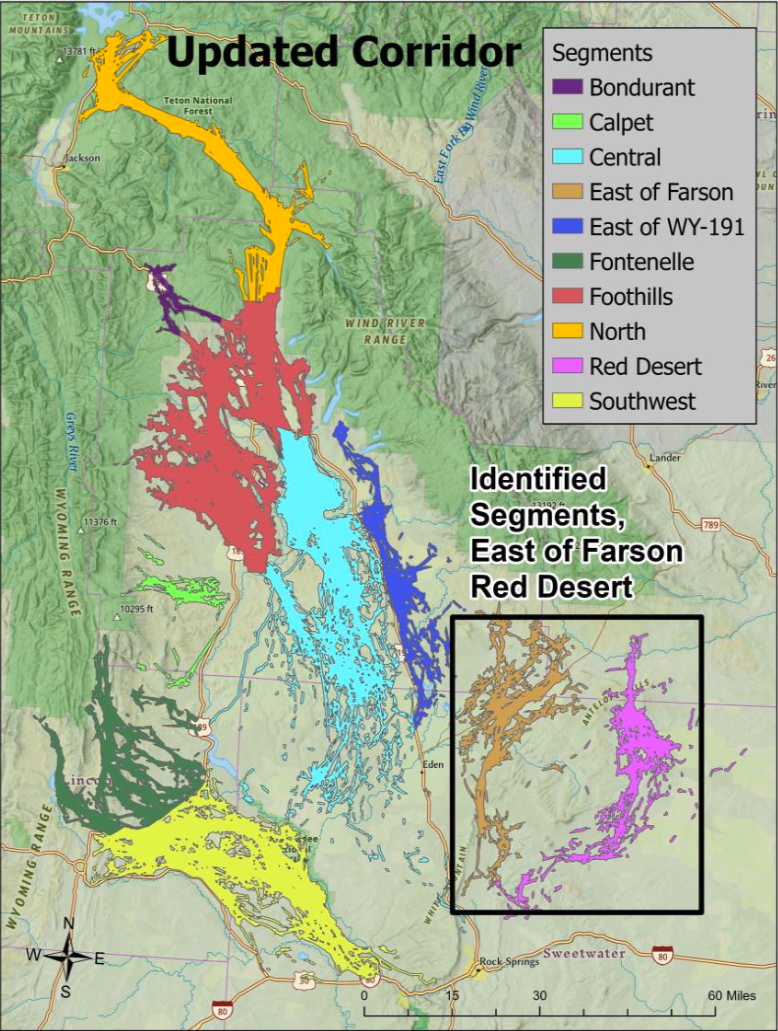
Game and Fish revived efforts to protect the migration in late 2023 and early 2024. Biologists pulled together one of North America’s most comprehensive migration datasets, benefiting from approximately two decades of GPS collar information collected from more than 400 pronghorn.
Some controversy followed the process until near the end. There was a debate about whether to designate the migration’s two easternmost segments, in the Red Desert and east of Farson. The Game and Fish Department proposed excluding the routes, but was overridden by its commission. Then Gordon upended that decision, excluding the two segments.
Vetting the migration corridor through a Gordon-appointed working group was the second-to-last step in the designation process.
“Today’s designation demonstrates that voluntary, locally driven conservation works,” said Robb Slaughter, who chaired the group, during the commemoration at Trapper’s Point.
Time will tell if that’s the case. Wyoming’s migration policy is, by design, permissive of development. Private land is exempt from protections, and designation is not an assurance that new stressors won’t be added to the landscape.

“Today is not the end of the process,” Slaughter said. “It’s the beginning of the next chapter. Continued monitoring, adaptive management, research, and cooperation will ensure these recommendations remain effective as conditions change.”
But Friday was the end of the migration designation process. The governor’s informal OK — no signature was needed — was the last step, said Sara DiRienzo, the governor’s deputy policy advisor.
Wildlife advocates celebrated the moment.
“This is historical,” Bruce said. It’s the first effort to protect the full length of a pronghorn migration corridor in the nation, she said.
San Francisco, CA
Newlyweds celebrate Pride-themed weddings inside SF City Hall as parade preparations underway

SAN FRANCISCO (KGO) — On Friday in San Francisco, hundreds of newlyweds began the next chapter of their love story at City Hall.
As they got married inside, Pride preparations were also underway outside of City Hall.
These Pride-themed City Hall weddings were all happening as the setup for the Pride celebration at Civic Center were wrapping up in preparation for Pride Saturday and Sunday.
More than 250 couples arrived for Pride Friday, some of them getting commemorative Pride marriage licenses.
2026 SAN FRANCISCO PRIDE PARADE: How to watch exclusively on ABC7, what to know
Couples like Chris Parker and Jared Duensing got a very special officiant: San Francisco Mayor Daniel Lurie.
“This is such a wonderful day, and so happy to finally be married after four years of knowing each other in such a wonderful location. Being married by the mayor was so special,” said newlywed Chris Parker.
“Just happy and excited for those couples, and I’m happy and excited for our city to show off what makes San Francisco so great — and our LGBTQ+ community is a huge part of why San Francisco is so special,” Lurie said.
All of this leads to a huge weekend in San Francisco.
The stage being set up just outside of City Hall will mark the end of the parade route — but there’s a lot happening before that.
MORE: San Francisco Pride insiders reveal their must-know tips for the weekend
On Friday afternoon, the annual Trans March takes place at Dolores Park.
On Saturday, both the Trans Ally March and Rally and the Dyke March will take place.
On Saturday, performers will start taking the stage at Civic Center Plaza starting at noon.
All of this, of course, is leading up to Sunday’s big parade when thousands will line Market Street.
Zach Fuentes will be hosting SF Pride Parade coverage only on ABC7 Eyewitness News this Sunday with Drew Tuma, Cameron Bopp and Tara Campbell — as well as with our community guest hosts.
Copyright © 2026 KGO-TV. All Rights Reserved.
Denver, CO
Denver Transplant Games sets Guinness World Record for mos living donors, recipients in one place at one time

DENVER (KMGH) — The biennial Transplant Games wrapped up in Denver this week, bringing hundreds of organ donors and recipients together to compete in everything from cycling and swimming to darts and trivia at venues all over the city.
In fact, the games set a Guinness World Record for most living donors and recipients in one place at one time, with 966 gathering at the Colorado Convention Center.
Angela Laino, who used to live in Boulder, came back to Colorado to compete in the games. She donated a kidney to a stranger in January before running in the 5K event.
“I’m what they call a non-directed living kidney donor, which means that I don’t know who my recipient was,” she explained. “So I just said, ‘Whoever needs my kidney, I’m sure they’ll find the best match for it.’”
Laino said she was inspired by her job, working “on and off” as a dialysis social worker for 17 years.
“I really saw the challenges that my patients faced,” she said. “I saw what they had to go through to get on the [transplant] wait list… I know what transplant means for people. I’ve seen it firsthand. And to be able to see them come out here, compete, they’re doing basketball, they’re doing badminton, they’re swimming, they’re cycling, they’re running. They are living their full lives, and that’s really what transplant can do for people.”
Laino said the games unite the community and show off its resilience.
“When you go through the transplant process, sometimes you feel alone, you feel like you’re the only one going through this,” Laino said. “And then you come to an event like this and you literally see thousands of people. You see recipients, living donors, donor families coming together for the same cause. It’s really inspiring, because it really helps to get the word out, spread awareness about the organ shortage, and it shows people what recipients and donors can do after they have the surgery.”
Dr. Michael O’Shea — a nephrologist, a doctor who cares for kidney disease patients and the kidneys in general — agrees. But he said more needs to be down to support patients and spread the word about the need for organ donations.
The National Kidney Foundation estimates 37 million Americans have Chronic Kidney Disease, which occurs when kidneys cannot filter the blood properly, leading to serious health issues. Because symptoms can be minimal in early stages of the disease, many patients don’t realize they have it.
“I think education about kidney transplant, both on the patient side as well as on the potential donor side, could be markedly ramped up and improved,” Dr. O’Shea said. “It’s struggles with communication between transplant centers, patients, and community nephrologists. No one’s fault. It’s just a very complicated delivery system.”
In the case of kidneys, people can become diseased donors — who register to donate in the case of their sudden death — or living donors, who donate one kidney will relying on the other. Dr. O’Shea said both are critical to meet nationwide demand for life-saving transplants, though the living donations tend to have a longer lifespan — around roughly 20 years — for recipients.
“A number of folks get transplanted every year off this list,” O’Shea explained. “It is also true that a greater number of folks get added to the list every year.”
To register to become a deceased donor, Coloradans can visit their local Department of Motor Vehicles office or visit registerme.org.
O’Shea said those considering living donations face an “exceedingly small” medical risk for end-stage kidney disease, but should consult with their doctor about the decision.
Even as the games leave Denver, a reminder will stick around through the summer. Denver Parks and Recreation, the Downtown Denver Partnership and DaVita have partnered to set up a basketball court in Skyline Park near Arapahoe and 17th Streets, in order to keep the spirit of the games alive and honor the resilience of organ donors, recipients and their families.
-

 West Virginia4 minutes ago
West Virginia First Foundation advances key initiatives at second quarterly board meeting
-

 Wyoming11 minutes ago
At 6,000-year-old crossing, Gov. Gordon OKs Wyoming’s first-ever designated pronghorn migration route – WyoFile
-

 Crypto14 minutes ago
SpaceX Lands Nasdaq-100 Spot Weeks After Record IPO
-

 Finance19 minutes ago
Hong Kong vows stronger exchange with reforms, bond futures and gold push
-

 Fitness26 minutes ago
Health Watch: Fitness Friday – exercise and dementia
-
Movie Reviews34 minutes ago
Film review: ‘Tuner’ mixes classical music, crime, and Dustin Hoffman | The Jerusalem Post
-

 World43 minutes ago
Rescuers comb Venezuelan quake rubble, thousands reported missing
-

 Lifestyle1 hour ago
Former Vice President Mike Pence believes Washington is more ‘swampy’ under Trump


