Shanica Knowles, Anna Maria Perez de Tagle, Miley Cyrus, Cody Linley, Jason Earles and Moisés Arias attend the premiere of Disney’s ‘Hannah Montana 20th Anniversary Special’ on March 23, 2026 in Los Angeles, California. (Brianna Bryson/WireImage)
West
Biden's rent-control plan will only make America’s housing crisis worse

NEWYou can now listen to Fox News articles!
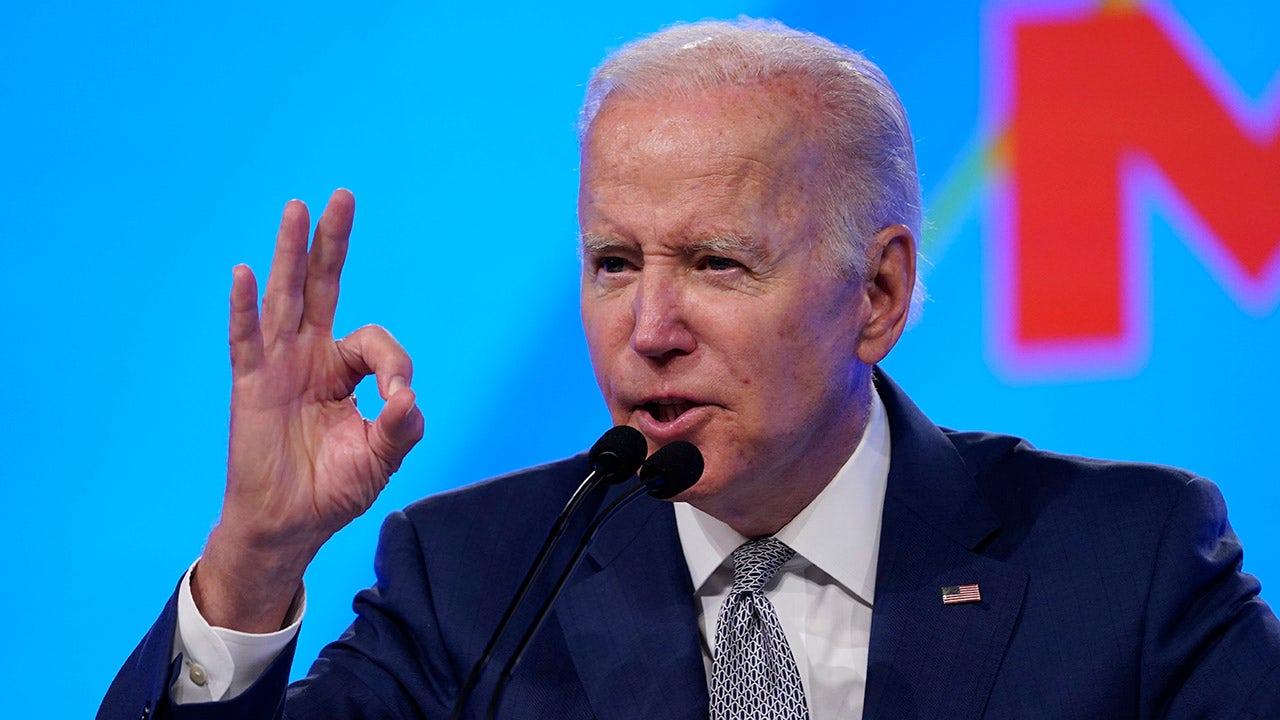
President Joe Biden is suggesting that a federal limit on annual rent increases in residential units will ease housing costs. This is what happens when economist Milton Friedman isn’t “running the show”: Policymakers follow ideas that make the problem they say they’re solving infinitely worse.
“While the prior administration gave special tax breaks to corporate landlords, I’m working to lower housing costs for families,” Biden said Tuesday. He urged congressional Republicans to “join Democrats to pass my plan to lower housing costs for Americans,” in which corporate owners would have “a choice to either cap rent increases on existing units at 5% or risk losing current valuable federal tax breaks.”
If he had only looked west, he would have seen the damage caused by rent-control policies in California.
BIDEN UNVEILS PLAN TO CAP NATIONAL RENT INCREASES AT 5%
California is one of the most rent-controlled states in the country. Even though more than a dozen cities have some type of law that limits how much owners can increase rental rates, it is going through a resurgence of anti-landlord rules, which is sure to spike even higher if voters approve a measure on the November ballot that repeals state limits on rent control.
President Joe Biden proposed national rent control, which has already failed locally, especially in California. (AP Photo/Susan Walsh)
While common sense tells us that rent control laws are counterproductive, it’s clear that lawmakers often miss the obvious. For those, and for the activists who believe rent ceilings are beneficial, we have data.
For instance, a 2019 study by the American Economic Association found that San Francisco landlords “treated by rent control” reduced “rental housing supplies by 15% by selling to owner-occupants and redeveloping buildings,” which “likely drove up market rents in the long run, ultimately undermining the goals of” the city’s 1994 ballot initiative.
The authors noted that “a substantial body of economic research has warned about potential negative efficiency consequences of limiting rent increases below market rates.” Those consequences include the “overconsumption of housing by tenants of rent-controlled apartments”; the misallocation of housing; “negative spillovers onto neighboring housing” that lower “the amenity value of these neighborhoods and mak(e) them less desirable places to live”; and “neglect of required maintenance” – because who’s going to pour money into an asset when the law cuts into the return on that investment?
Rent control in Berkeley in the late 1970s created a large-scale dislocation because “a large number of University of California-Berkeley students simply stayed in their apartments long after graduation,” says economics professor William L. Anderson. The result was a “massive shortage of housing for new students, who then had to look for housing in nearby cities like Oakland.”
A two-decade study by California State University, Sacramento and the Sacramento Regional Research Institute discovered that rent control laws in Berkeley and Santa Monica reduced the supply of rental housing by nearly 7.5% in the former and more than 8.7% in the latter.
CLICK HERE FOR MORE FOX NEWS OPINION
Over that period, the number of college-age students living in Berkeley fell by almost 11%, while in Santa Monica, “formerly a haven for UCLA students,” the college-age student population dropped more than 50%.
In California’s biggest city, rent control has so skewed the housing market that property owners are offering tenants large sums of money, in some cases as high as six figures, as an incentive to move out. The hardship of rent control is forcing owners to make difficult decisions about their properties. Sometimes, the only options are demolishing their units and using the real estate for other purposes because they cannot afford to continue leasing their property.
While common sense tells us that rent control laws are counterproductive, it’s clear that lawmakers often miss the obvious. For those, and for the activists who believe rent ceilings are beneficial, we have data.
Even the state’s own nonpartisan fiscal and policy adviser has warned lawmakers of the negative consequences of rent control. In a 2016 report, the Legislative Analyst’s Office said rent-control laws fail to “increase the supply of housing and, in fact, likely would discourage new construction,” which is perpetually needed in California to drive housing down to more affordable prices.
During the 2020 presidential campaign, Biden said “Milton Friedman isn’t running the show anymore,” in an interview in which he said the next federal pandemic stimulus needed to be “a hell of a lot bigger” than the $2 trillion CARES Act that had just passed.
Friedman was a brilliant economist who would have bristled at the ease in which today’s lawmakers spend other people’s money. But he never ran whatever show Biden had in mind, though he did, as economist Stephen Moore has said, have “a profound impact on major policy decisions.” Biden would be wise to follow the advice that Friedman freely gave during his life, but he instead has chosen to take California foolishness national.
CLICK HERE TO READ MORE FROM KERRY JACKSON
Read the full article from Here

Continue Reading

HONOLULU (HawaiiNewsNow) – Over the last month, strong earthquakes of magnitude 6.0 and higher have rocked the Philippines, Japan, Venezuela, and even Hawaii.
Researchers have been closely monitoring the activity, and while it may seem like more quakes than normal, they say it’s about on par with forecasts.
“This is all pretty normal for earthquakes. On a given year, we expect around 15 between magnitude 7 and 8, and about 150 between magnitude 6 and 7,” said Helen Janiszewski, assistant professor at the University of Hawaii at Manoa’s Department of Earth Sciences.
The quakes are, however, hitting in more populated places compared to some large earthquakes in past years, making them more noticeable.
“A couple years ago, there was an actual very similar, sequence of earthquakes to the one that we had in Venezuela where it was, 7.8 and 8.1 in very close sequence, but it was here, where no one lives,” Janiszewski said, pointing to the Southern Atlantic Ocean on a map.
Despite advancements in technology, researchers say there’s still no way to precisely predict when and where the next big earthquake will strike. But some seismology enthusiasts believe patterns can be monitored, studied, and used to implement potential life-saving warnings.
“I think it’s something that could happen as well across the world if people, scientists got together and really understood what’s happening. And then governments also utilize this knowledge to better notify and warn their citizens,” Pahoa resident Bob Gentzel said.
There are upwards of 100 seismographs throughout Hawaii constantly monitoring for quake activity.
Very subtle energy from the Venezuela quake was mapped traveling through the continent.
Some hope investments will be made in early-warning technology, as well as individual emergency preparedness.
“I’m just trying to prove the point that they can be forecastable because I want to save lives,” Gentzel said.
Janiszewski added, “There’s a lot that we can do still in the interim, both on an individual scale for preparedness in your own home as well as investment at community and state levels.”
Copyright 2026 Hawaii News Now. All rights reserved.

MERIDIAN, Idaho — After months of delays, the Idaho Transportation Department says the final obstacle preventing the activation of new variable speed limit signs has been cleared, putting the long-awaited safety project one step closer to going live.
The electronic signs, installed along one of Idaho’s busiest roadways, will lower the speed limit from 55 mph to 45 mph during weekday rush hours — from 7 to 9 a.m. and again from 4 to 6 p.m. Officials say the safety project’s goal is to reduce crashes while improving traffic flow during the busiest times of day.
WATCH | Why these variable speed signs haven’t turned on months after installation
Eagle Road’s long-awaited variable speed signs one step closer to operation
The signs have remained inactive for months, prompting questions from Idaho News 6 viewers about why they had yet to be turned on.
According to ITD, the delay stemmed from the need to provide electrical service to the signs. Idaho Power first had to obtain easements from nearby property owners before power could be extended to the new infrastructure — a process that took longer than originally anticipated.
PREVIOUS COVERAGE | Meridian business owner recounts scary crash, welcoming lower speed limits on Eagle Rd
Idaho Power confirmed this week that the easement work and power installation portion of the project is now complete.
With electricity now connected, ITD says the remaining steps include final system testing before the signs are activated. The agency expects the variable speed limits could begin operating as soon as next week.
The project has been years in the making. Meridian Police have long advocated for reduced speeds during peak commuting hours along Eagle Road, citing the corridor’s growing traffic volumes and history of crashes.
PREVIOUS COVERAGE | New road signs are coming to a stretch of Eagle Rd in Meridian
“I like it at 55, you get places faster, but it might help with accidents,” said Maddie Romine is a manager at Chicken Delite Mediterranean near Ustick and Eagle. She said she often avoids driving the corridor during afternoon rush hour because of heavy congestion and crashes she and her coworkers have witnessed.
“I don’t like to drive it anytime after 3 p.m. because it’s pretty congested,” Romine said.
Jim Howell, who drives Eagle Road nearly every day for work, said the corridor has changed dramatically over the past two decades.
“Lately, to travel 7½ miles takes 45 minutes,” Howell said. “Traffic doesn’t move because there are a lot of stoplights, so timing of the stoplights is key.”
PREVIOUS COVERAGE | Meridian business owner weighs in on Eagle Road turn closures
Meridian Police and the City of Meridian said they were disappointed the project did not launch as originally expected earlier this year but are looking forward to the additional safety benefits once the system becomes operational.
Once activated, the electronic signs will automatically display the lower 45 mph speed limit during weekday morning and evening commutes before returning to 55 mph during off-peak hours.
Idaho News 6 will continue following the project and provide updates once the signs officially go live.
Send tips to Meridian neighborhood reporter Kalkidan Meyer
Have a story idea from Meridian? Share it with Kalkidan below —

After Miley Cyrus reunited with her alter ego for the Hannah Montana 20th anniversary special in March, one of her co-stars is explaining his absence.
Mitchel Musso, who played Hannah’s friend Oliver Oken on the Disney Channel show, noted he had a scheduling conflict, but he would have made time for the reunion if it was a new episode of the 2006-’11 series or a movie.
“The kid in me was banking on it, like ‘I can’t wait for us to all be on set again,’ and it just didn’t work out that way,” he said on the Joe Vulpis Podcast. “Do something other than what was done. Like, do an episode. Do the show. The set’s still there. Or it can be dressed very quick with somebody who’s a pro, and they did that for that and just did it differently.”
Musso continued, “It is what it is. But it wasn’t the right thing and I was busy doing something that was more important, right? But it would have been way more important if it would have just been an episode, or a movie, or a whatever. Of course, that would have been more important.”
The actor said he would have “dropped everything” if it meant getting back into character as Oliver. “It would have been everything,” he said.
“It didn’t turn out that way… Of course they asked me. But like I said, it wasn’t presented correctly,” added Musso. “And I’ve been waiting 10 years. You know, the people they say 20. My break’s been 10. So, it’s too long of a wait to do it in a way that isn’t even close to, in my opinion, correct.”
Emily Osment, who played Miley and Oliver’s friend Lilly Truscott, was also absent from the reunion special, noting she was busy filming Georgie & Mandy’s First Marriage but feels “lucky to have been a part of this once-in-a-generation goliath of a television show” like Hannah Montana.
-

 Florida5 minutes ago
Florida tattoo shop refuses service to military and veterans for being ‘war criminals’
-

 Georgia8 minutes ago
What would it take for Missouri football to stun Georgia in 2026?
-

 Hawaii13 minutes ago
Scientists say major earthquakes feel frequent, but activity is on track
-
Idaho20 minutes ago
Eagle Road’s long-awaited variable speed signs one step closer to operation
-

 Illinois23 minutes ago
Illinois Lt. Gov. candidates focus on affordability in pitch to Rockford voters
-

 Indiana28 minutes ago
Indiana Fever President Addresses Player Safety After Alyssa Thomas' Suspension
-

 Iowa35 minutes ago
Iowa City Regina baseball finds winning formula under new leadership
-
 Kansas38 minutes ago
Video shows disruption during Osawatomie City Council meeting with data center developer

