President Biden had just arrived back at the White House following a weekend at Camp David with his family, walking through the doors from the South Lawn shortly after 7 p.m. He had 45 minutes before he was to deliver remarks about the Supreme Court’s decision to grant immunity to Donald Trump for official acts he took as president.
News
Biden family grapples with pressure on their patriarch to step aside


The president motioned to his son Hunter, who was standing nearby, asking him to listen and join the fine-tuning of the remarks that would be loaded into the teleprompter and delivered to a nation that had grown deeply skeptical of the president’s mental acuity in the aftermath of a stumbling, meandering debate performance four nights prior.
Hunter’s presence that evening raised eyebrows among some White House staffers, who saw it as a troubling sign that a politically problematic family member was taking a renewed part in official business. But for those in and close to the family, it was the latest sign that Hunter had stabilized his life and was assuming a role he’d long held inside his father’s orbit as a confidant and sounding board.
As remarkable as the past few weeks have been in the wider political universe, they have been equally turbulent inside the tight-knit Biden family, unfolding as the latest chapter in the clan’s long story of resolve amid tumult. Family members have flashed through a range of emotions, people close to them say — sadness, anger, determination — and are deeply frustrated by what they see as the betrayal and second-guessing of a man who has spent a half-century as a dedicated leader of the Democratic Party.
This picture of the Biden family in its patriarch’s hour of peril is based on interviews with multiple people with direct knowledge of the family’s thinking and private actions. They spoke on the condition of anonymity to discuss sensitive matters related to the president’s inner circle.
Family members have often been with Biden in recent weeks as he seeks to ride out the political storm stemming from his debate performance. First lady Jill Biden joined him for a campaign swing in Pennsylvania. After he was diagnosed with covid-19 on Wednesday and with calls escalating by the day that he reconsider his decision to stay in the race, she joined him at their home in Rehoboth Beach, Del.
Hunter, who lives in California, flew out to meet Biden when the president was in Las Vegas recently for campaign events. They have remained in close contact, with Hunter following daily, often hourly, developments, on calls with his father and acting as a sounding board and a gut check. Other family members have been exchanging their usual daily phone calls and frequent text messages.
But in a family where any member can call an emergency meeting, no one has summoned the clan to discuss the patriarch’s political future, despite the extensive speculation from outsiders about some grand family council.
The family’s anger is driven in part by a conviction that Biden could have moved beyond a bad performance in a 90-minute debate if so many Democrats had not immediately joined forces against him. They have come to view the past few weeks as a Game of Thrones-style war among various factions of the party, with the loudest calling on him to depart coming from those he has fought against in previous battles. The tone some in the party are taking in their effort to push him out has only stiffened Biden’s resolve to stay in, they say.
“It’s like they don’t know he’s Irish,” said one person close to the family.
The most striking development in this private world may be the return of Hunter Biden to a central, supporting role, just weeks after his criminal trial made him a source of personal worry and political peril.
When he was convicted on June 11 of felony charges related to lying on a gun-purchase form, the family rallied behind him. His father called to make sure he was okay, then flew to Wilmington to embrace him on an airport tarmac.
But overnight, the father-son roles have been reversed: As Joe Biden fights for his political life, Hunter has talked with his father frequently, providing support amid a clamor of skeptical Democrats.
Interviews with several people close to family members say that, contrary to frequent depictions of Hunter and Jill Biden as irrational cheerleaders prevailing on the president to stay in while his political advisers press him to reconsider, the family dynamics are far more nuanced. The president throughout has been clear that he is not withdrawing, and they have affirmed all along that they are behind him no matter what. Biden may yet change his mind, and those close to the family say they would support that decision, too.
When it comes to Hunter Biden, the past few weeks have shown how a father and a son, each well-versed in tragedy and trauma, have handled a series of extraordinary difficult moments, their own and each other’s.
“The thing both of them care about more than anything else is not harming the other,” said one person close to the family. “It all has a Shakespearean quality to it.”
Surviving a legal blow
On June 11, at around 11:15 a.m., a federal jury in Delaware found Hunter Biden guilty of felony gun charges. His crime was lying on a form when he bought a gun in 2018, but the week-long trial laid bare, in sometimes painful detail, his humiliating and distasteful behavior when he was in the throes of a drug addiction.
Hunter hugged each member of his legal team after the verdict, thanking them and comforting his top defense attorney, Abbe Lowell, and whispering, “It’s all right.”
He then gathered with his friends and family in a crowded room nearby for what several who were there describe as an emotional scene where Hunter was stoic even as many were in tears after a devastating verdict that shocked some in his camp.
“Look guys, I’m going to be okay. This isn’t hell,” Hunter said, according to people who were there. “My addiction was hell. Whatever happens, I’m standing here today, and that’s what matters.”
The president, who was in Washington, called his son and hastily made plans to fly to Wilmington to see Hunter. They met on the tarmac at Delaware Air National Guard base, embracing each other before Hunter flew back to his home in Los Angeles with his wife and young son, Beau.
That evening, the president and first lady personally called some of those who had attended the trial to thank them and to ask how they thought Hunter was doing.
The answers that came back were that he seemed surprisingly strong. It was an unquestionably significant legal setback, one that could result in a prison sentence, but he seemed to have achieved some sense of personal stability.
Joe Biden soon left for the Group of Seven conference in Italy, joined by several of Hunter’s older daughters, including Naomi, who had testified at the trial.
The weekend at Camp David
About two weeks later, as the president’s fateful debate performance played out in Atlanta, Hunter was home in California. Jill Biden was with her husband. Biden’s grandchildren were scattered around the country.
Afterward, they knew the debate had not gone well and worried about the impression it left. But it did not alter their approach to the campaign.
Many outside the family thought Biden faced an immediate decision about whether to stay in the race, but that seems never to have been a question for the president himself. He saw the debate simply as a setback in an otherwise sound campaign, a hurdle in a life full of them. That attitude was adopted by the family largely without discussion.
“There is no walking into this as if he’s like, ‘Should I get out, should I not get out?’ That’s just not who Joe Biden is,” said one person close to the family. “It’s not like he was teetering until he talked to Hunter and Jill.”
By late Saturday night, some 48 hours after the debate, the whole family was at Camp David — not for some emergency council, but for a prearranged gathering in the days before Independence Day. Just weeks earlier, the question was how Hunter was faring against his detractors; now it was how Joe would face his.
The tone of that weekend, in private moments without political advisers, set the course for the tumultuous weeks to come: Biden was staying in and the family was backing him. The question was how to proceed with the race, not whether to.
Many in the family, like their patriarch, believe the election remains close. They dismiss polls that show otherwise and do not believe an alternative candidate would fare any better against Trump. Deep in Biden’s psyche is the conviction that he is an underdog who has consistently been underestimated by party leaders, only to prove them wrong.
But family members resist the idea that they are the ones driving the decision. They resent any notion that they are propping up the president. He is capable of making these weighty decisions as he always has, they say, with their input and backing.
There is also a redemptive quality to the family discussions.
Five years ago, when Biden decided to run for president, the family was deeply fractured in the aftermath of his son Beau’s death, dealing with divorce, affairs and addiction. Hunter was in some ways more distant from his father than he’d ever been.
This post-debate gathering at Camp David showcased a family that was largely united, with Hunter as present in his father’s life as he was before a drug addiction tore him away.
Clear-eyed about the danger
When they returned to the White House after the weekend at Camp David, the family stayed close. They celebrated the Fourth of July together. Ashley Biden was dancing on the portico, hugging her father’s waist from behind. One granddaughter, Maisy, wore a white T-shirt with “I [heart] Joe” written on it.
Jill stood by his side. They looked on as fireworks burst in the sky.
Hunter flew back to Los Angeles on July 5 and his father flew to Wisconsin for a campaign event. They have remained in close contact.
Biden remains certain he is the party’s best option, according to those close to the family, and they support him in that. But they also recognize that things can change quickly in politics and that Biden could be 100 percent in until he’s 100 percent out.
“Hunter would support anything his dad wanted to do and he trusts his dad’s judgment,” one person close to the family said. “If his dad said, ‘I can hand this off and I can’t do it,’ Hunter would say, ‘Dad you’re the best, I love you, I trust you and I support you.’”
Of anyone in the family, Hunter has faced the most scrutiny as a result of his father’s presidency. That arguably gives him an incentive to hope his father pulls out rather than endure a vitriolic reelection race potentially followed by four more years of an unwelcome spotlight.
But if Biden pulled out and Trump were to win, some family members worry that he would use the Justice Department to target Hunter.
In recent days, those close to the family have become more combative as a growing number of Democrats have publicly called for him to step aside. If Biden gets out, they say, he should make the decision based on his own political gut and not because of external pressures from figures such as George Clooney, former president Barack Obama or former House speaker Nancy Pelosi (D-Calif.).
Still, those in the family orbit say Biden’s relatives are not oblivious to the storms roaring around him, making the days ahead, even for them, difficult to predict.
“They are not in a bubble. They don’t have their head in the sand,” one person close to the family said. “They’ve been very clear-eyed about this from the beginning. And that has continued.”


BOSTON (AP) — A federal judge on Thursday halted President Donald Trump’s executive order that sought to create a federal voter list and limit who can receive a mail ballot.
U.S. District Court Judge Indira Talwani, who was nominated by Democratic President Barack Obama, sided with a coalition of nearly two dozen states that challenged the Republican president’s order in granting a summary judgment. Her ruling applies to this year’s midterm election cycle.
Plaintiffs argued in two lawsuits, both filed in federal court in Boston, that Trump’s order should be found unconstitutional because the states and Congress, not the president, have the power to set election rules. The judge agreed, noting in her ruling that the provisions of Trump’s order “unconstitutionally violate the separation of powers.”
It was the second ruling in as many days against executive orders Trump has signed seeking oversight of the nation’s elections. A separate ruling Wednesday prohibited an executive order he had signed last year that would have required people to show documents proving their citizenship when registering to vote.
The administration, in its motions to dismiss the lawsuits challenging the order seeking to establish a federal voter list, argued that the motions are premature and that plaintiffs lacked the legal basis to bring their claim based on the Administrative Procedure Act, which governs how federal agencies develop and issue regulations.
But in an interim order before Thursday’s ruling, Talwani said the motions pertaining to this year’s election cycle were relevant: “In light of the EO’s specific deadlines over the next three months, and the reality that elections will be occurring throughout this period with the November 3, 2026 midterm occurring in just five months, postponing judicial review is impracticable and may inflict significant hardship on Plaintiffs,” she wrote. That order denied the Trump administration’s motion to dismiss the challenges.
Trump’s executive order, the second one aimed at elections during his second term, comes as he continues to raise the specter of widespread voting by noncitizens as a reason to change election rules. But states already have detailed processes aimed at keeping their voter rolls accurate, and voting by noncitizens has been shown to be rare. It also is a felony that can be punishable by deportation.
Trump issued his second order in March after a bill he supported to overhaul voting stalled in Congress. The order would have had the federal government create a list of eligible voters and then directed the U.S. Postal Service to deliver mail ballots only to those on the list. Election officials argued that it was ripe for abuse and could cause chaos, and the postal union has objected to the idea of mail carriers policing ballots.
The Postal Service has published a proposed rule required by Trump’s executive order in the Federal Register. Among other things, the rule would not apply to primary elections or overseas ballots.
The lawsuit seeking summary judgment was filed by Democratic attorneys general representing 22 states and the District of Columbia. Also signing on were attorneys representing Democratic Gov. Josh Shapiro of Pennsylvania, which has a Republican attorney general.
The states also told the court that the move imposes a costly burden on election officials to comply and would spread fear about the possibility of prosecution. Stephen Pezzi, a lawyer for the Trump administration, had argued that no one would be prosecuted for violating the order.
In a separate lawsuit filed against the executive order, a federal judge in Washington, D.C., in May agreed with the Trump administration that it was too early to block the order because it had yet to be implemented. That lawsuit was brought by Democratic and civil rights groups, who have appealed.
Since his 2020 presidential election loss to Democrat Joe Biden, Trump has groundlessly claimed mail voting is rife with fraud and has launched a federal investigation into that year’s vote, even though repeated audits and investigations, including ones run by Republicans, found it was free of widespread fraud. Trump also has said he wants to “take over” election administration in Democratic areas.
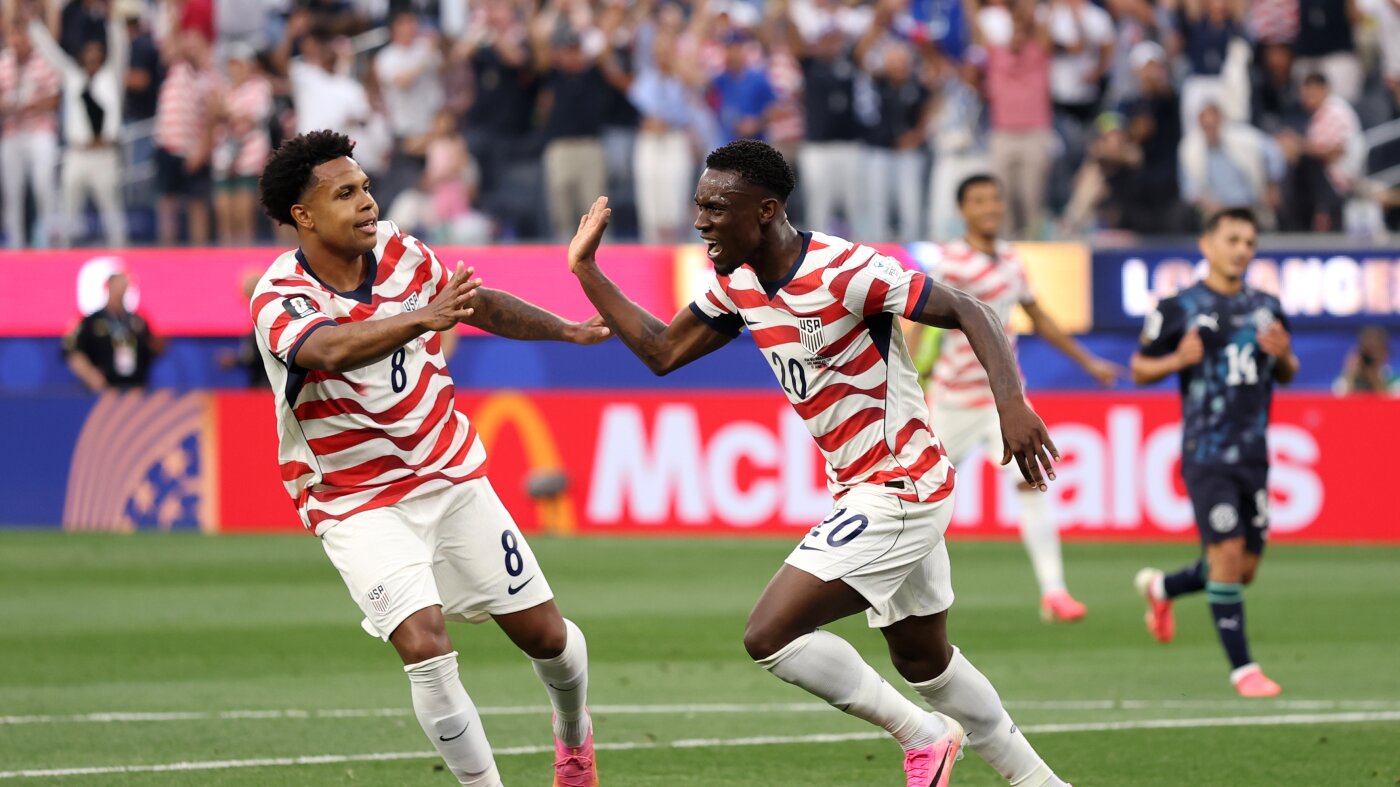
Folarin Balogun (r) of the U.S. celebrates scoring his team’s second goal with Weston McKennie during their World Cup match against Paraguay on June 12 in Inglewood, Calif. The U.S. defeated Paraguay and, later, Australia. The U.S. wraps up group play against Turkey on Thursday evening. Win, lose or draw, the U.S. has already won its group and will advance to the knockout round.
Richard Heathcote/Getty Images
hide caption
toggle caption
Richard Heathcote/Getty Images
INGLEWOOD, Calif. — For the U.S. men’s national soccer team, a loss in Thursday night’s FIFA World Cup game against Turkey wouldn’t change anything.
A win, though, would be history.

The squad’s earlier wins over Paraguay and Australia, plus two losses by Turkey to the same teams, mean the Americans have already won their group and clinched a favorable path in the knockout round, no matter the outcome of Thursday’s game.
But the American men have never won more than two games in a single World Cup. A third win would be new territory for this team, which has not been shy about its aspirations in this tournament and its confidence about living up to them.
“The group stage is not done yet. We want to end it the right way. We want to end it the way we came into it and continue to build off of the momentum that we’ve been creating,” said defender Mark McKenzie, speaking to reporters Wednesday.

Because the outcome of the game does not affect knockout-round placement, the U.S. can rest key starters who will enter the match with a yellow card. For those players — defenders Antonee Robinson and Chris Richards, midfielder Tyler Adams and forward Folarin Balogun — picking up a second yellow card against Turkey would result in a suspension in the Round of 32. (Any single yellow cards will be cleared after the group stage concludes.)
The team could also choose to ease in forward Christian Pulisic, who is expected to be available for the game after sitting out the U.S.-Australia game with a minor calf injury.
Turkey had come into the World Cup with high expectations. With talented young stars like the 21-year-old attackers Arda Güler of Real Madrid and Kenan Yildiz of Juventus, the team was thought by many — from analysts to the players themselves — to be a dark horse capable of a deep run.
Instead, they were eliminated last week when their loss to Paraguay followed the U.S. win over Australia, prompting apologies from Turkey’s despondent players to their fans after the game.
On Wednesday, Yildiz echoed that apology and promised to “give our best” in Thursday’s game against the U.S. “We had high expectations. I know because all of our country was supporting us and thought we will come very far,” Yildiz said. “Hopefully for the next game we can make a good result and go out with pride.”
The U.S. and Turkey last faced each other in an international friendly in June 2025, which Turkey won 2-1. The U.S. roster for that game was missing several key players, including Pulisic, Robinson, Balogun and midfielder Weston McKennie.
“We had a really young team, but we went out there and put in a good performance. I don’t think the result necessarily reflected how we played,” Richards said. “Whoever’s on the field, I know we’re going to go out there and give 110 percent.”

A federal judge on Wednesday permanently barred President Donald Trump’s administration from implementing most of his first executive order on elections, part of which sought to require people to show documentary proof of citizenship when they register to vote.
The ruling by U.S. District Court Judge Denise Casper in Boston effectively converts a preliminary injunction she issued a year ago, in which she temporarily blocked many of Trump’s efforts to overhaul elections, into a permanent ban.
Casper rejected the Republican administration’s argument that the lawsuit to block the changes brought by Democratic state attorneys general was premature because the rules had yet to be put in place. Instead, she agreed that the Constitution gives states and Congress the authority to regulate elections, and that Trump’s requirements violated the separation of powers.
The Constitution “does not grant the President any specific powers over elections,” wrote Casper.
Among other proposed changes, Trump’s order would have required people to provide documentary proof of citizenship when registering to vote, prevented mail ballots from being counted if they arrive after Election Day, even if they were postmarked by then, and punished states that failed to comply by withholding certain federal money.
In a statement, New York Attorney General Letitia James said she was grateful the court had blocked Trump’s “unconstitutional attempt to seize control of our elections” and would continue to defend voting rights in this year’s midterm elections.
“Generations of Americans fought tirelessly for the right to vote, and we honor their legacy by protecting that right against anyone who tries to undermine it,” said James, a Democrat.
A voter casts a ballot during New York’s primary election on Tuesday, June 23, 2026, in New York. (AP Photo/Ryan Murphy)
California Attorney General Rob Bonta, whose state was the lead plaintiff in the case, said the ruling reaffirmed the constitutional principle that it s up to the states and Congress to set election rules.
“While we are proud of this result, we are clear-eyed that President Trump’s attacks on voting rights and our elections show no signs of slowing down,” Bonta, a Democrat, said in a statement. “So let me be clear: we will keep fighting back every step of the way.”
Requests for comment sent to the White House and he U.S. Department of Justice were not immediately returned.
The ruling was the latest in a series against the elections executive order Trump signed just months after taking office for his second term. The Republican president has since signed another executive order on elections that seeks to create a national voter list and limit mail balloting. That directive also faces multiple legal challenges.
Last fall, a federal judge in Washington, D.C., overseeing a separate challenge to the first election executive order by civil rights and Democratic Party-aligned groups blocked the government from taking steps to include the proof-of-citizenship requirement on the federal voter registration form. That judge later barred Trump’s defense secretary from requiring documentary proof of citizenship when military personnel register to vote or request ballots.
In an apparent nod to the difficulty of implementing a proof-of-citizen requirement by executive order, Trump is pushing legislation in the Republican-controlled Congress to create such a mandate. The SAVE America Act has passed the House but has stalled in the Senate, leading Trump to advocate for eliminating the filibuster that is blocking the legislation.
On Wednesday, he abruptly canceled the expected signing of a bipartisan housing bill, saying he would not sign legislation until Congress passes his proof of citizenship requirement for voting.
The president and many of his Republican allies have been promoting the narrative that voting by noncitizens is a major problem, when in fact it’s quite rare. The federal voter registration form already requires people to attest that they are U.S. citizens. Violating that is punishable as a felony that can lead to prison or deportation.
In another major voting case, the U.S. Supreme Court is due to issue an opinion soon on whether mail ballots must arrive by Election Day. That could immediately change the rules in 14 states that allow grace periods ranging from days to weeks if the ballots are postmarked by Election Day.
Casper, who was nominated by Democratic President Barack Obama, is the chief judge for the U.S. District Court for the District of Massachusetts.
-

 Crypto2 minutes ago
Bitcoin Slides Nearly 20% in June as $715M in Crypto Long Bets Collapse
-

 Finance7 minutes ago
Anne Arundel County Launches New Finance and Procurement Platform
-

 Fitness14 minutes ago
How Kaye Adams’ varied exercise routine keeps her fit at 63 – and why she swapped HIIT for walking
-

 Movie Reviews22 minutes ago
8News Reel Talk: ‘Toy Story 5’ movie review
-

 World32 minutes ago
Strong Earthquake Rocks Venezuela Capital
-

 Health1 hour ago
Does Berberine Aid Weight Loss? The Best Time To Take It To Boost Results
-
 Lifestyle1 hour ago
John Cena wanted to step away from the WWE ring before he became ‘too slow for the show’ : Wild Card with Rachel Martin
-

 Technology1 hour ago
Here’s a bunch of Prime Day deals on keyboards, mice, and other peripherals we like

