Politics
Trump's untruths pile up. Biden gets facts wrong too. Do voters care?

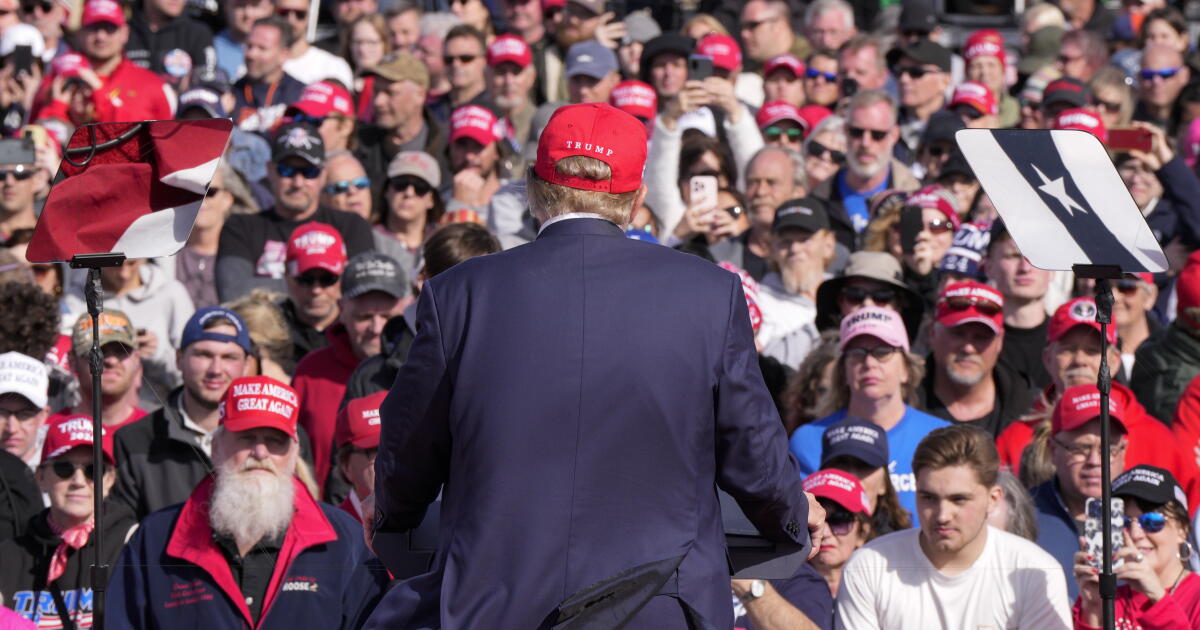
Former President Trump was on another one of his screeds about how Democratic prosecutors were persecuting him, saying he’d been “investigated by the Democrats more than Billy the Kid, Jesse James and Al Capone combined.”
The crowd at a 2022 rally in North Carolina seemed to eat if up, having a hearty laugh when Trump concluded: “I think I’m perhaps the most honest human being that God ever created.” The crowd broke into applause.
As Trump campaigns to retake the White House, polls suggest Republicans have become increasingly willing to accept his pronouncements, even as a cottage industry of fact-checkers suggests reality lies elsewhere. That’s because his grievances and complaints about an America under siege feel true in the guts of a “vast segment of the population,” who therefore view Trump as a truth-teller, said Steve Schmidt, a longtime Republican political consultant.
“So Trump is two things at once,” said Schmidt, who writes a blog on national politics that portrays the 45th president as a demagogue and a threat to democracy. “He is simultaneously the most prolific liar in the history of American politics, and he is the most honest president we have ever had.”
Donald Trump ‘is simultaneously the most prolific liar in the history of American politics, and he is the most honest president we have ever had.’
— Steve Schmidt, Republican political consultant
Several major media outlets had created fact-checking teams before Trump rose to prominence. In 2016, the New York Times made what then was depicted as a momentous step when it called then-candidate Trump’s claim that President Obama was not born in America “a lie.”
But once the former reality show host won the presidency, fact-check outfits went into overdrive.
The Washington Post counted 30,573 “false or misleading claims” by Trump during his presidency. Many were repeat offenses, such as the more than 800 claims about election fraud, which were roundly rejected in the courts. After its 1,000th fact-checking of Trump this year, PolitiFact reported he was entirely or mostly wrong more than three-quarters of the time.
“It’s not unusual for politicians of both parties to mislead, exaggerate or make stuff up,” reported PolitiFact, which did not let President Biden off the hook — finding 41% of nearly 300 of his statements entirely or mostly wrong. “But American fact-checkers have never encountered a politician who shares Trump’s disregard for factual accuracy.”
Trump’s core supporters show no sign of being put off.
A case in point came this month, when Trump used a campaign event in Grand Rapids, Mich., to renew his long-running crusade against undocumented migrants.
Trump told the story of Ruby Garcia, whose alleged killer was in the country illegally. Trump called her a “beautiful … incredible young woman.” He said he “spoke to some of her family” about her tragic death.
But Garcia’s sister soon told Ken Kolker of the local NBC News affiliate that Trump hadn’t spoken to anyone in the Garcia family. And Mavi Garcia didn’t appreciate the former president turning her 25-year-old sister’s death into a political talking point.
“He did not speak with any of us,” Mavi Garcia told Target 8.
The Trump campaign did not respond to requests from The Times and other news outlets to discuss the discrepancy.
The episode once might have been a showstopper in American politics, a former — and perhaps future — president called out by an everyday American. But no signs emerged of supporters objecting to the error, and the Garcia incident quickly became part of the ambient noise of a campaign that promises to get louder and uglier.
A recent Washington Post survey found Republicans less likely than they were in the midst of Trump’s presidency to acknowledge his untruths.
Asked whether Trump regularly makes misleading statements, the share of Republicans who say he does dipped by 10 percentage points, to 38%, compared to 2018. And the percentage of Republicans who say Trump usually makes flat-out false claims dipped down to 8% from 14%.
The coverage of Trump’s Ruby Garcia claims also pointed out other dubious comments by him that day.
PolitiFact, run by a Florida-based journalism education outfit, the Poynter Institute, focused on Trump’s inflammatory, and untrue, claim that Venezuela was emptying its prisons and sending criminals to the United States. It also noted that, “overall, violent crime and homicides have declined under Joe Biden’s presidency.”
FactCheck.org, run by the Annenberg Public Policy Center at the University of Pennsylvania, focused on how Trump’s statements about immigration were misleading, noting that “apprehensions at the [S]outhwest border, were 14.7% higher in Trump’s final year in office compared with the last full year before he was sworn in.” Apprehensions hit a record high at the end of 2023, during Biden’s tenure.
On Fox News, anchor Bret Baier asked about Trump’s claim being rejected by Garcia’s sister. But commentator Charles Hurt never addressed the apparent falsehood, justifying Trump’s remarks as being about “something that matters deeply to people.” Hurt shifted the subject to another family whose daughter was killed in an accidental shooting committed by a man who migrated illegally from Mexico.
Contrast the sharply divergent news coverage given to Trump and Ruby Garcia to reports of an earlier Biden misstatement — about where he was the day after 9/11.
In September of last year, it was President Biden being called out for a falsehood, when he said — on the 22nd anniversary of the terrorist attacks on America — that he had visited Ground Zero the day after the World Trade Center towers were destroyed in 2001. In fact, he had joined a congressional delegation there nine days later.
Many outlets, including MSNBC, NBC, CNN, and PolitiFact mentioned Biden’s misstatement. A Wall Street Journey story asked, “Was that a gaffe born out of fatigue, an honest mistake or an exaggeration from a president with a penchant for dropping himself in the middle of the action?”
The Washington Post, the New York Times and the Los Angeles Times did not report the episode, though the Post cited a critic who attacked Biden for marking the anniversary in Alaska.
Fox devoted a good portion of its prime time to roasting Biden for “lying” about being at Ground Zero on Sept. 12, with Sean Hannity inviting several guests to trash the president for commemorating 9/11 at a locale other than New York City, the Pentagon or Shanksville, Pa. Though Biden spoke from a U.S. airbase that responded to the attacks, the Fox commentators called his behavior shameful.
Generally, Biden has been less prone to the sort of unscripted moments that fact-checkers feast on, said PolitiFact Editor in Chief Katie Sanders, explaining, in part, why so many of Trump’s statements have been scrutinized.
“When a politician is speaking off-the-cuff, without carefully prepared remarks in front of them, they tend to be less accurate,” Sanders said.
Kathleen Hall Jamieson, a scholar on political communication and co-founder of FactCheck.org, said the reactions to misstatements tend to fit into well-worn narratives. Biden’s critics belittle the 81-year-old’s memory and mental capabilities. Trump’s critics note his history of lying.
Trump himself boasted in his 1987 memoir that he had mastered the art of “hyperbole.”
“People want to believe that something is the biggest and the greatest and the most spectacular. I call it truthful hyperbole,” Trump wrote. “It’s an innocent form of exaggeration — and a very effective form of promotion.”
Whether any of the campaign’s untruths make a lasting impression on voters depends on many factors, including whether they become the subject of ads, a memorable debate moment or a campaign trail meme, Jamieson said.
“Joe the Plumber” became a recurring character in the 2008 presidential campaign when Samuel Joseph Wurzelbacher of Ohio pressed then-Illinois Sen. Barack Obama about whether his tax plan would hurt small businesses. Arizona Sen. John McCain, Obama’s Republican opponent, brought Wurzelbacher to future campaign events and made sure his view was featured in the final debate between the candidates.
Jamieson said “confirmation bias” always has been a hallmark of political true believers, but it has only intensified in the Trump era, on both sides.
“It’s a way of understanding virtually everything,” Jamieson said, explaining how people sometimes process unfavorable messages. “They are already inside their tribe, so if there is a dissonant message, the way to reduce the dissonance is to say it doesn’t matter, or it doesn’t change that candidate’s fidelity on a core issue.”
Times researcher Scott Wilson contributed to this report.

Politics
EXCLUSIVE: FBI adds alleged COVID fraudster accused of taking $5M from kids’ meal program to Most Wanted list

FBI makes first arrest from its ‘most wanted fraudsters’ list
FBI Director Kash Patel announces the first arrest on the “Most Wanted Fraudsters” list. Said Ereg, a Minneapolis man, is accused of stealing over $4.2 million from a federal child nutrition program during the COVID-19 pandemic. Minnesota Senate candidate Michele Tafoya emphasizes the need for accountability for fraudulent activities.
NEWYou can now listen to Fox News articles!
EXCLUSIVE: The FBI is adding Fahad Mohamed Nur to its Most Wanted Fraudsters List, accusing the Minnesota businessman of allegedly stealing more than $5 million that was intended to feed children during the COVID-19 pandemic.
Nur has been on the run since 2022 and is wanted for his alleged role in a fraud scheme that exploited Minnesota’s Federal Child Nutrition Program during the COVID-19 pandemic, according to the FBI. The bureau alleges he owned a vendor and purported food supplier that received more than $5 million in fraudulent program funds by submitting fake invoices before laundering the proceeds.
The Bureau believes Nur has ties to Somalia and may currently be living there.
The FBI is offering a reward of up to $150,000 for information leading to Nur’s arrest and conviction.
OWNER OF DAYCARE IN VIRAL NICK SHIRLEY VIDEO CHARGED IN $4.6M DAYCARE FRAUD SCHEME, PROSECUTORS SAY
Fahad Mohamed Nur has been on the run since 2022 and may be in Somalia, according to the FBI. (Federal Bureau of Investigation)
Nur is the latest addition to the FBI’s Most Wanted Fraudsters List, which officials say has already resulted in the arrests of two fugitives within weeks of its launch.
“Under President Trump’s and Vice President Vance’s leadership with the White House Task Force to Eliminate Fraud, the FBI’s historic ‘Most Wanted Fraudsters list’ has already seen tremendous success – with two subjects brought to justice in a matter of weeks, apprehended out of Somalia and the Philippines,” FBI Director Kash Patel said in a statement to Fox News Digital.
Patel said the early arrests demonstrate that the FBI is aggressively pursuing fugitives accused of stealing from American taxpayers.
FBI ADDS 2 FUGITIVES TO ‘MOST WANTED FRAUDSTERS’ LIST AMID HISTORIC $6.5B HEALTHCARE TAKEDOWN: PATEL
FBI Director Kash Patel conducts a news conference at the Department of Justice on Thursday, December 4, 2025. (Tom Williams/CQ-Roll Call, Inc via Getty Images)
“Our newest subject – Fahad Mohamed Nur – has been on the run since 2022 for allegedly stealing over $5 million from a child nutrition program in Minnesota.”
Patel added: “Collectively, the Task Force has already uncovered more than $13 billion in fraud, and the rapid success of the Most Wanted Fraudsters List should show all Americans that this FBI will [be] at the forefront pursuing the worst of the worst who stole from hardworking American taxpayers.”
DR OZ WARNS MEDICARE SCAMMERS ARE STEALING BILLIONS — AND YOUR PERSONAL INFORMATION COULD BE NEXT
Federal agents enter an office building as a search warrant is executed at Ultimate Home Health Services over potential Medicaid fraud, on December 18, 2025 in Bloomington, Minnesota, United States. (Christopher Juhn/Anadolu via Getty Images)
Federal officials say the investigation is part of a broader government effort targeting pandemic-era fraud.
“The Department’s robust partnership with the FBI and the White House Task Force to Eliminate Fraud has already delivered historic results. That partnership grows even stronger today with the addition of this latest subject to the Most Wanted Fraudsters list,” said Acting Attorney General Todd Blanche. “President Trump has made it clear: Fraudsters no longer have a safe haven in America. Law enforcement will continue to use every tool at its disposal to bring those who steal from American taxpayers to justice.”
The White House Task Force to Eliminate Fraud, led by Vice President JD Vance, has already uncovered more than $13 billion in fraud, according to the FBI.
CLICK HERE TO DOWNLOAD THE FOX NEWS APP
Anyone with information about Nur’s whereabouts is urged to contact the FBI at 1-800-CALL-FBI, their local FBI office, the nearest U.S. Embassy or Consulate, or submit a tip online at tips.fbi.gov.

With the 2026-27 season premiere of “60 Minutes” just two months away, CBS News leadership is getting closer to deciding who will fill the recent departures of longtime correspondents Scott Pelley, Sharon Alfonsi, Cecilia Vega and Anderson Cooper.
Seth Doane, a longtime correspondent based in Italy who is often seen on “CBS Sunday Morning,” is under consideration, along with chief investigative correspondent Jim Axelrod, who currently has a lead role in the “Eye On America” series featured on the “CBS Evening News with Tony Dokoupil.”
Sir Trevor Phillips, a British journalist and former politician who recently joined CBS News as senior global affairs correspondent, is expected to have a role on the program, according to people briefed on the plan. Phillips had a long career in the U.K., producing and writing documentaries and most recently hosted the Sky News program “Sunday Morning with Trevor Phillips.”
Phillips received a knighthood in 2022 for his service to equality and human rights for the U.K. But he also generated controversy over his career for comments about the British Muslim community, which led to a yearlong suspension from the Labour Party in 2020.
A CBS News representative declined comment beyond saying the division is looking at a number of internal and external candidates.
Dokoupil is expected to deliver four “60 Minutes” pieces a season. Major Garrett, the network’s chief Washington correspondent, will also have a contributor role.
Matt Gutman, hired from ABC News last year as national correspondent, is under strong consideration. He is being put in front of test audiences, according to several people at the network.
Holly Williams, a foreign correspondent working out of Istanbul for CBS News since 2012, and Mariana van Zeller, a journalist for National Geographic Channel, are both said to remain in contention.
The newcomers will join Bill Whitaker, Leslie Stahl, Jon Wertheim and Norah O’Donnell, who are all returning as correspondents. O’Donnell will also continue in her role as senior correspondent for the network, occasionally anchoring specials.
The rebuild of the talent line-up comes after the upheaval at the program that has occurred since Bari Weiss joined CBS News as edtior in chief in October.
Longtime correspondent Scott Pelley was fired last month after confronting management about the May 28 dismissal of his colleagues Alfonsi and Vega along with the program’s executive producer Tanya Simon and her second-in-command Draggan Mihailovich.
In February, Cooper decided not to sign a new deal as a “60 Minutes” contributor, as the CNN anchor cited a desire to spend more time with his family. But Cooper has reportedly told colleagues that he does not want to work for Weiss.
The internal disruption at “60 Minutes” followed a highly successful season. In its 57th season, “60 Minutes” was the most watched news program on television with an average of 9.1 million viewers a week according to Nielsen data. The program bucked the overall decline in traditional TV viewing by growing 9 percent over the previous season.
After the dismissal of his “60 Minutes” colleagues, Pelley accused Weiss of trying to “murder” the program and claimed she was putting “her thumb on the scale” for more favorable coverage of the Trump administration. He was fired with cause after confronting management at a June 1 meeting.
Weiss came to CBS when parent company Paramount acquired her digital web site The Free Press, known for its criticism of progressive policies and its strong support of Israel.
Weiss was hired by Paramount Chief Executive David Ellison with a mandate to move the news division to the political center. The pronouncement has created the perception that CBS News is looking to placate the Trump administration as Paramount sought regulatory approval for its $111 billion acquisition of Warner Bros. Discovery, which will also give the company ownership of CNN.
The noise surrounding Weiss has hurt CBS News despite strong reporting that is often far from being pro-MAGA. This past weekend’s “CBS Sunday Morning” featured a segment from national security correspondent David Martin about the Department of Defense interfering with the editorial independence of Stars & Stripes, the military newspaper.
Trump complained vehemently about his last interview with O’Donnell on “60 Minutes,” — conducted the day after a gunman tried to enter the White House Correspondents Assn. dinner in Washington on April 25.
Politics
Abbott orders probe after Texas hospital advertises ‘birth packages’ in Mexico: ‘Citizenship is not for sale’

NEWYou can now listen to Fox News articles!
Texas Gov. Greg Abbott ordered an investigation into a Texas hospital Tuesday after it confirmed to Fox News that it advertised Spanish-language “Birth Packages in South Texas” on billboards in Mexico promoting childbirth services to pregnant foreign nationals near the U.S.-Mexico border.
Mission Regional Medical Center confirmed to Fox News that it was responsible for the advertising campaign, which promoted deliveries starting at $3,950 for a natural birth and $5,525 for a C-section and directed viewers to a website, havemybabyinTEXAS.com, that has since been taken offline.
The billboards also displayed a telephone number beginning with “001,” the country code used to place calls to the United States from Mexico.
‘WEAPONS OF MASS REPRODUCTION’: WATCHDOG UNVEILS ACTION PLAN TO CURB BIRTH TOURISM AFTER SUPREME COURT RULING
Gov. Greg Abbott speaks during a bill signing in the State Capitol on April 23, 2025, in Austin, Texas. (Brandon Bell/Getty Images)
“The marketing materials regarding maternity services are no longer in use due to any unintended misunderstanding,” a hospital spokesperson said in a statement to Fox News. “We do not support or facilitate any unlawful activity and work to comply with all applicable federal and state laws and regulations.”
The spokesperson said the campaign included two billboards located within approximately five miles of the hospital near a U.S.-Mexico border crossing. The hospital said both billboards and the website were removed Monday after images began circulating on social media. The spokesperson also said the campaign began in 2021 but did not specify when the billboards were installed.
Abbott on Tuesday directed Texas Health and Human Services Commission Executive Commissioner Stephanie Muth to investigate Mission Regional Medical Center for potential violations of state law and contractual obligations.
REPUBLICAN ACCUSES SCOTUS OF BETRAYING US, PUSHES BILL RESTRICTING BIRTHRIGHT CITIZENSHIP, PREGNANT VISITORS
A Spanish-language billboard promotes birth packages at Mission Regional Medical Center, advertising pricing for natural deliveries and C-sections in South Texas. (Right Angle News)
Images of the billboard circulated on social media before the hospital said it removed the advertisements Monday.
“Birth tourism’ is an illegal practice that exploits the extraordinary hospitality that the United States and Texas offer to millions of foreign travelers each year,” Abbott wrote in a July 7 letter obtained by Fox News. “Unfortunately, thousands of foreign travelers come to the United States under false pretenses to give birth and secure citizenship for their children.”
TRUMP SUFFERS MAJOR SUPREME COURT DEFEAT AS JUSTICES UPHOLD BIRTHRIGHT CITIZENSHIP
An English-language billboard promotes birth packages at Mission Regional Medical Center, advertising pricing for natural deliveries and C-sections in South Texas. (Right Angle News)
Abbott directed HHSC to “immediately and thoroughly investigate” the hospital and said any violations should be referred to the Texas Attorney General for civil enforcement and to the appropriate district or county attorney for potential criminal prosecution.
“American citizenship is not for sale and Texas will not permit our healthcare system to be used as a magnet for birth tourism,” Abbott wrote.
The governor also said he plans to work with the Texas Legislature during its next session “to strengthen state law and eliminate birth tourism in Texas.”
“Unfortunately, birth tourism operations are not a new phenomenon,” General Counsel of the Oversight Project Kyle Brosnan said to Fox News Digital in a statement. “The Supreme Court’s egregiously wrong decision in the birthright citizenship case is going to open the floodgates to the birth tourism industry. Our country is much more than a pile of magic dirt. The only answer to these type of practices are criminal investigations and the mass deportation of illegal aliens.”
Mission Regional Medical Center also said it intends to cooperate with state officials.
CLICK HERE TO DOWNLOAD THE FOX NEWS APP
“We intend to work cooperatively and transparently with local and state officials,” the hospital said in a statement obtained by Fox News. “Our focus remains on delivering safe, high-quality care to every patient who seeks our services.”
The investigation comes as President Donald Trump’s executive order seeking to limit automatic birthright citizenship for some children born in the United States remains the subject of ongoing legal challenges.
-

 World5 minutes ago
‘The Kitchen’ Director Alonso Ruizpalacios at BAM: ‘We Need More Trojan Horses’
-

 News10 minutes ago
Manhattan Building’s Columns Buckled Beneath New Addition, Images Show
-
 Lifestyle47 minutes ago
Can you say no to a friend’s wedding? : It’s Been a Minute
-

 Technology55 minutes ago
The robotaxi law that could ban Tesla
-

 World1 hour ago
US urges donors to abandon UNRWA funding as UN defends agency’s mission
-

 Politics1 hour ago
EXCLUSIVE: FBI adds alleged COVID fraudster accused of taking $5M from kids’ meal program to Most Wanted list
-

 Health1 hour ago
One walking habit could signal a healthier brain after 80, scientists say
-

 Sports1 hour ago
New Jersey pro wrestling promotion bringing the fight to the beach

